Paper II — Q8
(a) An air-conditioned space is maintained at 25 °C DBT and 50% RH. The outside conditions are 40 °C DBT and 27 °C WBT. The space…
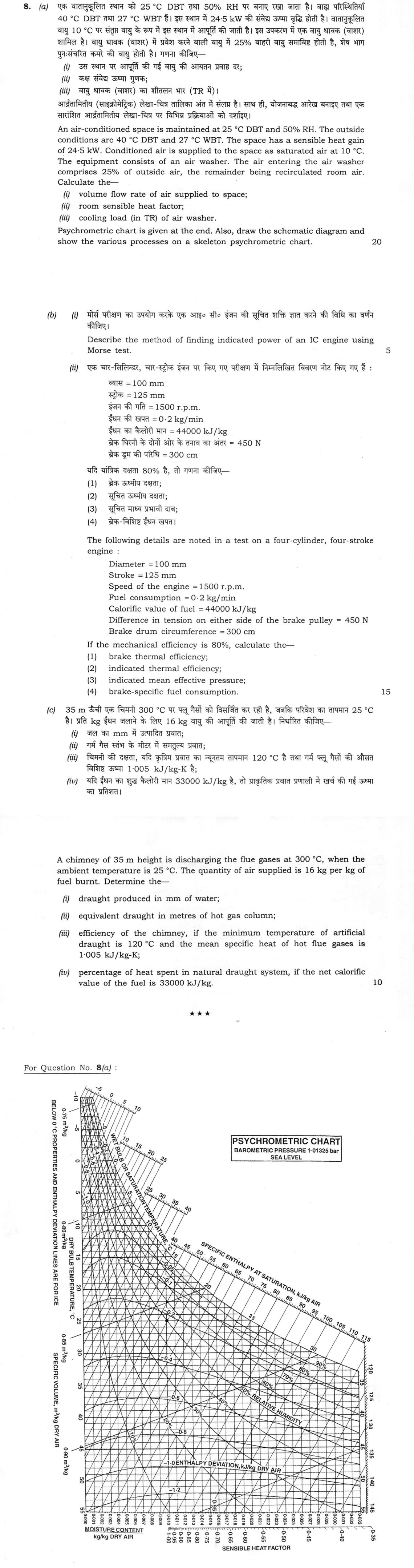
An air-conditioned space is maintained at 25 °C DBT and 50% RH. The outside conditions are 40 °C DBT and 27 °C WBT. The space has a sensible heat gain of 24·5 kW. Conditioned air is supplied to the space as saturated air at 10 °C. The equipment consists of an air washer. The air entering the air washer comprises 25% of outside air, the remainder being recirculated room air. Calculate the— volume flow rate of air supplied to space;
room sensible heat factor;
cooling load (in TR) of air washer. Psychrometric chart is given at the end. Also, draw the schematic diagram and show the various processes on a skeleton psychrometric chart. 20 marks
Describe the method of finding indicated power of an IC engine using Morse test. 5 marks
The following details are noted in a test on a four-cylinder, four-stroke engine : Diameter = 100 mm Stroke = 125 mm Speed of the engine = 1500 r.p.m. Fuel consumption = 0·2 kg/min Calorific value of fuel = 44000 kJ/kg Difference in tension on either side of the brake pulley = 450 N Brake drum circumference = 300 cm If the mechanical efficiency is 80%, calculate the— (1) brake thermal efficiency; (2) indicated thermal efficiency; (3) indicated mean effective pressure; (4) brake-specific fuel consumption. 15 marks
A chimney of 35 m height is discharging the flue gases at 300 °C, when the ambient temperature is 25 °C. The quantity of air supplied is 16 kg per kg of fuel burnt. Determine the— draught produced in mm of water;
equivalent draught in metres of hot gas column;
efficiency of the chimney, if the minimum temperature of artificial draught is 120 °C and the mean specific heat of hot flue gases is 1.005 kJ/kg-K;
percentage of heat spent in natural draught system, if the net calorific value of the fuel is 33000 kJ/kg. 10 marks
हिंदी में प्रश्न पढ़ें
एक वातानुकूलित स्थान को 25 °C DBT तथा 50% RH पर बनाए रखा जाता है। बाह्य परिस्थितियाँ 40 °C DBT तथा 27 °C WBT हैं। इस स्थान में 24·5 kW की संवेदी ऊष्मा वृद्धि होती है। वातानुकूलित वायु 10 °C पर संतृप्त वायु के रूप में इस स्थान में आपूर्ति की जाती है। इस उपकरण में एक वायु धावक (वाशर) शामिल है। वायु धावक (वाशर) में प्रवेश करने वाली वायु में 25% बाहरी वायु समाविष्ट होती है, शेष भाग पुनःसंचरित कमरे की वायु होती है। गणना कीजिए— उस स्थान पर आपूर्ति की गई वायु की आयतन प्रवाह दर;
कक्ष संवेदी ऊष्मा गुणक;
वायु धावक (वाशर) का शीतलन भार (TR में)। आर्द्रतामितीय (साइक्रोमेट्रिक) लेखा-चित्र तालिका अंत में संलग्न है। साथ ही, योजनाबद्ध आरेख बनाइए तथा एक सारांशित आर्द्रतामितीय लेखा-चित्र पर विभिन्न प्रक्रियाओं को दर्शाइए। (20 अंक)
मोर्स परीक्षण का उपयोग करके एक आई० सी० इंजन की सूचित शक्ति ज्ञात करने की विधि का वर्णन कीजिए। (5 अंक)
एक चार-सिलिन्डर, चार-स्ट्रोक इंजन पर किए गए परीक्षण में निम्नलिखित विवरण नोट किए गए हैं : व्यास = 100 mm स्ट्रोक = 125 mm इंजन की गति = 1500 r.p.m. ईंधन की खपत = 0·2 kg/min ईंधन का केलोरी मान = 44000 kJ/kg ब्रेक घिरनी के दोनों ओर के तनाव का अंतर = 450 N ब्रेक ड्रम की परिधि = 300 cm यदि यांत्रिक दक्षता 80% है, तो गणना कीजिए— (1) ब्रेक ऊष्मीय दक्षता; (2) सूचित ऊष्मीय दक्षता; (3) सूचित माध्य प्रभावी दाब; (4) ब्रेक-विशिष्ट ईंधन खपत। (15 अंक)
35 m ऊँची एक चिमनी 300 °C पर फ्लू गैसों को विसर्जित कर रही है, जबकि परिवेश का तापमान 25 °C है। प्रति kg ईंधन जलाने के लिए 16 kg वायु की आपूर्ति की जाती है। निर्धारित कीजिए— जल का mm में उत्पादित प्रवात;
गर्म गैस स्तंभ के मीटर में समतुल्य प्रवात;
चिमनी की दक्षता, यदि कृत्रिम प्रवात का न्यूनतम तापमान 120 °C है तथा गर्म फ्लू गैसों की औसत विशिष्ट ऊष्मा 1·005 kJ/kg-K है;
यदि ईंधन का शुद्ध केलोरी मान 33000 kJ/kg है, तो प्राकृतिक प्रवात प्रणाली में खर्च की गई ऊष्मा का प्रतिशत। (10 अंक)
Model answer
Drafted with AI by UPSC Answer Check against this question's marking rubric, to the expected length. UPSC does not publish answers for Mains — this is one way to score well, not an official key. How we build rubrics and answers.
(a) Summer air-conditioning with an air washer (20 marks)
The layout is shown below. Outside air O (25% by mass) mixes with recirculated room air R (75%) to give M, which enters the air washer and leaves as saturated air S at 10 °C, supplied to the space. The processes are shown on the skeleton chart that follows.


Properties (from the chart or the psychrometric equations, at 1.01325 bar).
- S (10 °C, saturated): W_s = 0.00762 kg/kg, h_s = 29.2 kJ/kg, v_s = 0.812 m³/kg.
- R (25 °C, 50% RH): W_r = 0.00986 kg/kg, h_r = 50.2 kJ/kg.
- O (40 °C DBT, 27 °C WBT): W_o = 0.0171 kg/kg, h_o = 84.3 kJ/kg.
(i) Volume flow rate of supply air. The room sensible heat gain is carried by the supply air, which is warmed from 10 °C to 25 °C. With the humid specific heat c_pm = 1.005 + 1.88 × 0.00762 = 1.019 kJ/kg·K:
ṁ_a = 24.5/(1.019 × (25 − 10)) = 1.60 kg/s.
Volume flow rate at the supply state = ṁ_a v_s = 1.60 × 0.812 = 1.30 m³/s (about 78 m³/min).
(ii) Room sensible heat factor. The total room load is ṁ_a (h_r − h_s) = 1.60 × (50.2 − 29.2) = 33.6 kW, so the room latent load is 33.6 − 24.5 = 9.1 kW (check: 1.60 × (0.00986 − 0.00762) × 2500 = 9.0 kW).
RSHF = 24.5/33.6 = 0.73.
(iii) Cooling load of the air washer. The mixed state M follows from the 25% : 75% mixing of dry air:
- W_m = 0.75 × 0.00986 + 0.25 × 0.0171 = 0.01167 kg/kg.
- h_m = 0.75 × 50.2 + 0.25 × 84.3 = 58.8 kJ/kg, corresponding to T_m = 28.8 °C.
Cooling load = ṁ_a (h_m − h_s) = 1.60 × (58.8 − 29.2) = 47.4 kW. The condensed water, ṁ_a (W_m − W_s) = 0.0065 kg/s at about 10 °C (42 kJ/kg), carries away 0.27 kW, which changes the load only slightly, to 47.1 kW.
Cooling load ≈ 47.1/3.517 ≈ 13.4 TR, that is about 13.5 TR by chart readings.
(b)(i) Morse test for indicated power (5 marks)
The Morse test finds the indicated power of a multi-cylinder engine, with no indicator diagram, from brake-power measurements alone. Its main use is on engines of two or more cylinders, spark-ignition or compression-ignition.
- The engine is run at a chosen constant speed and throttle (or fuel-rack) setting, and the brake power B for all n cylinders working is measured on the dynamometer.
- One cylinder is then cut out: in an SI engine by shorting its spark plug, and in a CI engine by cutting off its fuel injection. Its piston keeps moving, so it now absorbs power as friction and pumping.
- The load is reduced to bring the speed back to the original value, and the brake power B₁ with that cylinder cut out is measured. Speed and throttle setting stay as before, so the friction power is assumed unchanged.
- The indicated power of the cut-out cylinder is I₁ = B − B₁.
- The cylinders are cut out in turn, which gives I₂ = B − B₂ and so on up to I_n.
The total indicated power is IP = I₁ + I₂ + … + I_n = nB − (B₁ + B₂ + … + B_n). The mechanical efficiency then follows as η_m = B/IP. The method assumes that the friction power and the mixture distribution do not change when a cylinder is cut out, so it is approximate, and it cannot be used for a single-cylinder engine.
(b)(ii) Four-cylinder, four-stroke engine test (15 marks)
Given: D = 100 mm, L = 125 mm, N = 1500 rpm, four cylinders, fuel 0.2 kg/min, CV = 44 000 kJ/kg, net brake tension 450 N, drum circumference 3 m, η_m = 0.80.
Brake power. B = net tension × circumference × revolutions per second = 450 × 3 × (1500/60) = 33 750 W = 33.75 kW.
Heat supplied. Fuel energy rate = (0.2/60) × 44 000 = 146.67 kW.
(1) Brake thermal efficiency. η_bth = 33.75/146.67 = 0.230, that is 23.0%.
(2) Indicated thermal efficiency. IP = B/η_m = 33.75/0.80 = 42.19 kW, so η_ith = 42.19/146.67 = 0.2876, that is 28.8%.
(3) Indicated mean effective pressure. IP = p_im L A n (N/2)/60 for a four-stroke engine, with A = π/4 × 0.1² = 7.854 × 10⁻³ m² and n = 4. The swept volume per second is 7.854 × 10⁻³ × 0.125 × 4 × 1500/(2 × 60) = 0.04909 m³/s, so
p_im = 42 187.5/0.04909 = 8.59 × 10⁵ Pa = 8.59 bar.
(4) Brake specific fuel consumption. bsfc = (0.2 × 60)/33.75 = 0.356 kg/kWh.
(c) Natural-draught chimney (10 marks)
Data: H = 35 m, flue gas temperature T_g = 300 + 273 = 573 K, ambient T_a = 25 + 273 = 298 K, air per kg of fuel m = 16 kg, so the flue gas is 17 kg per kg of fuel. The gas constant is taken as 287 J/kg·K, so ρ = 353/T at 1.013 bar.
(i) Draught in mm of water. The densities are ρ_a = 353/298 = 1.1846 kg/m³ and ρ_g = (353/573) × (17/16) = 0.6546 kg/m³. Then
h_w = H (ρ_a − ρ_g) = 35 × (1.1846 − 0.6546) = 18.55 mm of water (1 mm of water = 1 kg/m²).
(ii) Equivalent hot-gas column. h_g = h_w/ρ_g = 18.55/0.6546 = 28.3 m of hot gas.
(iii) Chimney efficiency. The energy of the draught per kg of fuel is the flue gas mass times g times the gas column: 17 × 9.81 × 28.34 = 4726 J = 4.73 kJ. The heat carried by the gas above the minimum temperature for artificial draught (120 °C) is 17 × 1.005 × (300 − 120) = 3075 kJ. Then
η_chimney = 4.73/3075 = 0.00154, that is 0.154%, showing how inefficient natural draught is.
(iv) Heat spent on natural draught. The heat carried above 120 °C by the gas, which is the price paid for a hot enough chimney, is 3075 kJ per kg of fuel, so its share of the net calorific value is
3075/33 000 × 100 = 9.32%.
Only 4.73/33 000 = 0.014% of the fuel energy appears as useful draught work.
How this answer will be evaluated
Evaluation rubric
Each sub-part is marked on its own, against the marks and word limit printed on the paper.
- (a) Air-conditioned space at 25 °C, 50% RH, outside 40 °C DBT/27 °C WBT, sensible gain 24.5 kW, supply saturated at 10 °C, air washer with 25% outside air: find (i) supply air volume flow, (ii) RSHF and (iii) washer load in TR; draw the schematic and skeleton chart (20 marks). 20 marks
Must cover
- Supply mass flow 1.60 kg/s from 24.5/(c_pm × 15) and volume flow about 1.30 m³/s (v_s ≈ 0.81 m³/kg)
- RSHF ≈ 0.73 from total room load 33.6 kW (latent about 9.1 kW)
- Mixed state M from 75% room and 25% outside air: W_m ≈ 0.0117, h_m ≈ 58.8 kJ/kg (T_m ≈ 28.8 °C)
- Washer load ṁ_a(h_m − h_s) ≈ 47 kW ≈ 13.4 TR, with a schematic and chart showing O, R, M, S and the room ratio line
Loses marks
- Treating mixing as a simple temperature average without humidity.
- Using room RH or the outside state for the supply density.
- Omitting the schematic or the chart.
Earns more
- Properties of R, O and S read correctly from the chart.
- Mixing on the dry-air mass basis and the process line M–S drawn to the saturation curve at 10 °C.
Extra mark
- Condensate enthalpy correction of about 0.27 kW
- (b)(i) Describe the method of finding the indicated power of an IC engine using the Morse test (5 marks). 5 marks
Must cover
- Constant speed and throttle setting, measure brake power B with all cylinders firing
- Cut out one cylinder (spark shorted for SI, fuel cut for CI) and restore the speed by reducing the load
- I_j = B − B_j for each cylinder, and total IP = nB − ΣB_j
- Assumptions and limits: friction power constant, multi-cylinder engines only
Loses marks
- Using an indicator diagram for the Morse test.
- Stating that the speed falls and is left uncorrected.
- Applying it to a single-cylinder engine.
Earns more
- Note that the cut cylinder is motored and absorbs friction.
- Mechanical efficiency = B/IP given.
Extra mark
- Comment on the accuracy of the method
- (b)(ii) Four-cylinder four-stroke engine test (D = 100 mm, L = 125 mm, 1500 rpm, 0.2 kg/min fuel, CV = 44 000 kJ/kg, tension difference 450 N, drum circumference 300 cm, η_m = 80%): find (1) brake thermal efficiency, (2) indicated thermal efficiency, (3) imep and (4) bsfc (15 marks). 15 marks
Must cover
- Brake power = 450 × 3 × 25 = 33.75 kW and fuel energy 146.67 kW
- (1) Brake thermal efficiency ≈ 23.0%
- (2) IP = 42.19 kW and indicated thermal efficiency ≈ 28.8%
- (3) imep ≈ 8.59 bar with four cylinders and N/2 power strokes; (4) bsfc ≈ 0.356 kg/kWh
Loses marks
- Using N in place of N/2 for imep.
- Using the drum diameter instead of the circumference.
- bsfc in the wrong units.
Earns more
- Correct four-stroke form of the IP equation with n = 4.
- Units consistent, with kW, bar and kg/kWh.
Extra mark
- Cross-check of imep from the swept volume per second
- (c) Chimney 35 m high, flue gas at 300 °C, ambient 25 °C, 16 kg air per kg of fuel: find (i) draught in mm of water, (ii) equivalent hot-gas column, (iii) chimney efficiency for a minimum artificial-draught temperature of 120 °C, (iv) percentage of heat spent (10 marks). 10 marks
Must cover
- Densities ρ_a ≈ 1.185 and ρ_g ≈ 0.655 kg/m³ with 17 kg flue gas per kg fuel
- (i) h_w ≈ 18.55 mm of water
- (ii) h_g = h_w/ρ_g ≈ 28.3 m of hot gas
- (iii) η ≈ 0.154% and (iv) heat spent ≈ 9.3% of 33 000 kJ/kg
Loses marks
- Using 16 kg of flue gas.
- Absolute temperature not used.
- Efficiency quoted as a large percentage.
Earns more
- Flue gas mass taken as air plus fuel, 17 kg.
- Draught work per kg fuel 4.73 kJ against 3075 kJ of gas heat.
Extra mark
- Note that only 0.014% of fuel energy is converted into draught work
What "Calculate" is asking you to do
Apply the standard formula or schedule to data the question has already supplied — a table of readings, cost records, a balance sheet — and produce the number. The method is rarely in doubt; the marks sit in the named intermediate quantities, each of which has to appear as a labelled line.
Structure that answers it
Data as given → formula or standard treatment, named → substitution → each intermediate, labelled → result with units
Where marks are lost
Omitting an intermediate the marking scheme pays for separately, or rounding at an intermediate line so the final figure drifts. In commerce and accountancy, any figure in a statement that no numbered working note supports is treated as unearned.
Practice this exact question
Write your answer and it is marked point by point against the model answer above — what you covered, what you missed, what you got wrong.
Evaluate my answer →More from Mechanical Engineering 2026 Paper II
- Q5 (a) The air-fuel ratio of an SI engine varies under different operating conditions. Write…
- Q6 (a) In an Otto cycle, the pressure and temperature at the beginning of compression are 1…
- Q7 (a) In a cogeneration plant, the net power output is 6 MW and the heating load is 1·5 MW.…
- Q8 (a) An air-conditioned space is maintained at 25 °C DBT and 50% RH. The outside condition…