Paper II — Q2
(a) (i) During a heat transfer process, the entropy change of incompressible substances, such as water, can be determined from ΔS…
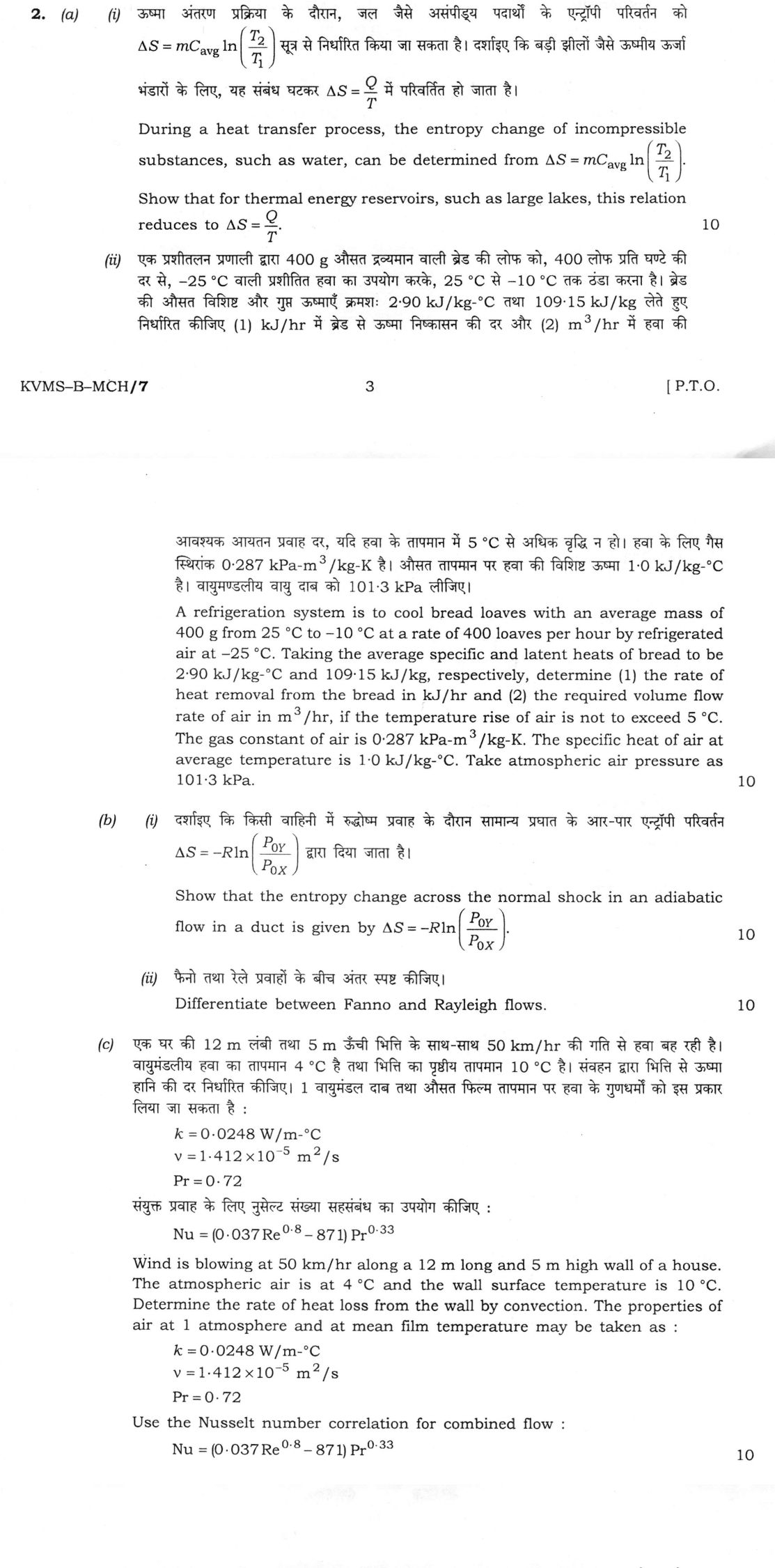
During a heat transfer process, the entropy change of incompressible substances, such as water, can be determined from ΔS = mC_avg ln (T₂/T₁). Show that for thermal energy reservoirs, such as large lakes, this relation reduces to ΔS = Q/T. 10 marks
A refrigeration system is to cool bread loaves with an average mass of 400 g from 25 °C to –10 °C at a rate of 400 loaves per hour by refrigerated air at –25 °C. Taking the average specific and latent heats of bread to be 2·90 kJ/kg-°C and 109·15 kJ/kg, respectively, determine (1) the rate of heat removal from the bread in kJ/hr and (2) the required volume flow rate of air in m³/hr, if the temperature rise of air is not to exceed 5 °C. The gas constant of air is 0·287 kPa-m³/kg-K. The specific heat of air at average temperature is 1·0 kJ/kg-°C. Take atmospheric air pressure as 101·3 kPa. 10 marks
Show that the entropy change across the normal shock in an adiabatic flow in a duct is given by ΔS = −R ln (P₀Y / P₀X). 10 marks
Differentiate between Fanno and Rayleigh flows. 10 marks
Wind is blowing at 50 km/hr along a 12 m long and 5 m high wall of a house. The atmospheric air is at 4 °C and the wall surface temperature is 10 °C. Determine the rate of heat loss from the wall by convection. The properties of air at 1 atmosphere and at mean film temperature may be taken as : k = 0·0248 W/m-°C, v = 1·412×10⁻⁵ m²/s, Pr = 0·72. Use the Nusselt number correlation for combined flow : Nu = (0·037 Re⁰·⁸ − 871) Pr⁰·³³ 10 marks
हिंदी में प्रश्न पढ़ें
ऊष्मा अंतरण प्रक्रिया के दौरान, जल जैसे असंपीड्य पदार्थों के एन्ट्रॉपी परिवर्तन को ΔS = mC_avg ln (T₂/T₁) सूत्र से निर्धारित किया जा सकता है। दर्शाइए कि बड़ी झीलों जैसे ऊष्मीय ऊर्जा भंडारों के लिए, यह संबंध घटकर ΔS = Q/T में परिवर्तित हो जाता है। (10 अंक)
एक प्रशीतलन प्रणाली द्वारा 400 g औसत द्रव्यमान वाली ब्रेड की लोफ को, 400 लोफ प्रति घंटे की दर से, –25 °C वाली प्रशीतित हवा का उपयोग करके, 25 °C से –10 °C तक ठंडा करना है। ब्रेड की औसत विशिष्ट और गुप्त ऊष्माएँ क्रमशः 2·90 kJ/kg-°C तथा 109·15 kJ/kg लेते हुए निर्धारित कीजिए (1) kJ/hr में ब्रेड से ऊष्मा निष्कासन की दर और (2) m³/hr में हवा की आवश्यक आयतन प्रवाह दर, यदि हवा के तापमान में 5 °C से अधिक वृद्धि न हो। हवा के लिए गैस स्थिरांक 0·287 kPa-m³/kg-K है। औसत तापमान पर हवा की विशिष्ट ऊष्मा 1·0 kJ/kg-°C है। वायुमण्डलीय वायु दाब को 101·3 kPa लीजिए। (10 अंक)
दर्शाइए कि किसी वाहिनी में रुद्धोष्म प्रवाह के दौरान सामान्य प्रघात के आर-पार एन्ट्रॉपी परिवर्तन ΔS = −R ln (P₀Y / P₀X) द्वारा दिया जाता है। (10 अंक)
फैनो तथा रेले प्रवाहों के बीच अंतर स्पष्ट कीजिए। (10 अंक)
एक घर की 12 m लंबी तथा 5 m ऊँची भित्ति के साथ-साथ 50 km/hr की गति से हवा बह रही है। वायुमण्डलीय हवा का तापमान 4 °C है तथा भित्ति का पृष्ठीय तापमान 10 °C है। संवहन द्वारा भित्ति से ऊष्मा हानि की दर निर्धारित कीजिए। 1 वायुमंडल दाब तथा औसत फिल्म तापमान पर हवा के गुणधर्मों को इस प्रकार लिया जा सकता है : k = 0·0248 W/m-°C, v = 1·412×10⁻⁵ m²/s, Pr = 0·72. संयुक्त प्रवाह के लिए नुसेल्ट संख्या सहसंबंध का उपयोग कीजिए : Nu = (0·037 Re⁰·⁸ − 871) Pr⁰·³³ (10 अंक)
Model answer
Drafted with AI by UPSC Answer Check against this question's marking rubric, to the expected length. UPSC does not publish answers for Mains — this is one way to score well, not an official key. How we build rubrics and answers.
(a)(i) Entropy change of a thermal energy reservoir (10 marks)
For an incompressible substance of mass m and average specific heat C, taken from T₁ to T₂ with negligible work, ΔS = m C ln(T₂/T₁), and the heat absorbed is Q = m C (T₂ − T₁).
A thermal energy reservoir (a large lake, the atmosphere) is so large that its mass and heat capacity are very large. It can absorb or give up a finite amount of heat Q with only a tiny change in temperature, so T₂ = T₁ + ΔT with ΔT ≪ T₁. Write x = ΔT/T₁, which is very small. Expanding the logarithm as a series:
ln(T₂/T₁) = ln(1 + x) = x − x²/2 + x³/3 − … ≈ x = (T₂ − T₁)/T₁
Terms of order x² and above are negligible. Therefore
ΔS = m C (T₂ − T₁)/T₁ = Q/T₁
Since T₁ ≈ T₂ = T for the reservoir, this is
ΔS = Q/T
where T is the (constant) reservoir temperature and Q is the heat received by the reservoir (positive) or given up by it (negative). This is the entropy change for a reversible heat transfer at constant temperature, dS = δQ/T.
(a)(ii) Cooling of bread loaves (10 marks)
Data: mass flow of bread = 400 loaves/h × 0.4 kg = 160 kg/h, cooled from 25 °C to −10 °C, with c = 2.90 kJ/kg·°C and latent heat h_fg = 109.15 kJ/kg (freezing). Air enters at −25 °C, with c_p = 1.0 kJ/kg·°C, R = 0.287 kPa·m³/kg·K, and a permitted rise of 5 °C, at 101.3 kPa.
(1) Rate of heat removal from the bread. Each kg of bread gives up sensible heat and latent heat:
- Sensible heat = c ΔT = 2.90 × (25 − (−10)) = 2.90 × 35 = 101.5 kJ/kg.
- Latent heat = 109.15 kJ/kg.
- Total = 210.65 kJ/kg.
Q̇ = 160 × 210.65 = 33 704 kJ/h (about 9.36 kW).
(2) Volume flow rate of air. The heat removed from the bread is gained by the air, so ṁ_air c_p ΔT = Q̇:
ṁ_air = 33 704/(1.0 × 5) = 6740.8 kg/h
The specific volume of air at −25 °C (248.15 K) and 101.3 kPa is v = RT/P = 0.287 × 248.15/101.3 = 0.7031 m³/kg. Hence
V̇ = ṁ_air v = 6740.8 × 0.7031 = 4739 m³/h
(b)(i) Entropy change across a normal shock (10 marks)
For a perfect gas, the Gibbs relation T ds = dh − v dP with dh = c_p dT and v/T = R/P gives
ds = c_p dT/T − R dP/P
The stagnation state of a flow is reached by an isentropic deceleration, so the entropy of the stagnation state equals the entropy of the flow. Integrating between the stagnation states 0x (upstream of the shock) and 0y (downstream), with c_p constant:
s_y − s_x = s₀y − s₀x = c_p ln(T₀y/T₀x) − R ln(P₀y/P₀x)
The flow through the shock is adiabatic with no work, so the stagnation enthalpy is conserved, h₀x = h₀y. Since h₀ = c_p T₀, T₀y = T₀x, and the first term is zero. Therefore
ΔS = s_y − s_x = −R ln(P₀y/P₀x)
Since the shock is irreversible, ΔS > 0, which requires P₀y < P₀x, that is the stagnation pressure falls across the shock. Only this loss of stagnation pressure produces the entropy rise.
(b)(ii) Fanno flow and Rayleigh flow (10 marks)
Both are one-dimensional, steady flows of a perfect gas in a constant-area duct, and in both, the entropy is maximum at M = 1, where the flow chokes. They differ as follows.
- Physical effect: Fanno flow is adiabatic flow with wall friction. Rayleigh flow is frictionless flow with heat addition or removal.
- Conserved quantities: in Fanno flow, mass flux (ρV) and stagnation enthalpy (h₀, so T₀ is constant) are conserved, and momentum is not, because of friction. In Rayleigh flow, mass flux and momentum (the impulse function P + ρV²) are conserved, and stagnation enthalpy is not, since heat is exchanged.
- Curve on the h–s (T–s) plane: the Fanno line is the locus of states of constant G and h₀, and the Rayleigh line the locus of constant G and impulse. Both have a maximum-entropy point at M = 1, with the subsonic branch above it and the supersonic branch below.
- Direction of Mach number: in Fanno flow, friction always drives M towards 1, so subsonic flow accelerates and supersonic flow decelerates, and entropy rises. In Rayleigh flow, heating drives M towards 1 from either side (subsonic flow accelerates, supersonic decelerates), and cooling moves M away from 1.
- Stagnation properties: in Fanno flow T₀ is constant and P₀ falls. In Rayleigh flow T₀ rises with heating and falls with cooling, and P₀ falls with heating.
- Choking limit: Fanno flow reaches M = 1 at the maximum duct length L* (the choked length). Rayleigh flow reaches M = 1 when the heat added reaches its limit (thermal choking).
- Special feature: the Rayleigh line has its maximum temperature on the subsonic side at M = 1/√γ (0.845 for γ = 1.4). The two curves for the same G and h₀ intersect at the two states connected by a normal shock.
(c) Convective heat loss from a wall in a wind (10 marks)
Data: flow length L = 12 m, height 5 m, so the area is A = 60 m². V = 50 km/h = 13.89 m/s, T_∞ = 4 °C, T_s = 10 °C, k = 0.0248 W/m·°C, ν = 1.412 × 10⁻⁵ m²/s and Pr = 0.72.
Reynolds number.
Re_L = V L/ν = 13.89 × 12/(1.412 × 10⁻⁵) = 1.180 × 10⁷
This is above the transition value (5 × 10⁵), so the flow is turbulent over most of the length, and the combined laminar–turbulent correlation is appropriate.
Nusselt number.
Nu = (0.037 Re^0.8 − 871) Pr^0.33 = (0.037 × 4.546 × 10⁵ − 871) × 0.72^0.33
Nu = (16 820 − 871) × 0.8973 = 14 310
Heat transfer coefficient.
h = Nu k/L = 14 310 × 0.0248/12 = 29.6 W/m²·°C
Heat loss.
Q = h A (T_s − T_∞) = 29.57 × 60 × (10 − 4) = 10 650 W ≈ 10.6 kW
How this answer will be evaluated
Evaluation rubric
Each sub-part is marked on its own, against the marks and word limit printed on the paper.
- (a)(i) (a)(i) Show that for thermal energy reservoirs, ΔS = mC ln(T₂/T₁) reduces to ΔS = Q/T (10 marks). 10 marks
Must cover
- Reservoir has very large heat capacity so its temperature change is tiny, T₂ = T₁ + ΔT with ΔT ≪ T₁
- Expansion ln(1 + x) ≈ x with x = ΔT/T₁
- Q = mC(T₂ − T₁) substituted to give ΔS = Q/T₁
- Conclusion ΔS = Q/T with T ≈ T₁ ≈ T₂
Loses marks
- Assuming T₂ = T₁ without justification.
- Deriving from a formula for gases instead.
Earns more
- Series expansion terms of higher order neglected explicitly.
- Link to reversible isothermal heat transfer dS = δQ/T.
Extra mark
- Sign convention for Q
- (a)(ii) (a)(ii) Bread from 25 °C to −10 °C at 400 loaves/h of 400 g: find (1) heat removal rate and (2) air volume flow rate for a 5 °C air rise (10 marks). 10 marks
Must cover
- Bread mass rate 160 kg/h
- Sensible 101.5 kJ/kg plus latent 109.15 kJ/kg gives Q̇ = 33 704 kJ/h
- Air mass flow 6740.8 kg/h from ṁ c_p ΔT = Q̇
- Specific volume RT/P = 0.703 m³/kg at −25 °C and V̇ ≈ 4739 m³/h
Loses marks
- Leaving out the latent heat.
- Using the air at 25 °C for the specific volume.
Earns more
- Temperature converted to kelvin.
- Units of kJ/h stated.
Extra mark
- Refrigeration power 9.36 kW
- (b)(i) (b)(i) Show that the entropy change across a normal shock in an adiabatic duct flow is −R ln(P₀y/P₀x) (10 marks). 10 marks
Must cover
- Gibbs relation ds = c_p dT/T − R dP/P for a perfect gas
- Stagnation states connected to the flow states isentropically
- Energy equation h₀x = h₀y gives T₀y = T₀x, so the temperature term vanishes
- Result ΔS = −R ln(P₀y/P₀x) with stagnation pressure loss
Loses marks
- Using static temperatures in place of stagnation temperatures.
- Omitting the adiabatic condition.
Earns more
- Statement that ΔS > 0 requires P₀y < P₀x.
- Integration between stagnation states shown.
Extra mark
- Comment that static pressure and Mach relations are not needed
- (b)(ii) (b)(ii) Differentiate between Fanno and Rayleigh flows (10 marks). 10 marks
Must cover
- Physical effect: friction in adiabatic flow (Fanno) versus heat transfer in frictionless flow (Rayleigh)
- Conserved quantities: mass and h₀ for Fanno, mass and impulse for Rayleigh
- Curves on the h–s plane with maximum entropy at M = 1
- Mach-number direction and choking limits of each
Loses marks
- Swapping the assumptions of the two flows.
- Stating that Fanno flow includes heat transfer.
Earns more
- Stagnation-property behaviour compared.
- Point-by-point comparison rather than separate paragraphs.
Extra mark
- Intersection of both lines as the normal shock states
- (c) (c) Wind at 50 km/h along a 12 m × 5 m wall at 10 °C in 4 °C air: find the convective heat loss using Nu = (0.037Re^0.8 − 871)Pr^0.33 (10 marks). 10 marks
Must cover
- Velocity 13.89 m/s and Re_L = 1.18 × 10⁷
- Nu = (0.037Re^0.8 − 871)Pr^0.33 ≈ 14 300
- h = Nu k/L ≈ 29.6 W/m²·°C with L = 12 m
- Q = hAΔT ≈ 10.6 kW with A = 60 m²
Loses marks
- Using the 5 m height as the length.
- Forgetting to convert km/h to m/s.
Earns more
- Flow length 12 m used as the characteristic length.
- Comment that Re is above 5 × 10⁵.
Extra mark
- Note that the correlation covers laminar and turbulent parts
What "Prove" is asking you to do
Establish that the statement holds for every case it claims, not for one representative case. The argument must be closed: each line follows from a definition, a hypothesis, or a named theorem you are entitled to use.
Structure that answers it
Given and to prove, restated → theorem or construction to be used, named → the argument line by line → conclusion stated as proved
Where marks are lost
Testing one example, which illustrates but proves nothing. On an if and only if claim, proving one direction and stopping forfeits that half outright, and degenerate cases — zero, the empty set, the equality case — have to be disposed of rather than assumed away.
Practice this exact question
Write your answer and it is marked point by point against the model answer above — what you covered, what you missed, what you got wrong.
Evaluate my answer →More from Mechanical Engineering 2026 Paper II
- Q1 (a) A piston-cylinder contains 2 kg of argon at T₁ = 300 K and V₁ = 1 m³ (state 1). Argon…
- Q2 (a) (i) During a heat transfer process, the entropy change of incompressible substances,…
- Q3 (a) Steam at 40 °C is condensed in a power plant using cooling water available at 12 °C.…
- Q4 (a) (i) What does the NTU of a heat exchanger represent? Is a heat exchanger with a very…
- Q5 (a) The air-fuel ratio of an SI engine varies under different operating conditions. Write…