Paper I — Q8
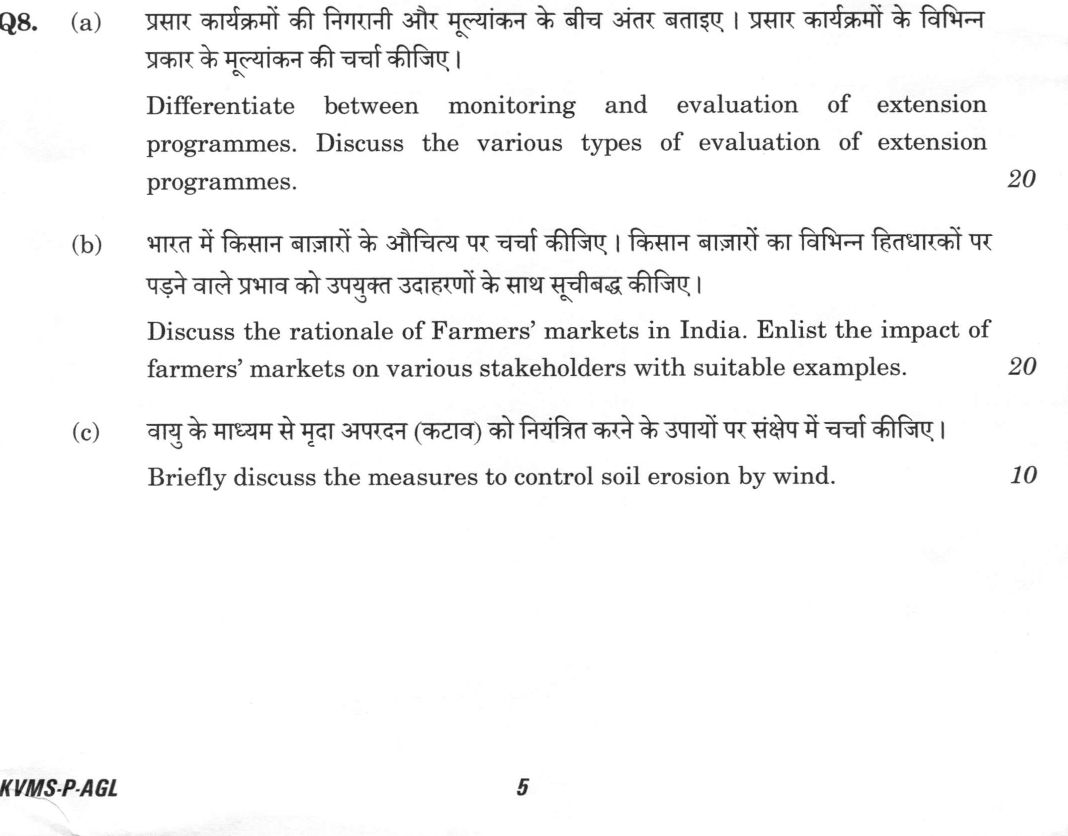
(a) Differentiate between monitoring and evaluation of extension programmes. Discuss the various types of evaluation of extension…
Differentiate between monitoring and evaluation of extension programmes. Discuss the various types of evaluation of extension programmes. 20 marks
Discuss the rationale of Farmers' markets in India. Enlist the impact of farmers' markets on various stakeholders with suitable examples. 20 marks
Briefly discuss the measures to control soil erosion by wind. 10 marks
हिंदी में प्रश्न पढ़ें
प्रसार कार्यक्रमों की निगरानी और मूल्यांकन के बीच अंतर बताइए। प्रसार कार्यक्रमों के विभिन्न प्रकार के मूल्यांकन की चर्चा कीजिए। (20 अंक)
भारत में किसान बाजारों के औचित्य पर चर्चा कीजिए। किसान बाजारों का विभिन्न हितधारकों पर पड़ने वाले प्रभाव को उपयुक्त उदाहरणों के साथ सूचीबद्ध कीजिए। (20 अंक)
वायु के माध्यम से मृदा अपरदन (कटाव) को नियंत्रित करने के उपायों पर संक्षेप में चर्चा कीजिए। (10 अंक)
Model answer
Drafted with AI by UPSC Answer Check against this question's marking rubric, to the expected length. UPSC does not publish answers for Mains — this is one way to score well, not an official key. How we build rubrics and answers.
(a) Monitoring and evaluation of extension programmes (20 marks)
Difference:
- Meaning: monitoring is the continuous checking of progress during implementation, of whether inputs, activities and outputs are as planned; evaluation is the systematic judgement of the worth, effectiveness and impact of a programme against its objectives.
- Timing: monitoring is continuous, throughout the programme; evaluation is periodic, at set points (baseline, mid-term, end, after completion).
- Purpose: monitoring gives early warning and allows corrective action; evaluation answers whether the programme achieved its aims, why, at what cost, and whether it should continue, change or stop.
- Focus: monitoring looks at inputs, activities and outputs; evaluation looks at outcomes, impact, relevance, efficiency and sustainability.
- Done by: monitoring is by programme managers and staff; evaluation is often by internal or external evaluators.
- Nature: monitoring is a management function and descriptive; evaluation is analytical and judgement-based, giving lessons for future programmes.
Types of evaluation:
- By timing: ex-ante or pre-evaluation (needs assessment and baseline before starting); formative or concurrent (during the programme, to improve it); and summative or ex-post (at the end or after, to assess final results and impact).
- By what is evaluated: input or effort evaluation (resources and activities), process evaluation (how the programme is carried out), output or performance evaluation (results such as farmers trained), outcome evaluation (change in knowledge, attitude, skill and adoption), and impact evaluation (long-term effects on yield, income and livelihood).
- By evaluator: internal or self-evaluation, external evaluation for objectivity, and participatory evaluation where farmers help.
- By method: quantitative (surveys, statistical measures) and qualitative (case studies, focus groups); also cost-benefit or efficiency evaluation.
Good evaluation uses clear objectives, indicators, reliable data and feedback to planners.
(b) Farmers' markets in India (20 marks)
Rationale. In the conventional chain, many intermediaries such as traders and commission agents take a large share of the consumer's rupee, so farmers receive low prices while consumers pay high ones. There are also delays in payment, weak market information, high post-harvest losses and market fees. Farmers' markets, where farmers sell directly to consumers on a fixed place and day, are justified to:
- Give farmers a higher share of the consumer price, and immediate cash.
- Give consumers fresh produce at fair prices and correct weights.
- Reduce intermediaries, marketing cost, transport and post-harvest loss.
- Give small and marginal farmers market access and a place to sell without licence or commission.
- Improve price transparency, and encourage the local economy and farm diversification.
Examples: Rythu Bazaars in Andhra Pradesh, Uzhavar Sandhais in Tamil Nadu, Apni Mandi in Punjab and Haryana, and similar direct-marketing yards in other states; Kisan Mandis and periodic haats also work as farmer-to-consumer outlets.
Impact on stakeholders:
- Farmers: better price realisation, quick payment, lower cost, and direct market information; farmers in Rythu Bazaars and Uzhavar Sandhais are reported to receive more than in wholesale markets.
- Consumers: lower prices than retail, freshness, quality and honest weights.
- Middlemen and commission agents: loss of business and resistance, and possible push for them to reform.
- Government and local bodies: the markets serve both farmers and consumers and help to check price rises, but need land and infrastructure, and market-fee income from regulated markets may fall.
- Environment and community: shorter supply chains, lower transport emissions and less packaging, and support for local produce.
Limitations: small volumes, limited range of produce, inadequate infrastructure and storage, seasonal supply and sustained government support needed. Linking with FPOs and e-NAM can strengthen them.
(c) Control of soil erosion by wind (10 marks)
Wind erosion, common in arid and semi-arid areas such as western Rajasthan, is checked by reducing wind velocity at the surface, keeping the soil covered, and making it less erodible.
- Vegetative cover: keep the land under crop or grass, grow cover crops, and use crop stubbles and residue mulch (about 5 to 6 tonnes per hectare).
- Windbreaks and shelterbelts: rows of trees and shrubs at right angles to the wind, such as Prosopis cineraria, Acacia tortilis, Casuarina and Ziziphus, protecting a distance of 10 to 15 times their height.
- Strip cropping and field arrangement: alternate strips of erosion-resistant crops (pearl millet, sorghum) and others, across the wind direction.
- Tillage: rough, cloddy surface by listing or ridging across the wind, minimum tillage, and avoiding tillage when dry.
- Soil amendments: farmyard manure, clay, and stabilisers to bind particles, and irrigation to keep the surface moist.
- Sand-dune stabilisation: brushwood fences, and sowing of grasses such as Lasiurus sindicus and Panicum turgidum, with tree planting.
- Land use control: regulate grazing and keep steep or sandy land under grass or forest.
How this answer will be evaluated
Evaluation rubric
Each sub-part is marked on its own, against the marks and word limit printed on the paper.
- (a) (a) Differentiate monitoring from evaluation of extension programmes; discuss the types of evaluation (20). 20 marks
Must cover
- Monitoring: continuous, during implementation, inputs-activities-outputs, corrective; evaluation: periodic judgement of worth and impact
- Differences on timing, purpose, focus, who does it, nature
- Types by timing: ex-ante, formative or concurrent, summative or ex-post
- Types by content and evaluator: input, process, output, outcome, impact; internal, external, participatory; quantitative and qualitative
Loses marks
- Treating monitoring and evaluation as identical.
- Only two types of evaluation.
- No differences drawn.
Earns more
- Examples from extension work.
- Indicators and feedback.
Extra mark
- Cost-benefit evaluation
- (b) (b) Rationale of farmers' markets in India; impact on stakeholders with examples (20). 20 marks
Must cover
- Rationale: fewer intermediaries, higher farmer share, fair prices for consumers, lower losses, access for small farmers
- Examples: Rythu Bazaar, Uzhavar Sandhai, Apni Mandi
- Impact on farmers, consumers, middlemen, government and environment
- Limitations and links with FPOs and e-NAM
Loses marks
- Confusing farmers' markets with APMC mandis.
- No stakeholder analysis.
- No examples.
Earns more
- Balanced view of costs and benefits.
- Price realisation comparison.
Extra mark
- Local economy and food miles
- (c) (c) Measures to control soil erosion by wind (10). 10 marks
Must cover
- Principles: reduce wind velocity, cover soil, make soil less erodible
- Vegetative cover, residue mulch, windbreaks and shelterbelts with species
- Strip cropping, rough cloddy tillage across wind, soil amendments
- Sand dune stabilisation and grazing control
Loses marks
- Describing water erosion measures such as bunds.
- Measures without principles.
- Only one or two measures.
Earns more
- Spacing or protection distance for windbreaks.
- Regional example such as western Rajasthan.
Extra mark
- Chemical stabilisers
What "Differentiate" is asking you to do
Fix the criteria on which the two differ and apply each criterion to both, so the pair can no longer be mixed up. Differentiate stems usually carry a further task attached — describe the mechanism, set out the principles, discuss the applications — and that task carries its own marks.
Structure that answers it
Criterion 1 applied to both → criterion 2 → criterion 3 → summary line or table → the attached second demand answered in full
Where marks are lost
Two standalone definitions placed side by side, leaving the reader to extract the difference. The second common loss is running out of space before the attached task, which is often worth as much as the differentiation.
Practice this exact question
Write your answer and it is marked point by point against the model answer above — what you covered, what you missed, what you got wrong.
Evaluate my answer →More from Agriculture 2026 Paper I
- Q5 Answer the following questions in about 150 words each : (a) Write down the approaches fo…
- Q6 (a) On the basis of Boron content, classify irrigation water suitability for various soil…
- Q7 (a) What are the various factors affecting farm profits ? Discuss the decisions which are…
- Q8 (a) Differentiate between monitoring and evaluation of extension programmes. Discuss the…