Paper I — Q7
(a) What are the various factors affecting farm profits ? Discuss the decisions which are critical to attain good farm profits…
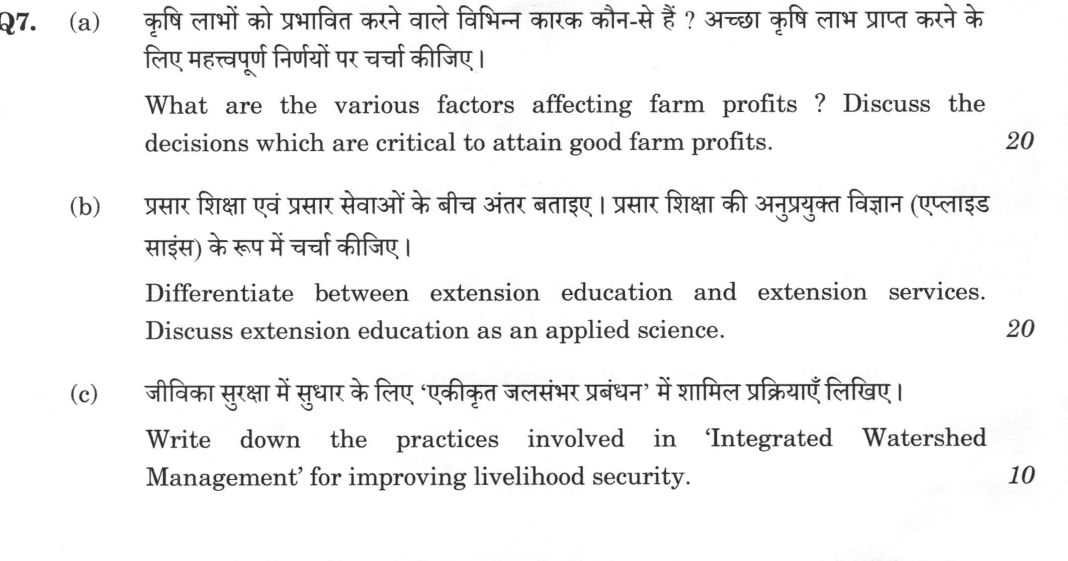
What are the various factors affecting farm profits ? Discuss the decisions which are critical to attain good farm profits. 20 marks
Differentiate between extension education and extension services. Discuss extension education as an applied science. 20 marks
Write down the practices involved in 'Integrated Watershed Management' for improving livelihood security. 10 marks
हिंदी में प्रश्न पढ़ें
कृषि लाभों को प्रभावित करने वाले विभिन्न कारक कौन-से हैं ? अच्छा कृषि लाभ प्राप्त करने के लिए महत्त्वपूर्ण निर्णयों पर चर्चा कीजिए। (20 अंक)
प्रसार शिक्षा एवं प्रसार सेवाओं के बीच अंतर बताइए। प्रसार शिक्षा की अनुप्रयुक्त विज्ञान (एप्लाइड साइंस) के रूप में चर्चा कीजिए। (20 अंक)
जीविका सुरक्षा में सुधार के लिए 'एकीकृत जलसंभर प्रबंधन' में शामिल प्रक्रियाएँ लिखिए। (10 अंक)
Model answer
Drafted with AI by UPSC Answer Check against this question's marking rubric, to the expected length. UPSC does not publish answers for Mains — this is one way to score well, not an official key. How we build rubrics and answers.
(a) Factors affecting farm profits and decisions critical to good profits (20 marks)
Farm profit is the difference between the value of farm output and the total cost of producing it. It is affected by the following factors:
- Yield: the physical productivity of crops and livestock, decided by seed, soil, inputs and management.
- Prices: the price received for produce, which depends on quality, timing and market; and the prices paid for inputs.
- Cost of production: fixed and variable costs, and the efficiency with which inputs are used.
- Size of farm and scale of operation: economies of scale in machinery, irrigation and marketing, though small holdings limit them.
- Cropping intensity and diversification: more crops per year, and enterprise mixes that spread risk.
- Technology and management ability: adoption of improved varieties and practices, timeliness of operations, and skill of the farmer.
- Capital, credit, infrastructure and marketing: interest cost, roads, storage, processing and market access.
- Weather, pests and other risks, and policy factors such as MSP, subsidies, taxes and trade rules.
Critical decisions for good profits:
- What to produce: choosing enterprises and crops with the highest returns, in line with the comparative advantage of the soil, climate and market.
- How to produce: choosing the technology and the combination and level of inputs, following the principle of equating marginal returns with marginal cost, and adopting cost-saving practices.
- How much to produce: scale and intensity, expansion or diversification, and the size of area under each crop.
- When to produce and sell: timeliness of sowing and operations, and marketing decisions on where, when and in what form to sell, including grading, storage and value addition.
- How to finance: use of own and borrowed capital, and choice of credit source.
- Risk management: crop insurance, diversification, and contract farming or forward sale.
- Record keeping and budgeting for regular review of costs and returns.
Good profit results from sound decisions in all of these, as no single one is enough.
(b) Extension education and extension services (20 marks)
Difference:
- Nature: extension education is an educational process, an informal, out-of-school education that changes the knowledge, attitudes and skills of rural people; extension services are the organised system or machinery that delivers information, advice, inputs and technical help to farmers.
- Objective: education aims at lasting change in human behaviour and developing people's capacity to solve their own problems; services aim at supplying technology, inputs and assistance to meet immediate needs.
- Approach: education is participatory, learning by doing, and voluntary; services are often a supply-driven or top-down delivery.
- Time frame: education is long-term; services give immediate, short-term benefits.
- Focus: education focuses on people, their learning and self-reliance; services focus on resources, programmes and technology.
- Examples: farmer training, demonstrations and group discussion are education; supply of seed, soil-testing, veterinary aid and credit linkage through the state department, Krishi Vigyan Kendras or ATMA are services.
Both are complementary, since services need educational effort to be effective.
Extension education as an applied science. It is defined as an applied science consisting of content derived from research, accumulated field experience, and relevant principles drawn from the behavioural sciences, synthesised with useful technology into a body of knowledge and principles for educating rural people. Its features:
- It draws principles from psychology, sociology, anthropology, education, communication and economics, and applies them to solve real field problems of agriculture and rural life.
- It has its own body of knowledge, teaching methods (individual, group and mass contact), evaluation techniques, and methods for diffusion and adoption of innovation.
- It uses scientific method: it observes, tests hypotheses, and evaluates programmes.
- It is interdisciplinary and problem-oriented, connecting research to farmers, and gives feedback from farmers to research.
- Its aim is practical, that is human development and change, and not knowledge alone.
Therefore it is an applied, not a pure, science.
(c) Integrated watershed management for livelihood security (10 marks)
Integrated watershed management treats the watershed as a unit, from ridge to valley, and combines soil, water and vegetation management with people's livelihoods. The practices are:
- Soil and moisture conservation: contour bunds, terraces, trenches, gully plugs and vegetative barriers on the upper and middle reaches.
- Water harvesting and groundwater recharge: check dams, farm ponds, percolation tanks and recharge wells in the drainage lines, giving supplemental irrigation.
- Vegetative measures: afforestation, agroforestry, and pasture development on non-arable land, providing fuel, fodder and timber.
- Improved crop and land management on arable land: improved varieties, diversification, integrated nutrient and pest management, and horticulture and dryland practices.
- Livelihood activities: livestock, fisheries, agroforestry, and income-generating activities, self-help groups, micro-enterprise and processing, especially for landless and women.
- Community participation and institutions: watershed committees, user groups and capacity building, with equity and shared benefits.
- Convergence and financing: use of watershed development funds under PMKSY together with the rural employment programme (MGNREGA, now succeeded by the VB-G RAM G Act, 2025), and monitoring through remote sensing.
Together these raise water availability, yield and income, reduce migration and vulnerability to drought, and strengthen livelihood security.
How this answer will be evaluated
Evaluation rubric
Each sub-part is marked on its own, against the marks and word limit printed on the paper.
- (a) (a) Factors affecting farm profits; decisions critical to attain good farm profits (20). 20 marks
Must cover
- Farm profit defined as value of output minus cost
- Factors: yield, prices, costs, scale, cropping intensity, technology and management, capital and marketing, risk and policy
- Critical decisions: what, how, how much, when to produce; marketing; financing; risk management
- Economic principles such as marginal returns and comparative advantage
Loses marks
- Listing factors with no decisions (or vice versa).
- Confusing profit with gross income.
- No economic reasoning.
Earns more
- Examples from Indian farming.
- Record keeping and budgeting.
Extra mark
- Contract farming or forward sale
- (b) (b) Differentiate extension education from extension services; discuss extension education as an applied science (20). 20 marks
Must cover
- Differences on nature, objective, approach, time frame, focus, with examples
- Extension education as informal out-of-school education changing knowledge, attitude and skills
- Applied science: content from research, field experience and behavioural sciences (definition)
- Features: interdisciplinary, methods, scientific approach, problem-orientation
Loses marks
- Treating the terms as synonyms.
- Ignoring the applied-science aspect.
- No examples.
Earns more
- Complementarity of the two.
- Indian institutions such as KVK or ATMA.
Extra mark
- Diffusion and adoption of innovations
- (c) (c) Practices in Integrated Watershed Management for improving livelihood security (10). 10 marks
Must cover
- Ridge-to-valley treatment: soil and moisture conservation
- Water harvesting and groundwater recharge
- Vegetative measures, agroforestry, improved crop and land management
- Livelihood activities, community institutions and convergence (PMKSY, rural employment programme)
Loses marks
- Only engineering structures.
- Ignoring livelihood aspect.
- Naming MGNREGA as current law without noting the VB-G RAM G Act, 2025.
Earns more
- Focus on landless and women.
- Outcomes for income and reduced migration.
Extra mark
- Remote sensing monitoring
What "Discuss" is asking you to do
Lay the issue out from more than one side — how it arose, what is claimed for it, what is held against it, and where it now stands. UPSC attaches discuss to broad topics with several live dimensions, so coverage of the dimensions earns more than the strength of your opinion.
Structure that answers it
Set the issue up → the case as it is made → the case against → the dimension both sides leave out → where the balance now lies
Where marks are lost
Listing facts with no thread between them, or arguing one side throughout and calling it a discussion.
Practice this exact question
Write your answer and it is marked point by point against the model answer above — what you covered, what you missed, what you got wrong.
Evaluate my answer →More from Agriculture 2026 Paper I
- Q4 (a) What do you mean by soil consistency and soil plasticity ? Briefly discuss the variou…
- Q5 Answer the following questions in about 150 words each : (a) Write down the approaches fo…
- Q6 (a) On the basis of Boron content, classify irrigation water suitability for various soil…
- Q7 (a) What are the various factors affecting farm profits ? Discuss the decisions which are…
- Q8 (a) Differentiate between monitoring and evaluation of extension programmes. Discuss the…