Paper I — Q4
(a) What do you mean by soil consistency and soil plasticity ? Briefly discuss the various forms of soil consistency found in…
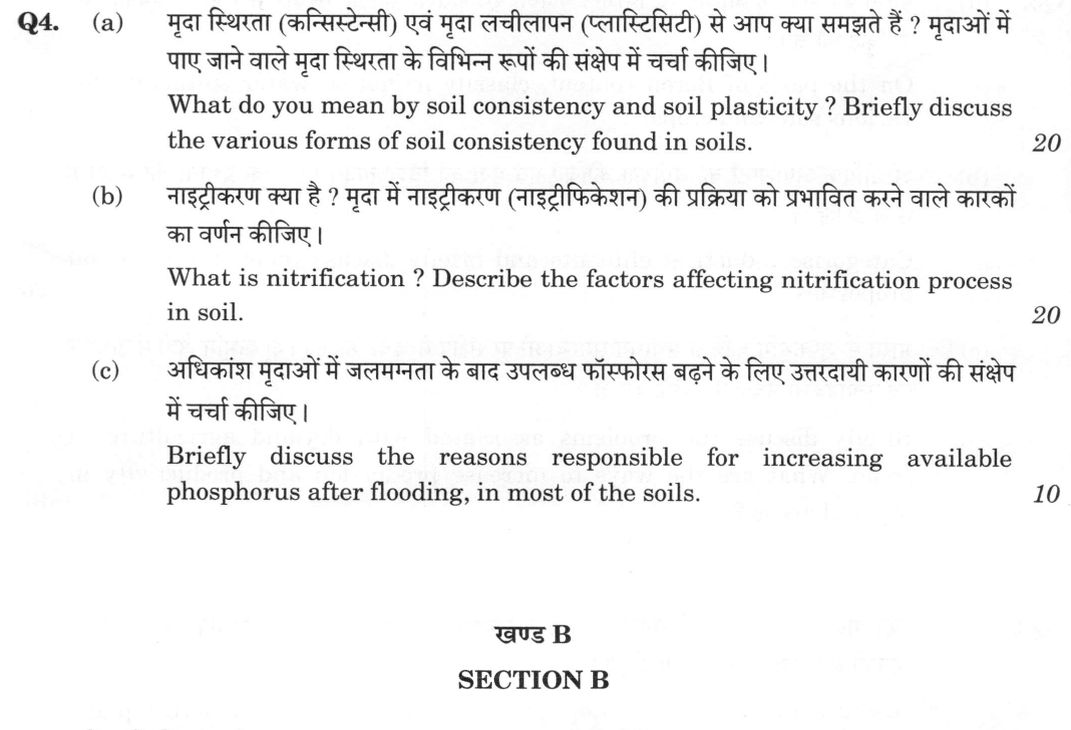
What do you mean by soil consistency and soil plasticity ? Briefly discuss the various forms of soil consistency found in soils. 20 marks
What is nitrification ? Describe the factors affecting nitrification process in soil. 20 marks
Briefly discuss the reasons responsible for increasing available phosphorus after flooding, in most of the soils. 10 marks
हिंदी में प्रश्न पढ़ें
मृदा स्थिरता (कन्सिस्टेन्सी) एवं मृदा लचीलापन (प्लास्टिसिटी) से आप क्या समझते हैं ? मृदाओं में पाए जाने वाले मृदा स्थिरता के विभिन्न रूपों की संक्षेप में चर्चा कीजिए। (20 अंक)
नाइट्रीकरण क्या है ? मृदा में नाइट्रीकरण (नाइट्रीफिकेशन) की प्रक्रिया को प्रभावित करने वाले कारकों का वर्णन कीजिए। (20 अंक)
अधिकांश मृदाओं में जलमग्नता के बाद उपलब्ध फॉस्फोरस बढ़ने के लिए उत्तरदायी कारणों की संक्षेप में चर्चा कीजिए। (10 अंक)
Model answer
Drafted with AI by UPSC Answer Check against this question's marking rubric, to the expected length. UPSC does not publish answers for Mains — this is one way to score well, not an official key. How we build rubrics and answers.
(a) Soil consistency and plasticity (20 marks)
Soil consistency is the resistance of soil to deformation or rupture, the manifestation of the forces of cohesion (attraction between soil particles) and adhesion (attraction of soil particles to other substances such as water films and tools) at different moisture contents. It decides how the soil behaves in tillage and engineering, and depends on texture, clay content and type, organic matter and moisture.
Soil plasticity is the ability of soil to be moulded into a shape by an applied force without rupture, and to retain that shape when the force is removed. It arises when the soil is moist enough to allow particles to slide over each other on water films, and is greatest in clayey soils, particularly those rich in 2:1 minerals such as montmorillonite, and is reduced by sand. It is measured by Atterberg limits: the plastic limit (lower moisture limit at which the soil is plastic), the liquid limit (upper limit, beyond which it flows), and the plasticity index, the difference between the two. A soil with a high index is difficult to till.
Forms of consistency by moisture condition:
- Wet soil: stickiness (adhesion to other objects) graded as non-sticky, slightly sticky, sticky and very sticky; and plasticity graded as non-plastic, slightly plastic, plastic and very plastic.
- Moist soil: the friability, graded as loose, very friable, friable, firm, very firm and extremely firm, and the friable state is the best for tillage.
- Dry soil: hardness, graded as loose, soft, slightly hard, hard, very hard and extremely hard.
- Cemented consistency, caused by cementing agents (calcium carbonate, silica, iron oxide), graded as weakly, strongly cemented and indurated.
- Two other terms: shrinkage limit (below which the soil does not shrink) and sticky limit. Importance: consistency determines the correct moisture at which to plough (tillage at the friable stage avoids clods and puddling), the workability of soil, resistance to erosion, and design of foundations and roads. Heavy soils show more of the wet forms (sticky, plastic), and sandy soils are loose or non-sticky in most conditions.
(b) Nitrification and factors affecting it (20 marks)
Nitrification is the biological oxidation of ammonium (NH4+) to nitrate (NO3-) by aerobic chemoautotrophic bacteria, in two steps:
- Step 1: NH4+ + 1.5 O2 → NO2- + 2H+ + H2O, by ammonia oxidisers such as Nitrosomonas, Nitrosospira and Nitrosococcus (and ammonia-oxidising archaea).
- Step 2: NO2- + 0.5 O2 → NO3-, by nitrite oxidisers such as Nitrobacter, Nitrospira and Nitrococcus. The process makes nitrogen mobile, since nitrate is not held by soil colloids, so it is easily taken up by crops but also leached or denitrified. The first step is rate-limiting, and nitrite rarely accumulates.
Factors:
- Supply of ammonium: the substrate is provided by mineralisation, urea hydrolysis or ammoniacal fertiliser; high concentrations of free ammonia inhibit Nitrobacter and cause nitrite accumulation.
- Aeration (oxygen): the process is strictly aerobic, so it is favoured in well-drained soils and stops in waterlogged or compacted soils.
- Moisture: optimum at about 50 to 60% of water-holding capacity; low in dry soil and in waterlogged soil.
- Temperature: optimum 25 to 35 degrees Celsius; slow below 10 and stops around 5 or above 45.
- Soil reaction: best at pH 6.5 to 8.5; inhibited below about 5.5 (acid soils), and lime promotes it.
- Organic matter and C:N ratio: a wide C:N ratio leads to immobilisation of ammonium, reducing nitrification; the organic matter supplies ammonium and energy for other organisms.
- Nutrients and salts: adequate calcium, phosphorus and micronutrients help; high salinity inhibits it.
- Nitrification inhibitors and toxic substances: nitrapyrin, dicyandiamide, neem cake and karanja, and certain pesticides slow the process, prolonging availability of ammonium; used to save fertiliser nitrogen.
- Soil texture and microbial population, and cropping, through root exudates. Management uses these factors to improve nitrogen use efficiency, for example by splitting fertiliser, using neem-coated urea and controlling drainage.
(c) Rise in available phosphorus after flooding (10 marks)
Flooding increases the availability of phosphorus in most soils, because of these changes:
- Reduction of ferric to ferrous: ferric phosphate, and phosphate held on ferric oxide and hydroxide coatings, is reduced to more soluble ferrous phosphate, releasing phosphate (reductive dissolution of the occluded, unavailable phosphorus).
- Change of pH towards neutrality: pH of acid soils rises and pH of alkaline and calcareous soils falls, towards about 7. In acid soils, the solubility of iron and aluminium phosphates increases; in alkaline soils, that of calcium phosphates.
- Release of anions: organic acids and carbonate formed by decomposition displace the phosphate held on clay and oxide surfaces (anion exchange).
- Greater mineralisation of organic phosphorus, and its solubilisation by microorganisms.
- Greater diffusion of phosphate through the water film, since the water-filled pores increase mobility to the roots.
- Reduced formation of insoluble aluminium-phosphate compounds in the presence of organic anions; and lower fixation. These effects explain why rice, grown flooded, often responds less to phosphorus than upland crops, though the effect is temporary and phosphorus can be fixed again when the soil dries.
How this answer will be evaluated
Evaluation rubric
Each sub-part is marked on its own, against the marks and word limit printed on the paper.
- (a) (a) Soil consistency and plasticity; forms of soil consistency (20). 20 marks
Must cover
- Consistency defined as expression of cohesion and adhesion at various moisture
- Plasticity defined; Atterberg limits (plastic limit, liquid limit, plasticity index) and factors
- Forms in wet, moist and dry states with grades (sticky and plastic; friable; hard)
- Cemented consistency and importance for tillage and engineering
Loses marks
- Confusing consistency with soil structure.
- Only definitions without forms.
- Wrong grouping of forms by moisture state.
Earns more
- Effect of clay type and organic matter.
- Friable stage as the best for tillage.
Extra mark
- Shrinkage limit and sticky limit
- (b) (b) Nitrification; factors affecting nitrification in soil (20). 20 marks
Must cover
- Definition: biological oxidation of ammonium to nitrate
- Two steps and organisms: Nitrosomonas (NH4 to NO2), Nitrobacter (NO2 to NO3) with equations
- Factors: ammonium supply, aeration, moisture, temperature, pH, C:N ratio, salts
- Inhibitors and management (neem-coated urea, DCD, nitrapyrin) and significance
Loses marks
- Confusing nitrification with nitrogen fixation or denitrification.
- Wrong organisms for the two steps.
- No factors.
Earns more
- Optimum values for temperature, pH and moisture.
- Nitrate leaching or denitrification as consequences.
Extra mark
- Ammonia-oxidising archaea
- (c) (c) Reasons for the increase in available phosphorus after flooding in most soils (10). 10 marks
Must cover
- Reduction of ferric phosphate to more soluble ferrous phosphate
- Reductive dissolution of iron oxide coatings releasing occluded P
- pH shift towards neutrality increasing solubility of Fe, Al and Ca phosphates
- Anion displacement by organic anions, mineralisation of organic P, greater diffusion
Loses marks
- Stating that flooding decreases phosphorus.
- Confusing with nitrogen loss under flooding.
- No chemistry given.
Earns more
- Relevance to rice.
- Reversal on drying.
Extra mark
- Lower fixation by organic anions
What "Discuss" is asking you to do
Lay the issue out from more than one side — how it arose, what is claimed for it, what is held against it, and where it now stands. UPSC attaches discuss to broad topics with several live dimensions, so coverage of the dimensions earns more than the strength of your opinion.
Structure that answers it
Set the issue up → the case as it is made → the case against → the dimension both sides leave out → where the balance now lies
Where marks are lost
Listing facts with no thread between them, or arguing one side throughout and calling it a discussion.
Practice this exact question
Write your answer and it is marked point by point against the model answer above — what you covered, what you missed, what you got wrong.
Evaluate my answer →More from Agriculture 2026 Paper I
- Q1 Answer the following questions in about 150 words each : (a) What are the major sources o…
- Q2 (a) Give an account of greenhouse gas (GHG) emissions from agriculture. State the mitigat…
- Q3 (a) Discuss the vegetative propagation methods adopted in forest plants with suitable exa…
- Q4 (a) What do you mean by soil consistency and soil plasticity ? Briefly discuss the variou…
- Q5 Answer the following questions in about 150 words each : (a) Write down the approaches fo…
- Q6 (a) On the basis of Boron content, classify irrigation water suitability for various soil…
- Q7 (a) What are the various factors affecting farm profits ? Discuss the decisions which are…