Paper I — Q1
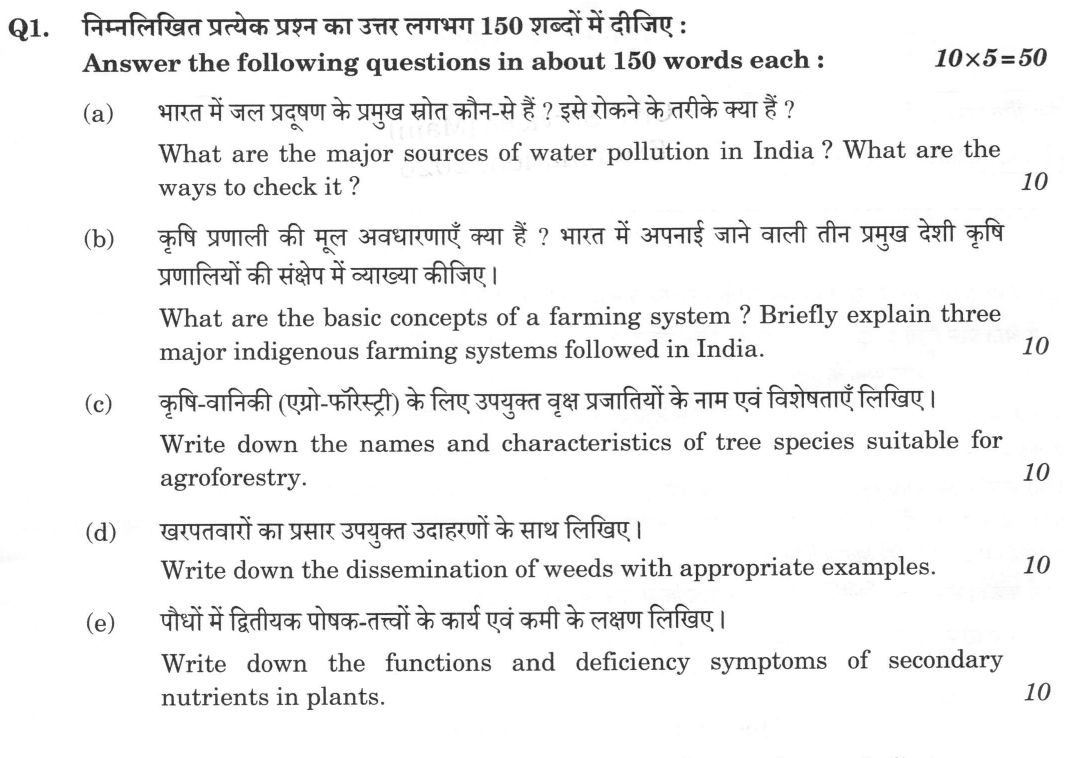
(a) What are the major sources of water pollution in India ? What are the ways to check it ? (10 marks) (b) What are the basic…
Answer the following questions in about 150 words each :
What are the major sources of water pollution in India ? What are the ways to check it ? 10 marks
What are the basic concepts of a farming system ? Briefly explain three major indigenous farming systems followed in India. 10 marks
Write down the names and characteristics of tree species suitable for agroforestry. 10 marks
Write down the dissemination of weeds with appropriate examples. 10 marks
Write down the functions and deficiency symptoms of secondary nutrients in plants. 10 marks
हिंदी में प्रश्न पढ़ें
निम्नलिखित प्रत्येक प्रश्न का उत्तर लगभग 150 शब्दों में दीजिए :
भारत में जल प्रदूषण के प्रमुख स्रोत कौन-से हैं ? इसे रोकने के तरीके क्या हैं ? (10 अंक)
कृषि प्रणाली की मूल अवधारणाएँ क्या हैं ? भारत में अपनाई जाने वाली तीन प्रमुख देशी कृषि प्रणालियों की संक्षेप में व्याख्या कीजिए। (10 अंक)
कृषि-वानिकी (एग्रो-फोरेस्ट्री) के लिए उपयुक्त वृक्ष प्रजातियों के नाम एवं विशेषताएँ लिखिए। (10 अंक)
खरपतवारों का प्रसार उपयुक्त उदाहरणों के साथ लिखिए। (10 अंक)
पौधों में द्वितीयक पोषक-तत्वों के कार्य एवं कमी के लक्षण लिखिए। (10 अंक)
Model answer
Drafted with AI by UPSC Answer Check against this question's marking rubric, to the 150-word length. UPSC does not publish answers for Mains — this is one way to score well, not an official key. How we build rubrics and answers.
(a) Water pollution in India: sources and control (10 marks)
Major sources. Point sources: untreated or partly treated domestic sewage from towns, which is the largest load on rivers, and industrial effluents from tanneries, textiles, distilleries, sugar, paper and chemical units carrying organic matter, heavy metals and toxic chemicals. Non-point sources: agricultural runoff with fertilisers (nitrate and phosphate, causing eutrophication) and pesticide residues, urban storm runoff, mining and oil spills, solid waste dumped in water, and thermal discharge from power plants. Groundwater also carries geogenic fluoride and arsenic.
Ways to check it:
- Treatment of sewage in sewage treatment plants, and of industrial effluent in effluent treatment plants, with zero liquid discharge for the most polluting units.
- Enforcement of the Water (Prevention and Control of Pollution) Act, 1974 through the CPCB and State Pollution Control Boards, with the polluter-pays principle.
- Integrated nutrient and pest management, and buffer strips, to cut agricultural runoff.
- River programmes such as Namami Gange, reuse of treated water, and rainwater harvesting.
- Monitoring and public awareness.
(b) Farming system and indigenous farming systems (10 marks)
Basic concepts. A farming system is a resource-management strategy that integrates crops, livestock, fish, trees and other enterprises, along with the farm household, to gain higher and sustainable income from limited resources. Its concepts are: the system and its sub-systems with a boundary; inputs and outputs, with recycling of by-products (straw to cattle, dung to crops); interaction and synergy among components; diversity and risk spreading; resource-use efficiency; the farm household as the decision-making unit; and sustainability and stability.
Three indigenous systems:
- Shifting cultivation (jhum) in the North-East: forest is cut and burned, mixed crops are grown for one to three years, and the plot is then left fallow.
- Homestead or home-garden system of Kerala and coastal areas: multi-storeyed combinations of coconut, arecanut, spices, fruit trees, vegetables and livestock.
- Apatani rice-fish culture of Arunachal Pradesh: fish reared in irrigated paddy fields, with bunds carrying crops, needing no fertiliser.
(c) Tree species suitable for agroforestry (10 marks)
Suitable species share the following characteristics: fast growth and a short rotation; multiple uses (fodder, fuel, timber, fruit, green manure); nitrogen fixation; deep taproot, which avoids competition with crops; light or narrow crown that allows sunlight through; ability to coppice and to withstand lopping; tolerance of drought, salinity or waterlogging as the site requires; and freedom from allelopathic effect and from harbouring pests.
Examples: Leucaena leucocephala (subabul), a fast-growing nitrogen fixer giving fodder and fuel, for alley cropping; Gliricidia sepium, for green manure and live fences; Prosopis cineraria (khejri) of arid areas, a nitrogen fixer giving pods and lopped fodder; Dalbergia sissoo (shisham) and Populus deltoides (poplar) for timber on farm boundaries, poplar with winter crops as it sheds its leaves; Azadirachta indica (neem) for oil cake and pest control; Casuarina equisetifolia for coastal sands; Acacia nilotica, Albizia lebbeck, Melia dubia and Grevillea robusta (shade for tea and coffee).
(d) Dissemination of weeds (10 marks)
Weeds spread by:
- Wind: light seeds with a pappus or wings, such as Tridax procumbens, Parthenium hysterophorus, Sonchus and Typha.
- Water: irrigation channels and floods carry seeds and vegetative parts, as in Eichhornia (water hyacinth), Alternanthera and rice weeds.
- Animals and birds: seeds with hooks or spines cling to fur (Xanthium, Achyranthes, Cenchrus), or pass through droppings after being eaten (Lantana).
- Man and machinery: contaminated crop seed, such as Phalaris minor in wheat seed and Cuscuta in lucerne, implements, vehicles and imported grain (Parthenium came with imported wheat); unrotted farmyard manure.
- Vegetative propagules: tubers and rhizomes spread by tillage, such as Cyperus rotundus and Cynodon dactylon.
- Explosive fruit dehiscence, as in Oxalis and Euphorbia hirta. Prevention therefore relies on clean seed, quarantine, cleaning machinery, composted manure and clean irrigation water.
(e) Secondary nutrients: functions and deficiency symptoms (10 marks)
The secondary nutrients are calcium, magnesium and sulphur.
Calcium: forms calcium pectate of the cell wall and middle lamella, keeps membranes intact, and helps cell division, root growth and enzyme activation. It is immobile, so deficiency shows in young tissues: stunted, distorted new leaves, death of growing tips, poor root growth, blossom-end rot of tomato and "pops" in groundnut.
Magnesium: the central atom of chlorophyll and an activator of enzymes of phosphate transfer (ATP-related). It is mobile, so interveinal chlorosis begins on older leaves, with leaf margins later turning red or purple; grass tetany appears in animals.
Sulphur: a component of the amino acids cysteine and methionine, proteins, coenzyme A, vitamins (biotin, thiamine), and mustard oils and glucosinolates, raising oil content. It is immobile, so a pale yellow chlorosis affects young leaves first, with thin stems and delayed maturity; "tea yellows" is an example.
How this answer will be evaluated
Evaluation rubric
Each sub-part is marked on its own, against the marks and word limit printed on the paper.
- (a) (a) Major sources of water pollution in India and ways to check it (10, about 150 words). 10 marks · 150 words
Must cover
- Point sources: domestic sewage and industrial effluents
- Non-point sources: agricultural runoff (fertilisers, pesticides), urban runoff, mining, oil, thermal
- Control: STPs, ETPs, zero liquid discharge, Water Act 1974 with CPCB and SPCBs
- Preventive measures: INM and IPM, buffer strips, river programmes, awareness
Loses marks
- Listing only sources or only remedies.
- Confusing air and water pollution.
- Over the word limit.
Earns more
- Eutrophication or geogenic contaminants.
- Namami Gange or polluter-pays.
Extra mark
- Reuse of treated water
- (b) (b) Basic concepts of a farming system; three major indigenous farming systems in India (10, about 150 words). 10 marks · 150 words
Must cover
- Definition: integration of crops, livestock, fish, trees with the household
- Concepts: sub-systems, inputs-outputs, recycling, synergy, diversity, sustainability
- Three indigenous systems named (jhum, home gardens, Apatani rice-fish or similar)
- Brief description of each
Loses marks
- Describing modern integrated farming only.
- Fewer than three systems.
- Over the word limit.
Earns more
- Correct region for each system.
- Risk spreading and resource efficiency.
Extra mark
- Zabo or Kuhl irrigation examples
- (c) (c) Names and characteristics of tree species suitable for agroforestry (10, about 150 words). 10 marks · 150 words
Must cover
- Characteristics: fast growth, multipurpose, nitrogen fixing, deep roots, light crown, coppicing
- Suitable species named correctly (subabul, Gliricidia, khejri, poplar, shisham, neem)
- Use of each species (fodder, fuel, timber, green manure, shade)
- No allelopathy or competition with crops
Loses marks
- Naming species with no characteristics.
- Including species harmful to crops without qualification.
- Over the word limit.
Earns more
- Species matched to agro-climatic region.
- Botanical names given.
Extra mark
- Alley cropping or boundary plantation systems
- (d) (d) Dissemination of weeds with appropriate examples (10, about 150 words). 10 marks · 150 words
Must cover
- Wind, water, animals and birds, man and machinery, vegetative propagules
- Correct example for each agency
- Explosive dehiscence or crop-seed contamination
- Prevention linked to spread
Loses marks
- Only defining weeds.
- Wrong examples for a mode of spread.
- Over the word limit.
Earns more
- Botanical names.
- Parthenium introduction with imported grain.
Extra mark
- Quarantine measures
- (e) (e) Functions and deficiency symptoms of secondary nutrients in plants (10, about 150 words). 10 marks · 150 words
Must cover
- Secondary nutrients identified: calcium, magnesium, sulphur
- Functions: Ca (cell wall), Mg (chlorophyll), S (amino acids, proteins)
- Deficiency symptoms with mobility: Ca and S in young leaves, Mg in older leaves
- Distinct symptoms named (blossom-end rot, interveinal chlorosis, yellowing of young leaves)
Loses marks
- Including N, P or K.
- Confusing Ca with Mg symptoms.
- Over the word limit.
Earns more
- Crop examples.
- Correct mobility reasoning.
Extra mark
- Grass tetany
What "Explain" is asking you to do
Make the working of something clear — what sets it off, what follows from what, and what it produces. Explain is the Commission's mechanism word: it dominates the technical papers and the “explain why” stems, where the marks sit in the causal chain and not in the label.
Structure that answers it
State what it is → the initiating condition → the chain of cause, step by step → an instance where it plays out → what the chain produces
Where marks are lost
Describing what something looks like instead of why it works that way. Naming the stages without linking them reads as description too.
Practice this exact question
Write your answer and it is marked point by point against the model answer above — what you covered, what you missed, what you got wrong.
Evaluate my answer →More from Agriculture 2026 Paper I
- Q1 Answer the following questions in about 150 words each : (a) What are the major sources o…
- Q2 (a) Give an account of greenhouse gas (GHG) emissions from agriculture. State the mitigat…
- Q3 (a) Discuss the vegetative propagation methods adopted in forest plants with suitable exa…
- Q4 (a) What do you mean by soil consistency and soil plasticity ? Briefly discuss the variou…