Paper I — Q3
(a) Discuss the vegetative propagation methods adopted in forest plants with suitable examples and their limitations. (20…
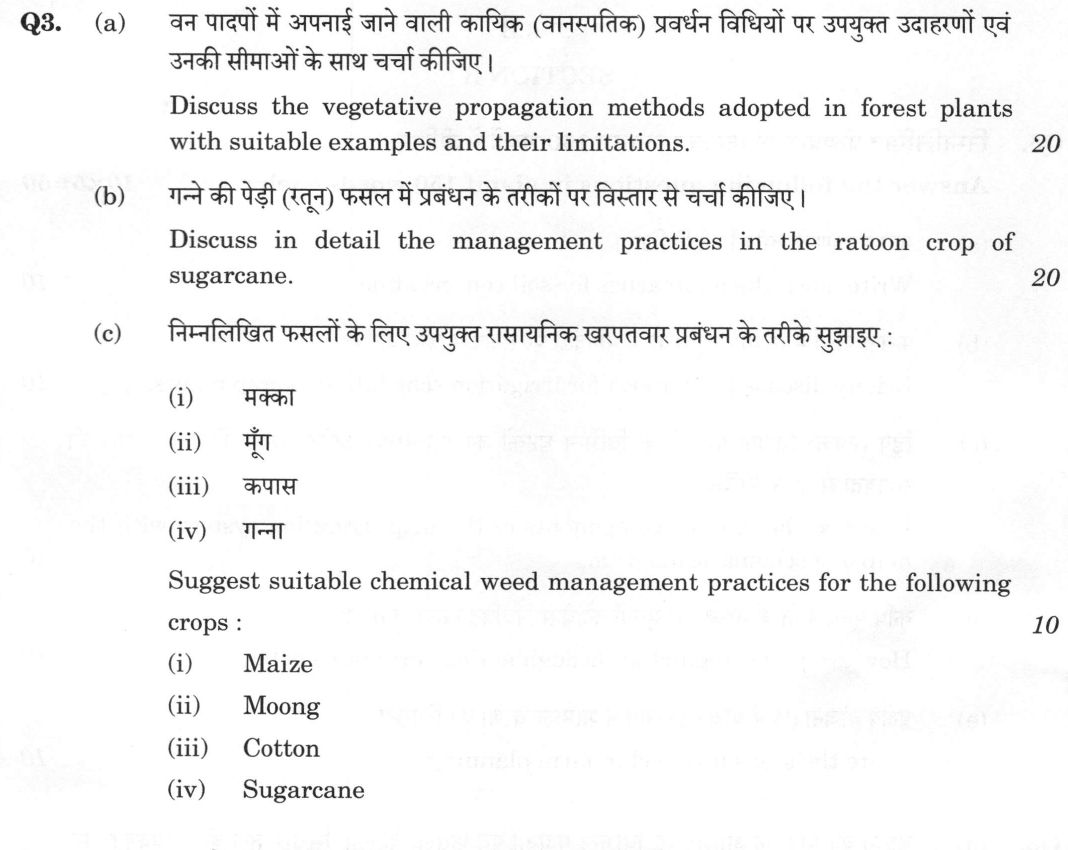
Discuss the vegetative propagation methods adopted in forest plants with suitable examples and their limitations. 20 marks
Discuss in detail the management practices in the ratoon crop of sugarcane. 20 marks
Suggest suitable chemical weed management practices for the following crops : Maize
Moong
Cotton
Sugarcane 10 marks
हिंदी में प्रश्न पढ़ें
वन पादपों में अपनाई जाने वाली कायिक (वानस्पतिक) प्रवर्धन विधियों पर उपयुक्त उदाहरणों एवं उनकी सीमाओं के साथ चर्चा कीजिए। (20 अंक)
गन्ने की पेड़ी (रतून) फसल में प्रबंधन के तरीकों पर विस्तार से चर्चा कीजिए। (20 अंक)
निम्नलिखित फसलों के लिए उपयुक्त रासायनिक खरपतवार प्रबंधन के तरीके सुझाइए : मक्का
मूँग
कपास
गन्ना (10 अंक)
Model answer
Drafted with AI by UPSC Answer Check against this question's marking rubric, to the expected length. UPSC does not publish answers for Mains — this is one way to score well, not an official key. How we build rubrics and answers.
(a) Vegetative propagation of forest plants (20 marks)
Vegetative propagation raises new plants from vegetative parts, giving clones that are genetically identical to the parent. It is used for species that produce little or unreliable seed, to multiply superior (plus) trees, for seed orchards and clonal plantations, and to obtain uniform, fast-growing stock.
Methods, with examples:
- Stem cuttings: Populus deltoides (poplar) and Salix from hardwood cuttings; Eucalyptus hybrids and Casuarina as rooted cuttings from coppice shoots under mist; Dalbergia sissoo by branch cuttings; bamboo by culm, branch and rhizome cuttings.
- Root cuttings and suckers: Dalbergia sissoo, Ailanthus excelsa, Populus tremula and Robinia pseudoacacia, which produce root suckers.
- Stump planting: Tectona grandis (teak) stumps, with a prepared root and short shoot, planted in the field.
- Layering: air layering (gootee) in species such as Simarouba and Ficus, and ground layering in shrubs.
- Grafting and budding: to multiply plus trees in seed orchards, as with teak, Pinus, neem and Acacia; patch or T-budding of teak and sandalwood.
- Offsets, rhizomes and clump division: bamboo (Bambusa, Dendrocalamus).
- Coppicing, where stumps of cut trees sprout, as in Eucalyptus, sal and teak.
- Micropropagation (tissue culture): bamboo, teak, Eucalyptus, sandalwood and Casuarina, for large-scale, disease-free clones.
Limitations:
- Narrow genetic base: large-scale monoclonal plantations are highly vulnerable to a pest, disease or climate stress, as seen with poplar and eucalypt diseases.
- Loss of genetic diversity and adaptability, and no gain from natural selection.
- Maturation: cuttings from old trees root poorly, while juvenile material is required; some species (many hardwoods, pines, sal) are difficult to root.
- Root system may be weaker and shallower than seedlings, with no taproot, leading to instability and drought sensitivity, and possible plagiotropic growth in grafts and cuttings.
- Cost, technical skill and infrastructure (mist chambers, nursery, tissue-culture laboratory).
- Possible graft incompatibility and transmission of systemic diseases and viruses through the parent.
- Difficult mass multiplication for many species, and seeds are still needed for genetic improvement and breeding. For these reasons vegetative propagation should be used together with seed-based propagation to keep a broad genetic base.
(b) Management practices in ratoon crop of sugarcane (20 marks)
The ratoon is the crop regrown from stubbles of the harvested plant crop. It saves seed cost, land preparation and time, matures earlier and needs less water, but yields tend to decline with each ratoon unless it is well managed. Ratoon crops are commonly taken for one or two, at most three, cycles.
Practices:
- Time and method of harvest: harvest the plant crop early, ideally in the early season (before February–March), close to the ground so that buds below the surface sprout and give a strong root system.
- Stubble shaving: cut stubbles even at ground level or below, using a sharp cutter or stubble shaver, to induce shoots from underground buds; treat the cut surface with a fungicide (such as carbendazim) against red rot and pineapple disease.
- Trash management: retain the trash as mulch in alternate rows (about 5 to 8 tonnes per hectare) to conserve moisture, suppress weeds, and add organic matter; do not burn it.
- Off-barring: cut the old ridges at the stubble base on both sides to let new roots grow, using a plough or off-barring device, which is then followed by earthing up.
- Gap filling within 3 to 4 weeks, with pre-germinated setts or seedlings, so that plant population is 1 lakh or more of millable canes per hectare.
- Fertiliser: about 25% more nitrogen than in the plant crop, in split doses, with phosphorus and potash by soil test; along with FYM or press mud, and, where indicated, iron and zinc, since ratoons often show iron chlorosis.
- Irrigation: the first light irrigation right after stubble shaving or fertiliser application, and then at 7 to 10 day intervals in summer, according to need; drip irrigation and fertigation improve efficiency.
- Weed control: atrazine as pre-emergence and 2,4-D later, with inter-row cultivation and mulching.
- Plant protection: control of early shoot borer, top shoot borer, pyrilla and whitefly, and rogueing of diseased clumps, as ratoon carries over pests and diseases.
- Earthing up in 2 to 3 months to prevent lodging, and propping. Ratoon should be raised only from a healthy, high-yielding plant crop free of disease, and the field should be replanted when yield falls.
(c) Chemical weed management (10 marks)
(i) Maize: atrazine at 1.0 to 1.5 kg per hectare as pre-emergence within 2 days after sowing, controlling broadleaf weeds and some grasses; post-emergence tembotrione (about 120 g per hectare) or topramezone at 15 to 20 days for mixed weeds; 2,4-D for broadleaf weeds.
(ii) Moong (green gram): pendimethalin at 0.75 to 1.0 kg per hectare as pre-emergence; imazethapyr (about 50 to 75 g per hectare) as early post-emergence at 20 days; quizalofop-ethyl for grassy weeds, with one hand weeding at 30 to 35 days.
(iii) Cotton: pendimethalin at 1.0 kg per hectare pre-emergence, or fluchloralin pre-plant incorporated; pyrithiobac sodium (about 62.5 to 75 g per hectare) post-emergence for broadleaf weeds and quizalofop-ethyl for grasses; directed inter-row spray of glyphosate or paraquat with a shield, avoiding contact with the crop.
(iv) Sugarcane: atrazine at 2 kg per hectare (or metribuzin at 1.0 kg) pre-emergence, within 3 to 5 days of planting; 2,4-D at 3 to 4 weeks for broadleaf weeds and sedges, and halosulfuron for Cyperus rotundus; directed spray of glyphosate in the inter-row. Use recommended dose, spray volume 500 litres of water per hectare with a flat-fan nozzle, and rotate herbicides.
How this answer will be evaluated
Evaluation rubric
Each sub-part is marked on its own, against the marks and word limit printed on the paper.
- (a) (a) Vegetative propagation methods in forest plants with examples and limitations (20). 20 marks
Must cover
- Meaning and reasons for vegetative propagation (clones, plus trees, seed orchards)
- Methods with forest examples: cuttings, root suckers, stumps, layering, grafting and budding, offsets, coppice, tissue culture
- Correct species examples (poplar, eucalypt, teak, sissoo, bamboo)
- Limitations: narrow genetic base, poor rooting of mature material, weak roots, cost, disease risk
Loses marks
- Describing horticultural propagation only.
- Methods without any examples.
- No limitations.
Earns more
- Combined use with seed propagation.
- Plagiotropism or graft incompatibility.
Extra mark
- Clonal forestry in India
- (b) (b) Management practices of the ratoon crop of sugarcane (20). 20 marks
Must cover
- Meaning of ratoon and its advantages
- Harvest close to the ground, stubble shaving with fungicide, off-barring, gap filling
- Trash mulching, extra nitrogen (about 25% more), iron and zinc, irrigation
- Weed, pest and disease control, earthing up, number of ratoons
Loses marks
- Describing plant-crop management only.
- Burning trash.
- Leaving out fertiliser or irrigation.
Earns more
- Doses or timings specified.
- Ratoon-specific problems (iron chlorosis, decline in yield).
Extra mark
- Ratoon management devices or drip fertigation
- (c) (c) Chemical weed management for maize, moong, cotton and sugarcane (10). 10 marks
Must cover
- Maize: atrazine pre-emergence with timing and dose, and post-emergence option
- Moong: pendimethalin pre-emergence, imazethapyr or quizalofop post-emergence
- Cotton: pendimethalin pre-emergence and post-emergence options with directed spray
- Sugarcane: atrazine or metribuzin pre-emergence, 2,4-D or halosulfuron later
Loses marks
- Naming herbicides not recommended for the crop.
- Omitting one of the four crops.
- No dose or timing.
Earns more
- Dose per hectare, time of application and spray volume.
- Herbicide rotation.
Extra mark
- Integrated weed management with one hand weeding
What "Discuss" is asking you to do
Lay the issue out from more than one side — how it arose, what is claimed for it, what is held against it, and where it now stands. UPSC attaches discuss to broad topics with several live dimensions, so coverage of the dimensions earns more than the strength of your opinion.
Structure that answers it
Set the issue up → the case as it is made → the case against → the dimension both sides leave out → where the balance now lies
Where marks are lost
Listing facts with no thread between them, or arguing one side throughout and calling it a discussion.
Practice this exact question
Write your answer and it is marked point by point against the model answer above — what you covered, what you missed, what you got wrong.
Evaluate my answer →More from Agriculture 2026 Paper I
- Q1 Answer the following questions in about 150 words each : (a) What are the major sources o…
- Q2 (a) Give an account of greenhouse gas (GHG) emissions from agriculture. State the mitigat…
- Q3 (a) Discuss the vegetative propagation methods adopted in forest plants with suitable exa…
- Q4 (a) What do you mean by soil consistency and soil plasticity ? Briefly discuss the variou…
- Q5 Answer the following questions in about 150 words each : (a) Write down the approaches fo…
- Q6 (a) On the basis of Boron content, classify irrigation water suitability for various soil…