Paper I — Q6
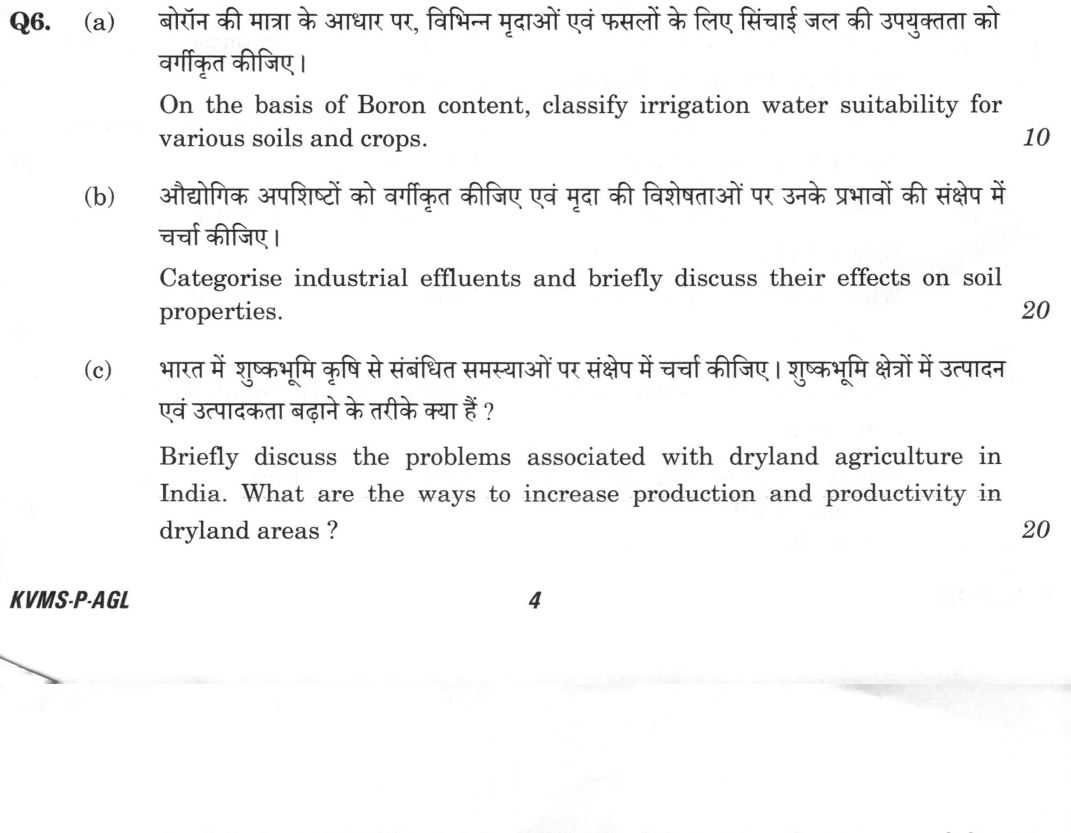
(a) On the basis of Boron content, classify irrigation water suitability for various soils and crops. (10 marks) (b) Categorise…
On the basis of Boron content, classify irrigation water suitability for various soils and crops. 10 marks
Categorise industrial effluents and briefly discuss their effects on soil properties. 20 marks
Briefly discuss the problems associated with dryland agriculture in India. What are the ways to increase production and productivity in dryland areas ? 20 marks
हिंदी में प्रश्न पढ़ें
बोरॉन की मात्रा के आधार पर, विभिन्न मृदाओं एवं फसलों के लिए सिंचाई जल की उपयुक्तता को वर्गीकृत कीजिए। (10 अंक)
औद्योगिक अपशिष्टों को वर्गीकृत कीजिए एवं मृदा की विशेषताओं पर उनके प्रभावों की संक्षेप में चर्चा कीजिए। (20 अंक)
भारत में शुष्कभूमि कृषि से संबंधित समस्याओं पर संक्षेप में चर्चा कीजिए। शुष्कभूमि क्षेत्रों में उत्पादन एवं उत्पादकता बढ़ाने के तरीके क्या हैं ? (20 अंक)
Model answer
Drafted with AI by UPSC Answer Check against this question's marking rubric, to the expected length. UPSC does not publish answers for Mains — this is one way to score well, not an official key. How we build rubrics and answers.
(a) Classification of irrigation water on the basis of boron (10 marks)
Boron is essential in trace amounts but is toxic to plants when in excess, and the margin between deficiency and toxicity is narrow. Toxicity appears as yellowing and scorching of leaf tips and margins, starting on older leaves, and leaf drop. Crops differ greatly in tolerance, so Wilcox (1955) classified irrigation water by boron concentration (parts per million) for three groups of crops:
- Class 1, excellent: sensitive crops below 0.33; semi-tolerant crops below 0.67; tolerant crops below 1.0.
- Class 2, good: sensitive 0.33 to 0.67; semi-tolerant 0.67 to 1.33; tolerant 1.0 to 2.0.
- Class 3, permissible: sensitive 0.67 to 1.00; semi-tolerant 1.33 to 2.00; tolerant 2.0 to 3.0.
- Class 4, doubtful: sensitive 1.00 to 1.25; semi-tolerant 2.00 to 2.50; tolerant 3.0 to 3.75.
- Class 5, unsuitable: sensitive above 1.25; semi-tolerant above 2.50; tolerant above 3.75.
Sensitive crops include citrus, stone fruits, apple, pear, grape, walnut and beans. Semi-tolerant crops include wheat, barley, maize, cotton, oats, potato, tomato and sunflower. Tolerant crops include lucerne, sugar beet, cabbage, carrot, asparagus, and date palm. Fine-textured and organic soils adsorb boron and reduce the risk, and leaching with good water removes it.
(b) Industrial effluents and their effects on soil (20 marks)
Categories of industrial effluents, by industry and nature of pollutant, are:
- Organic-rich effluents from sugar mills, distilleries (spent wash), dairies, paper and pulp, food processing and tanneries, with high BOD and COD.
- Inorganic and chemical effluents from fertiliser, chemical, pharmaceutical, textile and dye units, with acids, alkalis, salts and high total dissolved solids.
- Heavy-metal-bearing effluents from electroplating, batteries, tanneries (chromium), mining and metallurgy, with cadmium, lead, chromium, nickel, zinc, copper and mercury.
- Thermal effluent from power plants and cooling water; and radioactive waste from nuclear and mining operations.
By toxicity, effluents are toxic (metals, cyanides, phenols, pesticides) or non-toxic (mostly organic or nutrient-rich); and by physical form they are suspended, colloidal or dissolved.
Effects on soil properties:
- Physical: suspended solids, oils and grease clog pores and reduce infiltration and aeration; sodium in the effluent disperses clay and destroys soil structure and leads to crusting and low permeability; effluent with high organic load may waterlog and make the soil anaerobic.
- Chemical: acidic or alkaline effluent alters soil pH; high salt content raises electrical conductivity (salinisation) and sodium adsorption ratio (sodicity); heavy metals accumulate in the soil and are taken up by crops, entering the food chain; some effluents (spent wash, sugar mill and dairy effluent) add nitrogen, potassium and organic matter, which is a benefit if diluted and applied at a controlled rate, but excess causes nutrient imbalance and nitrate pollution of groundwater.
- Biological: toxic effluents reduce the population and enzyme activity of soil microorganisms and earthworms and inhibit nitrogen fixation and nitrification, while organic effluents may temporarily increase microbial activity.
- Crop effects: poor germination, stunted growth, reduced yield and quality, and contaminated produce.
Effluents therefore need treatment to meet standards before use for irrigation, with monitoring of the soil.
(c) Dryland agriculture in India (20 marks)
Problems. Dryland or rainfed agriculture covers about half of India's net sown area and supplies a large share of the country's coarse cereals, pulses, oilseeds and cotton. Its problems:
- Erratic and uncertain rainfall, with delayed onset, long dry spells and early withdrawal of the monsoon, causing frequent drought and crop failure.
- Poor soils: shallow, coarse or heavy, with low water-holding capacity and organic matter, and susceptibility to water and wind erosion, crusting and low fertility.
- High evaporative demand and runoff losses; the soil moisture is inadequately conserved.
- Low input use: less fertiliser, poor seed and use of low-yielding local varieties, with low yields and high variability.
- Small, fragmented holdings and low capacity to take risk; poor credit, insurance, markets and infrastructure.
- Pest and weed problems under moisture stress, and low adoption of technology.
Ways to increase production and productivity:
- In-situ moisture conservation: contour bunding, compartmental bunds, broad-bed and furrow, ridge-and-furrow and conservation furrows, mulching, and deep summer ploughing.
- Rainwater harvesting and recycling: farm ponds and check dams, with supplemental irrigation at critical stages, using drip or sprinklers.
- Crop planning: drought-tolerant crops and short-duration varieties (pearl millet, sorghum, pigeonpea, groundnut, castor), intercropping and mixed cropping (pearl millet with pigeonpea), timely sowing, seed treatment and hardening, and contingency crop plans for delayed monsoon.
- Nutrient management: integrated use of farmyard manure and fertiliser, in the right time and placement, with legumes in rotation.
- Weed control, thinning of plant population, and anti-transpirants, and mid-season correction in dry spells.
- Watershed management: the watershed approach for soil and water conservation on a community basis, as in watershed development under PMKSY.
- Alternative land use: agroforestry, silvipasture, horticulture such as ber, custard apple and pomegranate, and livestock integration, as risk-spreading.
- Support: crop insurance, weather advisories, credit, remunerative prices for millets and pulses, and research through All India Coordinated Research Project on Dryland Agriculture and CRIDA.
How this answer will be evaluated
Evaluation rubric
Each sub-part is marked on its own, against the marks and word limit printed on the paper.
- (a) (a) Classify irrigation water for various soils and crops on the basis of boron content (10). 10 marks
Must cover
- Boron toxicity and narrow range between deficiency and toxicity
- Five classes (excellent to unsuitable) with ppm limits for sensitive, semi-tolerant and tolerant crops (Wilcox)
- Examples of sensitive, semi-tolerant and tolerant crops
- Soil influence and remedy (fine texture, leaching)
Loses marks
- Classifying by salinity or sodicity instead of boron.
- Wrong crop tolerance groups.
- No numerical limits.
Earns more
- Correct ppm thresholds.
- Toxicity symptoms.
Extra mark
- Comparison with other quality criteria (EC, SAR, RSC)
- (b) (b) Categorise industrial effluents and briefly discuss their effects on soil properties (20). 20 marks
Must cover
- Categories: organic-rich, inorganic and chemical, heavy metal bearing, thermal and radioactive, with sources
- Physical effects: pore clogging, dispersion by sodium, crusting, poor infiltration
- Chemical effects: pH change, salinity and sodicity, heavy metal accumulation, nutrient imbalance
- Biological effects and effects on crops; need for treatment
Loses marks
- Confusing effluents with sewage or air pollutants.
- Effects on water only, not soil.
- No categorisation.
Earns more
- Beneficial use of diluted spent wash or sugar mill effluent.
- Food chain entry of metals.
Extra mark
- Standards or CPCB norms
- (c) (c) Problems of dryland agriculture in India; ways to increase production and productivity (20). 20 marks
Must cover
- Problems: erratic rainfall and drought, poor soils, low water-holding capacity, erosion, low input use, small holdings
- In-situ moisture conservation and water harvesting with supplemental irrigation
- Crop planning: drought-tolerant crops and varieties, intercropping, contingency plans, timely sowing
- Nutrient management, watershed approach, alternative land use and institutional support
Loses marks
- Only problems or only remedies.
- Irrigation-based solutions only.
- Confusing dryland with desert farming.
Earns more
- Named programmes such as PMKSY or CRIDA.
- Rainfed share of net sown area.
Extra mark
- Anti-transpirants or mid-season correction
What "Classify" is asking you to do
Sort into categories on a stated basis, and make the basis explicit before you sort. A classification is judged on whether the categories are exhaustive, mutually exclusive and drawn on a single consistent principle.
Structure that answers it
State the basis of classification → category one with its members → category two → category three → note the overlaps and borderline cases
Where marks are lost
Categories that are not mutually exclusive, or a basis of division left unstated.
Practice this exact question
Write your answer and it is marked point by point against the model answer above — what you covered, what you missed, what you got wrong.
Evaluate my answer →More from Agriculture 2026 Paper I
- Q3 (a) Discuss the vegetative propagation methods adopted in forest plants with suitable exa…
- Q4 (a) What do you mean by soil consistency and soil plasticity ? Briefly discuss the variou…
- Q5 Answer the following questions in about 150 words each : (a) Write down the approaches fo…
- Q6 (a) On the basis of Boron content, classify irrigation water suitability for various soil…
- Q7 (a) What are the various factors affecting farm profits ? Discuss the decisions which are…
- Q8 (a) Differentiate between monitoring and evaluation of extension programmes. Discuss the…