Paper II — Q1
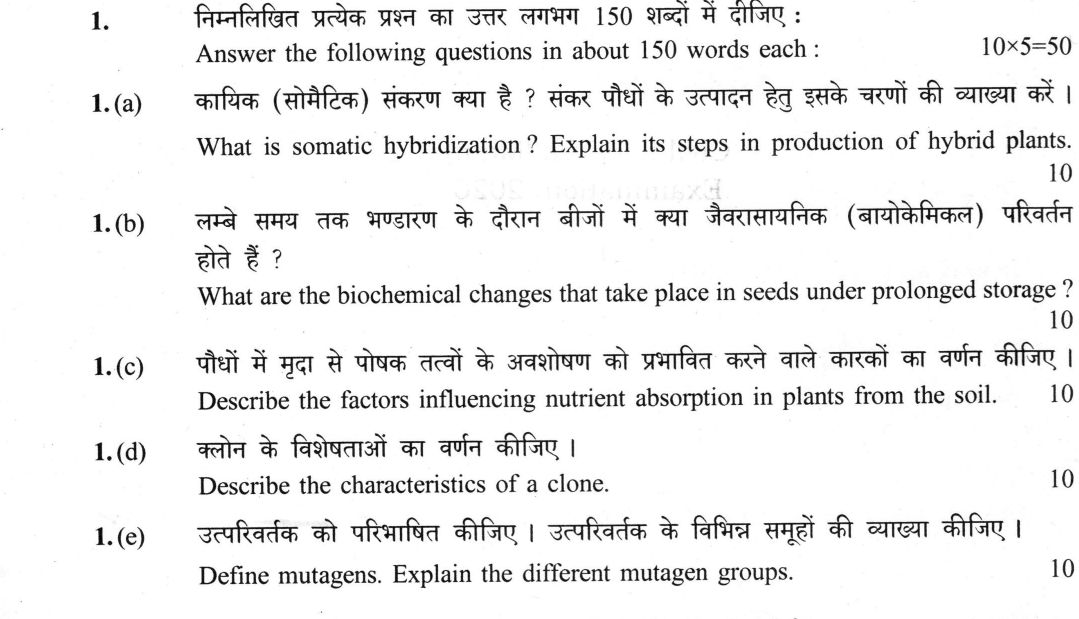
(a) What is somatic hybridization ? Explain its steps in production of hybrid plants. (10 marks) (b) What are the biochemical…
Answer the following questions in about 150 words each :
What is somatic hybridization ? Explain its steps in production of hybrid plants. 10 marks
What are the biochemical changes that take place in seeds under prolonged storage ? 10 marks
Describe the factors influencing nutrient absorption in plants from the soil. 10 marks
Describe the characteristics of a clone. 10 marks
Define mutagens. Explain the different mutagen groups. 10 marks
हिंदी में प्रश्न पढ़ें
निम्नलिखित प्रत्येक प्रश्न का उत्तर लगभग 150 शब्दों में दीजिए :
कायिक (सोमैटिक) संकरण क्या है ? संकर पौधों के उत्पादन हेतु इसके चरणों की व्याख्या करें । (10 अंक)
लम्बे समय तक भण्डारण के दौरान बीजों में क्या जैवरासायनिक (बायोकेमिकल) परिवर्तन होते हैं ? (10 अंक)
पौधों में मृदा से पोषक तत्वों के अवशोषण को प्रभावित करने वाले कारकों का वर्णन कीजिए । (10 अंक)
क्लोन के विशेषताओं का वर्णन कीजिए । (10 अंक)
उत्परिवर्तक को परिभाषित कीजिए । उत्परिवर्तक के विभिन्न समूहों की व्याख्या कीजिए । (10 अंक)
Model answer
Drafted with AI by UPSC Answer Check against this question's marking rubric, to the 150-word length. UPSC does not publish answers for Mains — this is one way to score well, not an official key. How we build rubrics and answers.
(a) Somatic hybridisation (10 marks)
Somatic hybridisation is the fusion of protoplasts (cells stripped of their walls) from somatic cells of two different plants, and the regeneration of a hybrid plant from the fused cell. It bypasses sexual incompatibility, and can combine distant species, as in pomato (potato and tomato). Steps in producing hybrid plants:
- Isolation of protoplasts: leaf or callus tissue is treated with cell-wall-degrading enzymes (cellulase, pectinase, macerozyme) in an osmoticum such as mannitol, to prevent bursting; protoplasts are purified.
- Fusion of protoplasts: induced by polyethylene glycol, high calcium at high pH, or electrofusion.
- Identification and selection of hybrid cells: by complementation markers, fluorescent labels, or mechanical isolation of heterokaryons.
- Culture of fused cells: cell wall regenerates, and the cell divides to form callus.
- Regeneration of plants: shoots and roots from callus on suitable hormone media; then hardening.
- Verification of hybrid nature by chromosome count, isozymes and molecular markers.
The result may be a symmetric hybrid or a cybrid, with cytoplasm from one parent, useful for traits such as male sterility.
(b) Biochemical changes in seeds under prolonged storage (10 marks)
During long storage, seeds age and lose vigour and viability, with the following biochemical changes:
- Lipid peroxidation by free radicals, giving toxic products (malondialdehyde) and loss of membrane integrity, which raises leakage of electrolytes and sugars.
- Hydrolysis of stored lipids to free fatty acids by lipases, and rancidity in oilseeds.
- Declining activity of enzymes such as dehydrogenases, catalase, peroxidase and amylases, and loss of respiratory capacity and ATP production, from mitochondrial damage.
- Denaturation and degradation of proteins, and formation of insoluble complexes.
- Hydrolysis of starch and increase in reducing sugars, and Maillard-type reactions between sugars and proteins.
- Damage to DNA and RNA, with breaks and chromosomal aberrations, and reduced protein synthesis and repair.
- Decreased soluble sugars that protect membranes, and accumulation of aldehydes and other toxic metabolites.
These changes are faster at high moisture and temperature, and are slowed by dry and cool storage in airtight containers.
(c) Factors influencing nutrient absorption from the soil (10 marks)
Nutrients reach the root by mass flow, diffusion and root interception, and are absorbed by active and passive processes. The factors are:
- Plant factors: species and variety; size, extent and surface of the root system and root hairs; root cation exchange capacity; mycorrhizal association; stage of growth; and metabolic energy from respiration.
- Nutrient supply: the concentration and form of nutrient in soil solution, and its replenishment from the exchangeable and solid phases.
- Soil moisture, since nutrients move in the water film, and transpiration draws them by mass flow.
- Aeration: oxygen is needed for respiration and active uptake, and waterlogging reduces absorption.
- Temperature: uptake rises with temperature up to an optimum.
- Soil reaction and organic matter: pH controls availability, for example of phosphorus and micronutrients.
- Ionic interactions: antagonism (for example potassium with calcium and magnesium) and synergism (nitrate and cation uptake).
- Salinity, light and photosynthesis (which supplies energy), and rhizosphere microorganisms.
(d) Characteristics of a clone (10 marks)
A clone is a group of genetically identical individuals produced from a single plant by vegetative (asexual) propagation, using parts such as cuttings, tubers, suckers, runners, grafts or tissue culture. Examples are potato, sugarcane, banana, sweet potato, cassava and most fruit varieties. Its characteristics:
- All members are genetically uniform, since they come from mitotic division of one parent, and are identical with it.
- They are often highly heterozygous, and the heterozygosity is preserved without segregation, since no meiosis occurs, so the type is fixed and true to type.
- Propagation is by vegetative means, so a desirable genotype is multiplied quickly and maintained indefinitely, even where seed is scarce or the crop is sterile (banana).
- Variation arises only by somatic mutation (bud sports), and clonal selection acts on it.
- They may carry systemic diseases and viruses from the parent, and a narrow genetic base makes them vulnerable to pests.
- New variability comes by hybridisation and selection among seedlings, with the best genotype then cloned.
(e) Mutagens (10 marks)
A mutagen is a physical or chemical agent that raises the frequency of heritable changes in the genetic material (mutations) above the spontaneous level. Groups of mutagens:
- Physical mutagens, ionising radiation: X-rays, gamma rays (cobalt-60), alpha and beta particles, and fast neutrons, which cause breaks in chromosomes and gene mutations; and non-ionising ultraviolet light, which forms pyrimidine dimers and is used for pollen and microorganisms.
- Alkylating agents (chemical): ethyl methane sulphonate (EMS), methyl methane sulphonate, ethyl imine and nitrogen mustard add alkyl groups to bases and cause mispairing.
- Base analogues (chemical): 5-bromouracil and 2-aminopurine are incorporated in DNA in place of normal bases.
- Acridine dyes (chemical): proflavin and acridine orange intercalate in DNA and cause frameshifts.
- Other chemicals: nitrous acid and hydroxylamine, which deaminate or modify bases, and sodium azide.
Mutagens are used in mutation breeding to create variation in crops, as in the wheat variety Sharbati Sonora developed by gamma irradiation.
How this answer will be evaluated
Evaluation rubric
Each sub-part is marked on its own, against the marks and word limit printed on the paper.
- (a) (a) What is somatic hybridisation; steps in production of hybrid plants (10, about 150 words). 10 marks · 150 words
Must cover
- Definition: fusion of protoplasts of two plants and regeneration of a hybrid
- Isolation of protoplasts with enzymes in osmoticum
- Fusion (PEG, electrofusion), selection of hybrids, culture and regeneration
- Verification of hybrid and example such as pomato; cybrids
Loses marks
- Confusing with sexual hybridisation or with tissue culture in general.
- Steps out of order.
- Over the word limit.
Earns more
- Ways of selection of fused cells.
- Advantage over sexual hybridisation.
Extra mark
- Applications for male sterility or disease resistance
- (b) (b) Biochemical changes in seeds under prolonged storage (10, about 150 words). 10 marks · 150 words
Must cover
- Lipid peroxidation and membrane damage with leakage
- Hydrolysis of lipids to free fatty acids and loss of enzyme activity
- Protein denaturation, DNA damage, loss of respiration and ATP
- Effect of moisture and temperature on ageing
Loses marks
- Describing insect or fungal damage only.
- Physical changes only.
- Over the word limit.
Earns more
- Accumulation of toxic aldehydes or reducing sugars.
- Storage methods that slow ageing.
Extra mark
- Maillard reactions
- (c) (c) Factors influencing nutrient absorption in plants from soil (10, about 150 words). 10 marks · 150 words
Must cover
- Plant factors: root system, root hairs, root CEC, mycorrhiza, growth stage, energy
- Soil factors: nutrient concentration, moisture, aeration, temperature, pH
- Ion interactions: antagonism and synergism
- Mechanisms of contact: mass flow, diffusion, root interception
Loses marks
- Listing nutrient functions instead of factors.
- Only soil or only plant factors.
- Over the word limit.
Earns more
- Salinity, light and rhizosphere microbes.
- Examples of antagonism.
Extra mark
- Active versus passive uptake
- (d) (d) Describe the characteristics of a clone (10, about 150 words). 10 marks · 150 words
Must cover
- Definition: genetically identical individuals from a single plant by vegetative propagation
- Uniform and true to type; heterozygosity preserved
- Multiplied by vegetative means; examples such as potato, sugarcane, banana
- Variation only by somatic mutation; disease carry-over; narrow base
Loses marks
- Confusing a clone with a pure line or an inbred line.
- Stating that clones segregate.
- Over the word limit.
Earns more
- Clonal selection.
- Variability from hybridisation followed by cloning.
Extra mark
- Term coined by Webber
- (e) (e) Define mutagens; explain the different mutagen groups (10, about 150 words). 10 marks · 150 words
Must cover
- Definition: physical or chemical agents raising mutation frequency
- Physical: ionising radiation (X, gamma, neutrons) and ultraviolet
- Chemical: alkylating agents (EMS), base analogues, acridine dyes, nitrous acid, azide
- Use in mutation breeding, with an example variety
Loses marks
- Naming mutations instead of mutagens.
- Only physical or only chemical mutagens.
- Over the word limit.
Earns more
- Mode of action of each group.
- Handling precautions.
Extra mark
- Sharbati Sonora or another mutant variety
What "Explain" is asking you to do
Make the working of something clear — what sets it off, what follows from what, and what it produces. Explain is the Commission's mechanism word: it dominates the technical papers and the “explain why” stems, where the marks sit in the causal chain and not in the label.
Structure that answers it
State what it is → the initiating condition → the chain of cause, step by step → an instance where it plays out → what the chain produces
Where marks are lost
Describing what something looks like instead of why it works that way. Naming the stages without linking them reads as description too.
Practice this exact question
Write your answer and it is marked point by point against the model answer above — what you covered, what you missed, what you got wrong.
Evaluate my answer →More from Agriculture 2026 Paper II
- Q1 Answer the following questions in about 150 words each : (a) What is somatic hybridizatio…
- Q2 (a) Describe the causes and sources of disease resistance in plants. (20 marks) (b) Expla…
- Q3 (a) Define heritability. What do you mean by broad sense and narrow sense heritability ?…
- Q4 (a) Discuss about the problems and intricacies in the profitable marketing of seeds. (20…