Paper II — Q3
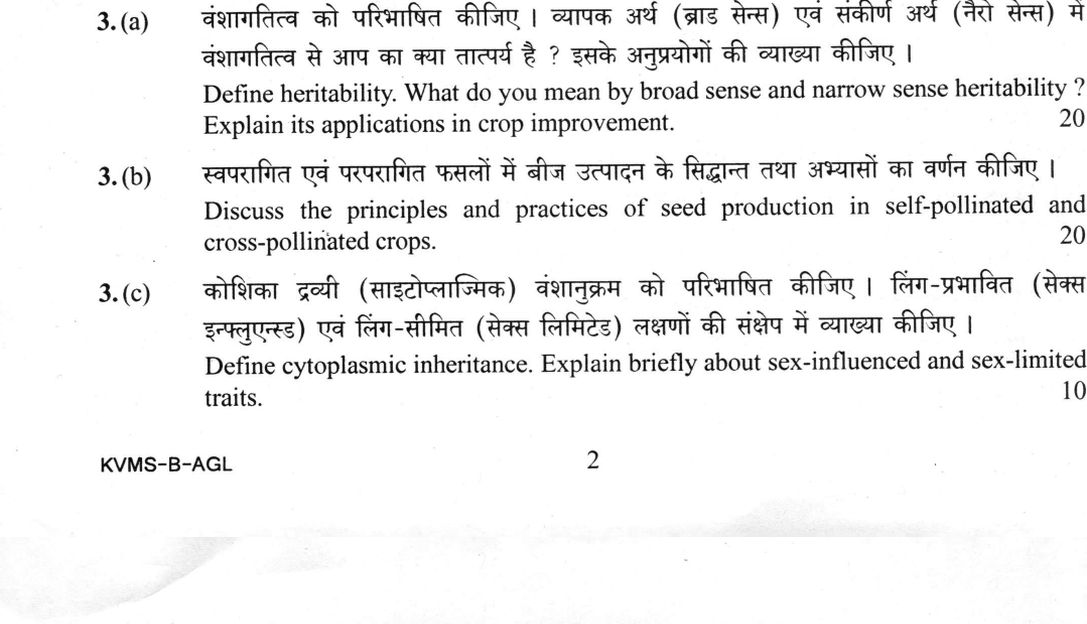
(a) Define heritability. What do you mean by broad sense and narrow sense heritability ? Explain its applications in crop…
Define heritability. What do you mean by broad sense and narrow sense heritability ? Explain its applications in crop improvement. 20 marks
Discuss the principles and practices of seed production in self-pollinated and cross-pollinated crops. 20 marks
Define cytoplasmic inheritance. Explain briefly about sex-influenced and sex-limited traits. 10 marks
हिंदी में प्रश्न पढ़ें
वंशागतित्व को परिभाषित कीजिए । व्यापक अर्थ (ब्राड सेन्स) एवं संकीर्ण अर्थ (नैरो सेन्स) में वंशागतित्व से आप का क्या तात्पर्य है ? इसके अनुप्रयोगों की व्याख्या कीजिए । (20 अंक)
स्वपरागित एवं परपरागित फसलों में बीज उत्पादन के सिद्धान्त तथा अभ्यासों का वर्णन कीजिए । (20 अंक)
कोशिका द्रव्यी (साइटोप्लाज्मिक) वंशानुक्रम को परिभाषित कीजिए । लिंग-प्रभावित (सेक्स इन्फ्लुएन्स्ड) एवं लिंग-सीमित (सेक्स लिमिटेड) लक्षणों की संक्षेप में व्याख्या कीजिए । (10 अंक)
Model answer
Drafted with AI by UPSC Answer Check against this question's marking rubric, to the expected length. UPSC does not publish answers for Mains — this is one way to score well, not an official key. How we build rubrics and answers.
(a) Heritability (20 marks)
Heritability is the proportion of the observed (phenotypic) variation in a trait, in a given population and environment, that is due to genetic differences. It measures how far the phenotype of parents is passed on to offspring, and it is a property of a population, not of an individual. Since phenotypic variance V_P = V_G + V_E (genetic plus environmental), and V_G = V_A + V_D + V_I (additive, dominance and epistatic), the two meanings are:
- Broad-sense heritability, h²(b) = V_G/V_P, the fraction of phenotypic variance due to all genetic effects. It is estimated from inbred lines or clones, where the variance among genotypes is separated from the environmental variance, and it is useful for self-pollinated and vegetatively propagated crops, where the whole genotype is fixed.
- Narrow-sense heritability, h²(n) = V_A/V_P, the fraction due to additive gene effects alone. It is the fraction that is transmitted reliably to progeny, so it predicts the response to selection. It is estimated by parent-offspring regression, or from half-sib and diallel or North Carolina analyses. Always h²(n) ≤ h²(b).
Values range from 0 to 1 (0 to 100%); above about 60% is usually called high.
Applications in crop improvement:
- Predicting genetic advance: the response to selection is R = h² × S (S is the selection differential), and genetic advance GA = k × h² × σ_P (k is the standardised selection intensity). High heritability with high GA shows additive gene action, and selection is effective.
- Choosing the selection method: a trait with high heritability, such as plant height, days to flowering or grain weight, can be selected in early generations by mass or pedigree selection; a low-heritability trait, such as yield, needs replicated testing and selection is deferred to later generations, or is done by recurrent selection.
- Choosing the breeding method: simple selection where additive variance is large, and hybridisation with recurrent selection, or heterosis breeding, where non-additive variance is large.
- Deciding the number of replications and locations, and the sample size, for a target reliability.
- Comparing genotypes and environments, and judging the trustworthiness of the observed differences.
- Indirect selection through correlated traits.
Cautions: heritability is not fixed, since it changes with population, environment, generation and the method of estimation, and a high value does not mean the trait is unaffected by the environment.
(b) Principles and practices of seed production in self-pollinated and cross-pollinated crops (20 marks)
The aim of seed production is to multiply seed of a released variety or hybrid in large quantity while maintaining its genetic purity, identity, physical quality and viability. Seed moves through the classes of breeder seed (produced by the originating breeder), foundation seed (from breeder seed) and certified seed (from foundation seed), and is regulated in India under the Seeds Act, 1966 and the Seeds Rules, 1968.
Principles:
- Genetic principles: keep the variety pure by preventing genetic deterioration, from mechanical mixture, natural crossing, mutation, residual variability and selection pressure. Limit the number of generations of multiplication.
- Agronomic principles: grow seed on a suitable, well-drained soil with known cropping history, in a region and season with favourable weather for seed setting and maturity, and give the best crop management.
- Isolation to prevent contamination, and rogueing to remove off-types.
- Seed quality standards: adequate physical purity, germination, moisture and freedom from disease.
Practices in self-pollinated crops (wheat, rice, groundnut, pulses): a small isolation distance is enough because natural crossing is low, for example about 3 m for rice and wheat. The pure seed is sown in a field free of volunteer plants, off-types are removed at the vegetative, flowering and pre-harvest stages, harvest is made at maturity, and the crop is threshed and cleaned separately.
Practices in cross-pollinated crops (maize, pearl millet, sunflower, cotton hybrids): the risk of pollen contamination is high, so isolation is larger, for example about 400 m for foundation and 200 m for certified seed in maize. For an open-pollinated variety, the whole field is kept isolated and rogued. For a hybrid, the seed parent (female) and pollen parent (male) are sown in fixed row ratios, with detasseling of the female (in maize) or the use of cytoplasmic male sterility, and staggered sowing so that flowering coincides. Rogueing of off-types and shedders is done before pollen shedding. Hand pollination or bagging is used for parental lines and for cotton.
Common to both: a field inspection by the certification agency, harvest at physiological maturity, drying to safe moisture (about 12% or below for cereals), threshing, cleaning and grading, seed treatment, testing, tagging, and storage in moisture-proof packing, with the requirement of about 98% physical purity and at least 80 to 85% germination for cereals.
(c) Cytoplasmic inheritance; sex-influenced and sex-limited traits (10 marks)
Cytoplasmic inheritance is the transmission of characters through genes located in cytoplasmic organelles, the mitochondria and plastids (and plasmids), and not in nuclear chromosomes. Because the egg supplies almost all the cytoplasm, the trait is usually inherited from the female parent alone, so reciprocal crosses differ and it does not follow Mendelian ratios. Examples are the variegation in four-o'clock (Mirabilis jalapa), plastid-inherited streptomycin resistance in Chlamydomonas, and cytoplasmic male sterility in maize and sorghum.
Sex-influenced traits are governed by autosomal genes present in both sexes, but the dominance relation depends on the sex. A heterozygote shows the trait in one sex and not in the other, under the influence of sex hormones. Examples: pattern baldness in humans, dominant in men and recessive in women, and horns in Dorset sheep, dominant in males.
Sex-limited traits are expressed in only one sex, though the genes are present in both, because the trait needs the sex organs or hormones of that sex. Examples: milk yield in cattle, egg production in poultry, beard growth in men, and cock plumage in fowl. The genes may still be passed on through the sex in which they do not show.
How this answer will be evaluated
Evaluation rubric
Each sub-part is marked on its own, against the marks and word limit printed on the paper.
- (a) (a) Define heritability; broad and narrow sense; its applications in crop improvement (20). 20 marks
Must cover
- Definition: proportion of phenotypic variance due to genetic variance
- Broad sense V_G/V_P versus narrow sense V_A/V_P, with the difference explained
- Applications: predicting genetic advance (R = h²S), choice of selection method and generation
- Cautions: population and environment specific; high heritability does not mean high gain
Loses marks
- Defining heritability as the transmission of traits from parent to offspring only.
- Interchanging V_A and V_G.
- Applications without the concept of additive variance.
Earns more
- Methods of estimation (parent-offspring regression, variance components).
- Range 0 to 1 and h²(n) ≤ h²(b).
Extra mark
- Formula GA = k h² σ_P
- (b) (b) Principles and practices of seed production in self- and cross-pollinated crops (20). 20 marks
Must cover
- Principles: genetic purity, suitable agronomic conditions, isolation, rogueing, quality standards
- Seed classes: breeder, foundation, certified, under the Seeds Act, 1966
- Self-pollinated crops: small isolation distance, rogueing, separate harvest
- Cross-pollinated crops: larger isolation (about 400 m or 200 m in maize), row ratio, detasseling or CMS, synchronised flowering
Loses marks
- Treating the two crop groups as identical.
- Ignoring isolation and rogueing.
- Describing only seed storage.
Earns more
- Field inspection, processing, seed treatment, testing and storage.
- Causes of genetic deterioration.
Extra mark
- Seed standards, for example purity 98% and germination 80–85%
- (c) (c) Define cytoplasmic inheritance; explain briefly sex-influenced and sex-limited traits (10). 10 marks
Must cover
- Cytoplasmic inheritance: organelle genes, maternal transmission, non-Mendelian, reciprocal difference
- Example such as Mirabilis variegation or CMS
- Sex-influenced: autosomal genes whose dominance depends on sex (baldness, horns in Dorset sheep)
- Sex-limited: expressed in one sex only (milk yield, egg production)
Loses marks
- Confusing sex-influenced or sex-limited traits with sex-linked ones.
- Attributing cytoplasmic inheritance to nuclear genes.
- Missing any of the three concepts.
Earns more
- Distinction from sex-linked traits.
- Reason for the maternal effect.
Extra mark
- Chlamydomonas streptomycin resistance
What "Explain" is asking you to do
Make the working of something clear — what sets it off, what follows from what, and what it produces. Explain is the Commission's mechanism word: it dominates the technical papers and the “explain why” stems, where the marks sit in the causal chain and not in the label.
Structure that answers it
State what it is → the initiating condition → the chain of cause, step by step → an instance where it plays out → what the chain produces
Where marks are lost
Describing what something looks like instead of why it works that way. Naming the stages without linking them reads as description too.
Practice this exact question
Write your answer and it is marked point by point against the model answer above — what you covered, what you missed, what you got wrong.
Evaluate my answer →More from Agriculture 2026 Paper II
- Q1 Answer the following questions in about 150 words each : (a) What is somatic hybridizatio…
- Q2 (a) Describe the causes and sources of disease resistance in plants. (20 marks) (b) Expla…
- Q3 (a) Define heritability. What do you mean by broad sense and narrow sense heritability ?…
- Q4 (a) Discuss about the problems and intricacies in the profitable marketing of seeds. (20…
- Q5 Answer the following questions in about 150 words each : (a) What is topiary ? Describe t…
- Q6 (a) What is high density orcharding ? Describe management practices for high density orch…