Paper II — Q6
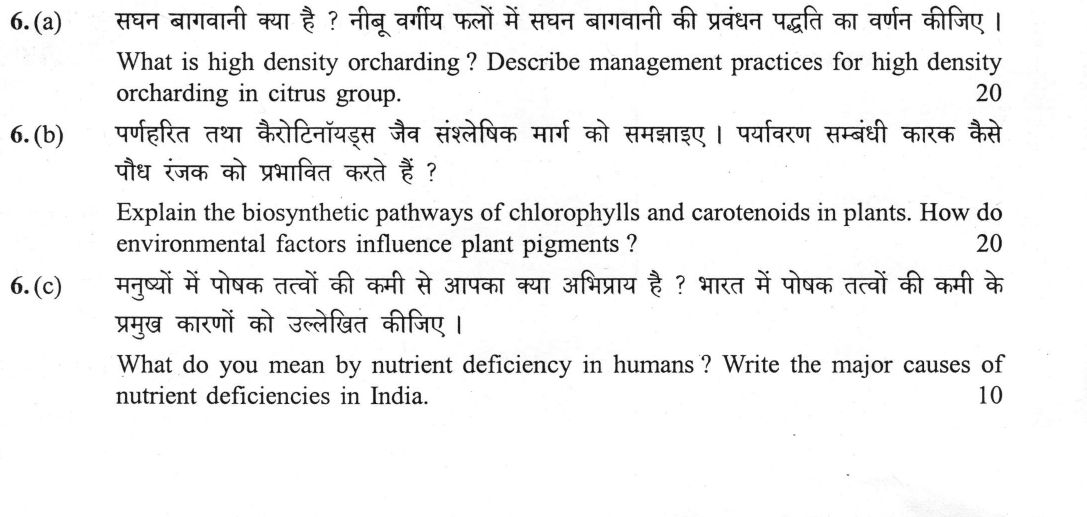
(a) What is high density orcharding ? Describe management practices for high density orcharding in citrus group. (20 marks) (b)…
What is high density orcharding ? Describe management practices for high density orcharding in citrus group. 20 marks
Explain the biosynthetic pathways of chlorophylls and carotenoids in plants. How do environmental factors influence plant pigments ? 20 marks
What do you mean by nutrient deficiency in humans ? Write the major causes of nutrient deficiencies in India. 10 marks
हिंदी में प्रश्न पढ़ें
सघन बागवानी क्या है ? नीबू वर्गीय फलों में सघन बागवानी की प्रबंधन पद्धति का वर्णन कीजिए । (20 अंक)
पर्णहरित तथा कैरोटिनॉयड्स जैव संश्लेषिक मार्ग को समझाइए । पर्यावरण सम्बंधी कारक कैसे पौध रंजक को प्रभावित करते हैं ? (20 अंक)
मनुष्यों में पोषक तत्वों की कमी से आपका क्या अभिप्राय है ? भारत में पोषक तत्वों की कमी के प्रमुख कारणों को उल्लेखित कीजिए । (10 अंक)
Model answer
Drafted with AI by UPSC Answer Check against this question's marking rubric, to the expected length. UPSC does not publish answers for Mains — this is one way to score well, not an official key. How we build rubrics and answers.
(a) High density orcharding and its management in citrus (20 marks)
High density orcharding (or high density planting, HDP) means planting more trees per unit area than the conventional spacing, by using dwarfing or compact plants and controlling the canopy, so as to get early, higher and more efficient returns per hectare. In citrus, the conventional spacing of about 6 × 6 m gives around 275 trees per hectare, whereas HDP uses about 3 × 3 m (about 1,100 trees) or closer, in hedgerows.
Management practices:
- Planting material: healthy, virus- and greening-free, certified budded plants on suitable dwarfing or semi-dwarfing rootstocks (trifoliate orange, Carrizo or Troyer citrange, Flying Dragon) and compact scion varieties.
- Site and layout: a deep, well-drained soil, a dependable water supply and full sun; square or hedgerow layout in the correct row direction.
- Training and pruning: training to a modified leader or open-centre shape from the first year, with regular light pruning, topping and skirting to hold the tree height at about 2.5 to 3 m, and thinning to admit light. Growth retardants such as paclobutrazol may be used to control vigour.
- Nutrition and irrigation: drip irrigation with fertigation in split doses, in line with the crop stage, and organic manure, with foliar sprays of micronutrients (zinc, iron, manganese) where deficient.
- Weed and soil management: mulching, and intercropping (legumes, vegetables) in the early years, before the canopies close.
- Crop regulation: bahar (flowering season) treatment in mandarin, sweet orange and lime, by withholding water and manuring, together with fruit thinning to maintain size and to check alternate bearing.
- Plant protection: integrated management of citrus psylla (which carries greening), leaf miner, canker, gummosis and mites, and prompt removal of infected trees.
- Rejuvenation and replacement when orchards age, and mechanisation for spraying and harvesting.
Advantages are early bearing, higher yield and returns per hectare, more efficient use of land, water, fertiliser and light, easier operations and better fruit quality. The drawbacks are the higher initial cost and the need for skilled management.
(b) Biosynthesis of chlorophylls and carotenoids; effect of environmental factors on plant pigments (20 marks)
Chlorophyll biosynthesis (in the chloroplast):
- Glutamate, activated as glutamyl-tRNA, is converted through glutamate-1-semialdehyde into 5-aminolevulinic acid (ALA), the first committed precursor. In plants this is the C5 pathway.
- Two ALA molecules condense (ALA dehydratase) into porphobilinogen (PBG); four PBG join (PBG deaminase and uroporphyrinogen III synthase) to give uroporphyrinogen III.
- Successive decarboxylation and oxidation give coproporphyrinogen III, protoporphyrinogen IX and protoporphyrin IX. Here the pathway branches: Fe insertion by ferrochelatase leads to haem, and Mg insertion by Mg-chelatase leads to chlorophyll.
- Mg-protoporphyrin IX is methylated and cyclised to form protochlorophyllide.
- In angiosperms, the light-dependent enzyme protochlorophyllide oxidoreductase (POR) reduces protochlorophyllide to chlorophyllide a; this is why seedlings are pale (etiolated) in the dark.
- Chlorophyll synthase adds the phytol tail to make chlorophyll a, and chlorophyllide a oxygenase converts part of it to chlorophyll b.
Carotenoid biosynthesis (in plastids):
- Isopentenyl diphosphate (IPP) and dimethylallyl diphosphate are formed by the plastidial MEP pathway from pyruvate and glyceraldehyde-3-phosphate.
- Geranylgeranyl diphosphate (C20) is formed, and two molecules condense (phytoene synthase, the key regulatory step) to give phytoene (C40).
- Desaturation and isomerisation (phytoene and ζ-carotene desaturases, isomerases) give lycopene.
- Cyclisation: two β-rings give β-carotene, and one β- and one ε-ring give α-carotene.
- Hydroxylation gives the xanthophylls: lutein from α-carotene, and zeaxanthin from β-carotene; zeaxanthin is epoxidised to violaxanthin and neoxanthin, and this is the xanthophyll cycle. Cleavage of these gives abscisic acid.
Environmental effects:
- Light: chlorophyll formation in angiosperms needs light. Shade leaves have more chlorophyll per unit of reaction centre, with a higher chlorophyll b ratio, while high light or UV lowers chlorophyll and raises carotenoids and xanthophylls (photoprotection) and anthocyanins.
- Temperature: chlorophyll is best formed at moderate temperature; cold or high heat reduces it and hastens degradation, and cool nights promote anthocyanin and carotenoid colour in fruit.
- Water stress and salinity: lower chlorophyll and hasten senescence.
- Nutrients: nitrogen and magnesium are constituents of chlorophyll, and iron (and manganese, sulphur) is needed for its synthesis, so their deficiency causes chlorosis.
- Others: senescence, ethylene, waterlogging and pollutants (ozone, heavy metals) break down chlorophyll and unmask carotenoids, as in autumn colours and ripening fruit.
(c) Nutrient deficiency in humans and its major causes in India (10 marks)
Nutrient deficiency in humans is a condition in which the diet or the body's absorption does not supply enough of one or more nutrients for normal growth, health and function. It includes deficiency of energy and protein (undernutrition, stunting, wasting) and of micronutrients such as iron, iodine, vitamin A, zinc, folate, and vitamins B₁₂ and D, called hidden hunger because the signs appear late. Anaemia and stunting remain widespread: NFHS-5 (2019–21) found about 57% of women aged 15–49 and 67% of children aged 6–59 months anaemic, and about 36% of children under five stunted.
Major causes in India:
- Poverty and low purchasing power, which limit food quantity and diversity.
- A cereal-dominated, monotonous diet, with too little pulses, milk, fruit, vegetables and animal foods.
- Low nutrient content of foods and crops, from soils poor in zinc, iron, iodine and selenium, and losses during milling (polished rice) and cooking.
- Poor absorption, from phytates and tannins in the diet, and infections, diarrhoea and worm infestation, with poor sanitation and unsafe water.
- Poor maternal nutrition, early marriage and pregnancy, and inadequate breastfeeding and complementary feeding of infants.
- Low awareness, gender inequity in food distribution, and limited access to health services.
Responses include fortification (iodised salt, fortified rice and oil), biofortified crops, supplementation and school and child feeding programmes, and dietary diversification.
How this answer will be evaluated
Evaluation rubric
Each sub-part is marked on its own, against the marks and word limit printed on the paper.
- (a) (a) Define high density orcharding; describe management practices for HDP in citrus (20). 20 marks
Must cover
- Definition: more trees per unit area with dwarfing or compact plants and canopy control; citrus spacing figures (about 3 × 3 m versus 6 × 6 m)
- Dwarfing rootstocks and certified disease-free planting material
- Training and pruning to limit height; drip irrigation with fertigation
- Bahar regulation, pest management (psylla, canker, greening), advantages and limits
Loses marks
- Describing conventional orchard management only.
- Recommending spacing that is not high density.
- Ignoring canopy control.
Earns more
- Weed and mulch management, intercropping in early years.
- Growth retardants or rejuvenation.
Extra mark
- Named rootstocks (Flying Dragon, Carrizo, Troyer)
- (b) (b) Explain the biosynthetic pathways of chlorophylls and carotenoids; how environmental factors influence plant pigments (20). 20 marks
Must cover
- Chlorophyll: glutamate to ALA (C5), PBG, uroporphyrinogen III, protoporphyrin IX, Mg-chelatase, protochlorophyllide
- Light-dependent POR step, chlorophyllide a, chlorophyll synthase and chlorophyll b
- Carotenoid: MEP/IPP, GGPP, phytoene, lycopene, cyclisation to α- and β-carotene, xanthophylls
- Environmental effects: light, temperature, water, nutrients (N, Mg, Fe), stress and senescence
Loses marks
- Stating that chlorophyll synthesis is light-independent in angiosperms.
- Omitting the carotenoid pathway or environmental part.
- Confusing the MEP pathway with the mevalonate pathway for plastid carotenoids.
Earns more
- Haem-chlorophyll branch point.
- Xanthophyll cycle and ABA.
Extra mark
- Etiolation and anthocyanin response
- (c) (c) What is nutrient deficiency in humans; write the major causes of nutrient deficiencies in India (10). 10 marks
Must cover
- Definition: inadequate supply or absorption of nutrients for normal health; macro and micronutrient deficiency (hidden hunger)
- Causes: poverty, cereal-based monotonous diet, poor soils and processing losses
- Poor absorption from infections and sanitation; maternal and child feeding practices
- Awareness, gender and health access; a data point such as NFHS-5 anaemia or stunting
Loses marks
- Listing diseases without causes.
- Unsourced or wrong statistics.
- Over-long remedies with no causes.
Earns more
- Named deficiencies (iron, iodine, vitamin A, zinc).
- Remedies: fortification, biofortification, supplementation.
Extra mark
- Phytates and bioavailability
What "Describe" is asking you to do
Give a full, ordered account of the thing named — its parts, stages or mechanism — in the sequence in which it actually exists or occurs. Most describe questions come from the science optionals, where the marks sit in correct technical detail and, where the stem says so, a labelled diagram.
Structure that answers it
One-line identification of the subject → the parts or stages in their real order, each with its defining detail → labelled diagram where the subject is structural → closing line on function or significance
Where marks are lost
Loose general prose where the examiner is ticking named parts, correct terminology and their sequence; and in the General Studies papers, turning to evaluation before the description is finished.
Practice this exact question
Write your answer and it is marked point by point against the model answer above — what you covered, what you missed, what you got wrong.
Evaluate my answer →More from Agriculture 2026 Paper II
- Q3 (a) Define heritability. What do you mean by broad sense and narrow sense heritability ?…
- Q4 (a) Discuss about the problems and intricacies in the profitable marketing of seeds. (20…
- Q5 Answer the following questions in about 150 words each : (a) What is topiary ? Describe t…
- Q6 (a) What is high density orcharding ? Describe management practices for high density orch…
- Q7 (a) Describe the scientific cultivation of mango with reference to regular bearer varieti…
- Q8 (a) Explain the factors encouraging infestation of pests during storage. Discuss control…