Paper II — Q8
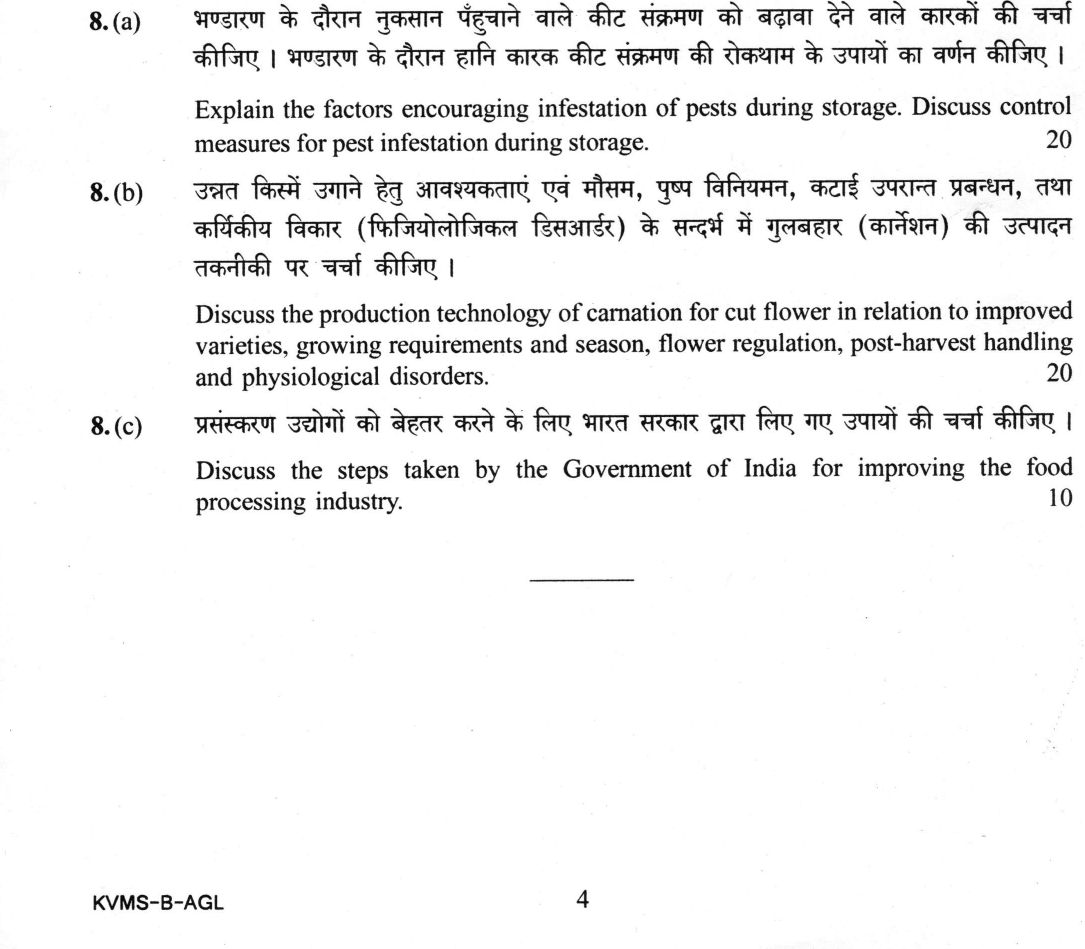
(a) Explain the factors encouraging infestation of pests during storage. Discuss control measures for pest infestation during…
Explain the factors encouraging infestation of pests during storage. Discuss control measures for pest infestation during storage. 20 marks
Discuss the production technology of carnation for cut flower in relation to improved varieties, growing requirements and season, flower regulation, post-harvest handling and physiological disorders. 20 marks
Discuss the steps taken by the Government of India for improving the food processing industry. 10 marks
हिंदी में प्रश्न पढ़ें
भण्डारण के दौरान नुकसान पहुँचाने वाले कीट संक्रमण को बढ़ावा देने वाले कारकों की चर्चा कीजिए । भण्डारण के दौरान हानि कारक कीट संक्रमण की रोकथाम के उपायों का वर्णन कीजिए । (20 अंक)
उन्नत किस्में उगाने हेतु आवश्यकताएं एवं मौसम, पुष्प विनियमन, कटाई उपरान्त प्रबन्धन, तथा कार्यिकीय विकार (फिजियोलॉजिकल डिसआर्डर) के सन्दर्भ में गुलबहार (कार्नेशन) की उत्पादन तकनीकी पर चर्चा कीजिए । (20 अंक)
प्रसंस्करण उद्योगों को बेहतर करने के लिए भारत सरकार द्वारा लिए गए उपायों की चर्चा कीजिए । (10 अंक)
Model answer
Drafted with AI by UPSC Answer Check against this question's marking rubric, to the expected length. UPSC does not publish answers for Mains — this is one way to score well, not an official key. How we build rubrics and answers.
(a) Factors encouraging pest infestation during storage, and control measures (20 marks)
Factors encouraging infestation:
- Grain moisture: grain stored above about 12 to 14% moisture (higher for oilseeds and pulses) favours insects, mites and moulds; dry grain slows their multiplication.
- Temperature: most stored-grain insects multiply fastest at about 25 to 35 °C, and below about 15 °C their development nearly stops.
- Relative humidity: above about 70% encourages insects and fungi, and grain absorbs moisture from air.
- Initial infestation: insects carried from the field, from old stock, bags, transport vehicles, threshing floors and cracks in the store (the pests include rice weevil, lesser grain borer, red flour beetle, khapra beetle, Angoumois grain moth, rice moth and pulse beetle).
- Poor hygiene: leftover grain, dust and debris, and mixing new grain with old.
- Damaged, broken or immature grain, and flour or dust, which attract secondary pests; also the variety and type of grain.
- Long storage, poor aeration, and unscientific storage structures with leaks and cracks, as well as rodents and birds.
- Lack of monitoring, so infestation is found late.
Control measures:
- Preventive: dry grain to safe moisture (about 12% for cereals, 8 to 9% for oilseeds); clean and repair stores and disinfect them with a residual insecticide spray before storage; use clean, treated bags, dunnage and proper stacking, with separation of old and new stock; rodent-proofing of stores.
- Physical and hermetic methods: airtight or hermetic storage (metal bins, silos, sealed bags), which starve insects of oxygen; low temperature and aeration; exposure to sun.
- Botanicals and inert dusts: neem leaves and neem seed kernel powder, and diatomaceous earth or ash, especially for farm-level storage of seed and small quantities.
- Curative chemical control: fumigation of sealed stacks with aluminium phosphide (phosphine) under trained supervision; contact insecticides on stack surfaces and bag surfaces; methyl bromide is now restricted.
- Controlled atmosphere with raised carbon dioxide or nitrogen, and irradiation, for high-value stocks.
- Rodent control by traps, baits (zinc phosphide, anticoagulants) and proofing.
- Integrated management with regular inspection, pheromone and probe traps, and record-keeping.
(b) Production technology of carnation as a cut flower (20 marks)
Carnation (Dianthus caryophyllus) is one of the leading cut flowers, grown mostly in protected cultivation.
Improved varieties: standard (single large flower) types, such as Master, Scania and Tanga, and spray types with several smaller flowers on a stem. Varieties are chosen for colour, stem length and strength, yield and calyx-splitting resistance.
Growing requirements and season: carnation prefers a cool, bright climate, with night temperature of about 10 to 12 °C and day temperature of about 18 to 21 °C, and high light; it is grown in polyhouses in the plains and hills, and in the open in cool hills. It needs a well-drained, friable, slightly acidic to neutral soil (pH 6 to 7) with low salinity, in raised beds. Rooted terminal cuttings, from healthy, disease-free mother plants, are planted in September to October in the plains, at about 15 to 20 cm spacing. The crop needs regular drip irrigation and fertigation, and supports of wire or plastic netting. Flowering starts about four to five months after planting, and the crop lasts one to two years.
Flower regulation: pinching (removal of the growing tip) is the main tool. Single pinching gives one early flush of flowers; one-and-a-half and double pinching stagger flowering and give more stems, so that the crop can be planned for peak demand periods. In standard types the side buds are removed (disbudding) so that one large terminal flower is left, and in spray types the terminal bud is removed so the side buds flower together. Long days and supplementary light in winter hasten flowering, and temperature and nutrition are managed to regulate the time.
Post-harvest handling: harvest in the morning at the paintbrush (early open) stage for local markets, or the tight-bud stage for distant ones. Grade by stem length, tie into bunches of 10 or 20, cool quickly to 2 to 4 °C, and hold in a solution with sucrose and a germicide. Because carnation is highly ethylene-sensitive, a pulse of silver thiosulphate or a similar anti-ethylene agent is used. Store at about 0 to 1 °C, packed in boxes.
Physiological disorders: calyx splitting (bursting), caused by temperature fluctuation, excess nitrogen, boron deficiency and irregular watering, and reduced by balanced nutrition, boron, steady temperature and by using rubber bands; blind shoots with no flower under low light or stress; bullheading (deformed flowers); and ethylene-induced petal in-rolling, or sleepiness, after harvest.
(c) Steps taken by the Government of India to improve the food processing industry (10 marks)
The Ministry of Food Processing Industries has taken these main steps to raise processing levels, cut post-harvest losses and improve farmers' income:
- Pradhan Mantri Kisan SAMPADA Yojana (2017): an umbrella scheme for mega food parks, integrated cold chain and value-addition infrastructure, food processing and preservation capacities, agro-processing clusters, backward and forward linkages, and food safety and quality infrastructure.
- Production Linked Incentive Scheme for Food Processing (PLISFPI, 2021), with an outlay of ₹10,900 crore, to support the growth of Indian brands, and to encourage processing of ready-to-cook and ready-to-eat foods, processed fruit and vegetables, marine and mozzarella products, and to support small and medium enterprises.
- Pradhan Mantri Formalisation of Micro Food Processing Enterprises (PMFME, 2020): credit-linked subsidy for micro-enterprises, with a One District One Product approach, support for branding and marketing, common infrastructure, and seed capital for self-help groups.
- Agriculture Infrastructure Fund (₹1 lakh crore, 2020) for post-harvest infrastructure, and a Food Processing Fund of ₹2,000 crore with NABARD for concessional finance.
- 100% foreign direct investment through the automatic route in food processing, and credit from banks under priority-sector lending, in addition to the Operation Greens scheme for tomato, onion and potato.
- Food safety and quality through FSSAI regulations, and a policy to promote exports through APEDA.
Sustained progress depends on cold chain capacity, skilled manpower, and better links to farmers through producer organisations.
How this answer will be evaluated
Evaluation rubric
Each sub-part is marked on its own, against the marks and word limit printed on the paper.
- (a) (a) Explain the factors encouraging pest infestation during storage; discuss control measures (20). 20 marks
Must cover
- Factors: grain moisture, temperature, humidity
- Factors: initial infestation, poor hygiene, damaged grain, storage structure and duration
- Preventive control: drying, sanitation, disinfection of stores, hermetic storage, rodent-proofing
- Curative control: phosphine fumigation, botanicals or inert dusts, controlled atmosphere; IPM with monitoring
Loses marks
- Field pests instead of storage pests.
- Only chemical control with no preventive measures.
- Only controls or only factors.
Earns more
- Named pests (rice weevil, khapra beetle, lesser grain borer, pulse beetle, rice moth).
- Safe moisture values for cereals and oilseeds.
Extra mark
- Methyl bromide restriction; pheromone or probe traps
- (b) (b) Discuss production technology of carnation as a cut flower: improved varieties, growing requirements and season, flower regulation, post-harvest handling, physiological disorders (20). 20 marks
Must cover
- Improved varieties: standard and spray types with examples
- Growing requirements: cool bright climate, night 10–12 °C, polyhouse, soil pH 6–7, planting season and spacing
- Flower regulation: single, one-and-half and double pinching; disbudding; light and temperature
- Post-harvest: stage of harvest, grading, cooling, ethylene protection (STS), storage; disorders: calyx splitting with causes and remedies
Loses marks
- Confusing carnation with another cut flower.
- Omitting any of the five asked heads.
- Calling a disease (Fusarium wilt) a physiological disorder.
Earns more
- Other disorders such as blindness, bullheading, sleepiness.
- Support, fertigation and duration of the crop.
Extra mark
- Long-day response and supplementary lighting
- (c) (c) Discuss the steps taken by the Government of India for improving the food processing industry (10). 10 marks
Must cover
- PM Kisan SAMPADA Yojana (2017) and its components, mega food parks and cold chain
- PLI scheme for food processing (₹10,900 crore) and PMFME (One District One Product)
- Agriculture Infrastructure Fund and finance through NABARD; 100% FDI through the automatic route
- Food safety (FSSAI), export promotion and Operation Greens
Loses marks
- Only listing scheme names without purpose.
- Wrong outlays or dates.
- Describing agriculture policy unrelated to processing.
Earns more
- Objectives: reduce post-harvest loss, raise farmers' income, create jobs.
- Priority-sector lending.
Extra mark
- Challenges: cold chain, skills, farmer linkages
What "Discuss" is asking you to do
Lay the issue out from more than one side — how it arose, what is claimed for it, what is held against it, and where it now stands. UPSC attaches discuss to broad topics with several live dimensions, so coverage of the dimensions earns more than the strength of your opinion.
Structure that answers it
Set the issue up → the case as it is made → the case against → the dimension both sides leave out → where the balance now lies
Where marks are lost
Listing facts with no thread between them, or arguing one side throughout and calling it a discussion.
Practice this exact question
Write your answer and it is marked point by point against the model answer above — what you covered, what you missed, what you got wrong.
Evaluate my answer →More from Agriculture 2026 Paper II
- Q5 Answer the following questions in about 150 words each : (a) What is topiary ? Describe t…
- Q6 (a) What is high density orcharding ? Describe management practices for high density orch…
- Q7 (a) Describe the scientific cultivation of mango with reference to regular bearer varieti…
- Q8 (a) Explain the factors encouraging infestation of pests during storage. Discuss control…