Paper II — Q5
(a) What is topiary ? Describe the characteristics of plants ideal for it. (10 marks) (b) Describe terrace garden and moon…
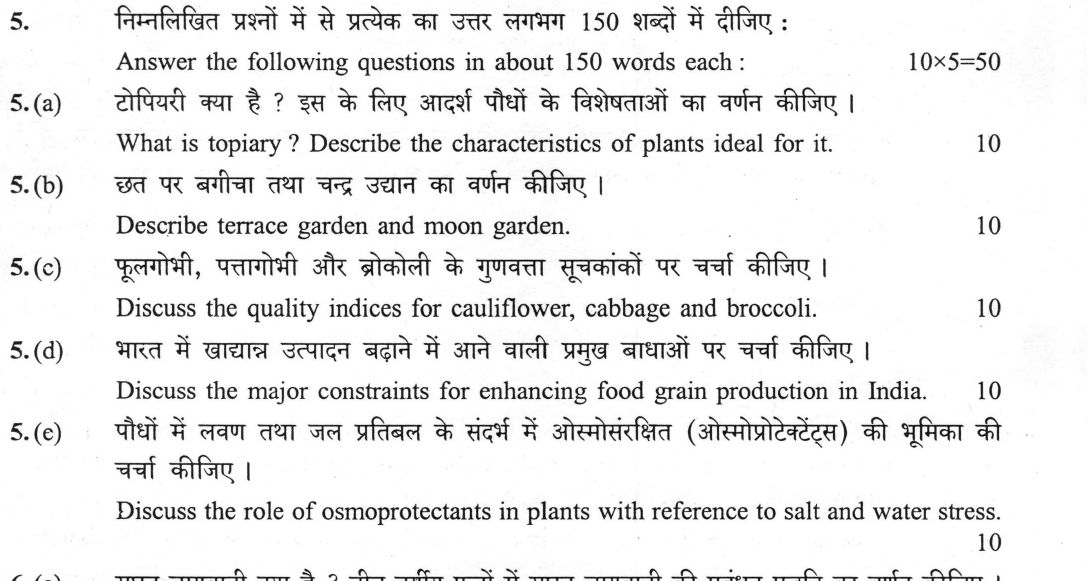
Answer the following questions in about 150 words each :
What is topiary ? Describe the characteristics of plants ideal for it. 10 marks
Describe terrace garden and moon garden. 10 marks
Discuss the quality indices for cauliflower, cabbage and broccoli. 10 marks
Discuss the major constraints for enhancing food grain production in India. 10 marks
Discuss the role of osmoprotectants in plants with reference to salt and water stress. 10 marks
हिंदी में प्रश्न पढ़ें
निम्नलिखित प्रश्नों में से प्रत्येक का उत्तर लगभग 150 शब्दों में दीजिए :
टोपियरी क्या है ? इस के लिए आदर्श पौधों के विशेषताओं का वर्णन कीजिए । (10 अंक)
छत पर बगीचा तथा चन्द्र उद्यान का वर्णन कीजिए । (10 अंक)
फूलगोभी, पत्तागोभी और ब्रोकोली के गुणवत्ता सूचकांकों पर चर्चा कीजिए । (10 अंक)
भारत में खाद्यान्न उत्पादन बढ़ाने में आने वाली प्रमुख बाधाओं पर चर्चा कीजिए । (10 अंक)
पौधों में लवण तथा जल प्रतिबल के संदर्भ में ओस्मोसंरक्षित (ओस्मोप्रोटेक्टेंट्स) की भूमिका की चर्चा कीजिए । (10 अंक)
Model answer
Drafted with AI by UPSC Answer Check against this question's marking rubric, to the 150-word length. UPSC does not publish answers for Mains — this is one way to score well, not an official key. How we build rubrics and answers.
(a) Topiary and ideal plants for it (10 marks)
Topiary is the horticultural art of clipping, pruning and training live shrubs or trees, usually evergreen, into ornamental geometric shapes (cones, spheres, spirals) or figures such as animals and birds, often over a wire frame. It needs repeated shearing through the year.
Characteristics of plants ideal for topiary:
- Small, dense, evergreen foliage with a fine texture, so the shape looks smooth.
- Compact, slow to moderate growth, which keeps the shape between clippings.
- Profuse branching with short internodes, and the ability to bud from old wood, so bare patches fill.
- Tolerance to repeated close clipping and quick recovery after it.
- Hardiness to local heat, drought and pests, and a long life.
- A flexible stem, for training on frames.
Examples: boxwood (Buxus), Duranta, Murraya paniculata, Ficus benjamina, Thuja, Juniperus, cypress and Pyracantha. Clipping is done on a regular schedule, and fertilising and watering keep the foliage healthy.
(b) Terrace garden and moon garden (10 marks)
A terrace (roof) garden is a garden made on the roof or terrace of a building, in containers, raised beds or a layered green-roof system. It needs a structural check of the roof load, waterproofing and a root barrier, a drainage layer, and a light growing medium (soil with cocopeat, compost, perlite or vermiculite). Drip irrigation, wind protection, shade and shallow-rooted, drought-tolerant plants (flowers, herbs, vegetables, small shrubs) are used. It lowers the building temperature, saves energy, reduces run-off, and gives food, space for recreation and cleaner air, in crowded cities.
A moon garden is a garden designed to be enjoyed at night, in moonlight and in the evening. It uses white or pale flowers and silver or grey foliage, which reflect the light, and night-blooming, strongly scented plants, such as raat ki rani (Cestrum nocturnum), night jasmine (Nyctanthes), tuberose, mogra, moonflower (Ipomoea alba) and four o'clock. Light paths, a pool that mirrors the moon, seating and soft lighting complete it.
(c) Quality indices for cauliflower, cabbage and broccoli (10 marks)
Quality is judged by the appearance, freshness and edibility of the part sold.
- Cauliflower (the curd): a compact, firm, smooth, creamy-white curd of uniform size, protected by trimmed wrapper leaves, and free of riceyness, fuzziness, leafiness, buttoning, browning or discoloration, and of insect and disease damage. A curd that is too mature is loose.
- Cabbage (the head): a firm, solid, compact head of the right size, weight and shape for the variety, with a small core, a fresh, clean colour, and no splitting, tipburn, or insect or disease damage.
- Broccoli (the head): a tight, compact, dark green (or purple) head with small, uniform, tightly closed buds, a firm and tender stem, and no yellowing, open flowers or bracts, which show age and delayed harvest.
Shared indices: freshness (turgor, no wilting), uniformity, freedom from pesticide residue, and, for nutrition, vitamin C, dry matter and glucosinolates. The shelf life depends on cooling soon after harvest.
(d) Major constraints for enhancing food grain production in India (10 marks)
- Shrinking and fragmented landholdings, which raise costs and block mechanisation.
- Degradation of soil: declining organic carbon, imbalanced use of nitrogen, phosphorus and potassium, micronutrient deficiencies, salinity and waterlogging.
- Water scarcity: falling groundwater levels in intensive areas, and dependence on the monsoon where irrigation is missing.
- Climate variability: erratic rainfall, drought, floods and heat stress, especially in the wheat grain-filling period.
- Yield plateau of the Green Revolution varieties in the main cereal areas, and slow spread of new varieties and technology on marginal lands.
- Pests, diseases and weeds, and poor availability of quality seed.
- Post-harvest losses in storage and handling, and weak market and price support outside some crops and regions.
- Inadequate credit, extension and investment, and a shift of area to more profitable crops.
Remedies include efficient irrigation, integrated nutrient management, climate-resilient varieties, farm mechanisation and better extension.
(e) Role of osmoprotectants under salt and water stress (10 marks)
Osmoprotectants (compatible solutes or osmolytes) are small, highly soluble, non-toxic organic molecules that accumulate in cells under salinity and water deficit without disturbing metabolism. Examples: proline, glycine betaine, trehalose, mannitol, sorbitol, sucrose and polyamines.
Roles:
- Osmotic adjustment: they lower the osmotic potential of the cytoplasm, so cells keep turgor and take up water, while toxic Na⁺ is sequestered in the vacuole.
- Protection of proteins, enzymes and membranes, including photosystem II, from denaturation, acting as chemical chaperones.
- Scavenging of reactive oxygen species, reducing oxidative damage.
- Storage of carbon and nitrogen, and a source of energy on recovery.
Plants may be given better tolerance by exogenous application, or by transgenes for their synthesis (betA, P5CS, otsA and otsB, mtlD).
How this answer will be evaluated
Evaluation rubric
Each sub-part is marked on its own, against the marks and word limit printed on the paper.
- (a) (a) What is topiary; describe the characteristics of plants ideal for it (10, about 150 words). 10 marks · 150 words
Must cover
- Definition: clipping and training live plants into ornamental shapes
- Small, dense, evergreen foliage
- Tolerance to repeated clipping, quick recovery, budding from old wood, slow compact growth
- Examples such as boxwood, Duranta, Murraya, Ficus
Loses marks
- Defining topiary as ordinary pruning or hedge-making.
- Naming large-leaved, fast-growing plants as ideal.
- Over the word limit.
Earns more
- Use of frames and regular schedule.
- Short internodes and hardiness.
Extra mark
- Cypress, Thuja or Pyracantha as examples
- (b) (b) Describe terrace garden and moon garden (10, about 150 words). 10 marks · 150 words
Must cover
- Terrace garden: roof-top garden; load check, waterproofing, drainage, light medium, containers
- Terrace garden benefits: cooling, energy saving, food, run-off reduction
- Moon garden: for night viewing; white or pale flowers and silver foliage
- Night-blooming fragrant plants (raat ki rani, night jasmine, tuberose, moonflower)
Loses marks
- Describing only one of the two gardens.
- Confusing moon garden with a night lighting scheme.
- Over the word limit.
Earns more
- Design features of the moon garden such as light paths and a pool.
- Irrigation and wind protection on terraces.
Extra mark
- Green-roof layers
- (c) (c) Discuss the quality indices for cauliflower, cabbage and broccoli (10, about 150 words). 10 marks · 150 words
Must cover
- Cauliflower curd: compact, white, uniform, free from riceyness, fuzziness and browning
- Cabbage head: firm, compact, right size and shape, no splitting or tipburn
- Broccoli head: tight, dark green, small uniform buds, no yellowing or open flowers
- Freshness and freedom from insect and disease damage as common indices
Loses marks
- Describing cultivation instead of quality.
- Treating the three crops identically.
- Over the word limit.
Earns more
- Nutritional quality such as vitamin C or glucosinolates.
- Post-harvest cooling and shelf life.
Extra mark
- Curd or head weight and size grades
- (d) (d) Discuss the major constraints for enhancing food grain production in India (10, about 150 words). 10 marks · 150 words
Must cover
- Small and fragmented holdings
- Soil degradation and imbalanced fertiliser use
- Water scarcity, groundwater decline and dependence on monsoon; climate variability
- Yield plateau, pests and diseases, quality seed, post-harvest losses, credit and extension
Loses marks
- Listing achievements of the Green Revolution.
- Unsupported or inaccurate figures.
- Over the word limit.
Earns more
- Marketing and price-support gaps.
- Remedies for the constraints.
Extra mark
- Data on irrigated area or yields (accurate)
- (e) (e) Discuss the role of osmoprotectants in plants with reference to salt and water stress (10, about 150 words). 10 marks · 150 words
Must cover
- Definition: small, soluble, non-toxic compatible solutes (proline, glycine betaine, trehalose, mannitol)
- Osmotic adjustment to maintain turgor and water uptake
- Protection of proteins, enzymes and membranes; ROS scavenging
- Engineering or exogenous application to raise tolerance
Loses marks
- Confusing osmoprotectants with antioxidant enzymes only.
- Describing salt stress without the role of the solutes.
- Over the word limit.
Earns more
- Vacuolar sequestration of Na⁺ versus cytosolic osmolytes.
- Genes such as betA, P5CS, otsA.
Extra mark
- Storage of carbon and nitrogen
What "Describe" is asking you to do
Give a full, ordered account of the thing named — its parts, stages or mechanism — in the sequence in which it actually exists or occurs. Most describe questions come from the science optionals, where the marks sit in correct technical detail and, where the stem says so, a labelled diagram.
Structure that answers it
One-line identification of the subject → the parts or stages in their real order, each with its defining detail → labelled diagram where the subject is structural → closing line on function or significance
Where marks are lost
Loose general prose where the examiner is ticking named parts, correct terminology and their sequence; and in the General Studies papers, turning to evaluation before the description is finished.
Practice this exact question
Write your answer and it is marked point by point against the model answer above — what you covered, what you missed, what you got wrong.
Evaluate my answer →More from Agriculture 2026 Paper II
- Q2 (a) Describe the causes and sources of disease resistance in plants. (20 marks) (b) Expla…
- Q3 (a) Define heritability. What do you mean by broad sense and narrow sense heritability ?…
- Q4 (a) Discuss about the problems and intricacies in the profitable marketing of seeds. (20…
- Q5 Answer the following questions in about 150 words each : (a) What is topiary ? Describe t…
- Q6 (a) What is high density orcharding ? Describe management practices for high density orch…
- Q7 (a) Describe the scientific cultivation of mango with reference to regular bearer varieti…
- Q8 (a) Explain the factors encouraging infestation of pests during storage. Discuss control…