Paper II — Q4
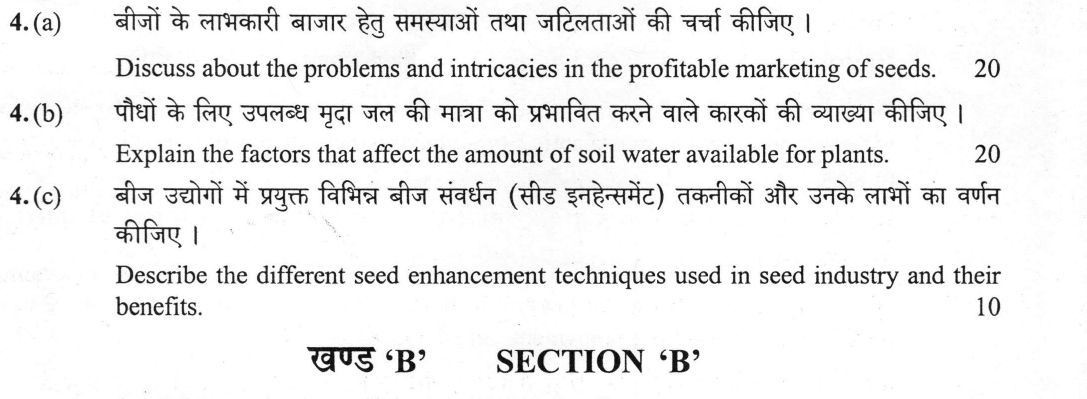
(a) Discuss about the problems and intricacies in the profitable marketing of seeds. (20 marks) (b) Explain the factors that…
Discuss about the problems and intricacies in the profitable marketing of seeds. 20 marks
Explain the factors that affect the amount of soil water available for plants. 20 marks
Describe the different seed enhancement techniques used in seed industry and their benefits. 10 marks
हिंदी में प्रश्न पढ़ें
बीजों के लाभकारी बाजार हेतु समस्याओं तथा जटिलताओं की चर्चा कीजिए । (20 अंक)
पौधों के लिए उपलब्ध मृदा जल की मात्रा को प्रभावित करने वाले कारकों की व्याख्या कीजिए । (20 अंक)
बीज उद्योगों में प्रयुक्त विभिन्न बीज संवर्धन (सीड इन्हेन्समेंट) तकनीकों और उनके लाभों का वर्णन कीजिए । (10 अंक)
Model answer
Drafted with AI by UPSC Answer Check against this question's marking rubric, to the expected length. UPSC does not publish answers for Mains — this is one way to score well, not an official key. How we build rubrics and answers.
(a) Problems and intricacies in the profitable marketing of seeds (20 marks)
Seed is a living, seasonal input whose value depends on its quality, which the buyer cannot see. This is why marketing it profitably is hard.
Problems:
- Perishability and seasonality: seed loses viability in storage, especially in humid, warm climates, and demand comes in a short sowing window, so unsold stock carried to the next season loses germination and must often be sold as grain at a loss.
- Uncertain demand: it depends on the monsoon, crop prices, area sown and farmers' choice of variety, so production planned a year ahead may be mismatched with the market.
- Bulk and cost: seed is bulky, and for low-value, self-pollinated crops the margin per kilogram is small, while transport, storage and processing are costly.
- Competition from farm-saved seed: farmers can save their own seed of varieties and open-pollinated crops, so the seed replacement rate is low, and the market is limited mostly to hybrids.
- Quality and trust: buyers cannot judge genetic purity or germination at purchase, so spurious, duplicate and sub-standard seed hurts honest sellers and brands, and forces costly quality assurance, testing and certification.
- Production risk: seed crops need isolation, rogueing and timely harvest, and weather, pests or contamination can cause rejection in field inspection or by the certification agency.
- Regulation and pricing: compliance with the Seeds Act, 1966, the Seeds Rules, 1968, the Seeds (Control) Order, 1983 and the Protection of Plant Varieties and Farmers' Rights Act, 2001, and price controls or state intervention in some crops, restrict margins.
- Infrastructure and credit: cold and dry storage, processing plants, dealer networks and working capital are needed, with the cost of credit high because of delays in payment by dealers.
- Farmer factors: low awareness, and reluctance to pay a higher price for improved seed, especially for small and marginal farmers.
- Research cost and IP: breeding is long and costly, and returns are hard to protect where seed can be reproduced.
Measures: demand forecasting and staggered production, quality assurance and labelling with genuine brands, extension and demonstrations, contract farming, better storage and logistics, timely credit, and enforcement against spurious seed.
(b) Factors affecting the amount of soil water available to plants (20 marks)
Plant-available water is the water held in the soil between field capacity (the water held against gravity, about −33 kPa or −1/3 bar; about −10 kPa in sandy soils) and the permanent wilting point (about −1500 kPa or −15 bar), where plants can no longer extract it. Available water capacity (AWC) = water at field capacity − water at the wilting point, and the amount available is AWC multiplied by the depth from which roots draw water.
Factors:
- Soil texture: the most important. Sands have large pores that drain quickly, so they hold little water at field capacity and little is available; clays hold a lot but also hold much of it too tightly (a high wilting point); silt loams and loams hold the most available water.
- Soil structure and organic matter: good aggregation gives a range of pore sizes, and organic matter, which binds water, increases both water retention and available water, particularly in coarse soils.
- Bulk density and compaction: compacted soils have fewer large pores and shallow roots, which reduces the volume of soil that is explored.
- Soil depth and rooting depth: available water is the sum over the root zone, so deep soils and deep-rooted crops draw more; hardpans, rock, a high water table or gravel layers restrict roots.
- Stratification and profile layers: a coarse layer over a fine one, or a clay layer, changes drainage and holds water back.
- Salinity and sodicity: dissolved salts lower the osmotic potential of soil water, so plants have less water that can actually be used even when the soil is moist.
- Water supply and loss: rainfall, irrigation, runoff and drainage, slope, infiltration rate, and evaporation and transpiration, with mulch, tillage and residues altering evaporation losses.
- Temperature and weather, which determine the demand.
- Crop and growth stage: the extent of the roots and the fraction of water the crop can use before stress (the management-allowed depletion, which differs among crops).
- Water table: capillary rise from a shallow water table adds to the supply.
Improving availability: organic manures, mulching, conservation tillage, breaking hardpans, and deep tillage.
(c) Seed enhancement techniques and their benefits (10 marks)
Seed enhancements are treatments applied after harvest and before sowing to improve germination, emergence, stand establishment, handling or performance.
- Priming: controlled hydration, so that germination processes begin without radicle emergence, followed by drying. Kinds are hydropriming, osmopriming (PEG, salts), halopriming, matrix priming and biopriming.
- Seed hardening: alternate soaking and drying to raise tolerance to drought.
- Seed pelleting and film coating: inert material is added to make small or irregular seeds (such as lettuce, tobacco, carrot and sugar beet) round and uniform for precision sowing, and a thin polymer film carries dyes, and reduces dust.
- Seed treatment with protectants: fungicides, insecticides or bio-agents (Trichoderma, Pseudomonas) against seed- and soil-borne pests.
- Inoculation with Rhizobium, Azotobacter or Azospirillum, and coating with micronutrients, growth regulators or superabsorbent polymers.
- Pregerminated seed with fluid drilling, and seed tapes.
Benefits: faster and more uniform germination and emergence, better stand and early vigour under stress, protection from pests and diseases, precise sowing and saving of seed, improved nutrient supply, fewer sprays, and higher yield.
How this answer will be evaluated
Evaluation rubric
Each sub-part is marked on its own, against the marks and word limit printed on the paper.
- (a) (a) Discuss the problems and intricacies in the profitable marketing of seeds (20). 20 marks
Must cover
- Perishability and seasonality of seed; unsold stock loses viability
- Uncertain demand tied to monsoon, prices and variety choice
- Farm-saved seed, low replacement rate, and spurious or sub-standard seed hurting trust
- Regulation (Seeds Act 1966, Seeds Control Order 1983, PPV&FR Act 2001), infrastructure, credit and production risk
Loses marks
- Describing seed production or storage without the marketing angle.
- A list of laws without linking them to profitability.
- Generic agricultural marketing problems only.
Earns more
- Bulk and low margin in self-pollinated crops.
- Measures such as forecasting, quality assurance, contract farming and extension.
Extra mark
- Intellectual-property and research-cost issues
- (b) (b) Explain the factors that affect the amount of soil water available for plants (20). 20 marks
Must cover
- Available water = field capacity minus permanent wilting point, with values (−33 kPa, −1500 kPa)
- Soil texture, structure and organic matter
- Soil and rooting depth, compaction, layers and salinity
- Water supply and losses (rain, irrigation, runoff, evaporation), crop, weather and water table
Loses marks
- Defining only field capacity or only wilting point.
- Confusing total soil water with available water.
- Ignoring salinity or rooting depth.
Earns more
- Why sands and clays both give low available water while loams give the most.
- Management to raise available water.
Extra mark
- Management-allowed depletion
- (c) (c) Describe the seed enhancement techniques used in the seed industry and their benefits (10). 10 marks
Must cover
- Definition: post-harvest treatments to improve germination, emergence or handling
- Priming (hydro, osmo, halo, matrix, bio) and hardening
- Pelleting, film coating and seed treatment with fungicides or bio-agents
- Benefits: uniform emergence, stand, stress tolerance, pest protection, precise sowing
Loses marks
- Describing only breeding or seed production.
- Listing techniques without benefits.
- Treating priming as germination in the soil.
Earns more
- Inoculation with Rhizobium or Azotobacter.
- Fluid drilling and seed tapes.
Extra mark
- Micronutrient or superabsorbent polymer coating
What "Discuss" is asking you to do
Lay the issue out from more than one side — how it arose, what is claimed for it, what is held against it, and where it now stands. UPSC attaches discuss to broad topics with several live dimensions, so coverage of the dimensions earns more than the strength of your opinion.
Structure that answers it
Set the issue up → the case as it is made → the case against → the dimension both sides leave out → where the balance now lies
Where marks are lost
Listing facts with no thread between them, or arguing one side throughout and calling it a discussion.
Practice this exact question
Write your answer and it is marked point by point against the model answer above — what you covered, what you missed, what you got wrong.
Evaluate my answer →More from Agriculture 2026 Paper II
- Q1 Answer the following questions in about 150 words each : (a) What is somatic hybridizatio…
- Q2 (a) Describe the causes and sources of disease resistance in plants. (20 marks) (b) Expla…
- Q3 (a) Define heritability. What do you mean by broad sense and narrow sense heritability ?…
- Q4 (a) Discuss about the problems and intricacies in the profitable marketing of seeds. (20…
- Q5 Answer the following questions in about 150 words each : (a) What is topiary ? Describe t…
- Q6 (a) What is high density orcharding ? Describe management practices for high density orch…
- Q7 (a) Describe the scientific cultivation of mango with reference to regular bearer varieti…