Paper II — Q2
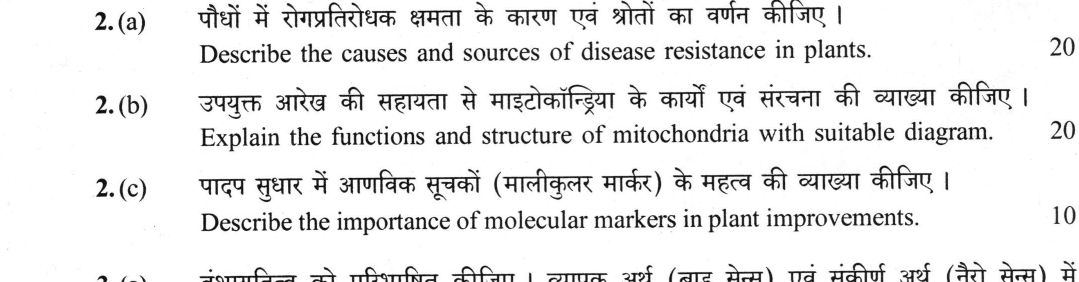
(a) Describe the causes and sources of disease resistance in plants. (20 marks) (b) Explain the functions and structure of…
Describe the causes and sources of disease resistance in plants. 20 marks
Explain the functions and structure of mitochondria with suitable diagram. 20 marks
Describe the importance of molecular markers in plant improvements. 10 marks
हिंदी में प्रश्न पढ़ें
पौधों में रोगप्रतिरोधक क्षमता के कारण एवं श्रोतों का वर्णन कीजिए । (20 अंक)
उपयुक्त आरेख की सहायता से माइटोकॉन्ड्रिया के कार्यों एवं संरचना की व्याख्या कीजिए । (20 अंक)
पादप सुधार में आणविक सूचकों (मालीकुलर मार्कर) के महत्व की व्याख्या कीजिए । (10 अंक)
Model answer
Drafted with AI by UPSC Answer Check against this question's marking rubric, to the expected length. UPSC does not publish answers for Mains — this is one way to score well, not an official key. How we build rubrics and answers.
(a) Causes and sources of disease resistance in plants (20 marks)
Disease resistance is the ability of a plant to prevent or limit the growth and damage caused by a pathogen. Its causes lie in the host's structure and chemistry, and in the way the host and pathogen interact.
Causes of resistance:
- Structural (pre-formed) barriers: a thick cuticle and wax, thick-walled epidermis, few or narrow stomata and lenticels, and lignified or suberised tissue, which stop entry. Hairs and closed flower structure can also reduce infection.
- Biochemical (pre-formed) defences: phenolics, saponins, tannins, glucosinolates and antimicrobial proteins present before attack, and the lack of a compound the pathogen needs (a receptor or nutrient), which gives non-host resistance.
- Induced defences: after recognition, plants build papillae, tyloses and gums, produce a hypersensitive response (HR) with localised cell death, generate reactive oxygen species, and form phytoalexins and pathogenesis-related (PR) proteins such as chitinases and glucanases. Systemic acquired resistance (SAR) operates through salicylic acid.
- Genetic basis: resistance is either vertical (race-specific, monogenic, governed by R genes and the gene-for-gene relationship, effective but breaking down when the pathogen changes) or horizontal (race-non-specific, polygenic, partial but more durable).
- Escape and tolerance: early maturity or altered sowing time helps the crop avoid the disease period, and tolerant plants yield well despite infection.
Sources of resistance:
- Cultivated varieties and landraces, the easiest source to use.
- Wild relatives and related species, which carry many resistance genes, for example the stem-rust resistance in wild wheat relatives and grassy-stunt resistance from Oryza nivara.
- Germplasm collections, gene banks and other breeders' lines, screened under natural or artificial epidemics.
- Induced mutations, where mutation breeding creates resistant plants.
- Genetic engineering and genome editing: transgenes (for example chitinase genes or virus coat-protein genes), RNA interference, and edited susceptibility (S) genes.
- Somaclonal variation and in-vitro selection against pathogen toxins.
These sources are used in breeding through backcrossing and pyramiding several genes, to give varieties with durable resistance.
(b) Structure and functions of mitochondria (20 marks)
Mitochondria are double-membrane organelles, about 0.5 to 1 µm wide and up to several µm long, found in all eukaryotic cells. They contain their own circular DNA and 70S ribosomes, divide by fission, and are inherited maternally in most crops, which is why they are called semi-autonomous organelles.
Structure, as shown in the diagram:
- The outer membrane is smooth and permeable to small molecules through porins.
- The inner membrane is selectively permeable and folded into cristae, which greatly increase its area. It carries the electron transport chain and the ATP synthase (F₀F₁) particles, and it contains cardiolipin.
- The intermembrane space lies between the two membranes; protons accumulate here to form a gradient.
- The matrix, enclosed by the inner membrane, holds the enzymes of the Krebs (TCA) cycle and β-oxidation of fatty acids, mitochondrial DNA, ribosomes, and calcium and phosphate granules.

Functions:
- ATP production (the powerhouse of the cell): pyruvate enters the matrix and passes through the Krebs cycle; NADH and FADH₂ pass electrons through the inner-membrane chain, and ATP synthase uses the proton gradient for oxidative phosphorylation.
- Fatty acid oxidation and part of amino acid metabolism.
- Photorespiration in plants, where mitochondria convert glycine to serine, and the alternative oxidase pathway, which gives heat, for example in thermogenic flowers such as Arum.
- Synthesis of some vitamins, iron-sulphur clusters and steroid precursors.
- Regulation of calcium and of programmed cell death, through the release of cytochrome c.
- Cytoplasmic male sterility in crops such as maize and rice, which is encoded by mitochondrial genes and is used in hybrid seed production.
(c) Importance of molecular markers in plant improvement (10 marks)
A molecular marker is a DNA sequence at a known location that shows variation between individuals and is inherited, so it can be used to follow a nearby gene. Examples are RFLP, RAPD, AFLP, SSR (microsatellites), SNPs and ISSR. They are unaffected by environment, appear at any growth stage, and are numerous.
Importance:
- Marker-assisted selection (MAS): plants are selected by a linked marker, instead of by the trait, which is useful for traits that are recessive, expressed late or hard to score, such as disease and quality traits, and saves time and cost.
- Marker-assisted backcrossing and gene pyramiding: a target gene is transferred while the rest of the genome of the recurrent parent is recovered faster, and several genes are combined in one variety, for example the bacterial blight genes in rice (Improved Samba Mahsuri).
- Gene mapping and QTL analysis: linkage maps place the genes for quantitative traits and help in their cloning.
- Germplasm characterisation and diversity: markers identify duplicates, measure genetic distance and guide the choice of parents.
- Variety identification and seed purity: DNA fingerprinting confirms hybrids and protects breeders' rights.
- Genomic selection and speeding up breeding: marker information is used to predict breeding value, and shortens the breeding cycle.
How this answer will be evaluated
Evaluation rubric
Each sub-part is marked on its own, against the marks and word limit printed on the paper.
- (a) (a) Describe the causes and sources of disease resistance in plants (20). 20 marks
Must cover
- Causes: structural barriers (cuticle, wax, thick walls, stomata) and pre-formed biochemical defences
- Induced defences: HR, phytoalexins, PR proteins, SAR
- Genetic basis: vertical (R genes, gene-for-gene) versus horizontal (polygenic, durable) resistance
- Sources: cultivars and landraces, wild relatives, germplasm, mutation, and genetic engineering or genome editing
Loses marks
- Describing pathogen biology or control measures instead of host resistance.
- Causes without sources, or sources without causes.
- Confusing resistance with immunity.
Earns more
- Escape and tolerance as separate from resistance.
- Examples such as Oryza nivara or Aegilops for wild-relative genes.
Extra mark
- Pyramiding of genes for durable resistance
- (b) (b) Explain the functions and structure of mitochondria with a suitable diagram (20). 20 marks
Must cover
- Double membrane: smooth outer, folded inner with cristae, intermembrane space and matrix
- Matrix holds Krebs cycle enzymes, mtDNA and 70S ribosomes; inner membrane carries the electron transport chain and ATP synthase
- Main function: ATP production through the Krebs cycle and oxidative phosphorylation
- A labelled diagram showing the membranes, cristae and matrix
Loses marks
- Diagram missing or unlabelled.
- Placing the electron transport chain in the matrix or outer membrane.
- Describing chloroplast instead of mitochondrion.
Earns more
- Other functions: fatty acid oxidation, photorespiration, calcium and cell death, cytoplasmic male sterility.
- Semi-autonomous nature and maternal inheritance.
Extra mark
- Alternative oxidase and heat in thermogenic flowers
- (c) (c) Describe the importance of molecular markers in plant improvement (10). 10 marks
Must cover
- Definition of a molecular marker with examples (RFLP, SSR, SNP)
- Marker-assisted selection, especially for recessive or late-expressing traits
- Gene mapping and QTL analysis, and marker-assisted backcrossing and gene pyramiding
- Germplasm characterisation, DNA fingerprinting and seed purity
Loses marks
- Describing genetic engineering rather than markers.
- Listing marker names without their use.
- Claiming markers are affected by environment.
Earns more
- Advantages of markers over morphological traits.
- Example such as Improved Samba Mahsuri.
Extra mark
- Genomic selection
What "Describe" is asking you to do
Give a full, ordered account of the thing named — its parts, stages or mechanism — in the sequence in which it actually exists or occurs. Most describe questions come from the science optionals, where the marks sit in correct technical detail and, where the stem says so, a labelled diagram.
Structure that answers it
One-line identification of the subject → the parts or stages in their real order, each with its defining detail → labelled diagram where the subject is structural → closing line on function or significance
Where marks are lost
Loose general prose where the examiner is ticking named parts, correct terminology and their sequence; and in the General Studies papers, turning to evaluation before the description is finished.
Practice this exact question
Write your answer and it is marked point by point against the model answer above — what you covered, what you missed, what you got wrong.
Evaluate my answer →More from Agriculture 2026 Paper II
- Q1 Answer the following questions in about 150 words each : (a) What is somatic hybridizatio…
- Q2 (a) Describe the causes and sources of disease resistance in plants. (20 marks) (b) Expla…
- Q3 (a) Define heritability. What do you mean by broad sense and narrow sense heritability ?…
- Q4 (a) Discuss about the problems and intricacies in the profitable marketing of seeds. (20…
- Q5 Answer the following questions in about 150 words each : (a) What is topiary ? Describe t…