Paper II — Q7
(a) Describe the scientific cultivation of mango with reference to regular bearer varieties, propagation, transplanting time…
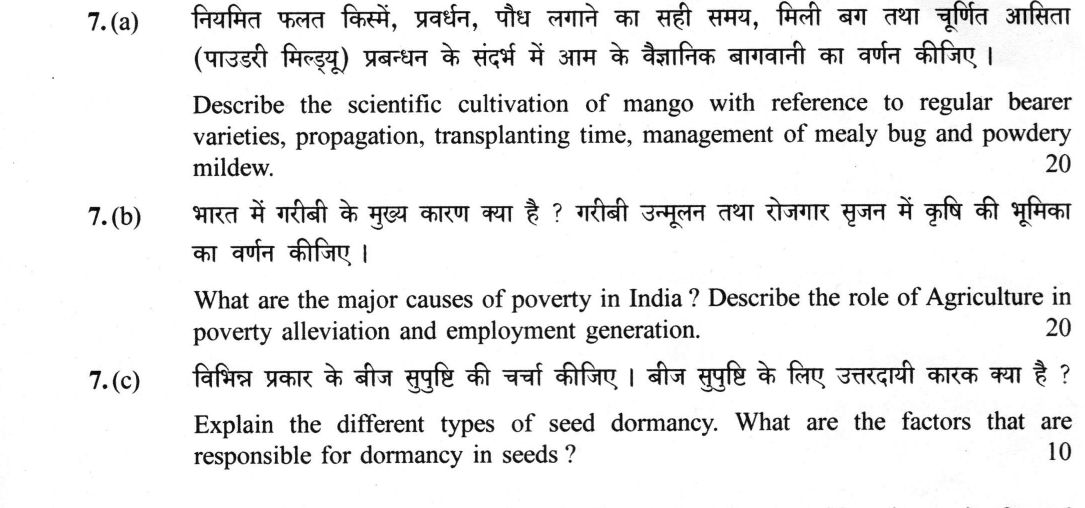
Describe the scientific cultivation of mango with reference to regular bearer varieties, propagation, transplanting time, management of mealy bug and powdery mildew. 20 marks
What are the major causes of poverty in India ? Describe the role of Agriculture in poverty alleviation and employment generation. 20 marks
Explain the different types of seed dormancy. What are the factors that are responsible for dormancy in seeds ? 10 marks
हिंदी में प्रश्न पढ़ें
नियमित फलत किस्में, प्रवर्धन, पौध लगाने का सही समय, मिली बग तथा चूर्णित आसिता (पाउडरी मिल्ड्यू) प्रबन्धन के संदर्भ में आम के वैज्ञानिक बागवानी का वर्णन कीजिए । (20 अंक)
भारत में गरीबी के मुख्य कारण क्या है ? गरीबी उन्मूलन तथा रोजगार सृजन में कृषि की भूमिका का वर्णन कीजिए । (20 अंक)
विभिन्न प्रकार के बीज सुपुष्टि की चर्चा कीजिए । बीज सुपुष्टि के लिए उत्तरदायी कारक क्या है ? (10 अंक)
Model answer
Drafted with AI by UPSC Answer Check against this question's marking rubric, to the expected length. UPSC does not publish answers for Mains — this is one way to score well, not an official key. How we build rubrics and answers.
(a) Scientific cultivation of mango (20 marks)
Mango (Mangifera indica) grows best in a tropical to subtropical climate with a dry spell at flowering, on deep, well-drained loamy soil of pH about 5.5 to 7.5. It is frost-sensitive.
Regular bearing varieties: Neelum, Banganapalli and Totapuri are dependable annual bearers, and the hybrids Mallika, Amrapali, Ratna and Arka Puneet bear regularly, with Amrapali suited to close planting. Many popular varieties, such as Alphonso, Langra and Chausa, tend to alternate bearing.
Propagation: mango is propagated vegetatively, so that the variety comes true. The common methods are veneer (side) grafting and softwood grafting on seedling rootstocks raised from stones, done in the monsoon (July to September), with inarching as an older method. Rootstocks such as Olour, Vellaikolamban and Kurukkan are used in different regions.
Planting time: grafts are planted at the onset of the monsoon, in July to August, in rain-fed areas, and in February to March where irrigation is available. Pits of 1 m³ are dug and left to weather, then filled with topsoil, farmyard manure and single superphosphate. Conventional spacing is about 10 × 10 m, and close spacing (for example 2.5 × 2.5 m for Amrapali) is used in high-density orchards. Young plants are staked, watered and protected from the sun.
General management: training to a good framework, split manuring each year, withholding irrigation for two to three months before flowering, and paclobutrazol or pruning to induce regular bearing.
Mealy bug (Drosicha mangiferae): the nymphs hatch from eggs in the soil in December to January and climb the trunk to suck the sap of panicles and shoots. Control is by ploughing and raking around the tree in November to December to expose and destroy eggs, a soil application of a recommended insecticide dust around the trunk, a 25 to 30 cm band of slippery polythene (with grease) tied round the trunk at about 1 m in December to stop the nymphs climbing, weed removal, and, when they reach the panicles, a spray of imidacloprid or dimethoate. Natural enemies such as the beetle Cryptolaemus montrouzieri also help.
Powdery mildew (Oidium mangiferae): a white, powdery fungal growth on the panicles, flowers and young fruits in cool, cloudy weather in January to March, which causes flower and fruit drop. Control is by spraying wettable sulphur (0.2%) or a systemic fungicide (such as tridemorph, hexaconazole or carbendazim, 0.1%) at panicle emergence, then at 15-day intervals, three sprays in all; sulphur should not be sprayed in hot weather.
(b) Causes of poverty in India; role of agriculture in poverty alleviation and employment (20 marks)
Poverty is the lack of the income or the capabilities to meet basic needs. India has made much progress: NITI Aayog's multidimensional poverty estimate fell from about 29% in 2013–14 to about 11% in 2022–23. But it persists, especially in rural areas, and among Scheduled Castes, Scheduled Tribes and marginal farmers and landless labour.
Major causes:
- Low agricultural productivity and dependence: much of the workforce depends on farming, with small, fragmented holdings and dependence on the monsoon.
- Unemployment, underemployment and disguised unemployment, and low wages in the informal sector.
- Population pressure, and low literacy, skills and health status.
- Inequality in land and assets, and caste, gender and regional disparities.
- Inadequate credit, infrastructure and market access, and vulnerability to drought, floods and price shocks.
- Inflation, slow growth of labour-intensive manufacturing, and leakages and gaps in the delivery of schemes.
- Historical causes, including the colonial period's stagnation of agriculture and de-industrialisation.
Role of agriculture:
- Employment: farming and allied activities employ about 46% of India's workforce (PLFS 2023–24) although they contribute about 18% of gross value added, so raising farm incomes lifts the largest number of people.
- Income and productivity: higher productivity through irrigation, improved seed, technology, MSP and market reforms raises farm incomes; crop insurance, credit (Kisan Credit Card) and direct support (PM-KISAN) reduce risk.
- Food security and prices: higher food-grain output supports the public distribution system and keeps food affordable for the poor.
- Diversification and non-farm links: horticulture, dairy, poultry, fisheries, agro-processing, farmer producer organisations and agri-enterprises give extra income and rural jobs, particularly for women and small farmers.
- Rural wage employment through public works (MGNREGA, now succeeded by the VB-G RAM G Act, 2025) that build irrigation and soil-conservation assets.
- Growth linkages: agriculture supplies raw materials and demand for industry and services, so growth in agriculture reduces poverty more than growth in other sectors.
(c) Types of seed dormancy and the factors responsible (10 marks)
Dormancy is the failure of a viable seed to germinate under conditions that are otherwise favourable.
Types:
- Primary dormancy, present when the seed leaves the plant.
- Secondary dormancy, induced in a non-dormant seed by unfavourable conditions such as high temperature, darkness or lack of oxygen.
- By cause: physical dormancy, from an impermeable seed coat (legumes, cotton, okra); physiological dormancy, from a metabolic block within the embryo, which needs after-ripening or chilling; morphological dormancy, from an underdeveloped embryo (carrot, celery); morphophysiological, a combination of the two; and combinational dormancy, physical plus physiological.
Factors responsible:
- A hard, impermeable seed coat that prevents entry of water and oxygen, or mechanically restrains the embryo.
- Immature or underdeveloped embryos.
- The need for after-ripening or chilling (stratification).
- Germination inhibitors such as abscisic acid, phenolics, coumarin and ammonia in the coat, endosperm or fruit, and lack of promoters such as gibberellins.
- Light (phytochrome control) and temperature requirements.
Dormancy is broken by scarification, stratification, leaching, growth regulators (GA₃), potassium nitrate, and light.
How this answer will be evaluated
Evaluation rubric
Each sub-part is marked on its own, against the marks and word limit printed on the paper.
- (a) (a) Describe the scientific cultivation of mango with reference to regular bearing varieties, propagation, planting time, mealy bug and powdery mildew management (20). 20 marks
Must cover
- Regular bearers (Neelum, Banganapalli, Totapuri, Mallika, Amrapali, Ratna, Arka Puneet) versus alternate bearers
- Propagation by veneer or softwood grafting on seedling rootstocks in the monsoon
- Planting time (onset of monsoon, July–August), pit preparation and spacing
- Mealy bug (Drosicha) control: raking in Nov–Dec, polythene band, insecticide, natural enemies; powdery mildew (Oidium): wettable sulphur or systemic fungicide, three sprays
Loses marks
- Listing only general cultural practices without the five asked heads.
- Naming alternate bearers as regular bearers.
- Confusing powdery mildew with downy mildew or anthracnose.
Earns more
- Climate and soil requirements.
- Manuring, irrigation withholding before flowering, paclobutrazol.
Extra mark
- High-density planting of Amrapali (2.5 × 2.5 m)
- (b) (b) What are the major causes of poverty in India; describe the role of agriculture in poverty alleviation and employment generation (20). 20 marks
Must cover
- Causes: low agricultural productivity, unemployment and underemployment, population pressure, inequality
- Causes: illiteracy, poor health, caste, gender and regional disparities, credit and market gaps, vulnerability to shocks
- Role of agriculture: employment of about 46% of workforce, farm income, food security
- Diversification (horticulture, dairy, fisheries, agro-processing), rural wage employment and growth linkages
Loses marks
- Describing only agriculture or only causes.
- Outdated or unsupported statistics.
- Omitting the employment role.
Earns more
- Accurate data such as the NITI Aayog MPI decline or PLFS share.
- Schemes such as PM-KISAN, MSP, KCC, crop insurance, MGNREGA (now VB-G RAM G Act, 2025).
Extra mark
- Historical causes; growth-poverty linkage
- (c) (c) Explain the different types of seed dormancy; what factors are responsible for dormancy in seeds (10). 10 marks
Must cover
- Primary and secondary dormancy
- Physical, physiological, morphological, morphophysiological and combinational types
- Factors: impermeable or hard seed coat, immature embryo, after-ripening or chilling need
- Factors: inhibitors (ABA, phenolics), lack of promoters (GA), light and temperature
Loses marks
- Confusing dormancy with loss of viability.
- Only listing methods to break dormancy.
- Missing the factors part.
Earns more
- Examples (legumes, carrot).
- Methods to break dormancy.
Extra mark
- Innate, induced and enforced classification
What "Describe" is asking you to do
Give a full, ordered account of the thing named — its parts, stages or mechanism — in the sequence in which it actually exists or occurs. Most describe questions come from the science optionals, where the marks sit in correct technical detail and, where the stem says so, a labelled diagram.
Structure that answers it
One-line identification of the subject → the parts or stages in their real order, each with its defining detail → labelled diagram where the subject is structural → closing line on function or significance
Where marks are lost
Loose general prose where the examiner is ticking named parts, correct terminology and their sequence; and in the General Studies papers, turning to evaluation before the description is finished.
Practice this exact question
Write your answer and it is marked point by point against the model answer above — what you covered, what you missed, what you got wrong.
Evaluate my answer →More from Agriculture 2026 Paper II
- Q4 (a) Discuss about the problems and intricacies in the profitable marketing of seeds. (20…
- Q5 Answer the following questions in about 150 words each : (a) What is topiary ? Describe t…
- Q6 (a) What is high density orcharding ? Describe management practices for high density orch…
- Q7 (a) Describe the scientific cultivation of mango with reference to regular bearer varieti…
- Q8 (a) Explain the factors encouraging infestation of pests during storage. Discuss control…