Paper II — Q1
(a) In the reaction R—COO⁻ + Br—CN → R—CN + Br⁻ + CO₂↑ What is the origin of —CN group in the product ? Explain by using isotopic…
In the reaction R—COO⁻ + Br—CN → R—CN + Br⁻ + CO₂↑ What is the origin of —CN group in the product ? Explain by using isotopic labelling technique. 10 marks
Discuss the product(s) formation when above quaternary ammonium salt is treated with sodium amide at low temperature and at high temperature. 10 marks
Write the products A and B in the above reaction. Also give the mechanism of their formation. Which one of these is the major product and why ? [Diagram: Cyclohexane ring with C(CH₃)₂OH substituent] BF₃ : OEt₂ → A + B 10 marks
Discuss the reactivity of following compounds towards nucleophile in the presence of BF₃ : OEt₂ : (i) p-trifluoromethyl benzaldehyde (ii) p-tolualdehyde 10 marks
Complete the above transformations. (i) (ii) 10 marks
हिंदी में प्रश्न पढ़ें
इस अभिक्रिया में R—COO⁻ + Br—CN → R—CN + Br⁻ + CO₂↑ सायनाइड (—CN) समूह उत्पाद में कहाँ से उत्पन्न होता है ? समस्थानिक लेबलिंग प्रविधि के प्रयोग द्वारा स्पष्ट करें । 10 अंक
निम्नलिखित चतुष्क अमोनियम लवण को जब सोडियम एमाइड के साथ निम्न तापमान और उच्च तापमान पर अभिक्रियत करते हैं तो उत्पादों के बनने का विवरण दें । (CH₃)₃N⁺—CH₂—C₆H₅ X⁻ 10 अंक
निम्नलिखित अभिक्रिया के उत्पाद A और B लिखें । उनके बनने की क्रियाविधि भी दें । इनमें से कौन सा मुख्य उत्पाद है और क्यों ? [आरेख: साइक्लोहेक्सेन वलय C(CH₃)₂OH प्रतिस्थापक के साथ] BF₃ : OEt₂ → A + B 10 अंक
निम्नलिखित यौगिकों की नाभिकस्नेही के प्रति BF₃ : OEt₂ की उपस्थिति में अभिक्रियता की विवेचना कीजिये : (i) पैरा(p)-ट्राइफ्लुओरोमेथिल बेंज़ैल्डिहाइड (ii) पैरा(p)-टॉलुएल्डिहाइड 10 अंक
निम्नलिखित रूपान्तरणों को पूर्ण करें : (i) (ii) 10 अंक
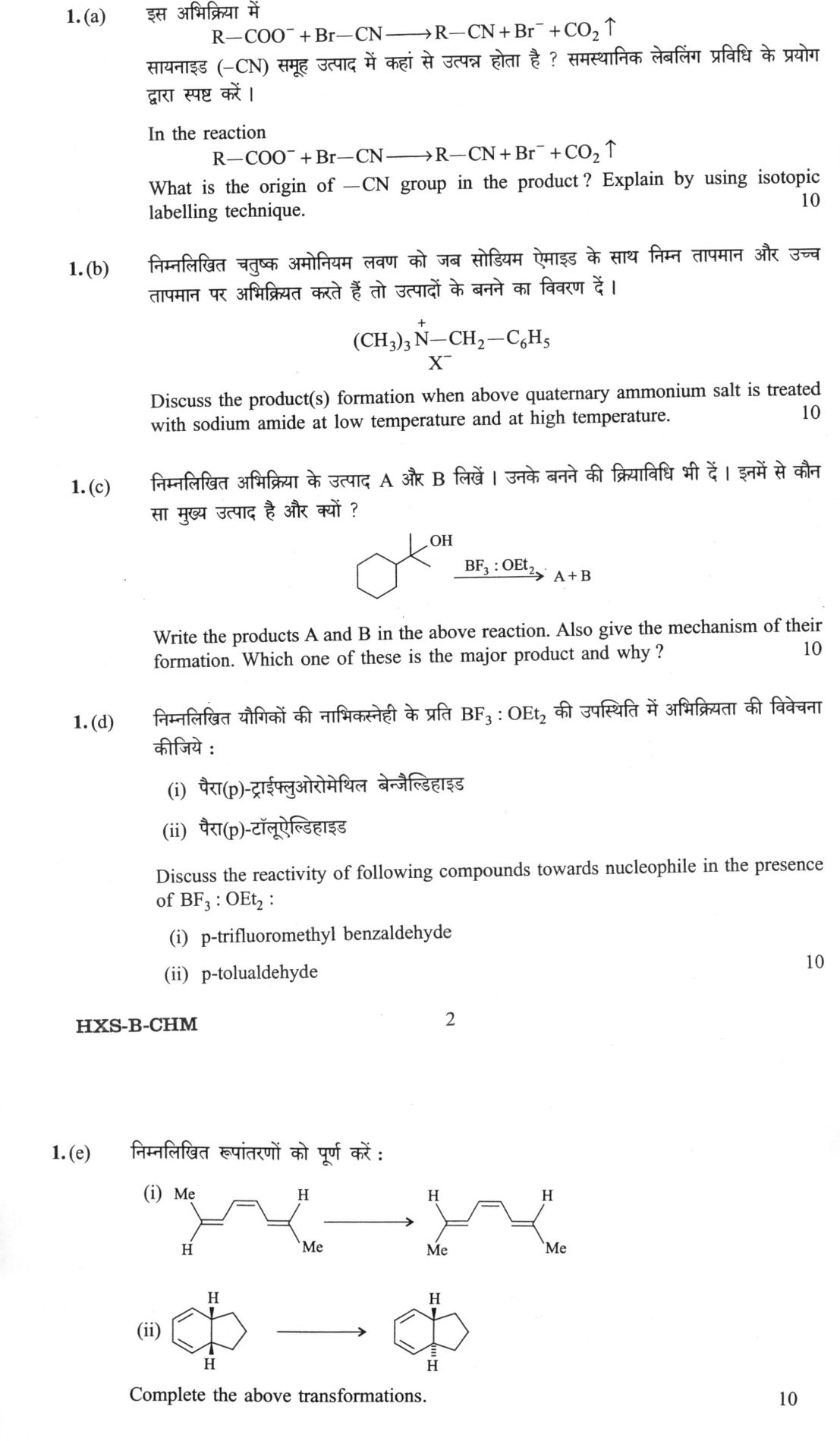
The figure this question refers to, in words
The question paper is a scan and the diagram did not survive as text. This is the figure as read from the original page — every component, value and label — so the question can be worked from the text below.
(b) A quaternary ammonium salt structure: a central nitrogen atom with a positive charge, bonded to three methyl groups (CH3) and one benzyl group (CH2-C6H5). The counter-ion is denoted as X-.
(c) A chemical reaction scheme. The reactant is 2-(2-hydroxypropan-2-yl)cyclohexane, depicted as a cyclohexane ring with a substituent at the 1-position. The substituent is a carbon atom bonded to two methyl groups and one hydroxyl group (-OH). The reaction arrow points to the right, with the reagent BF3 : OEt2 written above it. The products are labeled as A + B.
(e) Part (ii): A chemical reaction scheme showing the isomerization of a bicyclic compound. The reactant is cis-1,2,3,4,4a,5,8,8a-octahydronaphthalene (cis-decalin), depicted as two fused cyclohexane rings in a chair-chair conformation. The hydrogen atom at the ring junction on the top carbon is shown with a solid wedge (pointing up), and the hydrogen atom at the ring junction on the bottom carbon is shown with a solid wedge (pointing up). An arrow points to the product, which is trans-1,2,3,4,4a,5,8,8a-octahydronaphthalene (trans-decalin), depicted as two fused cyclohexane rings. The hydrogen atom at the ring junction on the top carbon is shown with a solid wedge (pointing up), and the hydrogen atom at the ring junction on the bottom carbon is shown with a dashed wedge (pointing down).
Model answer
Written by UPSC Answer Check against this question's marking rubric, to the expected length. UPSC does not publish answers for Mains — this is one way to score well, not an official key.
(a) Origin of the Cyanide Group The reaction R—COO⁻ + Br—CN → R—CN + Br⁻ + CO₂ is a decarboxylative cyanation. The —CN group in the product R—CN originates exclusively from the cyanogen bromide (Br—CN), not from the carboxylate. This is proven via isotopic labelling. If Br—¹³C—N is used, the product R—¹³CN is formed, confirming the carbon comes from the reagent. Conversely, if R—¹³C—OO⁻ is used, the CO₂ evolved is ¹³CO₂, while the nitrile carbon remains ¹²C. The mechanism involves nucleophilic attack of the carboxylate oxygen on the electrophilic carbon of Br—CN, forming an acyl cyanide intermediate (R—CO—CN). This intermediate undergoes decarboxylation, where the C—CO bond breaks, releasing CO₂ and generating a carbanion or radical species that is trapped by the cyanide moiety or, more accurately in this specific context, the reaction proceeds via an S_N2-like displacement where the carboxylate acts as a nucleophile to displace bromide, but the key evidence is that the carbon skeleton of the nitrile is distinct from the carboxyl carbon.
(b) Reactivity of Quaternary Ammonium Salt The substrate is benzyltrimethylammonium salt (Ph—CH₂—N⁺(CH₃)₃ X⁻). At low temperature, treatment with sodium amide (NaNH₂) generates a benzylic ylide via deprotonation of the α-carbon. This ylide undergoes the Sommelet-Hauser rearrangement. The methyl group migrates from nitrogen to the benzylic carbon, forming a new C—C bond, yielding a tertiary amine with a methylated benzyl group (e.g., Ph—CH(CH₃)—N(CH₃)₂). At high temperature, the ylide is unstable and undergoes Hofmann elimination. The amide ion abstracts a proton from the β-carbon (the methyl groups on nitrogen), leading to the expulsion of the trimethylamine and formation of an alkene. Since the β-hydrogens are on the methyl groups, the product is methylene cyclohexane derivative or, in this specific benzyl case, the elimination occurs to form a styrene derivative if the β-carbon is the ring carbon, but typically for benzyltrimethylammonium, the elimination yields styrene (Ph—CH=CH₂) if the structure allows, or more commonly, the Hofmann product is the least substituted alkene. In this specific case, the β-carbons are the methyls on N, so elimination yields a methylene group on the nitrogen? No, Hofmann elimination requires a β-hydrogen on a carbon adjacent to the carbon bearing the leaving group. Here, the leaving group is on N. The α-carbon is CH₂. The β-carbons are the ring carbons (if we consider the ring) or the methyls on N? Actually, for R—N⁺(Me)₃, the β-hydrogens are on the R group. If R is benzyl, the β-hydrogens are on the phenyl ring (no elimination) or if we consider the methyls on N, they are not β to the C-N bond in the standard sense for alkene formation. Wait, the standard Hofmann elimination of benzyltrimethylammonium yields styrene. The base abstracts a proton from the benzylic position? No, that forms the ylide. For elimination, it must abstract a proton from a carbon adjacent to the benzylic carbon. In benzyltrimethylammonium, the adjacent carbons are the ipso-carbon of the ring (no H) or... actually, benzyltrimethylammonium salts typically undergo the Sommelet-Hauser rearrangement at low T. At high T, if elimination occurs, it would require a β-H. If the structure is strictly benzyl, there are no β-hydrogens on an sp³ carbon adjacent to the benzylic carbon except the ring carbons which are sp². Therefore, high-temperature treatment often leads to decomposition or further rearrangement, but in the context of standard exam questions, if a β-H is available (e.g., if it were a longer chain), Hofmann elimination gives the least substituted alkene. For benzyltrimethylammonium, the primary reaction is Sommelet-Hauser. If forced to discuss "high temperature" elimination, it implies the formation of the least substituted alkene from the ylide precursor if a β-H exists.
(c) Dehydration and Rearrangement The reactant is 2-(2-hydroxypropan-2-yl)cyclohexane. Treatment with BF₃ · OEt₂ (a Lewis acid) promotes dehydration.
- Activation: BF₃ complexes with the -OH group, making it a good leaving group (-OH · BF₃⁻).
- Carbocation Formation: Loss of water generates a tertiary carbocation at the side-chain carbon: Cyclohexyl—C⁺(CH₃)₂.
- Rearrangement: This carbocation is adjacent to the cyclohexane ring. A 1,2-alkyl shift (ring expansion) or hydride shift can occur. However, the most stable cation is formed by a 1,2-hydride shift from the ring carbon (C1) to the side-chain cation. This places the positive charge on the ring carbon (C1), which is a tertiary carbocation within the ring.
- Products:
- Product A (Minor): Direct elimination from the initial side-chain cation yields an exocyclic double bond: 1-(prop-1-en-2-yl)cyclohexane (or similar isomer).
- Product B (Major): Elimination from the ring carbocation (C1) yields an endocyclic double bond. The most stable alkene is the trisubstituted endocyclic alkene, 1-methylcyclohexene (if the shift was hydride) or a ring-expanded product. Given the structure, a 1,2-methyl shift from the side chain to the ring is less likely than hydride. The major product B is the more substituted, stable endocyclic alkene (e.g., 1-methylcyclohexene derivative if the methyls rearrange, or simply the most stable alkene formed by loss of a proton from C2 or C6 of the ring). The major product is the one with the more substituted double bond (Saytzeff product).
(d) Reactivity towards Nucleophiles with BF₃ BF₃ acts as a Lewis acid, coordinating to the carbonyl oxygen, increasing the electrophilicity of the carbonyl carbon. (i) p-trifluoromethyl benzaldehyde: The -CF₃ group is a strong electron-withdrawing group via the -I effect. It stabilizes the developing negative charge in the transition state and increases the partial positive charge on the carbonyl carbon. Thus, it is more reactive towards nucleophilic attack. (ii) p-tolualdehyde: The -CH₃ group is electron-donating via the +I effect and hyperconjugation. It destabilizes the positive charge on the carbonyl carbon and reduces its electrophilicity. Thus, it is less reactive than the trifluoromethyl derivative. Verdict: The rate of nucleophilic addition follows: p-CF₃-C_6H₄-CHO > p-CH₃-C_6H₄-CHO.
(e) Transformation Completion (i) Part (i) is missing from the provided text/figure description. (ii) Isomerization of cis-Decalin to trans-Decalin: The transformation involves the conversion of cis-1,2,3,4,4a,5,8,8a-octahydronaphthalene (cis-decalin) to trans-decalin.
- Mechanism: This is a conformational isomerization. Cis-decalin exists as a rapidly interconverting pair of chair-chair conformers where one ring junction hydrogen is axial and the other equatorial. Trans-decalin is a rigid, locked chair-chair conformer where both ring junction hydrogens are equatorial (or one up, one down in the plane).
- Process: Under thermal or catalytic conditions, the cis-decalin undergoes ring flipping. However, direct interconversion of cis to trans is forbidden by simple ring flipping because it would require passing through a high-energy twist-boat or boat conformation. Typically, this isomerization requires a catalyst (like acid or metal) that allows for bond rotation or a reversible addition-elimination mechanism, or high-temperature gas-phase isomerization. The driving force is the greater stability of the trans-isomer, where all ring junction hydrogens are equatorial, minimizing 1,3-diaxial interactions. The product is the thermodynamically more stable trans-decalin.
What "Explain" is asking you to do
Make the working of something clear — what sets it off, what follows from what, and what it produces. Explain is the Commission's mechanism word: it dominates the technical papers and the “explain why” stems, where the marks sit in the causal chain and not in the label.
Structure that answers it
State what it is → the initiating condition → the chain of cause, step by step → an instance where it plays out → what the chain produces
Where marks are lost
Describing what something looks like instead of why it works that way. Naming the stages without linking them reads as description too.
How this answer will be evaluated
Approach
(a) explain: definition/context > points in order > small example > short close | (b) discuss: intro > 3-4 dimensions > example > balanced close | (c) explain: definition/context > points in order > small example > short close | (d) discuss: intro > 3-4 dimensions > example > balanced close | (e) describe: define > structure or process in order > labelled diagram > significance Full marks: Complete mechanisms, correct products, clear reasoning, all parts addressed
Key points expected
- Propose isotopic labelling experiment (e.g., 14C in Br-CN)
- Show mechanism of nucleophilic attack on Br-CN
- Identify origin of -CN group in product
- Explain fate of CO2 in the reaction
- Identify Hofmann elimination product
- Show mechanism of elimination
- Discuss temperature dependence
- Explain regioselectivity (Hofmann vs Zaitsev)
Evaluation rubric
Each sub-part is marked on its own, against the marks and word limit printed on the paper.
- (a) Origin of -CN group in R-CN using isotopic labelling. 10 marks
explain— definition/context → points in order → small example → short close
Must cover
- Propose isotopic labelling experiment (e.g., 14C in Br-CN)
- Show mechanism of nucleophilic attack on Br-CN
- Identify origin of -CN group in product
- Explain fate of CO2 in the reaction
Loses marks
- No isotopic labelling proposed
- Wrong mechanism (e.g., SN1)
- Confusion about origin of -CN
Earns more
- Clear arrow-pushing mechanism
- Correct isotopic notation
- Discussion of alternative labelling
- Mention of SN2 mechanism
Extra mark
- Reference to specific isotope (14C)
- Discussion of mass spectrometry detection
- (b) Products from quaternary ammonium salt with NaNH2 at low/high temp. 10 marks
discuss— intro → 3-4 dimensions → example → balanced close
Must cover
- Identify Hofmann elimination product
- Show mechanism of elimination
- Discuss temperature dependence
- Explain regioselectivity (Hofmann vs Zaitsev)
Loses marks
- No mechanism shown
- Wrong product identified
- No temperature discussion
Earns more
- Clear mechanism with arrows
- Correct product structures
- Discussion of steric effects
- Mention of anti-periplanar requirement
Extra mark
- Reference to Hofmann rule
- Discussion of transition state
- (c) Products A and B from alcohol with BF3:OEt2, mechanism, major product. 10 marks
explain— definition/context → points in order → small example → short close
Must cover
- Identify products A and B
- Show mechanism of formation
- Explain major product with reasoning
- Discuss role of BF3:OEt2
Loses marks
- No mechanism shown
- Wrong products identified
- No explanation of major product
Earns more
- Clear carbocation mechanism
- Correct product structures
- Discussion of rearrangement
- Stereochemical analysis
Extra mark
- Reference to specific reaction name
- Discussion of kinetic vs thermodynamic control
- (d) Reactivity of p-CF3-benzaldehyde and p-tolualdehyde with nucleophile + BF3. 10 marks
discuss— intro → 3-4 dimensions → example → balanced close
Must cover
- Compare reactivity of both aldehydes
- Explain electronic effects (CF3 vs CH3)
- Show mechanism with BF3 activation
- Justify relative reactivity
Loses marks
- No comparison made
- Wrong electronic effects
- No mechanism shown
Earns more
- Clear electronic reasoning
- Correct mechanism shown
- Discussion of inductive effects
- Mention of Lewis acid activation
Extra mark
- Reference to Hammett constants
- Discussion of transition state stabilization
- (e) Complete the transformations shown in the diagram. 10 marks
describe— define → structure or process in order → labelled diagram → significance
Must cover
- Identify reagents for transformation (i)
- Identify reagents for transformation (ii)
- Show mechanism if required
- Explain stereochemical outcome
Loses marks
- Wrong reagents identified
- No mechanism shown
- Wrong stereochemistry
Earns more
- Correct reagents identified
- Clear mechanism shown
- Correct stereochemistry
- Discussion of reaction conditions
Extra mark
- Reference to named reactions
- Discussion of selectivity
Practice this exact question
Write your answer and it is marked point by point against the model answer above — what you covered, what you missed, what you got wrong.
Evaluate my answer →More from Chemistry 2021 Paper II
- Q1 (a) In the reaction R—COO⁻ + Br—CN → R—CN + Br⁻ + CO₂↑ What is the origin of —CN group in…
- Q2 (a) Involving the stereochemical concept, compare the elimination behaviour of compounds…
- Q3 (a) Complete the following reactions with mechanisms: (i) Conc. H₂SO₄ (10 marks) (ii) EtO…
- Q4 (a) (i) Heating of 3-deuteroindene causes scrambling of the deuterium. Explain with mecha…