Paper II — Q8
8.(a) (i) Write the products X/Y in the above chemical transformations. I. MCPBA → X II. OsO₄ → X NaIO₄ → Y III. OH |…
8.(a) (i) Write the products X/Y in the above chemical transformations.
I. MCPBA → X
II. OsO₄ → X NaIO₄ → Y
III. OH | H₃C—CH—COOH BH₃/THF X
IV. CrO₃-Pyridine CH₂Cl₂ X
Predict the product in the reaction of 2-methyl-1-butene with diborane. Account for the regioselectivity observed in the reaction.
A molecule with molecular formula C₉H₁₈O exhibits only one signal at δ 1·2 ppm in ¹H NMR spectrum. This also exhibits a strong absorption at 1710 cm⁻¹ in IR spectrum. Propose structure for this molecule.
The UV spectrum of acetone exhibits two signals of different intensities, one at λₘₐₓ 280 nm and the other at λₘₐₓ 190 nm. Assign corresponding electronic transitions to the observed signals.
Predict the number of signals, nature of the signals (s/d/t/m) and approximate chemical shifts in ¹H NMR spectrum of methyl propenoate.
Acetone exhibits only one carbonyl stretching frequency in IR spectrum whereas chloroacetone exhibits two at 1725 and 1745 cm⁻¹. Explain why.
हिंदी में प्रश्न पढ़ें
८.(क) (i) निम्नलिखित रासायनिक रूपांतरणों में उत्पादित यौगिकों X/Y की संरचना लिखिए :
I. MCPBA → X
II. OsO₄ → X NaIO₄ → Y
III. OH | H₃C—CH—COOH BH₃/THF X
IV. CrO₃-पिरिडीन CH₂Cl₂ X
2-मेथिल-1-ब्यूटीन और डाइबोरेन की अभिक्रिया के उत्पाद का अनुमान लगाएं। इस अभिक्रिया में जो रीजियोसेलेक्टिविटी देखी गई उसका लेखा दें।
(ख) (i) एक अणु जिसका आणविक सूत्र C₉H₁₈O है वह ¹H NMR स्पेक्ट्रम में केवल एक सिग्नल δ 1·2 ppm पर देता है। यह IR स्पेक्ट्रम में भी एक प्रबल अवशोषण 1710 से.मी.⁻¹ पर देता है। इस अणु की संरचना अनुमानित करें।
ऐसीटोन का UV स्पेक्ट्रम विभिन्न तीव्रताओं के दो सिग्नल — एक λₘₐₓ 280 nm पर और दूसरा λₘₐₓ 190 nm पर दर्शाता है। इन सिग्नलों के संगत इलेक्ट्रॉनिक संक्रमण को अंकित करें।
(ग) (i) मेथिल प्रोपीनोएट के ¹H NMR स्पेक्ट्रम में सिग्नलों की संख्या, सिग्नलों का स्वरूप (s/d/t/m) और सन्निकट रासायनिक विस्थापन का अनुमान लगाएं।
IR स्पेक्ट्रम में ऐसीटोन केवल एक कार्बोनिल तनन आवृत्ति जबकि क्लोरोऐसीटोन दो 1725 से.मी.⁻¹ और 1745 से.मी.⁻¹ पर दर्शाती है। ऐसा क्यों, समझाइए।
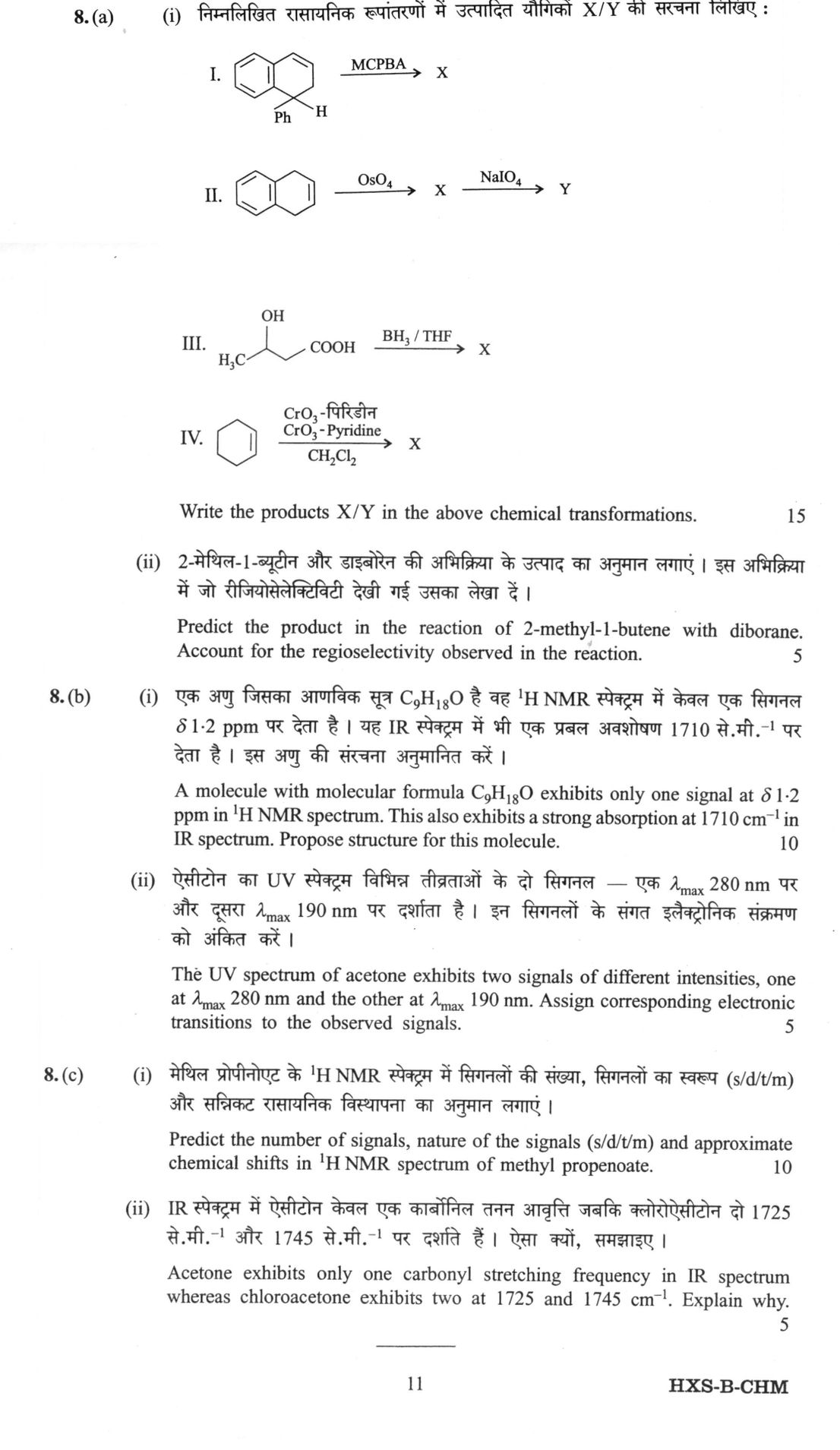
The figure this question refers to, in words
The question paper is a scan and the diagram did not survive as text. This is the figure as read from the original page — every component, value and label — so the question can be worked from the text below.
(a) Reaction II: 1,2-dihydronaphthalene (a benzene ring fused to a six-membered ring with one double bond). The first step shows reagent OsO4 above an arrow pointing to intermediate X. The second step shows reagent NaIO4 above an arrow pointing to product Y.
Model answer
Written by UPSC Answer Check against this question's marking rubric, to the expected length. UPSC does not publish answers for Mains — this is one way to score well, not an official key.
8(a)(i) Identification of Products
In transformation I, the reaction of an alkene with MCPBA yields an epoxide (X) via concerted syn-addition. In transformation II, OsO₄ adds to 1,2-dihydronaphthalene to form a *syn*-diol (X); subsequent oxidative cleavage with NaIO₄ (X) yields 1,2-naphthoquinone (Y). In transformation III, BH₃/THF reduces the carboxylic acid group of the lactic acid derivative to a primary alcohol, yielding 2-hydroxypropanal or the corresponding alcohol depending on the specific substrate structure implied, typically resulting in the anti-Markovnikov alcohol (X). In transformation IV, CrO₃-pyridine (PCC) oxidizes the primary alcohol to an aldehyde (X) without over-oxidation to the carboxylic acid.
8(a)(ii) Hydroboration of 2-methyl-1-butene
The reaction of 2-methyl-1-butene with diborane yields 3-methyl-1-butanol after oxidation. The regioselectivity is anti-Markovnikov. In the four-centered transition state, the electrophilic boron atom attaches to the less substituted terminal carbon. This is driven by electronic factors, where the developing positive charge in the transition state is better stabilized at the more substituted internal carbon, and steric factors, as the bulky borane prefers the less hindered terminal position.
8(b)(i) Structure Determination
The molecular formula C₉H₁₈O indicates one degree of unsaturation. The IR absorption at 1710 cm⁻¹ confirms a saturated ketone. The ¹H NMR spectrum shows a single signal at δ 1.2 ppm, implying all 18 protons are chemically equivalent. This high symmetry suggests a structure with two identical tert-butyl groups attached to the carbonyl carbon. The proposed structure is 2,2,4,4-tetramethyl-3-pentanone (di-tert-butyl ketone).
8(b)(ii) UV Spectrum of Acetone
Acetone exhibits two bands due to electronic transitions in the carbonyl chromophore. The weak band at λₘₐₓ 280 nm corresponds to the n→π\* transition (R-band), which is symmetry-forbidden but gains intensity through vibronic coupling. The strong band at λₘₐₓ 190 nm corresponds to the π→π\* transition (K-band), which is symmetry-allowed and thus more intense.
8(c)(i) ¹H NMR of Methyl Propenoate
Methyl propenoate (CH₂=CHCOOCH₃) exhibits three distinct signals. The methoxy protons (-OCH₃) appear as a singlet at ~3.7 ppm. The vinylic proton adjacent to the carbonyl (=CH-) appears as a doublet of doublets at ~5.8 ppm due to coupling with the two non-equivalent terminal protons. The terminal protons (=CH₂) appear as a doublet of doublets (or multiplet) at ~6.3 ppm, split by the large trans coupling, small cis coupling, and geminal coupling.
8(c)(ii) IR Spectrum of Chloroacetone
Acetone shows a single C=O stretch because it lacks low-frequency vibrations that can interact with the carbonyl mode. In chloroacetone, the C-Cl stretching vibration has a fundamental frequency whose overtone (2ν_C-Cl) coincides in energy with the C=O stretching frequency. This leads to Fermi resonance, an anharmonic coupling that splits the absorption into two distinct bands at 1725 and 1745 cm⁻¹. The inductive effect of the α-chlorine also shifts the carbonyl frequency to a higher value compared to acetone.
What "Explain" is asking you to do
Make the working of something clear — what sets it off, what follows from what, and what it produces. Explain is the Commission's mechanism word: it dominates the technical papers and the “explain why” stems, where the marks sit in the causal chain and not in the label.
Structure that answers it
State what it is → the initiating condition → the chain of cause, step by step → an instance where it plays out → what the chain produces
Where marks are lost
Describing what something looks like instead of why it works that way. Naming the stages without linking them reads as description too.
How this answer will be evaluated
Approach
(a(i)) map: locate accurately > label > one line on why it matters | (a(ii)) account for: state the phenomenon > the causes in order of weight > conclusion | (b(i)) map: locate accurately > label > one line on why it matters | (b(ii)) map: locate accurately > label > one line on why it matters | (c(i)) map: locate accurately > label > one line on why it matters | (c(ii)) account for: state the phenomenon > the causes in order of weight > conclusion Full marks: All products/structures correct with full mechanistic or spectroscopic justification.
Key points expected
- I: Epoxidation of the non-aromatic double bond
- II: X is cis-diol; Y is 1,2-diketone
- III: X is the corresponding alcohol (reduction of COOH)
- IV: X is cyclohexene oxide (epoxide)
- Product is 3-methyl-1-butanol (anti-Markovnikov)
- Boron adds to the less substituted carbon
- Hydrogen adds to the more substituted carbon
- Explanation based on steric or electronic factors
Evaluation rubric
Each sub-part is marked on its own, against the marks and word limit printed on the paper.
- (a(i)) Identify products X/Y for four specific organic transformations. 15 marks
map— locate accurately → label → one line on why it matters
Must cover
- I: Epoxidation of the non-aromatic double bond
- II: X is cis-diol; Y is 1,2-diketone
- III: X is the corresponding alcohol (reduction of COOH)
- IV: X is cyclohexene oxide (epoxide)
Loses marks
- Epoxidation of the aromatic ring in I
- Oxidation of the alkene to a diol in IV
Earns more
- Correct stereochemistry shown for the diol in II
- Correct regioselectivity for the epoxidation in I
Extra mark
- Mechanism of the PCC oxidation in IV
- (a(ii)) Product of 2-methyl-1-butene + diborane and its regioselectivity. 5 marks
account for— state the phenomenon → the causes in order of weight → conclusion
Must cover
- Product is 3-methyl-1-butanol (anti-Markovnikov)
- Boron adds to the less substituted carbon
- Hydrogen adds to the more substituted carbon
- Explanation based on steric or electronic factors
Loses marks
- Markovnikov product (2-methyl-2-butanol)
- Attributing selectivity to carbocation stability
Earns more
- Mention of the four-membered transition state
- Reference to the stability of the partial positive charge
Extra mark
- Drawing of the transition state geometry
- (b(i)) Structure of C9H18O based on NMR and IR data. 10 marks
map— locate accurately → label → one line on why it matters
Must cover
- Structure is 2,2,4,4-tetramethylcyclohexanone
- Single NMR signal implies high symmetry
- IR 1710 cm-1 indicates a ketone carbonyl
- Degree of unsaturation calculation (1)
Loses marks
- Proposing an aldehyde or ester
- Ignoring the single NMR signal constraint
Earns more
- Explanation of why all protons are equivalent
- Alternative isomers considered and rejected
Extra mark
- 3D conformational analysis of the ring
- (b(ii)) Assign electronic transitions for acetone UV signals. 5 marks
map— locate accurately → label → one line on why it matters
Must cover
- 190 nm is the n -> pi* transition
- 280 nm is the pi -> pi* transition
- 190 nm is the more intense signal
- 280 nm is the weaker (forbidden) signal
Loses marks
- Swapping the assignments for 190 and 280 nm
- Ignoring the intensity difference
Earns more
- Mention of the carbonyl chromophore
- Explanation of transition probabilities
Extra mark
- Molecular orbital diagram of the carbonyl group
- (c(i)) NMR signals, nature, and shifts for methyl propenoate. 10 marks
map— locate accurately → label → one line on why it matters
Must cover
- Three distinct signals for three proton environments
- Methoxy group: singlet at ~3.7 ppm
- Alpha-vinyl proton: doublet of doublets at ~6.1 ppm
- Beta-vinyl protons: doublets at ~1.9 and ~6.1 ppm
Loses marks
- Treating the two vinyl protons as equivalent
- Incorrect multiplicity for the methoxy group
Earns more
- Correct coupling constants (J values) for cis/trans
- Integration ratios of 3:1:1:1
Extra mark
- Detailed splitting diagram for the alpha-proton
- (c(ii)) Reason for two carbonyl peaks in chloroacetone IR. 5 marks
account for— state the phenomenon → the causes in order of weight → conclusion
Must cover
- Chloroacetone exists as s-cis and s-trans conformers
- Conformers have different dipole moments
- Different conformers have different C=O bond strengths
- Acetone has a single dominant conformer
Loses marks
- Attributing the split to impurities
- Ignoring the conformational aspect
Earns more
- Drawing of the s-cis and s-trans structures
- Mention of the dipole-dipole repulsion in s-cis
Extra mark
- Energy diagram showing the conformer equilibrium
Practice this exact question
Write your answer and it is marked point by point against the model answer above — what you covered, what you missed, what you got wrong.
Evaluate my answer →More from Chemistry 2021 Paper II
- Q5 (a) 2,4-Pentadione exhibits five signal in ¹H NMR spectrum. Account for the observation.…
- Q6 (a)(i) The molecule obtained on treatment of acetone with dilute sodium hydroxide exhibit…
- Q7 7.(a) Complete the above reaction sequence by writing the structures of A, B and C. I. C₆…
- Q8 8.(a) (i) Write the products X/Y in the above chemical transformations. I. MCPBA → X II.…