Paper II — Q2
(a) Involving the stereochemical concept, compare the elimination behaviour of compounds A and B in the presence of base. Also…
Involving the stereochemical concept, compare the elimination behaviour of compounds A and B in the presence of base. Also give the product(s) of the reactions. 20 marks
Comment upon the structure and stability of cyclopropylmethyl carbocation. (ii) Which one of the above compound is more acidic and why ? (iii) Write the product(s) in the above reaction. 15 marks
Indicating the stereochemistry of the product, complete the above reaction with mechanism. 10 marks (ii) Write down the products in the above reactions. 5 marks
हिंदी में प्रश्न पढ़ें
त्रिविम रासायनिक संकल्पना को सम्मिलित करते हुए क्षार की उपस्थिति में यौगिक A और B के उन्मूलन व्यवहार की तुलना करें । अभिक्रिया के उत्पादों को भी लिखें । 20 अंक
साइक्लोप्रोपाइलमेथिल कार्बोकैटायन की संरचना और स्थायित्व पर टिप्पणी करें । (ii) निम्नलिखित यौगिकों में कौन सा ज़्यादा अम्लीय है और क्यों ? (iii) निम्नलिखित अभिक्रिया में उत्पाद/उत्पादों को लिखें : 15 अंक
उत्पाद की त्रिविम रसायन को दर्शाते हुए निम्नलिखित अभिक्रिया को क्रियाविधि देते हुए पूर्ण करें : 10 अंक (ii) निम्नलिखित अभिक्रियाओं के उत्पादों को लिखें : 5 अंक
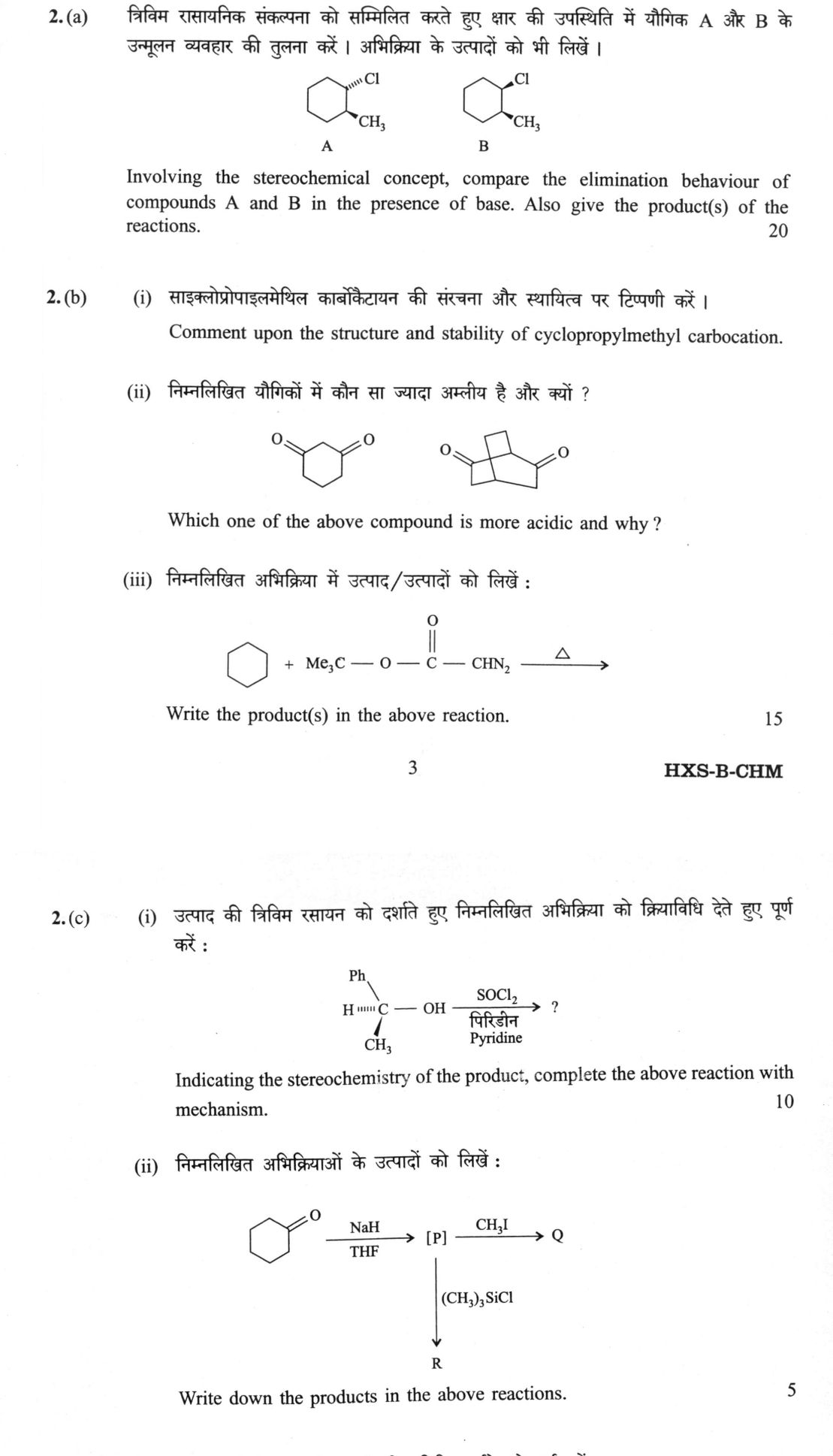
The figure this question refers to, in words
The question paper is a scan and the diagram did not survive as text. This is the figure as read from the original page — every component, value and label — so the question can be worked from the text below.
(a) Two chemical structures labeled A and B. Both are substituted cyclohexane rings. Structure A shows a cyclohexane ring with a chlorine atom (Cl) on a dashed bond (pointing away) and a methyl group (CH3) on a solid wedge bond (pointing towards) on adjacent carbons. Structure B shows a cyclohexane ring with a chlorine atom (Cl) on a solid wedge bond and a methyl group (CH3) on a solid wedge bond on adjacent carbons.
(b) Two chemical structures labeled A and B. Structure A is 1H-indene, a bicyclic aromatic compound consisting of a benzene ring fused to a five-membered ring containing one double bond. Structure B is cyclopentadiene, a five-membered ring containing two double bonds.
(c) Reaction scheme: Cyclohexanone (a six-membered ring with a ketone group) reacts with NaH in THF to form an intermediate labeled [P]. From [P], two reaction paths diverge: one path reacts with CH3I to form product Q; the other path reacts with (CH3)3SiCl to form product R.
Model answer
Written by UPSC Answer Check against this question's marking rubric, to the expected length. UPSC does not publish answers for Mains — this is one way to score well, not an official key.
Part (a) In (a), A is trans-1-chloro-2-methylcyclohexane (Cl dash, CH3 wedge) and B is cis (both wedge). E2 in a cyclohexane ring requires the C–Cl bond and the beta C–H bond to be anti-periplanar, which in a chair means trans-diaxial. A is most stable with both groups equatorial; the reactive conformer is the ring-flipped diaxial form, where Cl is axial but the C2 axial site is occupied by CH3. Hence no anti beta-H is available at C2, and only the axial H at C6 can be removed. A therefore gives only 3-methylcyclohex-1-ene, a less substituted Hofmann-type alkene, and reacts more slowly because the diaxial conformer is less populated. In B, the reactive conformer has Cl axial and CH3 equatorial; both C2 and C6 possess axial beta-H anti to Cl. Elimination toward C2 gives 1-methylcyclohex-1-ene, the more substituted Zaitsev product and major; elimination toward C6 gives 3-methylcyclohex-1-ene as minor. The cyclohexene products have no E/Z isomerism because the double bond is locked in the ring.
Part (b) (i) The cyclopropylmethyl cation is not a simple localized CH2+ ion. The vacant p orbital overlaps with the Walsh orbitals of the cyclopropane ring, giving a bridged bicyclobutonium/non-classical ion with a three-centre two-electron bond; this delocalization and homoaromatic character make it unusually stable. (ii) Among the drawn compounds, B, cyclopentadiene, is more acidic than A, 1H-indene. Deprotonation of B gives the cyclopentadienyl anion, a planar 6π aromatic anion with the charge delocalized over five equivalent carbons; indene gives an indenyl anion, also aromatic but with a larger 10π fused system and less incremental stabilization, so B has the lower pKa. The same conjugate-base principle explains cyclopropylmethyl acidity: the cyclopropylmethyl carbanion is stabilized by Walsh-orbital overlap and the higher effective s-character of bent cyclopropane C–C bonds, making such C–H bonds more acidic than ordinary alkyl C–H bonds. (iii) The acid–base reaction of the drawn A and B gives their conjugate bases, the indenyl anion and the cyclopentadienyl anion, the latter being the more stable product. The cyclopropylmethyl cation discussed in (i), when trapped by a nucleophile, gives the unrearranged cyclopropylmethyl product and, after ring expansion to the cyclobutyl cation, the cyclobutyl product; in solvolysis these are cyclopropylmethyl alcohol and cyclobutanol.
Part (c) NaH deprotonates cyclohexanone at the alpha carbon in THF to give the sodium enolate [P], represented by C- and O-enolate resonance forms. With CH3I, the carbon end of the enolate attacks methyl iodide by an SN2 process, displacing iodide; this C-alkylation gives Q, 2-methylcyclohexanone. No syn/anti addition is involved; because the enolate is planar, methyl can be introduced from either face, so Q is formed as a racemic pair, (R)- and (S)-2-methylcyclohexanone, shown as CH3 wedge in one enantiomer and CH3 dash in the other. With (CH3)3SiCl, the oxygen end of the enolate attacks silicon, chloride leaves, and R is the silyl enol ether 1-trimethylsiloxy-1-cyclohexene. The reaction is regioselective for O-silylation, while alkylation is C-selective; no E/Z isomerism arises in the cyclic enol ether. Thus, stereochemical constraints decide the alkene in (a), aromatic conjugate-base stability decides acidity in (b), and enolate face selectivity decides the stereochemical outcome in (c).
What "Compare" is asking you to do
Set the items against each other on named dimensions. In UPSC practice compare already carries both halves — likeness and difference — and where the stem names the dimensions, as in region, nature and climatic impact, those are the headings the examiner expects to see.
Structure that answers it
Dimensions named → both items on dimension 1 → dimension 2 → dimension 3 → where they converge and where they part
Where marks are lost
Two self-contained descriptive blocks with the comparison left for the reader to make. Marks here sit on the dimensions, so an answer that names none of them gives the examiner nothing to award.
How this answer will be evaluated
Approach
Framework: Concept > Structure or mechanism > Reasoning > Result. (a) compare: paired headings or table > key differences > significance > conclusion | (b(i)) comment: context > arguments both sides > judgment > close | (b(ii)) justify: claim > 3-4 reasons > evidence > conclusion | (b(iii)) enumerate: list the items in order > one line each > no commentary | (c(i)) explain: definition/context > points in order > small example > short close | (c(ii)) enumerate: list the items in order > one line each > no commentary Full marks: Accurate mechanisms, correct stereochemistry, clear reasoning for all parts.
Key points expected
- Identify A as trans-1-chloro-2-methylcyclohexane
- Identify B as cis-1-chloro-2-methylcyclohexane
- Apply anti-periplanar requirement for E2 elimination
- Show chair conformations for both isomers
- Draws the cyclopropylmethyl cation structure
- Identifies the empty p-orbital on the cationic carbon
- Shows overlap with the cyclopropane C-C sigma bond
- Explains stability via sigma-delocalization (hyperconjugation)
Evaluation rubric
Each sub-part is marked on its own, against the marks and word limit printed on the paper.
- (a) Compare elimination behavior of A and B using stereochemical concepts and provide products. 20 marks
compare— paired headings or table → key differences → significance → conclusion
Must cover
- Identify A as trans-1-chloro-2-methylcyclohexane
- Identify B as cis-1-chloro-2-methylcyclohexane
- Apply anti-periplanar requirement for E2 elimination
- Show chair conformations for both isomers
Loses marks
- Fails to show chair conformations
- Ignores anti-periplanar geometry
- Draws incorrect relative stereochemistry
Earns more
- Draws Newman projections for clarity
- Explains why A is slower (requires diaxial Cl/Me)
- Identifies 3-methylcyclohexene as product for A
- Identifies 1-methylcyclohexene as product for B
Extra mark
- Mentions Zaitsev vs Hofmann product ratios
- Notes steric hindrance in transition state
- (b(i)) Comment on the structure and stability of the cyclopropylmethyl carbocation.
comment— context → arguments both sides → judgment → close
Must cover
- Draws the cyclopropylmethyl cation structure
- Identifies the empty p-orbital on the cationic carbon
- Shows overlap with the cyclopropane C-C sigma bond
- Explains stability via sigma-delocalization (hyperconjugation)
Loses marks
- Claims it is unstable like a primary cation
- Fails to show orbital overlap
- Draws the wrong structure (e.g., cyclopropyl cation)
Earns more
- Mentions the 'bent bond' or Walsh orbital concept
- Compares stability to a simple primary carbocation
- Draws resonance-like structures showing charge distribution
Extra mark
- References the specific 'cyclopropylmethyl' cation name
- Mentions the planar geometry of the cationic center
- (b(ii)) Determine which compound is more acidic and provide the reason.
justify— claim → 3-4 reasons → evidence → conclusion
Must cover
- Identifies the more acidic compound (the bicyclic one)
- Draws the conjugate base (enolate) for the more acidic one
- Explains that the enolate is planar and stable
- Explains that the other enolate is destabilized by ring strain
Loses marks
- Selects the wrong compound as more acidic
- Fails to draw the conjugate base
- Attributes acidity to inductive effects only
Earns more
- Draws the non-planar enolate of the less acidic compound
- Mentions the loss of aromaticity (if applicable to the specific ring system)
- Uses the term 'geometric constraint' or 'steric clash'
Extra mark
- Provides pKa values if known
- Draws the specific transition state for deprotonation
- (b(iii)) Write the product(s) of the reaction between cyclohexene and the diazo ester.
enumerate— list the items in order → one line each → no commentary
Must cover
- Identifies the reaction as a Cope rearrangement
- Draws the cyclopropane ring in the product
- Shows the ester group attached to the cyclopropane
- Indicates the correct regiochemistry of the ester
Loses marks
- Draws a simple addition product (e.g., epoxide)
- Fails to form the cyclopropane ring
- Places the ester group on the wrong carbon
Earns more
- Draws the intermediate carbene or zwitterion
- Mentions the role of the metal catalyst (if implied)
- Shows the stereochemistry of the cyclopropane ring
Extra mark
- Names the specific reagent (e.g., diazoacetate)
- Mentions the 'Cope' name explicitly
- (c(i)) Complete the reaction with SOCl2/pyridine, showing mechanism and product stereochemistry. 10 marks
explain— definition/context → points in order → small example → short close
Must cover
- Draws the chlorosulfite intermediate
- Shows the SN2 backside attack by chloride
- Indicates inversion of configuration at the chiral center
- Draws the final alkyl chloride with inverted stereochemistry
Loses marks
- Shows retention of configuration
- Fails to show the chlorosulfite intermediate
- Draws the wrong product structure
Earns more
- Shows the leaving group (SO2 + Cl-) departure
- Uses wedge/dash notation correctly for the product
- Mentions the 'inversion' explicitly
Extra mark
- Draws the transition state for the SN2 step
- Mentions the role of pyridine as a base
- (c(ii)) Write the products P, Q, and R for the given reaction sequence. 5 marks
enumerate— list the items in order → one line each → no commentary
Must cover
- Identifies P as the sodium enolate of cyclohexanone
- Identifies Q as 2-methylcyclohexanone (alkylation product)
- Identifies R as the silyl enol ether (TMS enol ether)
- Draws the structures for P, Q, and R
Loses marks
- Draws P as the neutral ketone
- Fails to show the methyl group in Q
- Draws R as the silyl ether of the alcohol (wrong position)
Earns more
- Shows the resonance structures of the enolate P
- Indicates the kinetic vs thermodynamic enolate (if relevant)
- Draws the silyl group (TMS) correctly on the oxygen
Extra mark
- Mentions the 'TMS' abbreviation for trimethylsilyl
- Notes the regioselectivity of the alkylation
Practice this exact question
Write your answer and it is marked point by point against the model answer above — what you covered, what you missed, what you got wrong.
Evaluate my answer →More from Chemistry 2021 Paper II
- Q1 (a) In the reaction R—COO⁻ + Br—CN → R—CN + Br⁻ + CO₂↑ What is the origin of —CN group in…
- Q2 (a) Involving the stereochemical concept, compare the elimination behaviour of compounds…
- Q3 (a) Complete the following reactions with mechanisms: (i) Conc. H₂SO₄ (10 marks) (ii) EtO…
- Q4 (a) (i) Heating of 3-deuteroindene causes scrambling of the deuterium. Explain with mecha…
- Q5 (a) 2,4-Pentadione exhibits five signal in ¹H NMR spectrum. Account for the observation.…