Paper II — Q3
(a) Complete the following reactions with mechanisms: (i) Conc. H₂SO₄ (10 marks) (ii) EtO⁻ (10 marks) (b) (i) Write the…
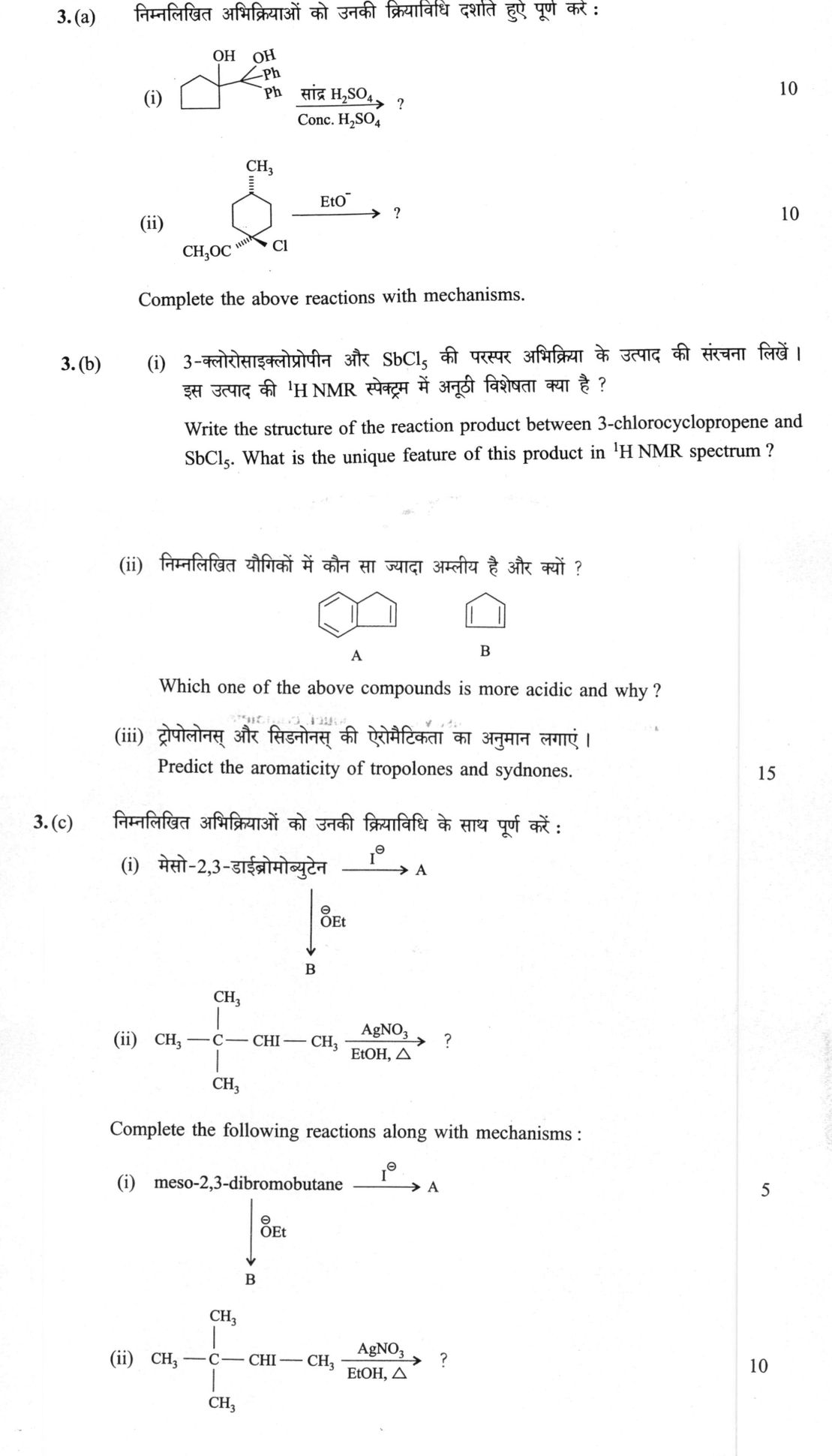
Complete the following reactions with mechanisms: Conc. H₂SO₄ 10 marks
EtO⁻ 10 marks
Write the structure of the reaction product between 3-chlorocyclopropene and SbCl₅. What is the unique feature of this product in ¹H NMR spectrum?
Which one of the above compounds is more acidic and why? (Structures A and B shown)
Predict the aromaticity of tropolones and sydnones.
Complete the following reactions along with mechanisms: meso-2,3-dibromobutane →(I⁻) A →(OEt⁻) B
CH₃—C—CHI—CH₃ →(AgNO₃, EtOH, Δ) ?
CH₃
हिंदी में प्रश्न पढ़ें
निम्नलिखित अभिक्रियाओं को उनकी क्रियाविधि दर्शाते हुए पूर्ण करें : Conc. H₂SO₄ 10 marks
EtO⁻ 10 marks
3-क्लोरोसाइक्लोप्रोपीन और SbCl₅ की परस्पर अभिक्रिया के उत्पाद की संरचना लिखें। इस उत्पाद की ¹H NMR स्पेक्ट्रम में अनूठी विशेषता क्या है?
निम्नलिखित यौगिकों में कौन सा ज्यादा अम्लीय है और क्यों? (A और B की संरचनाएं दिखाई गई हैं)
ट्रोपोलोन्स और सिड्नोन्स की ऐरोमैटिकता का अनुमान लगाएं।
निम्नलिखित अभिक्रियाओं को उनकी क्रियाविधि के साथ पूर्ण करें : मेसो-2,3-डाइब्रोमोब्यूटेन →(I⁻) A →(OEt⁻) B
CH₃—C—CHI—CH₃ →(AgNO₃, EtOH, Δ) ?
CH₃
The figure this question refers to, in words
The question paper is a scan and the diagram did not survive as text. This is the figure as read from the original page — every component, value and label — so the question can be worked from the text below.
(a) (i) Reaction of a 1,2-diol: A cyclopentane ring where the top-right carbon is bonded to an -OH group and also bonded to an exocyclic carbon atom. The exocyclic carbon is bonded to an -OH group and two phenyl groups (-Ph). The reaction arrow is labeled with 'Conc. H2SO4' (सांद्र H2SO4) leading to a question mark (?).
(ii) Reaction of a substituted cyclohexane: A six-membered ring where the top carbon has a dashed wedge to a -CH3 group, and the bottom carbon has two dashed bonds: one going down and to the left to a -CH3OC group, and one going down and to the right to a -Cl atom. The reaction arrow is labeled with EtO^- leading to a question mark (?).
(a(i)) A chemical reaction scheme. The reactant is a cyclopentane ring. At the 1-position, there is a hydroxyl group (OH) and a carbon atom bonded to two phenyl groups (Ph) and a hydroxyl group (OH). The reagent is concentrated sulfuric acid (Conc. H2SO4). The product is indicated by a question mark.
(a(ii)) A chemical reaction scheme. The reactant is a cyclohexane ring. At the 1-position, there is a methyl group (CH3) attached with a dashed wedge bond (pointing away). At the 3-position, there is a methoxycarbonyl group (CH3OC=O) attached with a dashed wedge bond and a chlorine atom (Cl) attached with a solid wedge bond (pointing towards). The reagent is ethoxide ion (EtO-). The product is indicated by a question mark.
(a(i)) A reaction scheme showing a starting material reacting with 'Conc. H2SO4' to form a product indicated by a question mark. The starting material is a cyclopentane ring. At the 1-position of the ring, there is a quaternary carbon atom bonded to a hydroxyl group (-OH) and a carbon atom that is part of a gem-diol group (a carbon atom bonded to two hydroxyl groups and two phenyl groups, -C(OH)2(Ph)2).
(a(ii)) A reaction scheme showing a starting material reacting with 'EtO-' to form a product indicated by a question mark. The starting material is a cyclohexane ring. At the 1-position, there is a chlorine atom (Cl) on a wedge bond (pointing up). At the 4-position, there is a methoxymethyl group (-CH2OCH3) on a wedge bond (pointing up). At the 3-position, there is a methyl group (CH3) on a dashed bond (pointing down).
(b) Two chemical structures labeled A and B. Structure A is 1H-indene, consisting of a benzene ring fused to a five-membered ring containing one double bond. Structure B is cyclopentadiene, a five-membered ring containing two double bonds.
(b(ii)) Two chemical structures labeled A and B. Structure A is 2,4-dihydroxybenzaldehyde (a benzene ring with an aldehyde group at position 1, and hydroxyl groups at positions 2 and 4). Structure B is 3,5-dihydroxybenzaldehyde (a benzene ring with an aldehyde group at position 1, and hydroxyl groups at positions 3 and 5).
(b(iii)) Two chemical structures labeled A and B. Structure A is tropolone (a seven-membered ring with three double bonds, one ketone group, and one hydroxyl group). Structure B is sydnone (a five-membered ring containing a nitrogen atom, a carbonyl group, and an N-oxide group, fused to a benzene ring).
(c) A reaction scheme showing a reactant structure: a central carbon atom bonded to a methyl group (CH3) on the left, a methyl group (CH3) on top, a methyl group (CH3) on the bottom, and a CHI group on the right, which is further bonded to a CH3 group. An arrow points to the right labeled with AgNO3 over EtOH, delta (heat symbol), leading to a question mark.
(c(i)) A reaction scheme. The starting material is meso-2,3-dibromobutane (CH3-CHBr-CHBr-CH3 with specific stereochemistry). It reacts with I- to form product A. Product A then reacts with OEt- to form product B.
(c(ii)) A reaction scheme. The starting material is 2-iodo-2-methylbutane (CH3-C(CH3)(I)-CH2-CH3). It reacts with AgNO3 in EtOH with heat (delta symbol) to form a product indicated by a question mark.
Model answer
Written by UPSC Answer Check against this question's marking rubric, to the expected length. UPSC does not publish answers for Mains — this is one way to score well, not an official key.
Part (a). (i) In conc. H₂SO₄ the alcohol oxygen is protonated, converting –OH into a good leaving group. Loss of water gives a planar tertiary/benzylic carbocation; the step is E1-like, and the transition state has substantial carbocation character. If the substrate is a vicinal diol, protonation occurs preferentially at the OH that gives the more stable benzylic cation. A base in the medium then removes a β-H from the adjacent carbon, and the C–H electrons form the C=C. The product is the Zaitsev alkene, i.e. the more substituted, diphenyl-stabilised exocyclic alkene, because both the carbocation and the alkene are maximally substituted. (ii) EtO⁻ is a strong, small base, so the secondary cyclohexyl chloride undergoes E2. In the reactive chair conformer the C–Cl bond must be axial; the ethoxide lone pair abstracts only the β-H that is trans-diaxial/anti-periplanar to Cl. The C–H bond electrons form the π bond as the C–Cl bond breaks, giving a single stereospecific cyclohexene. The product is the cyclohexene in which the double bond is between the carbon bearing Cl and the β-carbon carrying the anti-H; in the drawn 1-methyl-3-methoxycarbonyl system this is the more substituted endocyclic alkene. If a ring flip is needed to make Cl axial, that conformer is the one that reacts; the anti-periplanar requirement, not simple Zaitsev preference alone, fixes the alkene position and geometry.
Part (b). (i) SbCl₅ acts as a Lewis acid and removes Cl⁻ from 3-chlorocyclopropene, giving [C₃H₃]⁺[SbCl₆]⁻. The cyclopropenyl cation has three p orbitals and 2π electrons, so it is Hückel-aromatic (4n+2, n=0). Its ¹H NMR spectrum shows one sharp singlet because the three protons are symmetry-equivalent and the aromatic ring current shields them, giving an unusually high-field peak. (ii) The stronger acid is the compound whose conjugate base is stabilised by the aromatic 2π cyclopropenyl cationic system. The other would generate a 4π cyclopropenyl anion, which is antiaromatic and therefore much less stable. This is the same principle that makes 2π cyclopropenyl cations unusually stable and 4π cyclopropenyl anions unusually reactive. Hence B, the cation-forming case, is more acidic than A. (iii) Tropolone is aromatic: the seven-membered ring contains a 10π delocalised system (three C=C bonds, the C=O π bond and an oxygen lone pair, 4n+2, n=2), reinforced by zwitterionic cycloheptatrienyl-oxide resonance. Sydnone is also aromatic: the five-membered oxadiazolone ring has 6π electrons, with the N-oxide and carbonyl groups contributing to a planar Hückel-aromatic π system. Both are planar and show diamagnetic ring currents; tropolone’s aromaticity explains its low reactivity toward addition, while sydnone’s aromaticity is consistent with its stable N-oxide resonance.
Part (c). (i) I⁻ attacks one stereocentre of meso-2,3-dibromobutane from the back side by SN2. The C–Br bond breaks as the C–I bond forms, inverting that centre and destroying the internal mirror plane; A is therefore chiral 2-iodo-3-bromobutane. If the starting meso is (2R,3S), attack at C-2 gives (2S,3S); attack at C-3 gives the enantiomer, so A is chiral, racemic if both centres are attacked equally. Ethoxide then gives E2: it removes the β-H anti-periplanar to the leaving group, and simultaneous C–H and C–X bond cleavage gives trans-2-butene B. The inversion in the substitution step followed by anti elimination is what fixes the trans alkene. (ii) Ag⁺ coordinates to iodine and AgI precipitates, so the neopentyl-type iodide ionises to a secondary carbocation next to a quaternary carbon. Direct SN2 is sterically blocked, and the cation undergoes a 1,2-methyl shift: the C–CH₃ σ bond migrates to the cationic centre, giving a tertiary carbocation. In ethanol, attack by EtOH followed by deprotonation gives the rearranged ether, 2-ethoxy-2,3-dimethylbutane; under heat, E1 elimination from the same tertiary cation gives the rearranged Zaitsev alkene, 2,3-dimethyl-2-butene. Thus the products follow from Ag⁺-assisted ionisation, rearrangement to the most stable cation, and then either nucleophilic capture or heat-favoured elimination. These mechanisms show that product distribution is controlled by intermediate stability and stereoelectronic alignment.
What "Explain" is asking you to do
Make the working of something clear — what sets it off, what follows from what, and what it produces. Explain is the Commission's mechanism word: it dominates the technical papers and the “explain why” stems, where the marks sit in the causal chain and not in the label.
Structure that answers it
State what it is → the initiating condition → the chain of cause, step by step → an instance where it plays out → what the chain produces
Where marks are lost
Describing what something looks like instead of why it works that way. Naming the stages without linking them reads as description too.
How this answer will be evaluated
Approach
(a(i)) describe: define > structure or process in order > labelled diagram > significance | (a(ii)) describe: define > structure or process in order > labelled diagram > significance | (b(i)) describe: define > structure or process in order > labelled diagram > significance | (b(ii)) justify: claim > 3-4 reasons > evidence > conclusion | (b(iii)) explain: definition/context > points in order > small example > short close | (c(i)) describe: define > structure or process in order > labelled diagram > significance | (c(ii)) describe: define > structure or process in order > labelled diagram > significance Full marks: Complete mechanisms with correct stereochemistry and electronic reasoning
Key points expected
- Protonation of hydroxyl group
- Loss of water to form carbocation
- 1,2-hydride shift to form stable cation
- Elimination to form conjugated alkene
- Identification of anti-periplanar geometry
- E2 elimination mechanism
- Formation of double bond
- Correct stereochemical outcome
Evaluation rubric
Each sub-part is marked on its own, against the marks and word limit printed on the paper.
- (a(i)) Product and mechanism for acid-catalyzed dehydration of the diol. 10 marks
describe— define → structure or process in order → labelled diagram → significance
Must cover
- Protonation of hydroxyl group
- Loss of water to form carbocation
- 1,2-hydride shift to form stable cation
- Elimination to form conjugated alkene
Loses marks
- Missing carbocation rearrangement step
- Incorrect final alkene structure
Earns more
- Mention of phenyl group stabilization
- Correct stereochemistry of product
Extra mark
- Mention of Zaitsev's rule
- (a(ii)) Product and mechanism for elimination of the chloro-ether cyclohexane. 10 marks
describe— define → structure or process in order → labelled diagram → significance
Must cover
- Identification of anti-periplanar geometry
- E2 elimination mechanism
- Formation of double bond
- Correct stereochemical outcome
Loses marks
- Ignoring stereochemical requirements
- Wrong product regiochemistry
Earns more
- Discussion of steric hindrance
- Mention of base strength
Extra mark
- Drawing of Newman projection
- (b(i)) Structure of product from 3-chlorocyclopropene and SbCl5 and its NMR feature.
describe— define → structure or process in order → labelled diagram → significance
Must cover
- Formation of cyclopropenyl cation
- Structure of the cationic product
- Identification of aromaticity (2 pi electrons)
- Explanation of NMR signal (upfield shift)
Loses marks
- Failure to identify aromaticity
- Incorrect NMR prediction
Earns more
- Mention of Hückel's rule
- Specific chemical shift value
Extra mark
- Comparison with benzene NMR
- (b(ii)) Comparison of acidity between compounds A and B with reasoning.
justify— claim → 3-4 reasons → evidence → conclusion
Must cover
- Identification of more acidic compound
- Stability of conjugate base
- Resonance delocalization explanation
- Aromaticity of the anion
Loses marks
- Wrong compound identified
- Missing resonance argument
Earns more
- Drawing of resonance structures
- Mention of hybridization
Extra mark
- pKa values if known
- (b(iii)) Prediction of aromaticity for tropolones and sydnones. 15 marks
explain— definition/context → points in order → small example → short close
Must cover
- Analysis of tropolone aromaticity
- Analysis of sydnone aromaticity
- Application of Hückel's rule
- Counting of pi electrons
Loses marks
- Incorrect electron count
- Failure to apply Hückel's rule
Earns more
- Drawing of resonance structures
- Mention of zwitterionic character
Extra mark
- Mention of specific ring current effects
- (c(i)) Products A and B from meso-2,3-dibromobutane reactions. 5 marks
describe— define → structure or process in order → labelled diagram → significance
Must cover
- Formation of product A (iodide substitution)
- Formation of product B (elimination)
- Mechanism for each step
- Stereochemical outcome
Loses marks
- Wrong product structures
- Missing mechanism steps
Earns more
- Mention of SN2 vs E2
- Correct stereochemistry of products
Extra mark
- Mention of meso compound properties
- (c(ii)) Product and mechanism for reaction with AgNO3 in ethanol. 10 marks
describe— define → structure or process in order → labelled diagram → significance
Must cover
- Formation of carbocation intermediate
- 1,2-methyl shift rearrangement
- Formation of stable tertiary cation
- Substitution product formation
Loses marks
- Missing rearrangement step
- Wrong final product
Earns more
- Mention of SN1 mechanism
- Correct stereochemistry of product
Extra mark
- Mention of silver ion role
Practice this exact question
Write your answer and it is marked point by point against the model answer above — what you covered, what you missed, what you got wrong.
Evaluate my answer →More from Chemistry 2021 Paper II
- Q1 (a) In the reaction R—COO⁻ + Br—CN → R—CN + Br⁻ + CO₂↑ What is the origin of —CN group in…
- Q2 (a) Involving the stereochemical concept, compare the elimination behaviour of compounds…
- Q3 (a) Complete the following reactions with mechanisms: (i) Conc. H₂SO₄ (10 marks) (ii) EtO…
- Q4 (a) (i) Heating of 3-deuteroindene causes scrambling of the deuterium. Explain with mecha…
- Q5 (a) 2,4-Pentadione exhibits five signal in ¹H NMR spectrum. Account for the observation.…
- Q6 (a)(i) The molecule obtained on treatment of acetone with dilute sodium hydroxide exhibit…