Paper II — Q4
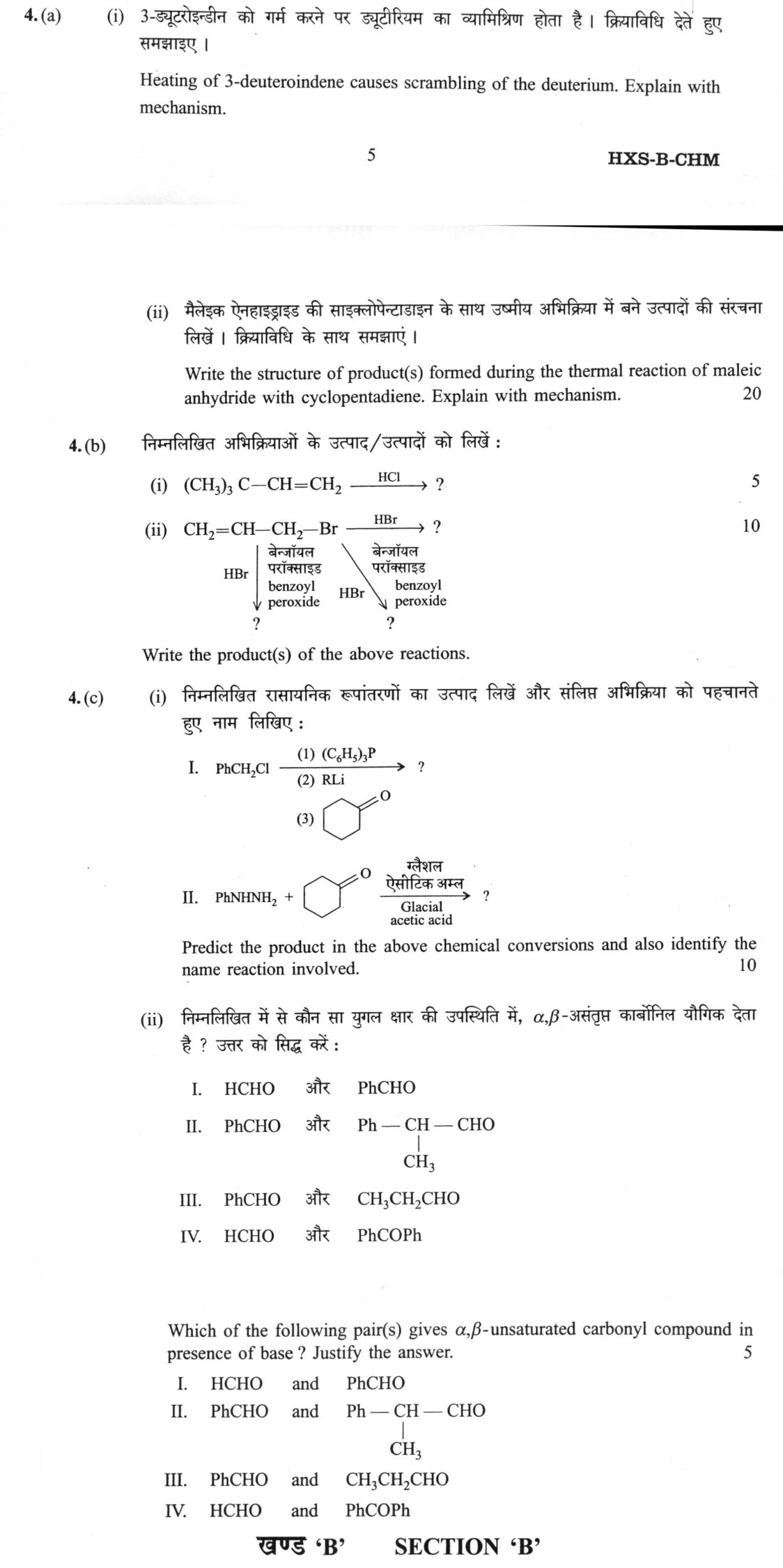
(a) (i) Heating of 3-deuteroindene causes scrambling of the deuterium. Explain with mechanism. (20 marks) (ii) Write the…
Heating of 3-deuteroindene causes scrambling of the deuterium. Explain with mechanism. 20 marks
Write the structure of product(s) formed during the thermal reaction of maleic anhydride with cyclopentadiene. Explain with mechanism. 20 marks
Write the product(s) of the following reactions: (CH₃)₃C—CH=CH₂ →(HCl) ? 5 marks
CH₂=CH—CH₂—Br →(HBr, benzoyl peroxide) ? 10 marks
Predict the product in the above chemical conversions and also identify the name reaction involved. (10 marks) I. PhCH₂Cl →(1) (C₆H₅)₃P (2) RLi (3) [cyclohexanone structure] ? II. PhNHNH₂ + [cyclohexanone structure] →(Glacial acetic acid) ?
Which of the following pair(s) gives α,β-unsaturated carbonyl compound in presence of base? Justify the answer. I. HCHO and PhCHO II. PhCHO and Ph—CH—CHO
CH₃ III. PhCHO and CH₃CH₂CHO IV. HCHO and PhCOPh
हिंदी में प्रश्न पढ़ें
3-ड्यूटेरोइंडीन को गर्म करने पर ड्यूटीरियम का व्यामिश्रण होता है। क्रियाविधि देते हुए समझाइए। 20 marks
मेलेइक ऐनहाइड्राइड की साइक्लोपेंटाडाइन के साथ उष्मीय अभिक्रिया में बने उत्पादों की संरचना लिखें। क्रियाविधि के साथ समझाइए। 20 marks
निम्नलिखित अभिक्रियाओं के उत्पाद/उत्पादों को लिखें : (CH₃)₃C—CH=CH₂ →(HCl) ? 5 marks
CH₂=CH—CH₂—Br →(HBr, बेंजॉयल परॉक्साइड) ? 10 marks
निम्नलिखित रासायनिक रूपांतरणों का उत्पाद लिखें और संलग्न अभिक्रिया को पहचानते हुए नाम लिखिए। (10) I. PhCH₂Cl →(1) (C₆H₅)₃P (2) RLi (3) [साइक्लोहेक्सनोन संरचना] ? II. PhNHNH₂ + [साइक्लोहेक्सनोन संरचना] →(मैशल, Glacial acetic acid) ?
निम्नलिखित में से कौन सा युगल क्षार की उपस्थिति में, α,β-असंतृप्त कार्बोनिल यौगिक देता है? उत्तर को सिद्ध करें : I. HCHO और PhCHO II. PhCHO और Ph—CH—CHO
CH₃ III. PhCHO और CH₃CH₂CHO IV. HCHO और PhCOPh
The figure this question refers to, in words
The question paper is a scan and the diagram did not survive as text. This is the figure as read from the original page — every component, value and label — so the question can be worked from the text below.
(b) Reaction scheme for 4(b)(ii): The starting material is 3-bromoprop-1-ene (CH2=CH-CH2-Br). There are three reaction arrows originating from this structure. The first arrow points to the right with 'HBr' written above it, leading to a question mark. The second arrow points downwards with 'HBr' and 'benzoyl peroxide' written to the left of the arrow, leading to a question mark. The third arrow points diagonally down-right with 'HBr' and 'benzoyl peroxide' written to the right of the arrow, leading to a question mark.
(c) Chemical structure for pair II: A benzene ring attached to a CH group, which is attached to a CHO group. The CH group is also attached to a CH3 group below it.
Model answer
Written by UPSC Answer Check against this question's marking rubric, to the expected length. UPSC does not publish answers for Mains — this is one way to score well, not an official key.
(a)(i) Heating 3-deuteroindene causes isotope scrambling by a concerted [1,5]-sigmatropic shift of D/H in the five-membered ring. The C–D σ bond and the four π electrons of the conjugated diene portion of indene form a six-electron cyclic transition state; the six-electron count includes the migrating σ bond and two π bonds, so suprafacial migration is thermally allowed by orbital symmetry. The deuterium label migrates from C-3 to C-1, while the reverse shift moves a hydrogen from C-1 to C-3, interconverting 3-deutero- and 1-deuteroindene. Because the process is reversible and no discrete carbocation is formed, repeated shifts distribute D between C-1 and C-3, so the original label is scrambled.
(a)(ii) Cyclopentadiene and maleic anhydride undergo a thermal Diels–Alder [4+2] cycloaddition. Cyclopentadiene is locked in the s-cis conformation and reacts suprafacially with the electron-poor dienophile through a chair-like transition state. The product is the endo-cis bicyclo[2.2.1]hept-5-ene-2,3-dicarboxylic anhydride, commonly called endo-cis-5-norbornene-2,3-dicarboxylic anhydride. The reaction is stereospecific: the cis dienophile gives a cis anhydride in the bicyclic product. The endo adduct is favoured kinetically because secondary orbital interactions between the diene π system and the dienophile carbonyl π* orbitals stabilise the endo transition state.
(b)(i) HCl adds to 3,3-dimethyl-1-butene initially by Markovnikov protonation at the terminal carbon, giving a secondary carbocation at C-2. This cation is adjacent to a quaternary carbon, so a 1,2-methyl shift from C-3 to C-2 gives a more stable tertiary carbocation. The rearrangement occurs because a tertiary cation is more stable than the initially formed secondary cation, and the shift is faster than direct chloride capture. Chloride attack on the rearranged cation gives 2-chloro-2,3-dimethylbutane as the major product.
(b)(ii) In the presence of benzoyl peroxide, HBr adds to allyl bromide by the peroxide or Kharasch radical chain, giving anti-Markovnikov addition. Benzoyl peroxide homolyses to radicals, which generate Br• from HBr. In propagation, Br• adds to the terminal alkene carbon to form the more stable secondary radical BrCH₂–CH•–CH₂Br; this radical abstracts H from HBr to give 1,3-dibromopropane and regenerate Br•. Termination by radical combination is possible but does not affect the chain product. Thus the product is 1,3-dibromopropane, not the ionic Markovnikov adduct.
(c)(i) I. PhCH₂Cl reacts with PPh₃ to give benzyltriphenylphosphonium chloride; RLi deprotonates it to the ylide PhCH=PPh₃. With cyclohexanone this is a Wittig reaction: the ylide attacks the carbonyl, the oxaphosphetane collapses, and benzylidenecyclohexane is formed, i.e. cyclohexane with an exocyclic =CHPh group. The driving force is formation of the strong P=O bond. II. Cyclohexanone and phenylhydrazine in glacial acetic acid condense to cyclohexanone phenylhydrazone. Mechanistically, the hydrazine nitrogen adds to the carbonyl carbon, followed by proton transfer and loss of water. The named transformation is phenylhydrazone or hydrazone formation; under these mild acetic acid conditions the product is the hydrazone, not a reduced methylene compound.
(c)(ii) A base-catalysed crossed aldol condensation giving an α,β-unsaturated carbonyl requires one enolizable partner and one non-enolizable partner, so that the enolate attacks the non-enolizable carbonyl and self-condensation is minimised. Pair I (HCHO/PhCHO) and pair IV (HCHO/PhCOPh) both contain two components without α-hydrogens, so no enolate and no aldol product can form. Formaldehyde and benzaldehyde/benzophenone cannot enolise; therefore they cannot furnish the aldol β-hydroxy intermediate. Pair II (PhCHO/PhCH(CH₃)CHO) and pair III (PhCHO/CH₃CH₂CHO) satisfy the requirement: benzaldehyde has no α-H, while 2-phenylpropanal and propanal have α-H. In pair II, the enolate of 2-phenylpropanal adds to benzaldehyde, and the resulting β-hydroxy aldehyde dehydrates to the corresponding crossed α,β-unsaturated aldehyde. In pair III the product is 2-methyl-3-phenylprop-2-enal. Hence pairs II and III give α,β-unsaturated carbonyl compounds.
What "Explain" is asking you to do
Make the working of something clear — what sets it off, what follows from what, and what it produces. Explain is the Commission's mechanism word: it dominates the technical papers and the “explain why” stems, where the marks sit in the causal chain and not in the label.
Structure that answers it
State what it is → the initiating condition → the chain of cause, step by step → an instance where it plays out → what the chain produces
Where marks are lost
Describing what something looks like instead of why it works that way. Naming the stages without linking them reads as description too.
How this answer will be evaluated
Approach
(a(i)) explain: definition/context > points in order > small example > short close | (a(ii)) explain: definition/context > points in order > small example > short close | (b(i)) explain: definition/context > points in order > small example > short close | (b(ii)) explain: definition/context > points in order > small example > short close | (c(i)) describe: define > structure or process in order > labelled diagram > significance | (c(ii)) justify: claim > 3-4 reasons > evidence > conclusion Full marks: Complete mechanisms with correct stereochemistry and named reactions
Key points expected
- Identify [1,3]-sigmatropic shift mechanism
- Show suprafacial migration of deuterium
- Draw transition state with orbital overlap
- Explain thermodynamic driving force
- Identify Diels-Alder reaction
- Draw concerted [4+2] cycloaddition mechanism
- Show correct endo/exo stereochemistry
- Name the specific product structure
Evaluation rubric
Each sub-part is marked on its own, against the marks and word limit printed on the paper.
- (a(i)) Mechanism for deuterium scrambling in 3-deuteroindene upon heating. 5 marks
explain— definition/context → points in order → small example → short close
Must cover
- Identify [1,3]-sigmatropic shift mechanism
- Show suprafacial migration of deuterium
- Draw transition state with orbital overlap
- Explain thermodynamic driving force
Loses marks
- Missing arrow-pushing mechanism
- Incorrect orbital symmetry
Earns more
- Mention Woodward-Hoffmann rules
- Note stereochemical outcome
Extra mark
- Draw energy profile diagram
- (a(ii)) Structure and mechanism for thermal reaction of maleic anhydride with cyclopentadiene. 20 marks
explain— definition/context → points in order → small example → short close
Must cover
- Identify Diels-Alder reaction
- Draw concerted [4+2] cycloaddition mechanism
- Show correct endo/exo stereochemistry
- Name the specific product structure
Loses marks
- Product without mechanism
- Incorrect stereochemistry
Earns more
- Explain endo rule preference
- Mention orbital symmetry requirements
Extra mark
- Draw transition state geometry
- (b(i)) Product of (CH₃)₃C—CH=CH₂ with HCl. 5 marks
explain— definition/context → points in order → small example → short close
Must cover
- Show Markovnikov addition product
- Identify carbocation intermediate
- Explain regioselectivity
Loses marks
- Anti-Markovnikov product
- Missing carbocation intermediate
Earns more
- Mention steric hindrance effects
- (b(ii)) Products of CH₂=CH—CH₂—Br with HBr under peroxide conditions. 10 marks
explain— definition/context → points in order → small example → short close
Must cover
- Show anti-Markovnikov addition
- Identify radical mechanism
- Draw radical chain propagation steps
- Explain peroxide effect
Loses marks
- Markovnikov product
- Missing radical intermediates
Earns more
- Compare with ionic mechanism
- Mention radical stability
- (c(i)) Products and named reactions for PhCH₂Cl and PhNHNH₂ conversions. 10 marks
describe— define → structure or process in order → labelled diagram → significance
Must cover
- Identify Wittig reaction for I
- Identify Wolff-Kishner reduction for II
- Draw correct alkene product for I
- Draw cyclohexane product for II
Loses marks
- Wrong named reaction
- Incorrect product structure
Earns more
- Show ylide formation mechanism
- Mention reaction conditions
Extra mark
- Draw intermediate structures
- (c(ii)) Identify pair(s) giving α,β-unsaturated carbonyl in base with justification. 5 marks
justify— claim → 3-4 reasons → evidence → conclusion
Must cover
- Identify valid aldol condensation pairs
- Explain enolate formation requirement
- Justify based on α-hydrogen availability
- Show dehydration step
Loses marks
- Missing α-hydrogen analysis
- No dehydration explanation
Earns more
- Mention crossed aldol selectivity
- Note steric factors
Practice this exact question
Write your answer and it is marked point by point against the model answer above — what you covered, what you missed, what you got wrong.
Evaluate my answer →More from Chemistry 2021 Paper II
- Q1 (a) In the reaction R—COO⁻ + Br—CN → R—CN + Br⁻ + CO₂↑ What is the origin of —CN group in…
- Q2 (a) Involving the stereochemical concept, compare the elimination behaviour of compounds…
- Q3 (a) Complete the following reactions with mechanisms: (i) Conc. H₂SO₄ (10 marks) (ii) EtO…
- Q4 (a) (i) Heating of 3-deuteroindene causes scrambling of the deuterium. Explain with mecha…
- Q5 (a) 2,4-Pentadione exhibits five signal in ¹H NMR spectrum. Account for the observation.…
- Q6 (a)(i) The molecule obtained on treatment of acetone with dilute sodium hydroxide exhibit…
- Q7 7.(a) Complete the above reaction sequence by writing the structures of A, B and C. I. C₆…