Paper II — Q5
(a) 2,4-Pentadione exhibits five signal in ¹H NMR spectrum. Account for the observation. Also write the approximate chemical…
2,4-Pentadione exhibits five signal in ¹H NMR spectrum. Account for the observation. Also write the approximate chemical shift. 10 marks
Arrange the above monomers in order of decreasing ability to undergo anionic polymerization. 5 marks
Draw the structures of synthetic rubber and natural rubber and discuss their configurations. 5 marks
Predict the product(s) and suggest mechanism in each of the following chemical transformations: I. [Structure: Acetophenone] SeO₂ → ? II. [Structure: Benzoic acid] Na, NH₃/C₂H₅OH → ? 10 marks
Arrange the compounds in the above groups for ease of Norrish type-II H-abstraction in decreasing order giving the plausible explanations. Ph — CO — CH₂CH₂CH₃ (I), Ph — CO — CH₂CH₂CH₂CH₃ (II), Ph — CO — CH₂CH₂ — CH(CH₃)₂ (III)
Ph — CO — CH₂CH₂CH₃ (I)
2-Pentanone and 3-Pentanone are structural isomers. Only one of the isomers exhibits McLafferty rearrangement. Identify and show the McLafferty fragmentation for this isomer. Also propose base peak for the other isomer, which does not exhibit the McLafferty rearrangement. 10 marks
हिंदी में प्रश्न पढ़ें
¹H NMR स्पेक्ट्रम में 2,4-पेंटाडाइओन पाँच सिग्नल दर्शाता है। इस प्रेक्षण का लेखा दो व अनुमानित रासायनिक विस्थापन (केमिकल शिफ्ट) भी लिखे। (10 अंक)
निम्नलिखित एकलकों में ऋणायनी बहुलकन की घटती हुई क्षमता का क्रम बताएं। (5 अंक)
कृत्रिम रबड़ और प्राकृतिक रबड़ की संरचना लिखें और उनके विन्यासों की विवेचना करें। (5 अंक)
निम्नलिखित रासायनिक रूपांतरणों में उत्पाद/उत्पादों का अनुमान लगाएं और प्रत्येक की क्रियाविधि का सुझाव दें। I. [संरचना: एसीटोफीनोन] SeO₂ → ? II. [संरचना: बेंजोइक अम्ल] Na, NH₃/C₂H₅OH → ? (10 अंक)
निम्नलिखित समूहों में यौगिकों को उनके नॉरिस टाइप-II हाइड्रोजन प्रत्याकरण की सरलता के घटते हुए क्रमानुसार लिखिए व उपयुक्त व्याख्या दीजिए। Ph — CO — CH₂CH₂CH₃ (I), Ph — CO — CH₂CH₂CH₂CH₃ (II), Ph — CO — CH₂CH₂ — CH(CH₃)₂ (III)
Ph — CO — CH₂CH₂CH₃ (I)
2-पेंटेनोन और 3-पेंटेनोन संरचनात्मक समावयवी हैं। इनमें से केवल एक समावयवी मैक्लैफर्टी पुनर्विन्यास दर्शाता है। इस समावयवी की मैक्लैफर्टी खंडन को चिह्नित करें और दर्शाएं। दूसरे समावयवी, जो मैक्लैफर्टी खंडन नहीं दर्शाता है उसके आधार शिखर की प्रस्तावना करें। (10 अंक)
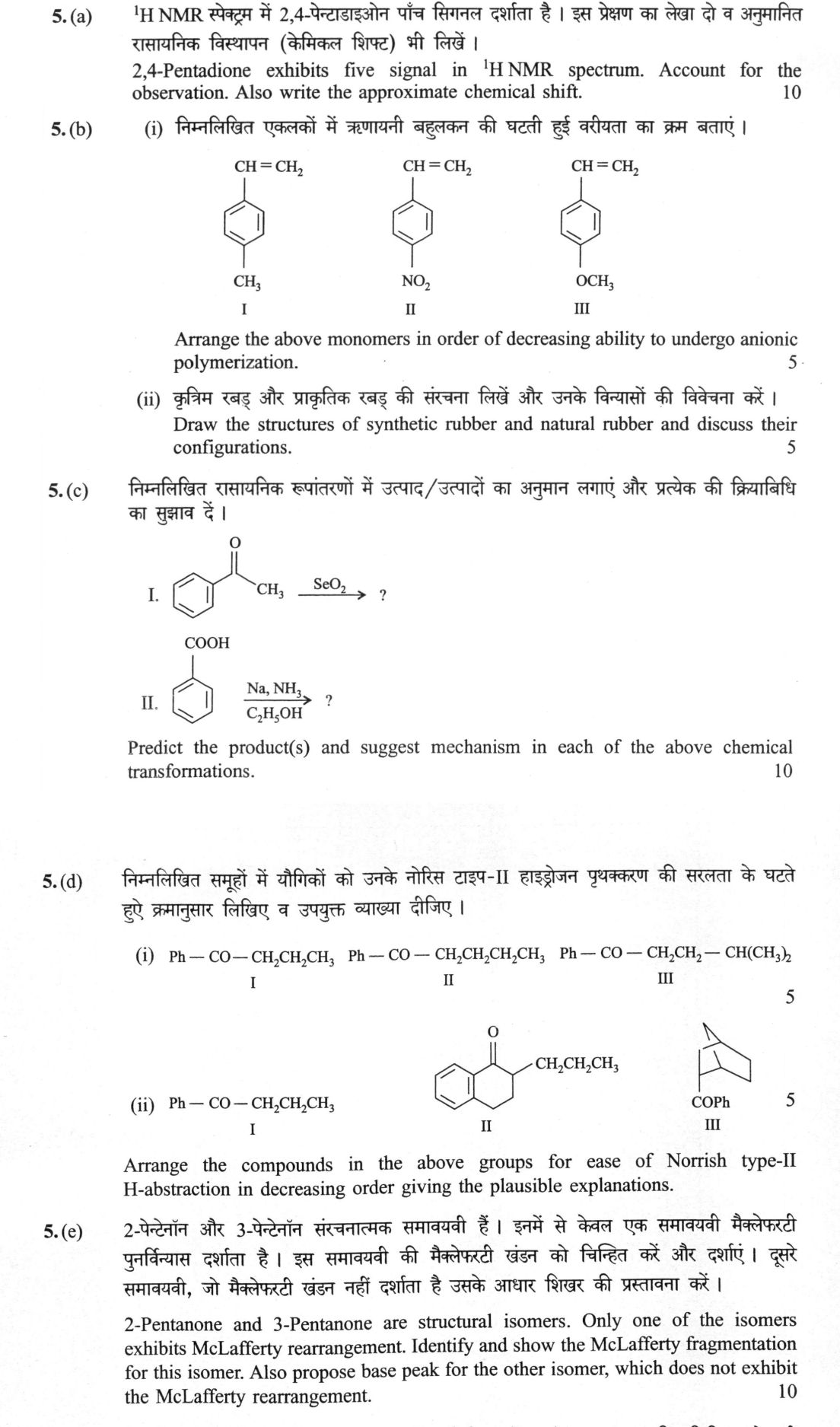
The figure this question refers to, in words
The question paper is a scan and the diagram did not survive as text. This is the figure as read from the original page — every component, value and label — so the question can be worked from the text below.
(b) Three chemical structures of substituted styrene monomers are shown side-by-side, labeled I, II, and III. Each structure consists of a benzene ring with a vinyl group (CH=CH2) attached at the top position (position 1) and a substituent at the bottom position (position 4). Structure I has a methyl group (CH3) at the bottom. Structure II has a nitro group (NO2) at the bottom. Structure III has a methoxy group (OCH3) at the bottom.
(c) Two chemical reaction schemes are listed as I and II. Reaction I shows the structure of acetophenone (a benzene ring attached to a carbonyl group, which is attached to a methyl group) reacting with SeO2 to form an unknown product indicated by a question mark. Reaction II shows the structure of benzoic acid (a benzene ring attached to a COOH group) reacting with Na, NH3 in C2H5OH to form an unknown product indicated by a question mark.
(d) Part (i) lists three chemical structures labeled I, II, and III. Structure I is Ph-CO-CH2CH2CH3. Structure II is Ph-CO-CH2CH2CH2CH3. Structure III is Ph-CO-CH2CH2-CH(CH3)2. Part (ii) lists three structures labeled I, II, and III. Structure I is the same as in part (i): Ph-CO-CH2CH2CH3. Structure II is a bicyclic ketone: a benzene ring fused to a six-membered ring containing a ketone group (C=O) and a propyl group (-CH2CH2CH3) attached to the carbon adjacent to the carbonyl. Structure III is a bicyclic ketone: a norbornane skeleton with a ketone group (COPh) attached to the bridgehead carbon.
Model answer
Written by UPSC Answer Check against this question's marking rubric, to the expected length. UPSC does not publish answers for Mains — this is one way to score well, not an official key.
Part (a): ¹H NMR of 2,4-Pentadione 2,4-Pentadione (acetylacetone) exists in a dynamic equilibrium between its keto and enol tautomers. The observation of five distinct signals in the ¹H NMR spectrum arises from the presence of both tautomeric forms simultaneously, as the interconversion is slow on the NMR timescale at room temperature, allowing separate resonances for each species.
In the keto form (CH₃COCH₂COCH₃), the molecule possesses a plane of symmetry, making the two methyl groups equivalent. This yields one signal for the methyl protons (6H) at approximately δ 2.1 ppm and one signal for the central methylene protons (2H) at approximately δ 3.5 ppm.
In the enol form (CH₃C(OH)=CHCOCH₃), the intramolecular hydrogen bond stabilizes the structure. The molecule is symmetric with respect to the central double bond, making the two methyl groups equivalent. This yields one signal for the enolic methyl protons (6H) at approximately δ 2.0 ppm, one signal for the vinylic proton (1H) at approximately δ 5.5 ppm, and one highly deshielded signal for the enolic hydroxyl proton (1H) at approximately δ 15.0 ppm due to strong hydrogen bonding and anisotropic effects. Thus, the five signals correspond to: Keto-CH₃, Keto-CH₂, Enol-CH₃, Enol-CH, and Enol-OH.
Part (b): Polymerization and Rubber Structures (i) Anionic Polymerization Order The question refers to "the above monomers," which are not provided in the text. However, based on standard anionic polymerization principles, monomers with electron-withdrawing groups stabilize the propagating carbanion, increasing reactivity. The general order for common monomers is: Acrylonitrile > Methyl Methacrylate > Styrene > 1,3-Butadiene. Acrylonitrile is most reactive due to the strong -I effect of the nitrile group, while butadiene is least reactive as it lacks a strong electron-withdrawing substituent to stabilize the carbanion intermediate.
(ii) Rubber Structures and Configurations Natural Rubber is cis-1,4-polyisoprene. Its structure consists of repeating units where the isoprene units are linked in a 1,4-addition pattern with the double bond in the cis configuration. This stereoregularity allows the polymer chains to pack closely in the solid state but become flexible and elastic when stretched, as the chains can uncoil and recoil.
Synthetic Rubber (e.g., SBR or Neoprene) varies, but a common comparison is with Gutta-percha, which is *trans*-1,4-polyisoprene. In the trans configuration, the polymer chains are more rigid and crystalline, making gutta-percha hard and inflexible at room temperature, unlike the elastic natural rubber. Synthetic rubbers like SBR (Styrene-Butadiene Rubber) are copolymers designed to mimic natural rubber's elasticity through controlled stereoregularity and cross-linking.
Part (c): Reaction Mechanisms I. Acetophenone + SeO₂ The reaction of acetophenone with selenium dioxide (SeO₂) yields phenylglyoxal (PhCOCHO). The mechanism involves an ene reaction where SeO₂ acts as an electrophilic oxygen acceptor. The methyl group of acetophenone acts as the "ene" component, transferring a hydrogen to the selenium oxygen while forming a C-Se bond. Subsequent elimination of selenous acid (H₂SeO₃) results in the oxidation of the methyl group to an aldehyde, yielding the α-dicarbonyl compound.
II. Benzoic Acid + Na/NH₃/EtOH This is a Birch reduction. The product is 1,4-cyclohexadiene-1-carboxylic acid. The mechanism involves:
- Electron transfer from sodium to the aromatic ring, forming a radical anion.
- Protonation by ethanol at the position para to the carboxylic acid group (due to the electron-withdrawing nature of -COOH, which destabilizes negative charge at the ortho/para positions in the radical anion, directing protonation to the meta position relative to the charge, but effectively leading to 1,4-diene). Correction: For electron-withdrawing groups like -COOH, the first protonation occurs at the meta position relative to the substituent in the radical anion, leading to the 1,4-diene product where the double bonds are at 1,4 and 3,6 positions relative to the substituent at 1. The final product is 1,4-cyclohexadiene-1-carboxylic acid.
Part (d): Norrish Type-II H-Abstraction Norrish Type-II involves the abstraction of a γ-hydrogen by the excited carbonyl oxygen, forming a 1,4-biradical. The ease of abstraction depends on the stability of the transition state and the accessibility of the γ-hydrogen.
(i) Order: III > II > I
- Structure III (PhCOCH₂CH₂CH(CH₃)₂) has a branched γ-carbon. The γ-hydrogens are tertiary or secondary, and the resulting 1,4-biradical is more stable due to hyperconjugation. The six-membered transition state is less strained.
- Structure II (PhCOCH₂CH₂CH₂CH₃) has a straight chain. The γ-hydrogen is primary, leading to a less stable primary radical in the biradical intermediate.
- Structure I (PhCOCH₂CH₂CH₃) is the simplest, with a primary γ-hydrogen. The transition state is the least favorable due to the lack of alkyl substitution stabilizing the developing radical character.
(ii) Order: The question lists only one compound (I) for part (ii) in the provided text, but typically compares cyclic vs acyclic. Assuming a comparison with a cyclic ketone (e.g., 2-cyclohexanone derivative), cyclic ketones often undergo Norrish Type-II more readily if the γ-hydrogen is accessible. However, based on the text provided, only Structure I is listed. If comparing I with a cyclic analog, the cyclic form may be faster due to pre-organization of the γ-hydrogen in the required geometry.
Part (e): McLafferty Rearrangement 2-Pentanone (CH₃COCH₂CH₂CH₃) exhibits McLafferty rearrangement. It has a γ-hydrogen on C5. The mechanism involves the transfer of a γ-hydrogen to the carbonyl oxygen via a six-membered cyclic transition state, followed by cleavage of the C2-C3 bond. This expels propene (CH₂=CHCH₃, 42 Da) and forms an enol radical cation of acetic acid (CH₂=C(OH)CH₃⁺•), which has a mass of 58. Wait, let's recalculate. 2-Pentanone: CH₃-CO-CH₂-CH₂-CH₃. γ-H is on C5. Transfer H to O. Cleavage of C2-C3 bond. Fragment 1: CH₂=C(OH)CH₃⁺• (Mass: 12+2+12+16+1+12+3 = 58). Fragment 2: CH₂=CH-CH₃ (Propene, Mass 42). So, the McLafferty peak is at m/z 58.
3-Pentanone (CH₃CH₂COCH₂CH₃) does not exhibit McLafferty rearrangement because it lacks a γ-hydrogen (the carbons adjacent to the carbonyl are α, and the next are β; there is no γ-carbon with hydrogens in a position to form a 6-membered TS). The base peak for 3-pentanone arises from α-cleavage. Cleavage of the C-C bond next to the carbonyl yields the acylium ion CH₃CH₂CO⁺ (Mass: 12+3+12+2+12+16+1 = 57) or the ethyl cation. The m/z 57 peak (C₃H₅O⁺) is typically the base peak due to the stability of the acylium ion.
Conclusion The spectroscopic and mechanistic analyses demonstrate the interplay between molecular structure and reactivity. The NMR signals of 2,4-pentadione reflect tautomeric equilibrium, while the polymerization and photochemical behaviors are governed by electronic effects and stereoelectronic constraints. The mass spectrometric data confirms the presence or absence of γ-hydrogens, distinguishing between 2-pentanone and 3-pentanone.
What "Explain" is asking you to do
Make the working of something clear — what sets it off, what follows from what, and what it produces. Explain is the Commission's mechanism word: it dominates the technical papers and the “explain why” stems, where the marks sit in the causal chain and not in the label.
Structure that answers it
State what it is → the initiating condition → the chain of cause, step by step → an instance where it plays out → what the chain produces
Where marks are lost
Describing what something looks like instead of why it works that way. Naming the stages without linking them reads as description too.
How this answer will be evaluated
Approach
(a) account for: state the phenomenon > the causes in order of weight > conclusion | (b(i)) justify: claim > 3-4 reasons > evidence > conclusion | (b(ii)) describe: define > structure or process in order > labelled diagram > significance | (c) suggest: the problem in one line > implementable measures > who acts > conclusion | (d) justify: claim > 3-4 reasons > evidence > conclusion | (e) justify: claim > 3-4 reasons > evidence > conclusion Full marks: Accurate structures, mechanisms, and reasoning with correct nomenclature and chemical shifts.
Key points expected
- Identify the five distinct proton environments
- Explain the role of keto-enol tautomerism
- Assign approximate chemical shifts to each signal
- Distinguish between enol and keto forms
- Provide the correct order (II > I > III)
- Explain the effect of electron-withdrawing groups
- Explain the effect of electron-donating groups
- Relate stability of the carbanion to reactivity
Evaluation rubric
Each sub-part is marked on its own, against the marks and word limit printed on the paper.
- (a) Explain the origin of five 1H NMR signals in 2,4-pentanedione and provide approximate chemical shifts. 10 marks
account for— state the phenomenon → the causes in order of weight → conclusion
Must cover
- Identify the five distinct proton environments
- Explain the role of keto-enol tautomerism
- Assign approximate chemical shifts to each signal
- Distinguish between enol and keto forms
Loses marks
- Ignoring the enol form
- Incorrect assignment of chemical shifts
Earns more
- Mention hydrogen bonding in the enol form
- Note the symmetry of the molecule
Extra mark
- Draw the tautomeric structures
- (b(i)) Arrange the substituted styrenes in order of decreasing anionic polymerization ability. 5 marks
justify— claim → 3-4 reasons → evidence → conclusion
Must cover
- Provide the correct order (II > I > III)
- Explain the effect of electron-withdrawing groups
- Explain the effect of electron-donating groups
- Relate stability of the carbanion to reactivity
Loses marks
- Incorrect order of reactivity
- Confusing cationic and anionic polymerization
Earns more
- Mention resonance stabilization of the carbanion
Extra mark
- Draw the resonance structures of the carbanions
- (b(ii)) Draw structures of synthetic and natural rubber and discuss their configurations. 5 marks
describe— define → structure or process in order → labelled diagram → significance
Must cover
- Draw the structure of natural rubber (cis-1,4-polyisoprene)
- Draw the structure of synthetic rubber (trans-1,4-polyisoprene)
- Identify the cis configuration in natural rubber
- Identify the trans configuration in synthetic rubber
Loses marks
- Drawing incorrect structures
- Confusing cis and trans configurations
Earns more
- Mention the source of natural rubber (Hevea brasiliensis)
- Mention the source of synthetic rubber (Gumammi balsam)
Extra mark
- Compare the physical properties of the two rubbers
- (c) Predict products and suggest mechanisms for the given chemical transformations. 10 marks
suggest— the problem in one line → implementable measures → who acts → conclusion
Must cover
- Predict the product of acetophenone with SeO2
- Predict the product of benzoic acid with Na/NH3/EtOH
- Provide a mechanism for the SeO2 reaction
- Provide a mechanism for the Birch reduction
Loses marks
- Incorrect product prediction
- Missing or incorrect mechanism
Earns more
- Identify the SeO2 reaction as allylic oxidation
- Identify the Na/NH3 reaction as Birch reduction
Extra mark
- Draw the intermediate species in the mechanisms
- (d) Arrange the compounds in order of ease of Norrish type-II H-abstraction and explain. 10 marks
justify— claim → 3-4 reasons → evidence → conclusion
Must cover
- Provide the correct order for group (i)
- Provide the correct order for group (ii)
- Explain the role of steric hindrance
- Explain the role of ring strain
Loses marks
- Incorrect order of reactivity
- Failing to explain the reasoning
Earns more
- Mention the formation of a six-membered transition state
- Discuss the stability of the resulting enol
Extra mark
- Draw the transition state for the H-abstraction
- (e) Identify the isomer showing McLafferty rearrangement and show the fragmentation. 10 marks
justify— claim → 3-4 reasons → evidence → conclusion
Must cover
- Identify 2-pentanone as the isomer showing McLafferty rearrangement
- Show the McLafferty fragmentation for 2-pentanone
- Identify the base peak for 3-pentanone
- Explain why 3-pentanone does not show McLafferty rearrangement
Loses marks
- Identifying the wrong isomer
- Incorrect fragmentation pattern
Earns more
- Draw the mechanism for the McLafferty rearrangement
- Mention the formation of a six-membered transition state
Extra mark
- Calculate the m/z values for the fragments
Practice this exact question
Write your answer and it is marked point by point against the model answer above — what you covered, what you missed, what you got wrong.
Evaluate my answer →More from Chemistry 2021 Paper II
- Q2 (a) Involving the stereochemical concept, compare the elimination behaviour of compounds…
- Q3 (a) Complete the following reactions with mechanisms: (i) Conc. H₂SO₄ (10 marks) (ii) EtO…
- Q4 (a) (i) Heating of 3-deuteroindene causes scrambling of the deuterium. Explain with mecha…
- Q5 (a) 2,4-Pentadione exhibits five signal in ¹H NMR spectrum. Account for the observation.…
- Q6 (a)(i) The molecule obtained on treatment of acetone with dilute sodium hydroxide exhibit…
- Q7 7.(a) Complete the above reaction sequence by writing the structures of A, B and C. I. C₆…
- Q8 8.(a) (i) Write the products X/Y in the above chemical transformations. I. MCPBA → X II.…