Paper II — Q7
7.(a) Complete the above reaction sequence by writing the structures of A, B and C. I. C₆H₅—CH = CH₂ n-BuLi A 1,3-butadiene B…
7.(a) Complete the above reaction sequence by writing the structures of A, B and C.
I. C₆H₅—CH = CH₂ n-BuLi A 1,3-butadiene B H₂O C (excess)
II. [diagram] NH₂OH A 55% H₂SO₄ B Δ C
Discuss the solvent compatibility for LiAlH₄ and NaBH₄ reagents and the factors responsible for differential reactivity. Also suggest preferred reagent between the two for the above transformations.
A molecule with molecular formula C₁₀H₁₄O exhibits a broad band at 3464 cm⁻¹ in IR spectrum. Its mass spectrum exhibits base peak at m/z 135 and the ¹H NMR spectrum exhibits the following signals: δ 1·3 (d, 6H); 2·4 (s, 3H), 3·4 (m, 1H), 4·6 (s, D₂O exchangeable), 6·6 (s, 1H), 6·8 (d, 1H) and 7·1 (d, 1H). Deduce the structure.
हिंदी में प्रश्न पढ़ें
७.(क) निम्नलिखित अभिक्रियाओं के अनुक्रमों में A, B और C की संरचना लिखकर पूर्ण करें :
I. C₆H₅—CH = CH₂ n-BuLi A 1,3-ब्यूटाडाइीन B H₂O C (excess) 1,3-butadiene
II. [diagram] NH₂OH A 55% H₂SO₄ B Δ C
(ख) LiAlH₄ और NaBH₄ अभिकर्मकों की विलायक के प्रति अनुकूलता और उनकी अवकल अभिक्रियाशीलता के उत्तरदायी कारणों की विवेचना कीजिए । निम्नलिखित रूपांतरणों के लिए इनमें से कौन सा अभिकर्मक ज्यादा अच्छा है वह भी बताएं ।
(ग) एक अणु जिसका आण्विक सूत्र C₁₀H₁₄O है वह IR स्पेक्ट्रम में एक विस्तृत बैंड 3464 सेमी⁻¹ पर दर्शाता है । इसके मास स्पेक्ट्रम में m/z 135 पर आधार शिखर और ¹H NMR स्पेक्ट्रम में निम्नलिखित सिग्नल प्रदर्शित करता है : δ 1·3 (d, 6H); 2·4 (s, 3H), 3·4 (m, 1H), 4·6 (s, D₂O विनिमय (exchangeable)), 6·6 (s, 1H), 6·8 (d, 1H) और 7·1 (d, 1H). इस अणु की संरचना करें ।
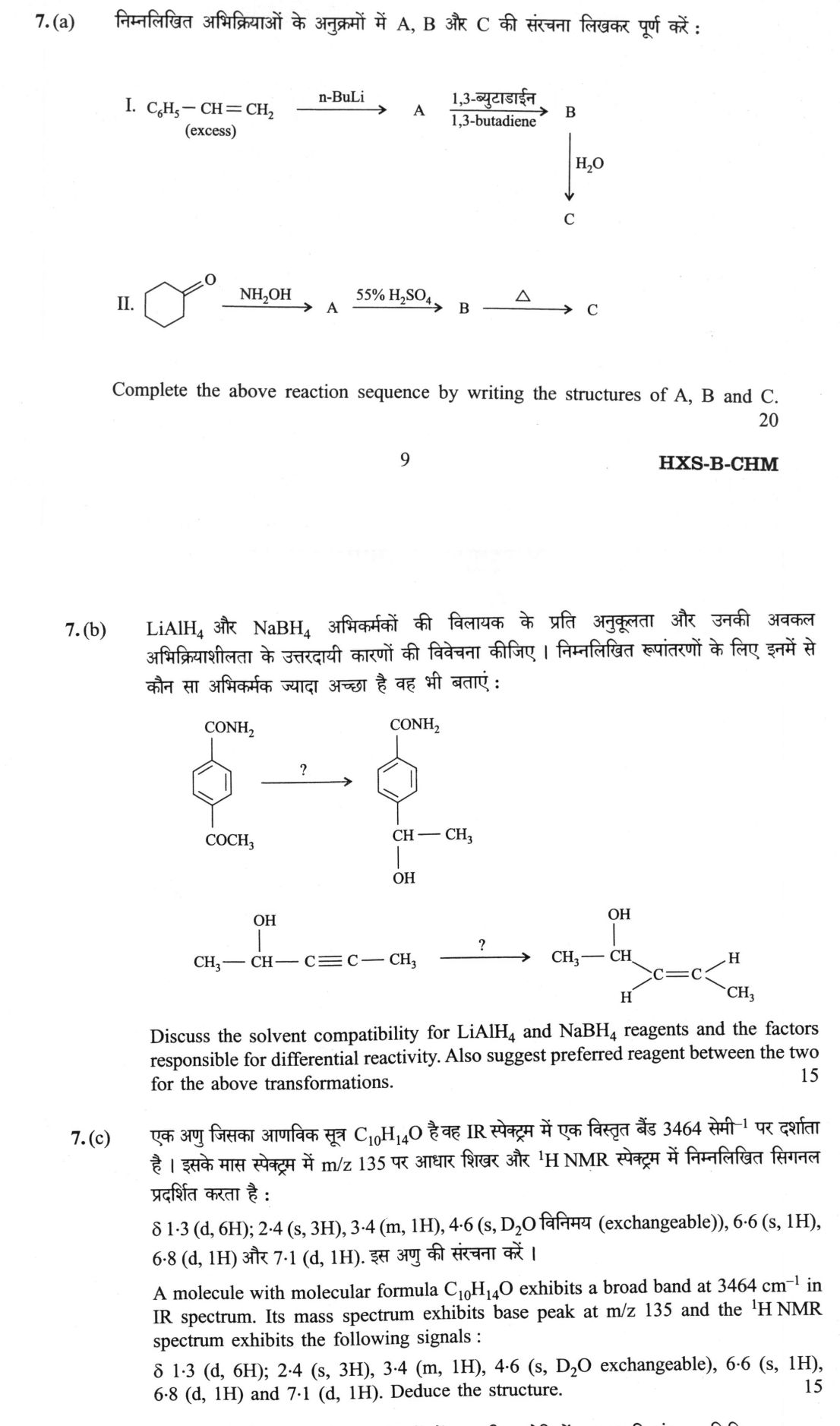
The figure this question refers to, in words
The question paper is a scan and the diagram did not survive as text. This is the figure as read from the original page — every component, value and label — so the question can be worked from the text below.
(a) Reaction Scheme II: A chemical structure of cyclohexanone (a six-membered ring with a double-bonded oxygen atom) is shown. An arrow points to the right with 'NH2OH' written above. The arrow points to a label 'A'. From 'A', an arrow points to the right with '55% H2SO4' written above. This arrow points to a label 'B'. From 'B', an arrow points to the right with a delta symbol (Δ) written above. This arrow points to a label 'C'.
(b) Reaction scheme 2: The reactant is 4-pentyn-2-ol, drawn as CH3-CH(OH)-C≡C-CH3. An arrow labeled with a question mark points to the product: 4-penten-2-ol, drawn as CH3-CH(OH)-CH=CH-CH3. The stereochemistry of the double bond is shown with the hydrogen on the first alkene carbon pointing down and the methyl group on the second alkene carbon pointing down (cis/Z configuration).
What "Deduce" is asking you to do
Work backwards from the evidence given — a spectrum, a reaction sequence, a set of premises — to the structure or conclusion it forces, showing which datum rules out each alternative.
Structure that answers it
Evidence listed → what each datum indicates → alternatives eliminated → the conclusion → consistency check against every datum
Where marks are lost
Naming the right answer without showing what compels it. A conclusion that fits only part of the evidence, with one band or one premise left unaccounted for, is marked as a guess.
How this answer will be evaluated
Approach
(a) describe: define > structure or process in order > labelled diagram > significance | (b) discuss: intro > 3-4 dimensions > example > balanced close | (c) analyse: intro > causes > effects > stakeholders/linkages > way forward Full marks: All structures correct with mechanisms; reagents correctly matched with reasoning; structure deduced with full spectral assignment.
Key points expected
- I: A is benzyllithium (C6H5-CHLi-CH3)
- I: B is the Diels-Alder adduct (cyclohexene derivative)
- II: A is the oxime of cyclohexanone
- II: B is the nitrile (cyclohexanecarbonitrile)
- LiAlH4 requires anhydrous ether solvents (e.g., Et2O)
- NaBH4 is compatible with protic solvents (e.g., MeOH, H2O)
- LiAlH4 is a stronger, less selective reducing agent
- NaBH4 is a milder, more selective reducing agent
Evaluation rubric
Each sub-part is marked on its own, against the marks and word limit printed on the paper.
- (a) Draw structures of A, B, and C for both reaction sequences I and II. 20 marks
describe— define → structure or process in order → labelled diagram → significance
Must cover
- I: A is benzyllithium (C6H5-CHLi-CH3)
- I: B is the Diels-Alder adduct (cyclohexene derivative)
- II: A is the oxime of cyclohexanone
- II: B is the nitrile (cyclohexanecarbonitrile)
Loses marks
- Missing intermediate A or B in either sequence
- Incorrect regiochemistry in Diels-Alder product
Earns more
- I: C is the alcohol product of hydration
- II: C is the amine product of reduction
- Correct stereochemistry shown for Diels-Alder product
Extra mark
- Mechanism of Beckmann rearrangement shown
- (b) Compare LiAlH4 and NaBH4 reactivity and select the correct reagent for the two transformations. 15 marks
discuss— intro → 3-4 dimensions → example → balanced close
Must cover
- LiAlH4 requires anhydrous ether solvents (e.g., Et2O)
- NaBH4 is compatible with protic solvents (e.g., MeOH, H2O)
- LiAlH4 is a stronger, less selective reducing agent
- NaBH4 is a milder, more selective reducing agent
Loses marks
- Suggesting LiAlH4 for the ketone reduction
- Suggesting NaBH4 for the alkyne reduction
Earns more
- Identifies NaBH4 for the ketone to alcohol reduction
- Identifies LiAlH4 for the alkyne to alkene reduction
- Explains chemoselectivity regarding the amide group
Extra mark
- Mention of specific workup conditions for each reagent
- (c) Deduce the structure of the molecule C10H14O from the spectral data. 15 marks
analyse— intro → causes → effects → stakeholders/linkages → way forward
Must cover
- Identifies the aromatic ring (1,3,5-trisubstituted pattern)
- Identifies the isopropyl group (δ 1.3, d, 6H; δ 3.4, m, 1H)
- Identifies the methyl group (δ 2.4, s, 3H)
- Identifies the hydroxyl group (δ 4.6, s, D2O exchangeable)
Loses marks
- Incorrect substitution pattern on the benzene ring
- Ignoring the D2O exchangeable signal
Earns more
- Correctly assigns the base peak at m/z 135 to loss of methyl
- Draws the final structure: 2-isopropyl-4-methylphenol
- Calculates degree of unsaturation correctly
Extra mark
- Explains the splitting pattern of the aromatic protons
Model answer coming soon
Every evaluation on this site is marked against a verified model answer. This question's answer is still being written; evaluation opens the moment it lands.
More from Chemistry 2021 Paper II
- Q4 (a) (i) Heating of 3-deuteroindene causes scrambling of the deuterium. Explain with mecha…
- Q5 (a) 2,4-Pentadione exhibits five signal in ¹H NMR spectrum. Account for the observation.…
- Q6 (a)(i) The molecule obtained on treatment of acetone with dilute sodium hydroxide exhibit…
- Q7 7.(a) Complete the above reaction sequence by writing the structures of A, B and C. I. C₆…
- Q8 8.(a) (i) Write the products X/Y in the above chemical transformations. I. MCPBA → X II.…