Paper I — Q1
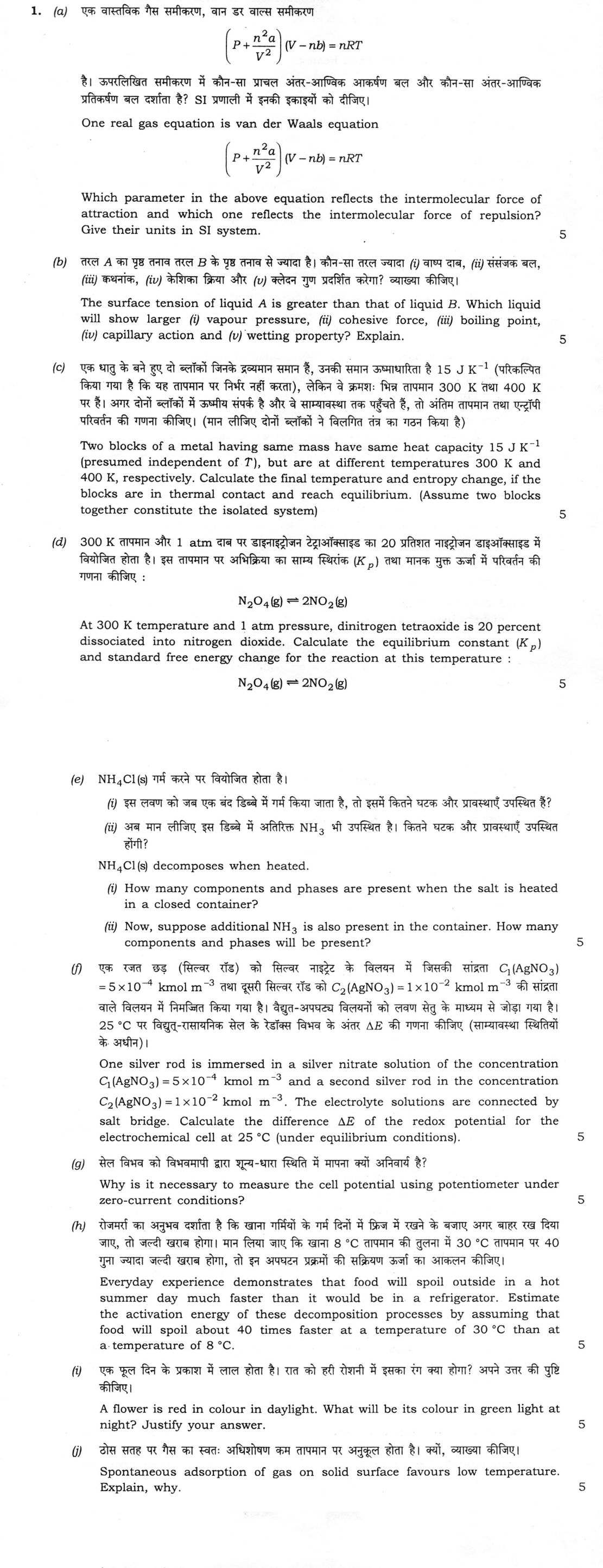
(a) One real gas equation is van der Waals equation (P + (n² a)/(V²))(V - nb) = nRT Which parameter in the above equation…
One real gas equation is van der Waals equation
(P + (n² a)/(V²))(V - nb) = nRT
Which parameter in the above equation reflects the intermolecular force of attraction and which one reflects the intermolecular force of repulsion? Give their units in SI system. 5 marks
The surface tension of liquid A is greater than that of liquid B. Which liquid will show larger (i) vapour pressure, (ii) cohesive force, (iii) boiling point, (iv) capillary action and (v) wetting property? Explain. 5 marks
Two blocks of a metal having same mass have same heat capacity 15 J K⁻¹ (presumed independent of T), but are at different temperatures 300 K and 400 K, respectively. Calculate the final temperature and entropy change, if the blocks are in thermal contact and reach equilibrium. (Assume two blocks together constitute the isolated system) 5 marks
At 300 K temperature and 1 atm pressure, dinitrogen tetraoxide is 20 percent dissociated into nitrogen dioxide. Calculate the equilibrium constant (Kₚ) and standard free energy change for the reaction at this temperature :
N₂O₄(g) ⇌ 2NO₂(g) 5 marks
NH₄Cl(s) decomposes when heated. How many components and phases are present when the salt is heated in a closed container?
Now, suppose additional NH₃ is also present in the container. How many components and phases will be present? 5 marks
One silver rod is immersed in a silver nitrate solution of the concentration C₁(AgNO₃) = 5×10⁻⁴ kmol m⁻³ and a second silver rod in the concentration C₂(AgNO₃) = 1×10⁻² kmol m⁻³. The electrolyte solutions are connected by salt bridge. Calculate the difference ΔE of the redox potential for the electrochemical cell at 25 °C (under equilibrium conditions). 5 marks
Why is it necessary to measure the cell potential using potentiometer under zero-current conditions? 5 marks
Everyday experience demonstrates that food will spoil outside in a hot summer day much faster than it would be in a refrigerator. Estimate the activation energy of these decomposition processes by assuming that food will spoil about 40 times faster at a temperature of 30 °C than at a temperature of 8 °C. 5 marks
A flower is red in colour in daylight. What will be its colour in green light at night? Justify your answer. 5 marks
(j) Spontaneous adsorption of gas on solid surface favours low temperature. Explain, why. 5 marks
हिंदी में प्रश्न पढ़ें
एक वास्तविक गैस समीकरण, वान डर वाल्स समीकरण
(P + (n² a)/(V²))(V - nb) = nRT
है। उपरलिखित समीकरण में कौन-सा प्राचल अंतर-आण्विक आकर्षण बल और कौन-सा अंतर-आण्विक प्रतिकर्षण बल दर्शाता है? SI प्रणाली में इनकी इकाइयों को दीजिए। (5 अंक)
तरल A का पृष्ठ तनाव तरल B के पृष्ठ तनाव से ज्यादा है। कौन-सा तरल ज्यादा (i) वाष्प दाब, (ii) संसंजक बल, (iii) कथनांक, (iv) केशिका क्रिया और (v) क्लेदन गुण प्रदर्शित करेगा? व्याख्या कीजिए। (5 अंक)
एक धातु के बने दो ब्लॉकों जिनके द्रव्यमान समान हैं, उनकी समान ऊष्माधारिता है 15 J K⁻¹ (परिकल्पित किया गया है कि यह तापमान पर निर्भर नहीं करता), लेकिन वे क्रमशः भिन्न तापमान 300 K तथा 400 K पर हैं। आगर दोनों ब्लॉकों में ऊष्मीय संपर्क है और वे साम्यावस्था तक पहुँचते हैं, तो अंतिम तापमान तथा एन्ट्रॉपी परिवर्तन की गणना कीजिए। (मान लीजिए दोनों ब्लॉकों को विलगित तंत्र का गठन किया है) (5 अंक)
300 K तापमान और 1 atm दाब पर डाइनाइट्रोजन टेट्राऑक्साइड का 20 प्रतिशत नाइट्रोजन डाइऑक्साइड में वियोजित होता है। इस तापमान पर अभिक्रिया का साम्य स्थिरांक (Kₚ) तथा मानक मुक्त ऊर्जा में परिवर्तन की गणना कीजिए :
N₂O₄(g) ⇌ 2NO₂(g) (5 अंक)
NH₄Cl(s) गर्म करने पर वियोजित होता है। इस लवण को जब एक बंद डिब्बे में गर्म किया जाता है, तो इसमें कितने घटक और प्रावस्थाएँ उपस्थित हैं?
अब मान लीजिए इस डिब्बे में अतिरिक्त NH₃ भी उपस्थित है। कितने घटक और प्रावस्थाएँ उपस्थित होंगी? (5 अंक)
एक रजत छड़ (सिल्वर रॉड) को सिल्वर नाइट्रेट के विलयन में जिसकी सांद्रता C₁(AgNO₃) = 5×10⁻⁴ kmol m⁻³ तथा दूसरी सिल्वर रॉड को C₂(AgNO₃) = 1×10⁻² kmol m⁻³ की सांद्रता वाले विलयन में निमज्जित किया गया है। वैद्युत-अपघट्य विलयनों को लवण सेतु के माध्यम से जोड़ा गया है। 25 °C पर विद्युत्-रासायनिक सेल के रेडॉक्स विभव के अंतर ΔE की गणना कीजिए (साम्यावस्था स्थितियों के अधीन)। (5 अंक)
सेल विभव को विभवमापी द्वारा शून्य-धारा स्थिति में मापना क्यों अनिवार्य है? (5 अंक)
रोजमर्रा का अनुभव दर्शाता है कि खाना गर्मियों के गर्म दिनों में फ्रिज में रखने के बजाए आग बाहर रख दिया जाए, तो जल्दी खराब होगा। मान लिया जाए कि खाना 8 °C तापमान की तुलना में 30 °C तापमान पर 40 गुना ज्यादा जल्दी खराब होगा, तो इन अपघटन प्रक्रमों की सक्रियण ऊर्जा का आकलन कीजिए। (5 अंक)
एक फूल दिन के प्रकाश में लाल होता है। रात को हरी रोशनी में इसका रंग क्या होगा? अपने उत्तर की पुष्टि कीजिए। (5 अंक)
(j) ठोस सतह पर गैस का स्वतः अधिशोषण कम तापमान पर अनुकूल होता है। क्यों, व्याख्या कीजिए। (5 अंक)
Model answer
Drafted with AI by UPSC Answer Check against this question's marking rubric, to the expected length. UPSC does not publish answers for Mains — this is one way to score well, not an official key. How we build rubrics and answers.
(a) van der Waals parameters (5 marks)
The parameter a reflects the intermolecular force of attraction: the term n²a/V² is the correction to the pressure, because attraction reduces the force with which molecules strike the wall. The parameter b reflects repulsion: it is the excluded volume, about four times the actual volume of the molecules per mole, and nb is subtracted from V. In SI units, a is in Pa m⁶ mol⁻² (equivalently N m⁴ mol⁻²) and b is in m³ mol⁻¹.
(b) Liquids A and B (5 marks)
A high surface tension means strong intermolecular attraction. Since γ_A > γ_B:
- (i) Vapour pressure: B is larger, because its molecules escape more easily from the weaker attraction.
- (ii) Cohesive force: A is larger, since surface tension measures cohesion.
- (iii) Boiling point: A is higher, because more energy is needed to overcome the attraction.
- (iv) Capillary action: A shows the larger rise, since h = 2γ cos θ/(rρg), for the same tube, density and contact angle.
- (v) Wetting property: B wets better, as its weaker cohesion lets it spread over the solid; A tends to form drops.
(c) Two metal blocks in thermal contact (5 marks)
Heat lost by the hot block equals heat gained by the cold block, and the heat capacities are equal, so the final temperature is the mean: T_f = (300 + 400)/2 = 350 K.
For each block ΔS = C ln(T_f/T_i).
ΔS = 15 ln(350/300) + 15 ln(350/400) = 15 ln(122500/120000) = 15 × 0.0206 ≈ +0.31 J K⁻¹.
It is positive, as required for an irreversible process in an isolated system.
(d) Dissociation of N₂O₄ (5 marks)
Start with 1 mol N₂O₄ and degree of dissociation α = 0.20: N₂O₄ = 0.80 mol, NO₂ = 0.40 mol, total 1.20 mol. The mole fractions are 0.80/1.20 = 2/3 and 0.40/1.20 = 1/3, and at P = 1 atm these equal the partial pressures.
K_p = p²(NO₂)/p(N₂O₄) = (1/3)²/(2/3) = 1/6 ≈ 0.167, which also equals 4α²P/(1 − α²) = 0.16/0.96.
ΔG° = −RT ln K_p = −8.314 × 300 × ln(0.1667) = −2494 × (−1.792) ≈ +4.47 × 10³ J mol⁻¹ ≈ +4.5 kJ mol⁻¹.
The positive value agrees with K_p < 1.
(e) Components and phases for NH₄Cl (5 marks)
The equilibrium is NH₄Cl(s) ⇌ NH₃(g) + HCl(g). Components C = S − R − r, where S is the number of species, R the number of independent reactions, and r the extra composition restrictions.
(i) Heated in a closed container, there are three species, one equilibrium, and NH₃ and HCl are in equal amounts because both come only from the salt: C = 3 − 1 − 1 = 1. The phases are two, solid NH₄Cl and one gas mixture (P = 2). Degrees of freedom F = C − P + 2 = 1.
(ii) With additional NH₃, the equal-amount restriction no longer holds: C = 3 − 1 = 2. The phases are still two (solid and gas), so F = 2 − 2 + 2 = 2.
(f) Silver concentration cell (5 marks)
Both electrodes are silver in AgNO₃, so this is a concentration cell without transference (with a salt bridge) and E° = 0. The electrode in the more concentrated solution, C₂, is the cathode and the dilute one, C₁, is the anode. For the Ag⁺/Ag couple, n = 1:
ΔE = (RT/F) ln(C₂/C₁) = 0.05916 log₁₀(1 × 10⁻²/5 × 10⁻⁴) = 0.05916 × log₁₀ 20 = 0.05916 × 1.301 ≈ 0.077 V.
So the cell potential is about 77 mV at 25 °C, treating the concentrations as activities.
(g) Why a potentiometer is used (5 marks)
A potentiometer measures the potential when the cell delivers zero current, by balancing it against a known opposing voltage. This is needed because the cell has internal resistance, so if a current i were drawn, the terminal voltage would be E − iR, lower than the true EMF. A current would also cause polarisation and change the electrode concentrations, and the process would no longer be reversible. Only at null (zero current) is the potential the equilibrium (reversible) EMF, which can be related to ΔG = −nFE. An ordinary voltmeter draws current and reads less than the EMF.
(h) Activation energy of food spoilage (5 marks)
From the Arrhenius equation, ln(k₂/k₁) = (E_a/R)(1/T₁ − 1/T₂), with T₁ = 281.15 K, T₂ = 303.15 K and k₂/k₁ = 40.
ln 40 = 3.689, and (1/281.15 − 1/303.15) = 3.5568 × 10⁻³ − 3.2987 × 10⁻³ = 2.58 × 10⁻⁴ K⁻¹.
E_a = 8.314 × 3.689/(2.58 × 10⁻⁴) ≈ 1.19 × 10⁵ J mol⁻¹ ≈ 119 kJ mol⁻¹.
(i) Colour of a red flower in green light (5 marks)
A flower appears red because its pigments absorb the other wavelengths, chiefly green and blue, and reflect or transmit red. In green light, the only light present is green, which the pigment absorbs, and there is no red light to reflect. Almost nothing reaches the eye from the petals, so the flower appears black (or very dark), while the green leaves look green.
(j) Adsorption at low temperature (5 marks)
Adsorption is spontaneous when ΔG = ΔH − TΔS < 0. When a gas is held on a surface its freedom of movement falls, so ΔS < 0 and −TΔS is positive; for ΔG to be negative ΔH must be negative and larger in size than TΔS. Adsorption is therefore exothermic, since bonds form between the gas and the surface. As temperature falls, the unfavourable −TΔS term shrinks, so ΔG becomes more negative and adsorption more favourable. This agrees with Le Chatelier's principle: lowering temperature favours the exothermic process, and physical adsorption in particular decreases as temperature rises.
How this answer will be evaluated
Evaluation rubric
Each sub-part is marked on its own, against the marks and word limit printed on the paper.
- (a) (a) Identify the van der Waals parameter for attraction and for repulsion, with SI units (5 marks). 5 marks
Must cover
- a = attraction (pressure correction n²a/V²)
- b = repulsion (excluded volume)
- Units: a in Pa m⁶ mol⁻²; b in m³ mol⁻¹
Loses marks
- Swapping a and b.
- Non-SI units only.
Earns more
- Reason for each correction term.
Extra mark
- b ≈ four times molecular volume
- (b) (b) Compare liquids A and B for five properties given γ_A > γ_B, with explanation (5 marks). 5 marks
Must cover
- Vapour pressure: B larger; boiling point: A higher
- Cohesive force: A larger
- Capillary action: A greater rise (h = 2γcosθ/rρg); wetting: B better
- Link to strength of intermolecular attraction
Loses marks
- Any property assigned to the wrong liquid.
- No explanation.
Earns more
- Explanation for each property.
Extra mark
- Contact-angle argument
- (c) (c) Final temperature and entropy change for two identical blocks at 300 K and 400 K (5 marks). 5 marks
Must cover
- T_f = 350 K (equal heat capacities)
- ΔS = C ln(T_f/T₁) + C ln(T_f/T₂)
- ΔS ≈ +0.31 J K⁻¹, positive as for an irreversible isolated process
Loses marks
- Using arithmetic error in ln values.
- Negative ΔS.
Earns more
- Explicit ln terms and arithmetic.
Extra mark
- Sign interpreted via second law
- (d) (d) K_p and ΔG° for N₂O₄ ⇌ 2NO₂ at 300 K with α = 0.20 (5 marks). 5 marks
Must cover
- Equilibrium moles 0.8 and 0.4; total 1.2
- Partial pressures 2/3 and 1/3 atm; K_p = 1/6 ≈ 0.167
- ΔG° = −RT ln K_p ≈ +4.5 kJ mol⁻¹
Loses marks
- Using mole fractions without pressure.
- Wrong sign of ΔG°.
Earns more
- Cross-check with 4α²P/(1−α²).
Extra mark
- Sign consistent with K_p < 1
- (e) (e) Components and phases of NH₄Cl heated in a closed container, without and with extra NH₃ (5 marks). 5 marks
Must cover
- (i) C = 1 and P = 2
- (ii) C = 2 and P = 2
- Reasoning by C = S − R − r and the equal-amount restriction
Loses marks
- Giving C = 2 in part (i).
- Counting gas phases separately.
Earns more
- F = C − P + 2 values (1 and 2).
Extra mark
- Explanation of why the restriction disappears
- (f) (f) Cell potential of the silver concentration cell at 25 °C (5 marks). 5 marks
Must cover
- Concentration cell, E° = 0, n = 1
- ΔE = (RT/F) ln(C₂/C₁) = 0.05916 log(20)
- ΔE ≈ 0.077 V
Loses marks
- Using n = 2.
- Inverting the concentration ratio giving a negative value.
Earns more
- Identification of anode and cathode.
Extra mark
- Mention of activities versus concentrations
- (g) (g) Why cell potential must be measured with a potentiometer at zero current (5 marks). 5 marks
Must cover
- No current drawn, so no internal-resistance drop (E − iR)
- Avoids polarisation and concentration change; reversibility
- Gives the equilibrium EMF related to ΔG = −nFE
Loses marks
- Saying the potentiometer amplifies the voltage.
- No mention of current.
Earns more
- Contrast with a voltmeter.
Extra mark
- Null-point principle explained
- (h) (h) Activation energy for spoilage rate ratio 40 between 30 °C and 8 °C (5 marks). 5 marks
Must cover
- Arrhenius equation in the two-temperature form
- T₁ = 281.15 K, T₂ = 303.15 K, ln 40 = 3.689
- E_a ≈ 119 kJ mol⁻¹
Loses marks
- Using °C in the formula.
- Result off by a factor of 1000.
Earns more
- Correct conversion to kelvin.
Extra mark
- Unit consistency in J mol⁻¹
- (i) (i) Colour of a red flower in green light with justification (5 marks). 5 marks
Must cover
- Appears black or very dark
- Red pigment absorbs green and reflects red
- No red component in green light, so nothing is reflected
Loses marks
- Answering green or red.
- No justification.
Earns more
- Mention of green leaves.
Extra mark
- Selective absorption explained
- (j) (j) Why gas adsorption on a solid is favoured at low temperature (5 marks). 5 marks
Must cover
- ΔG = ΔH − TΔS; ΔS < 0 on adsorption
- ΔH negative (exothermic); adsorption spontaneous when |ΔH| > |TΔS|
- Lower T reduces the −TΔS penalty; Le Chatelier's principle
Loses marks
- Stating ΔS > 0.
- Stating that adsorption is endothermic.
Earns more
- Physical adsorption decreases as T rises.
Extra mark
- Chemisorption contrast
What "Discuss" is asking you to do
Lay the issue out from more than one side — how it arose, what is claimed for it, what is held against it, and where it now stands. UPSC attaches discuss to broad topics with several live dimensions, so coverage of the dimensions earns more than the strength of your opinion.
Structure that answers it
Set the issue up → the case as it is made → the case against → the dimension both sides leave out → where the balance now lies
Where marks are lost
Listing facts with no thread between them, or arguing one side throughout and calling it a discussion.
Practice this exact question
Write your answer and it is marked point by point against the model answer above — what you covered, what you missed, what you got wrong.
Evaluate my answer →More from Chemistry 2026 Paper I
- Q1 (a) One real gas equation is van der Waals equation \left(P + \frac{n^2 a}{V^2}\right)(V…
- Q2 (a) The Maxwell distribution of molecular speed of a gaseous system is dN_c = 4πN ( M / (…
- Q3 (a) (i) Derive the expressions of chemical potential of a component in a mixture system i…
- Q4 (a) Draw and discuss the polarographic wave obtained in the case of a dropping mercury el…