Paper I — Q3
(a) (i) Derive the expressions of chemical potential of a component in a mixture system in terms of extensive thermodynamic…
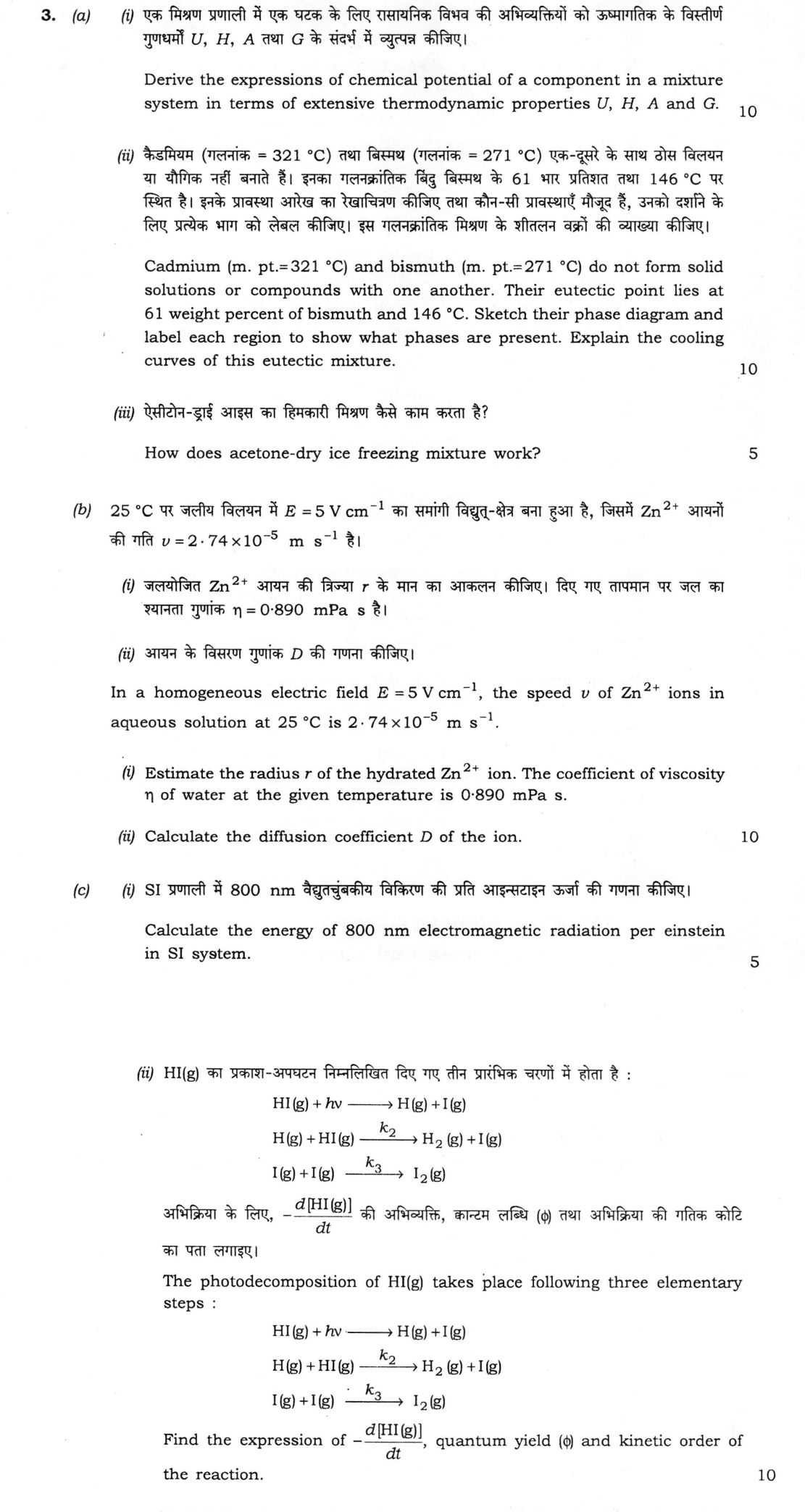
Derive the expressions of chemical potential of a component in a mixture system in terms of extensive thermodynamic properties U, H, A and G. 10 marks
Cadmium (m. pt.=321 °C) and bismuth (m. pt.=271 °C) do not form solid solutions or compounds with one another. Their eutectic point lies at 61 weight percent of bismuth and 146 °C. Sketch their phase diagram and label each region to show what phases are present. Explain the cooling curves of this eutectic mixture. 10 marks
How does acetone-dry ice freezing mixture work? 5 marks
In a homogeneous electric field E = 5 V cm⁻¹, the speed ν of Zn²⁺ ions in aqueous solution at 25 °C is 2.74×10⁻⁵ m s⁻¹. Estimate the radius r of the hydrated Zn²⁺ ion. The coefficient of viscosity η of water at the given temperature is 0.890 mPa s.
Calculate the diffusion coefficient D of the ion. 10 marks
Calculate the energy of 800 nm electromagnetic radiation per einstein in SI system. 5 marks
The photodecomposition of HI(g) takes place following three elementary steps :
HI(g) + hν ⟶ H(g) + I(g)
H(g) + HI(g) —k2→ H2(g) + I(g)
I(g) + I(g) —k3→ I2(g)
Find the expression of − d[HI(g)]/dt , quantum yield (φ) and kinetic order of the reaction. 10 marks
हिंदी में प्रश्न पढ़ें
एक मिश्रण प्रणाली में एक घटक के लिए रासायनिक विभव की अभिव्यक्तियों को ऊष्मागतिक के विस्तीर्ण गुणधर्मों U, H, A तथा G के संबंध में व्युत्पन्न कीजिए। (10 अंक)
कैडमियम (गलनांक = 321 °C) तथा बिस्मथ (गलनांक = 271 °C) एक-दूसरे के साथ ठोस विलयन या यौगिक नहीं बनाते हैं। इनका गलनांकित बिंदु बिस्मथ के 61 भार प्रतिशत तथा 146 °C पर स्थित है। इनके प्रावस्था आरेख का रेखाचित्रण कीजिए तथा कौन-सी प्रावस्थाएँ मौजूद हैं, उनको दर्शाने के लिए प्रत्येक भाग को लेबल कीजिए। इस गलनांकित मिश्रण के शीतलन वक्रों की व्याख्या कीजिए। (10 अंक)
ऐसीटोन-ड्राई आइस का हिमकारी मिश्रण कैसे काम करता है? (5 अंक)
25 °C पर जलीय विलयन में E = 5 V cm⁻¹ का समांगी विद्युत्-क्षेत्र बना हुआ है, जिसमें Zn²⁺ आयनों की गति ν = 2.74×10⁻⁵ m s⁻¹ है। जलयोजित Zn²⁺ आयन की त्रिज्या r के मान का आकलन कीजिए। दिए गए तापमान पर जल का श्यानता गुणांक η = 0.890 mPa s है।
आयन के विसरण गुणांक D की गणना कीजिए। (10 अंक)
SI प्रणाली में 800 nm वैद्युतचुंबकीय विकिरण की प्रति आइन्सटाइन ऊर्जा की गणना कीजिए। (5 अंक)
HI(g) का प्रकाश-अपघटन निम्नलिखित दिए गए तीन प्रारंभिक चरणों में होता है :
HI(g) + hν ⟶ H(g) + I(g)
H(g) + HI(g) —k2→ H2(g) + I(g)
I(g) + I(g) —k3→ I2(g)
अभिक्रिया के लिए, − d[HI(g)]/dt की अभिव्यक्ति, क्वांटम लब्धि (φ) तथा अभिक्रिया की गतिक कोटि का पता लगाइए। (10 अंक)
Model answer
Drafted with AI by UPSC Answer Check against this question's marking rubric, to the expected length. UPSC does not publish answers for Mains — this is one way to score well, not an official key. How we build rubrics and answers.
(a)(i) Chemical potential in terms of U, H, A and G (10 marks)
For a mixture, U = U(S, V, n₁, n₂, …), so
dU = T dS − P dV + Σμᵢ dnᵢ,
and hence μᵢ = (∂U/∂nᵢ)_S,V,nⱼ.
Enthalpy H = U + PV gives dH = dU + P dV + V dP = T dS + V dP + Σμᵢ dnᵢ, so μᵢ = (∂H/∂nᵢ)_S,P,nⱼ.
Helmholtz energy A = U − TS gives dA = dU − T dS − S dT = −S dT − P dV + Σμᵢ dnᵢ, so μᵢ = (∂A/∂nᵢ)_T,V,nⱼ.
Gibbs energy G = H − TS gives dG = −S dT + V dP + Σμᵢ dnᵢ, so μᵢ = (∂G/∂nᵢ)_T,P,nⱼ.
Thus μᵢ = (∂U/∂nᵢ)_S,V,nⱼ = (∂H/∂nᵢ)_S,P,nⱼ = (∂A/∂nᵢ)_T,V,nⱼ = (∂G/∂nᵢ)_T,P,nⱼ. Only the last is a partial molar quantity (at constant T and P, the usual laboratory conditions), and it is the one usually called the chemical potential: μᵢ = Ḡᵢ.
(a)(ii) Cadmium-bismuth phase diagram (10 marks)
Cd and Bi are completely miscible as liquids and completely immiscible as solids, so the system is a simple eutectic. On the diagram, the liquidus runs from the melting point of Cd (321 °C) and from that of Bi (271 °C), each falling as the second component is added, and the two lines meet at the eutectic point E (61% Bi, 146 °C). A horizontal line through E at 146 °C is the eutectic (solidus) line. The regions are: above the liquidus, a single liquid melt; to the left of E, below the liquidus, solid Cd + melt; to the right of E, solid Bi + melt; below 146 °C, solid Cd + solid Bi.

Cooling curves. Using the condensed phase rule F = C − P + 1 (pressure fixed), with C = 2:
- Melt of composition 30% Bi (Cd-rich): the temperature falls smoothly until the liquidus is reached, where Cd begins to solidify. The slope changes (a kink) because latent heat is released, and F = 1. As Cd separates, the melt becomes richer in Bi until it reaches the eutectic composition at 146 °C. Then P = 3 (Cd, Bi, melt) and F = 0, so the temperature stays constant (a horizontal halt) while the eutectic solidifies; after this only solids remain and cooling resumes.
- Eutectic melt (61% Bi): the temperature falls without a kink until 146 °C, then shows a single long halt until solidification is complete (F = 0), and then falls again.
- Melt richer in Bi (for example 85% Bi): the behaviour is the same as for the Cd-rich melt, with Bi separating at the kink, followed by the eutectic halt at 146 °C.
The length of the eutectic halt is greatest for the eutectic composition and decreases towards the pure components, which show only a single halt at their melting points.
(a)(iii) Acetone-dry ice freezing bath (5 marks)
Dry ice is solid CO₂, which sublimes at about −78 °C (195 K) at 1 atm and absorbs a large latent heat of sublimation (about 25 kJ mol⁻¹) as it does so. Acetone freezes only at about −95 °C, so it remains liquid at this temperature and acts as a fluid medium that makes good thermal contact with the flask and with all the pieces of dry ice. Heat flowing in from the vessel is used to sublime CO₂, which escapes as gas, so the bath stays at a nearly constant temperature of about −78 °C for as long as solid CO₂ remains, and cannot go lower because the CO₂ is at its sublimation point at 1 atm. The temperature is fixed by the phase change of CO₂, not by a eutectic, and acetone serves as the heat-transfer liquid. It is used to condense volatile substances and to cool reactions.
(b) Hydrated Zn²⁺ ion in an electric field (10 marks)
Data: E = 5 V cm⁻¹ = 500 V m⁻¹, v = 2.74 × 10⁻⁵ m s⁻¹, η = 0.890 mPa s = 8.90 × 10⁻⁴ Pa s, z = 2, T = 298 K.
(i) At steady speed the electric force equals Stokes' viscous drag: zeE = 6πηrv.
r = zeE/(6πηv) = (2 × 1.602 × 10⁻¹⁹ × 500)/(6π × 8.90 × 10⁻⁴ × 2.74 × 10⁻⁵) = 1.602 × 10⁻¹⁶/4.60 × 10⁻⁷ = 3.5 × 10⁻¹⁰ m ≈ 0.35 nm (350 pm).
This is larger than the ionic radius of Zn²⁺ (about 0.074 nm), as expected for a hydrated ion.
(ii) By the Stokes-Einstein relation, D = kT/(6πηr) = (1.381 × 10⁻²³ × 298)/(6π × 8.90 × 10⁻⁴ × 3.49 × 10⁻¹⁰) = 4.12 × 10⁻²¹/5.85 × 10⁻¹² ≈ 7.0 × 10⁻¹⁰ m² s⁻¹.
Check with the Nernst-Einstein relation: the mobility is u = v/E = 5.48 × 10⁻⁸ m² V⁻¹ s⁻¹, and D = uRT/(zF) = 5.48 × 10⁻⁸ × 8.314 × 298/(2 × 96 485) = 7.0 × 10⁻¹⁰ m² s⁻¹, in agreement.
(c)(i) Energy of one einstein of 800 nm radiation (5 marks)
One einstein is one mole of photons. The energy of one photon is E = hc/λ = (6.626 × 10⁻³⁴ × 2.998 × 10⁸)/(800 × 10⁻⁹) = 2.48 × 10⁻¹⁹ J.
Energy per einstein = N_A hc/λ = 6.022 × 10²³ × 2.48 × 10⁻¹⁹ = 1.495 × 10⁵ J mol⁻¹ ≈ 149.5 kJ per einstein (about 150 kJ).
(c)(ii) Photodecomposition of HI (10 marks)
Steps: (1) HI + hν → H + I, rate I_a (the rate of absorption of photons, in moles per unit volume per second); (2) H + HI → H₂ + I, rate constant k₂; (3) I + I → I₂, rate constant k₃.
Steady state for H: d[H]/dt = I_a − k₂[H][HI] = 0, so k₂[H][HI] = I_a.
Steady state for I: d[I]/dt = I_a + k₂[H][HI] − 2k₃[I]² = 0, so 2k₃[I]² = 2I_a and [I] = (I_a/k₃)^½.
HI is consumed in steps (1) and (2): −d[HI]/dt = I_a + k₂[H][HI] = I_a + I_a = 2I_a.
Quantum yield φ = (molecules of HI reacting)/(photons absorbed) = 2I_a/I_a = 2. One photon decomposes two HI molecules.
Order: the rate = 2I_a does not depend on [HI] itself, so the reaction is zero order in HI when I_a is constant (all the incident light is absorbed); when light is only weakly absorbed, I_a ∝ [HI] and the reaction shows apparent first order. The rate is first order in absorbed light intensity.
How this answer will be evaluated
Evaluation rubric
Each sub-part is marked on its own, against the marks and word limit printed on the paper.
- (a)(i) (a)(i) Derive expressions for the chemical potential of a component in a mixture in terms of U, H, A and G (10 marks). 10 marks
Must cover
- Fundamental equation dU = TdS − PdV + Σμᵢdnᵢ giving μᵢ = (∂U/∂nᵢ)_S,V,n
- Legendre transforms giving dH, dA, dG with Σμᵢdnᵢ
- μᵢ = (∂H/∂nᵢ)_S,P = (∂A/∂nᵢ)_T,V = (∂G/∂nᵢ)_T,P
- Only the G form is a partial molar quantity
Loses marks
- Naming all four as partial molar quantities.
- Wrong constant variables.
Earns more
- Each variable held constant stated correctly.
Extra mark
- Gibbs-Duhem mention
- (a)(ii) (a)(ii) Sketch the Cd-Bi eutectic phase diagram, label regions, and explain cooling curves (10 marks). 10 marks
Must cover
- Correct diagram: 321 °C, 271 °C, eutectic at 61% Bi and 146 °C, eutectic line
- Four regions labelled: melt; Cd + melt; Bi + melt; Cd + Bi
- Cooling curves: kink at liquidus and halt at 146 °C for off-eutectic melts
- Eutectic melt: single halt only; phase-rule reasoning F = C − P + 1 = 0
Loses marks
- Placing the eutectic at 50% Bi.
- Showing a solid solution region.
Earns more
- Axes labelled with wt% Bi and temperature.
- Explanation of the kink from released latent heat.
Extra mark
- Pure-component cooling curve
- (a)(iii) (a)(iii) Explain the working of an acetone-dry ice freezing bath (5 marks). 5 marks
Must cover
- Solid CO₂ sublimes at about −78 °C at 1 atm, absorbing latent heat
- Acetone remains liquid (freezing point about −95 °C) and gives thermal contact
- Temperature stays constant near −78 °C while solid CO₂ remains
Loses marks
- Saying acetone freezes.
- Claiming −196 °C.
Earns more
- Explanation that heat from the vessel drives sublimation.
Extra mark
- Not a eutectic effect
- (b) (b) Radius of hydrated Zn²⁺ and diffusion coefficient from ion speed 2.74 × 10⁻⁵ m s⁻¹ in 5 V cm⁻¹ (10 marks). 10 marks
Must cover
- Steady state zeE = 6πηrv with z = 2, E = 500 V m⁻¹
- r ≈ 3.5 × 10⁻¹⁰ m
- D = kT/(6πηr) ≈ 7.0 × 10⁻¹⁰ m² s⁻¹
- Consistency check via Nernst-Einstein
Loses marks
- Using z = 1.
- Leaving E in V cm⁻¹.
Earns more
- Unit conversion of E and η.
- Comment that r exceeds the bare ionic radius.
Extra mark
- Mobility u = v/E computed
- (c)(i) (c)(i) Energy of one einstein of 800 nm radiation in SI (5 marks). 5 marks
Must cover
- E per photon = hc/λ ≈ 2.48 × 10⁻¹⁹ J
- One einstein = N_A photons
- ≈ 1.495 × 10⁵ J mol⁻¹ ≈ 149.5 kJ
Loses marks
- Forgetting N_A.
- Using λ in nm.
Earns more
- Correct unit conversion of λ.
Extra mark
- Wavenumber or eV equivalent
- (c)(ii) (c)(ii) Derive −d[HI]/dt, quantum yield and order for the photodecomposition of HI (10 marks). 10 marks
Must cover
- Steady-state for H: k₂[H][HI] = I_a
- Steady-state for I: [I] = (I_a/k₃)^½
- −d[HI]/dt = 2I_a
- φ = 2
- Order: zero in HI at constant I_a (first order in absorbed intensity)
Loses marks
- Rate written as k[HI]² without derivation.
- φ = 1.
Earns more
- Justification for counting HI consumption in steps 1 and 2.
Extra mark
- Apparent first order when I_a ∝ [HI]
What "Derive" is asking you to do
Reach the stated expression from a starting relation, justifying every step. The destination is printed in the question, so only the route earns marks, and the assumptions you work under are part of that route.
Structure that answers it
Assumptions and notation defined → starting relation or governing equation → each step with its justification → the required expression → limiting case or boundary check
Where marks are lost
Writing the standard result first and fitting three lines to it, which an examiner reads at a glance. Marks also go on assumptions left unstated — lossless medium, small amplitude, errors independent with zero mean — and on symbols used before they are defined, even when the question says usual notations.
Practice this exact question
Write your answer and it is marked point by point against the model answer above — what you covered, what you missed, what you got wrong.
Evaluate my answer →More from Chemistry 2026 Paper I
- Q1 (a) One real gas equation is van der Waals equation \left(P + \frac{n^2 a}{V^2}\right)(V…
- Q2 (a) The Maxwell distribution of molecular speed of a gaseous system is dN_c = 4πN ( M / (…
- Q3 (a) (i) Derive the expressions of chemical potential of a component in a mixture system i…
- Q4 (a) Draw and discuss the polarographic wave obtained in the case of a dropping mercury el…
- Q5 (a) What is the de Broglie wavelength for a baseball (140 g) moving at 40 m s⁻¹? Comment…
- Q6 (a) (i) Predict the Lewis structures and geometry of the following as per VSEPR theory :…