Paper I — Q6
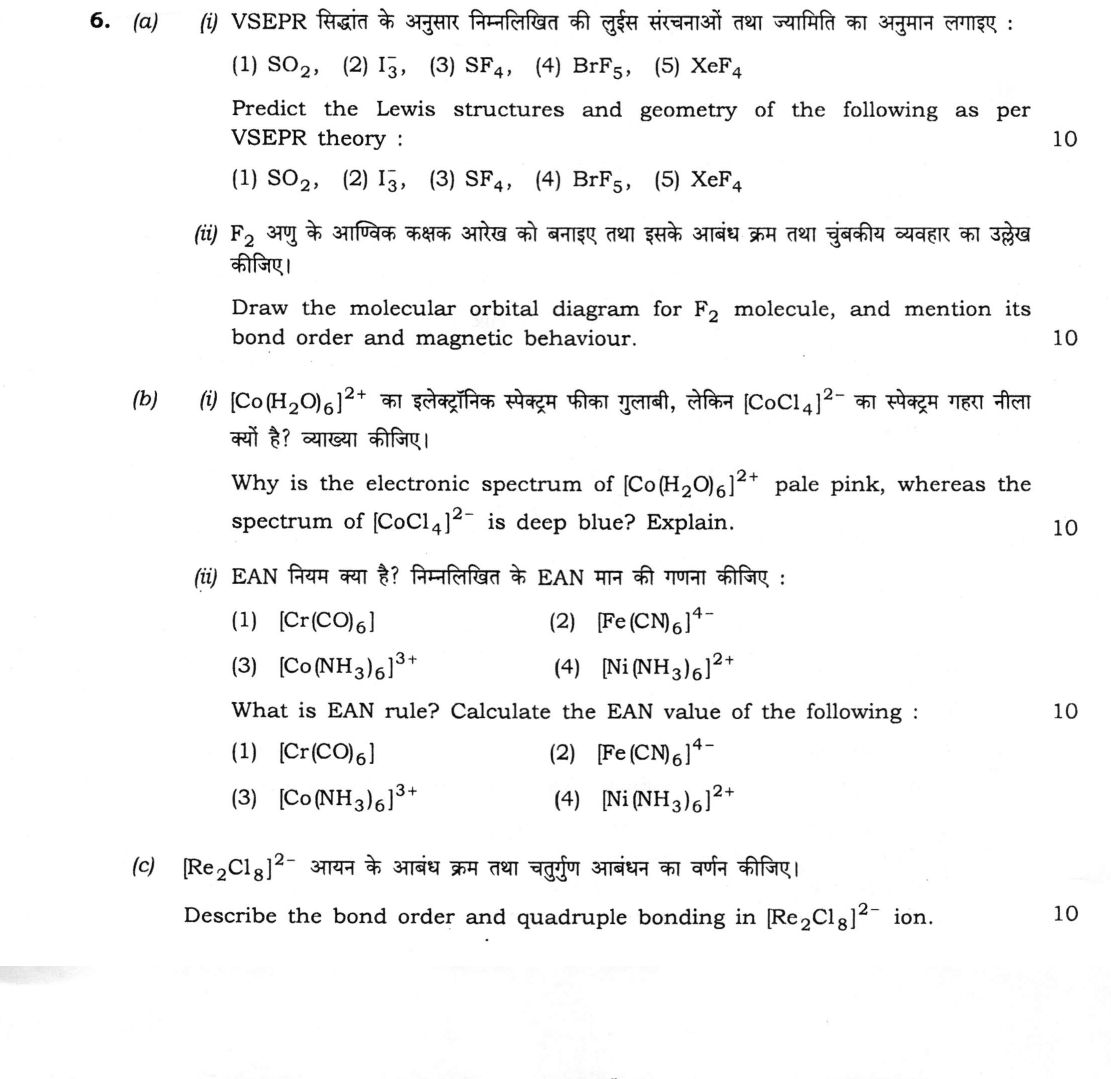
(a) (i) Predict the Lewis structures and geometry of the following as per VSEPR theory : (1) SO₂, (2) I₃⁻, (3) SF₄, (4) BrF₅, …
Predict the Lewis structures and geometry of the following as per VSEPR theory : (1) SO₂, (2) I₃⁻, (3) SF₄, (4) BrF₅, (5) XeF₄ 10 marks
Draw the molecular orbital diagram for F₂ molecule, and mention its bond order and magnetic behaviour. 10 marks
Why is the electronic spectrum of [Co(H₂O)₆]²⁺ pale pink, whereas the spectrum of [CoCl₄]²⁻ is deep blue? Explain. 10 marks
What is EAN rule? Calculate the EAN value of the following : (1) [Cr(CO)₆] (2) [Fe(CN)₆]⁴⁻ (3) [Co(NH₃)₆]³⁺ (4) [Ni(NH₃)₆]²⁺ 10 marks
Describe the bond order and quadruple bonding in [Re₂Cl₈]²⁻ ion. 10 marks
हिंदी में प्रश्न पढ़ें
VSEPR सिद्धांत के अनुसार निम्नलिखित की लुईस संरचनाओं तथा ज्यामिति का अनुमान लगाइए : (1) SO₂, (2) I₃⁻, (3) SF₄, (4) BrF₅, (5) XeF₄ (10 अंक)
F₂ अणु के आण्विक कक्षक आरेख को बनाइए तथा इसके आबंध क्रम तथा चुंबकीय व्यवहार का उल्लेख कीजिए। (10 अंक)
[Co(H₂O)₆]²⁺ का इलेक्ट्रॉनिक स्पेक्ट्रम फीका गुलाबी, लेकिन [CoCl₄]²⁻ का स्पेक्ट्रम गहरा नीला क्यों है? व्याख्या कीजिए। (10 अंक)
EAN नियम क्या है? निम्नलिखित के EAN मान की गणना कीजिए : (1) [Cr(CO)₆] (2) [Fe(CN)₆]⁴⁻ (3) [Co(NH₃)₆]³⁺ (4) [Ni(NH₃)₆]²⁺ (10 अंक)
[Re₂Cl₈]²⁻ आयन के आबंध क्रम तथा चतुर्गुण आबंधन का वर्णन कीजिए। (10 अंक)
Model answer
Drafted with AI by UPSC Answer Check against this question's marking rubric, to the expected length. UPSC does not publish answers for Mains — this is one way to score well, not an official key. How we build rubrics and answers.
(a)(i) Lewis structures and VSEPR geometry (10 marks)
Count the valence electrons on the central atom plus those of the bonded atoms (and the charge), divide by two to get the electron pairs, place bond pairs and lone pairs, and pick the geometry from the number of electron domains, with lone pairs occupying the most spacious positions.
- SO₂: 6 + 2 × 6 = 18 electrons. S is doubly bonded to one O and singly to the other, by resonance equivalent to two S=O bonds, with one lone pair on S. Three electron domains give trigonal planar electron geometry, so the molecule is bent (V-shaped), O-S-O about 119°.
- I₃⁻: 7 + 2 × 7 + 1 = 22 electrons. The central I has two bond pairs and three lone pairs, five domains in a trigonal bipyramid, with the three lone pairs in the equatorial plane. The molecule is linear, I-I-I 180°.
- SF₄: 6 + 4 × 7 = 34 electrons. S has four bond pairs and one lone pair, five domains; the lone pair lies in an equatorial position, so the shape is see-saw (disphenoidal). The axial F-S-F angle is about 173° and the equatorial one about 102°.
- BrF₅: 7 + 5 × 7 = 42 electrons. Br has five bond pairs and one lone pair, six domains in an octahedron; the molecule is square pyramidal, with the four basal F bent slightly away from the lone pair (F-Br-F about 85 to 90°).
- XeF₄: 8 + 4 × 7 = 36 electrons. Xe has four bond pairs and two lone pairs, six domains in an octahedron, the lone pairs opposite each other (trans, to reduce repulsion). The molecule is square planar, F-Xe-F 90° and non-polar.

(a)(ii) Molecular orbital diagram of F₂ (10 marks)
Each F atom has 7 valence electrons (2s² 2p⁵), so F₂ has 14. Because the 2s-2p energy gap in fluorine is large, there is little s-p mixing, and the order of the molecular orbitals is σ2s < σ*2s < σ2p < π2p (two, degenerate) < π*2p (two, degenerate) < σ*2p.
Filling the 14 electrons gives the configuration σ2s² σ*2s² σ2p² π2p⁴ π*2p⁴, with σ*2p empty.

Bond order = (bonding − antibonding)/2 = (8 − 6)/2 = 1, a single F-F bond. All the electrons are paired, so F₂ is diamagnetic. The low bond order and the repulsion between lone pairs explain the weak F-F bond (about 158 kJ mol⁻¹).
(b)(i) Colours of [Co(H₂O)₆]²⁺ and [CoCl₄]²⁻ (10 marks)
Both are Co(II), d⁷, and their colour arises from d-d transitions, but the intensities differ greatly because of the symmetry of the complex.
[Co(H₂O)₆]²⁺ is octahedral and has a centre of symmetry. The d-d transitions (⁴T₁g(F) → ⁴T₁g(P), at about 19 500 cm⁻¹, in the green region) are Laporte-forbidden because they are g → g (no change of parity); they are spin-allowed, but they gain only a little intensity from vibronic coupling, so the molar absorptivity is very small (about 5 to 10 L mol⁻¹ cm⁻¹). The green light is weakly absorbed, so the solution is a pale pink.
[CoCl₄]²⁻ is tetrahedral and has no centre of symmetry. The d-orbitals can mix with the p-orbitals of the same metal, which relaxes the Laporte restriction, and the molar absorptivity is greater by a factor of about 100 (about 600 L mol⁻¹ cm⁻¹). In addition, Δt is only about 4/9 of Δo and the chloride is a weak-field ligand, so the absorption (⁴A₂ → ⁴T₁(P)) moves to lower energy, about 15 000 cm⁻¹, in the red and orange region. The red and orange light is strongly absorbed and the blue light is transmitted, so the complex is a deep blue.
(b)(ii) EAN rule and calculations (10 marks)
Sidgwick's effective atomic number (EAN) rule says that a metal in a complex tends to gain electrons from the ligands until the total number of electrons around it equals that of the next noble gas. EAN = (atomic number Z of the metal) − (oxidation state) + 2 × (number of ligands, for two-electron donors).
- [Cr(CO)₆]: Cr is 0, so EAN = 24 − 0 + 2 × 6 = 36 (krypton). The rule is obeyed.
- [Fe(CN)₆]⁴⁻: Fe is +2, so EAN = 26 − 2 + 12 = 36. The rule is obeyed.
- [Co(NH₃)₆]³⁺: Co is +3, so EAN = 27 − 3 + 12 = 36. The rule is obeyed.
- [Ni(NH₃)₆]²⁺: Ni is +2, so EAN = 28 − 2 + 12 = 38. This exceeds 36, so the rule is not obeyed. The complex is stable anyway (high-spin d⁸, octahedral), which shows that the rule is not general.
(c) Bonding in [Re₂Cl₈]²⁻ (10 marks)
Each Re is Re(III), d⁴, so the ion has eight metal d electrons. The ion has a very short Re-Re distance of about 224 pm, and the two ReCl₄ units are eclipsed (D₄h). With the z axis along the Re-Re bond, each Re uses its d(x²−y²), s and p orbitals for the four Re-Cl bonds, leaving d(z²), d(xz), d(yz) and d(xy) for metal-metal bonding:
- d(z²) + d(z²) overlap head-on to give a σ bond;
- d(xz) + d(xz) and d(yz) + d(yz) overlap sideways to give two π bonds;
- d(xy) + d(xy) overlap face-to-face to give a δ bond, which needs the eclipsed arrangement.
The eight electrons fill σ² π⁴ δ², leaving the antibonding δ*, π* and σ* levels empty. The bond order is (8 − 0)/2 = 4, a quadruple bond consisting of one σ, two π and one δ bond. The δ bond is weak, and the δ → δ* transition gives the blue colour. If the two ends were rotated by 45° into the staggered form the δ overlap would be lost; the eclipsed geometry is retained even though the Cl···Cl repulsions favour staggering, evidence for the δ bond. The complex is diamagnetic.
How this answer will be evaluated
Evaluation rubric
Each sub-part is marked on its own, against the marks and word limit printed on the paper.
- (a)(i) (a)(i) Predict the Lewis structures and VSEPR geometry of SO₂, I₃⁻, SF₄, BrF₅ and XeF₄ (10 marks). 10 marks
Must cover
- SO₂: three domains, one lone pair, bent
- I₃⁻: five domains, three lone pairs, linear
- SF₄ see-saw; BrF₅ square pyramidal; XeF₄ square planar
- Electron counts and lone-pair placement (equatorial or trans) shown
Loses marks
- Calling SF₄ tetrahedral or seesaw with axial lone pair.
- XeF₄ tetrahedral.
Earns more
- Lewis structures drawn with lone pairs on the central atom.
- Bond angles approximated.
Extra mark
- Polarity of each
- (a)(ii) (a)(ii) Draw the MO diagram of F₂ with bond order and magnetic behaviour (10 marks). 10 marks
Must cover
- Correct order σ2s < σ*2s < σ2p < π2p < π*2p < σ*2p (no s-p mixing)
- Fourteen electrons filled: σ2s² σ*2s² σ2p² π2p⁴ π*2p⁴
- Bond order = 1
- Diamagnetic (all paired)
Loses marks
- Placing π2p above σ2p.
- Bond order 2 or paramagnetic.
Earns more
- Atomic levels connected to the molecular levels.
Extra mark
- Reason for no s-p mixing (large 2s-2p gap)
- (b)(i) (b)(i) Why [Co(H₂O)₆]²⁺ is pale pink and [CoCl₄]²⁻ deep blue (10 marks). 10 marks
Must cover
- Octahedral with centre of symmetry: d-d transition Laporte forbidden (g → g), weak, ε about 10
- Tetrahedral without centre of symmetry: d-p mixing relaxes the rule, ε about 100 times larger
- Δt ≈ 4/9 Δo: absorption shifts to lower energy in the red
- Colour from the transmitted light: pink versus blue
Loses marks
- Attributing the colour to charge transfer.
- Saying Δt > Δo.
Earns more
- Both are Co(II) d⁷ high-spin.
- Spin-allowed but Laporte-forbidden statement.
Extra mark
- Transition assignments
- (b)(ii) (b)(ii) State the EAN rule and calculate EAN for the four complexes (10 marks). 10 marks
Must cover
- Rule: metal gains electrons from ligands to reach the next noble-gas configuration
- [Cr(CO)₆] = 36; [Fe(CN)₆]⁴⁻ = 36
- [Co(NH₃)₆]³⁺ = 36
- [Ni(NH₃)₆]²⁺ = 38: rule not obeyed
Loses marks
- Using ligand charge instead of donated pairs.
- Reporting Ni as 36.
Earns more
- Formula EAN = Z − ox. state + 2 × CN.
Extra mark
- Reason the Ni(II) complex is stable anyway
- (c) (c) Describe the bond order and quadruple bonding in [Re₂Cl₈]²⁻ (10 marks). 10 marks
Must cover
- Re(III) d⁴, eight d electrons, Re-Re about 224 pm, eclipsed
- σ (dz²), two π (dxz, dyz) and one δ (dxy) bonds
- Configuration σ² π⁴ δ²
- Bond order 4; eclipsed geometry as evidence for the δ bond
Loses marks
- Bond order 3.
- Staggered geometry.
Earns more
- Role of dx²−y² in Re-Cl bonding.
Extra mark
- δ → δ* transition and colour
What "Predict" is asking you to do
State the outcome and show the rule or trend that produces it. In the science papers this is determinate — name the product or structure and the mechanism that yields it; in the general papers it is a projection, and the assumptions it rests on have to be named on the page.
Structure that answers it
Given inputs or present position → the governing rule or driver → the predicted outcome stated definitely → assumptions and conditions under which it holds
Where marks are lost
Hedging into a list of possibilities, which commits to nothing and is marked as description. Stating the right product without the mechanism loses the reasoning marks, which are usually the larger share.
Practice this exact question
Write your answer and it is marked point by point against the model answer above — what you covered, what you missed, what you got wrong.
Evaluate my answer →More from Chemistry 2026 Paper I
- Q3 (a) (i) Derive the expressions of chemical potential of a component in a mixture system i…
- Q4 (a) Draw and discuss the polarographic wave obtained in the case of a dropping mercury el…
- Q5 (a) What is the de Broglie wavelength for a baseball (140 g) moving at 40 m s⁻¹? Comment…
- Q6 (a) (i) Predict the Lewis structures and geometry of the following as per VSEPR theory :…
- Q7 (a) (i) Show that ψ(x) = e^(αx) is an eigenfunction for the operator  = d^n/dx^n. What i…
- Q8 (a) Differentiate between T and R conformation of hemoglobin. (10 marks) (b) (i) Describe…