Paper I — Q7
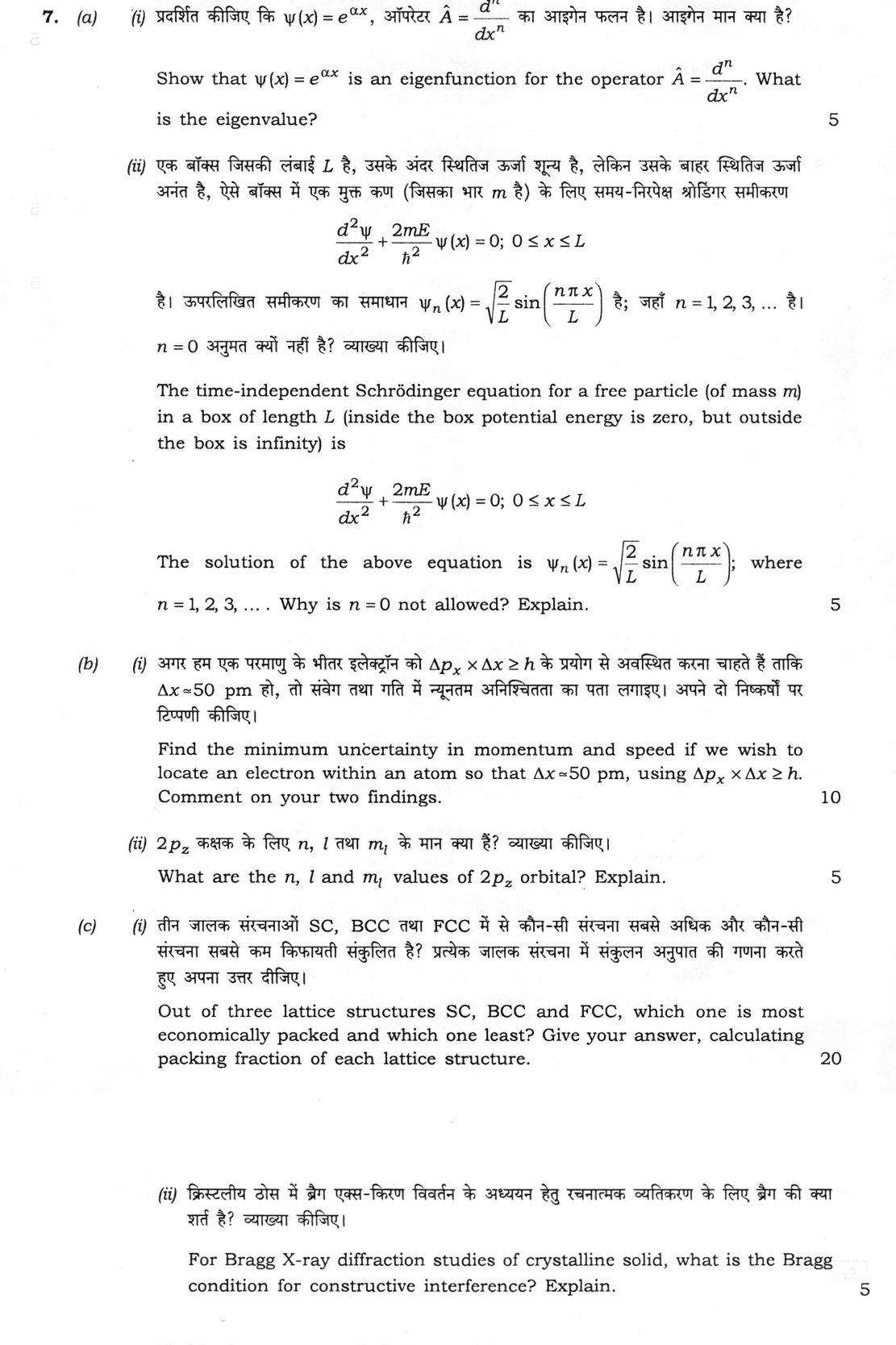
(a) (i) Show that ψ(x) = e^(αx) is an eigenfunction for the operator  = d^n/dx^n. What is the eigenvalue? (5 marks) (ii) The…
Show that ψ(x) = e^(αx) is an eigenfunction for the operator  = d^n/dx^n. What is the eigenvalue? 5 marks
The time-independent Schrödinger equation for a free particle (of mass m) in a box of length L (inside the box potential energy is zero, but outside the box is infinity) is
d²ψ/dx² + 2mE/ℏ² ψ(x) = 0; 0 ≤ x ≤ L
The solution of the above equation is ψₙ(x) = √(2/L) sin(nπx/L); where n = 1, 2, 3, ... . Why is n = 0 not allowed? Explain. 5 marks
Find the minimum uncertainty in momentum and speed if we wish to locate an electron within an atom so that Δx ≈ 50 pm, using Δpₓ × Δx ≥ h. Comment on your two findings. 10 marks
What are the n, l and m_l values of 2p_z orbital? Explain. 5 marks
Out of three lattice structures SC, BCC and FCC, which one is most economically packed and which one least? Give your answer, calculating packing fraction of each lattice structure. 20 marks
For Bragg X-ray diffraction studies of crystalline solid, what is the Bragg condition for constructive interference? Explain. 5 marks
हिंदी में प्रश्न पढ़ें
प्रदर्शित कीजिए कि ψ(x) = e^(αx), ऑपरेटर Â = d^n/dx^n का आइगेन फलन है। आइगेन मान क्या है? (5 अंक)
एक बॉक्स जिसकी लंबाई L है, उसके अंदर स्थितिज ऊर्जा शून्य है, लेकिन उसके बाहर स्थितिज ऊर्जा अनंत है, ऐसे बॉक्स में एक मुक्त कण (जिसका भार m है) के लिए समय-निरपेक्ष श्रोडिंगर समीकरण
d²ψ/dx² + 2mE/ℏ² ψ(x) = 0; 0 ≤ x ≤ L
है। उपरलिखित समीकरण का समाधान ψₙ(x) = √(2/L) sin(nπx/L) है; जहाँ n = 1, 2, 3, ... है। n = 0 अनुमत क्यों नहीं है? व्याख्या कीजिए। (5 अंक)
अगर हम एक परमाणु के भीतर इलेक्ट्रॉन को Δpₓ × Δx ≥ h के प्रयोग से अवस्थित करना चाहते हैं ताकि Δx ≈ 50 pm हो, तो संवेग तथा गति में न्यूनतम अनिश्चितता का पता लगाइए। अपने दो निष्कर्षों पर टिप्पणी कीजिए। (10 अंक)
2p_z कक्षक के लिए n, l तथा m_l के मान क्या हैं? व्याख्या कीजिए। (5 अंक)
तीन जालक संरचनाओं SC, BCC तथा FCC में से कौन-सी संरचना सबसे अधिक और कौन-सी संरचना सबसे कम किफायती संकुलित है? प्रत्येक जालक संरचना में संकुलन अनुपात की गणना करते हुए अपना उत्तर दीजिए। (20 अंक)
क्रिस्टलीय ठोस में ब्रैग एक्स-किरण विवर्तन के अध्ययन हेतु रचनात्मक व्यतिकरण के लिए ब्रैग की क्या शर्त है? व्याख्या कीजिए। (5 अंक)
Model answer
Drafted with AI by UPSC Answer Check against this question's marking rubric, to the expected length. UPSC does not publish answers for Mains — this is one way to score well, not an official key. How we build rubrics and answers.
(a)(i) Eigenfunction of d^n/dx^n (5 marks)
Operate with  = dⁿ/dxⁿ on ψ(x) = e^(αx). Each differentiation brings down a factor α:
dψ/dx = α e^(αx), d²ψ/dx² = α² e^(αx), …, dⁿψ/dxⁿ = αⁿ e^(αx).
Thus Âψ = αⁿ ψ, which has the form Âψ = aψ with a constant a. Hence e^(αx) is an eigenfunction of dⁿ/dxⁿ, and the eigenvalue is αⁿ.
(a)(ii) Why n = 0 is rejected for the particle in a box (5 marks)
For n = 0, ψ₀(x) = √(2/L) sin(0) = 0 for every x. A wave function that is zero everywhere means there is no particle in the box, since the probability density |ψ|² is zero everywhere and the normalisation condition ∫₀^L |ψ|² dx = 1 cannot be satisfied. The state is therefore not physical.
The energy Eₙ = n²h²/8mL² also shows why: n = 0 would give zero energy, but a particle confined to a region of width L has an uncertainty in position Δx ≈ L, so by the uncertainty principle the momentum cannot be zero. The lowest allowed state, n = 1, has zero-point energy h²/8mL² > 0. Negative n gives the same states as positive n (only a change of sign).
(b)(i) Uncertainty in the momentum and speed of an electron (10 marks)
Using Δpₓ Δx ≥ h with Δx ≈ 50 pm = 5.0 × 10⁻¹¹ m:
Δpₓ ≥ h/Δx = 6.626 × 10⁻³⁴ J s/(5.0 × 10⁻¹¹ m) = 1.3 × 10⁻²³ kg m s⁻¹.
The corresponding minimum uncertainty in speed, with mₑ = 9.109 × 10⁻³¹ kg, is
Δv = Δpₓ/mₑ = 1.325 × 10⁻²³/9.109 × 10⁻³¹ = 1.5 × 10⁷ m s⁻¹.
Comments:
- The uncertainty in the speed is about 1.5 × 10⁷ m s⁻¹, which is about 5% of the speed of light and is roughly seven times the speed of the electron in the first Bohr orbit of hydrogen (2.2 × 10⁶ m s⁻¹). The momentum of an electron cannot be known precisely if it is confined to an atom-sized region, so it cannot be pictured as moving along a definite orbit with a known speed.
- This shows why the Bohr model with sharp orbits is not tenable and why the electron in an atom has to be described by a wave function and a probability distribution (an orbital). Such a large uncertainty would be entirely negligible for a macroscopic object, since Planck's constant is very small in comparison with its mass and size.
(b)(ii) Quantum numbers of a 2p_z orbital (5 marks)
For a 2p_z orbital, n = 2, l = 1 and m_l = 0.
- The principal quantum number n = 2 gives the shell (size and energy). The orbital has n − l − 1 = 0 radial nodes.
- The letter p corresponds to l = 1, the azimuthal (angular momentum) quantum number, which allows m_l = −1, 0, +1, three p orbitals. l = 1 gives one angular node, a plane.
- The subscript z shows the orientation along the z axis. The orbital with m_l = 0 has angular dependence cos θ, so it points along z with its nodal plane being the xy plane. The pₓ and p_y orbitals are combinations of the m_l = +1 and −1 functions.
(c)(i) Packing fraction of SC, BCC and FCC lattices (20 marks)
Packing fraction = (volume of the atoms in the unit cell, treating atoms as touching hard spheres)/(volume of the unit cell). Let the cell edge be a and the atomic radius r.
Simple cubic (SC). There are 8 × 1/8 = 1 atom per cell. The atoms touch along the cell edge, so 2r = a, r = a/2. Packing fraction = (4/3)π(a/2)³/a³ = π/6 = 0.524, or 52.4%. The coordination number is 6.
Body-centred cubic (BCC). There are 8 × 1/8 + 1 = 2 atoms per cell. The atoms touch along the body diagonal (length √3 a), which holds 4r, so r = √3 a/4. Packing fraction = 2 × (4/3)π(√3 a/4)³/a³ = π√3/8 = 0.680, or 68.0%. The coordination number is 8.
Face-centred cubic (FCC). There are 8 × 1/8 + 6 × 1/2 = 4 atoms per cell. The atoms touch along the face diagonal (length √2 a), which holds 4r, so r = √2 a/4 = a/(2√2). Packing fraction = 4 × (4/3)π(√2 a/4)³/a³ = π√2/6 = 0.740, or 74.0%. The coordination number is 12.
Conclusion: FCC is the most efficiently (most economically) packed, with 74% of the volume filled (the same as hcp, the maximum possible for equal spheres) and 26% empty space, while SC is the least, with 52.4%. BCC, at 68%, lies between them.
(c)(ii) Bragg's condition (5 marks)
Bragg's condition for constructive interference of X-rays scattered from a set of parallel lattice planes of spacing d is nλ = 2d sin θ, where λ is the wavelength of the X-rays, θ is the glancing angle between the incident beam and the planes, and n = 1, 2, 3, … is the order of reflection.
Explanation: rays reflected from successive planes travel different paths. The extra path length of the ray from the lower plane is 2d sin θ. The reflected rays are in phase, and reinforce each other, only when this path difference equals a whole number of wavelengths. At other angles the reflected rays are out of phase and cancel. Since sin θ ≤ 1, diffraction requires λ ≤ 2d, so the wavelength must be comparable with the interatomic spacing, as it is for X-rays (about 100 pm).
How this answer will be evaluated
Evaluation rubric
Each sub-part is marked on its own, against the marks and word limit printed on the paper.
- (a)(i) (a)(i) Show that e^(αx) is an eigenfunction of dⁿ/dxⁿ and give the eigenvalue (5 marks). 5 marks
Must cover
- Repeated differentiation gives αⁿ e^(αx)
- Form Âψ = aψ recognised
- Eigenvalue αⁿ
Loses marks
- Giving eigenvalue α.
- Confusing eigenfunction with eigenvalue.
Earns more
- Stepwise n = 1, 2, …, n shown.
Extra mark
- Note that eigenvalue depends on n
- (a)(ii) (a)(ii) Explain why n = 0 is not allowed for a particle in a box (5 marks). 5 marks
Must cover
- ψ = 0 everywhere for n = 0
- No particle: cannot be normalised
- Zero energy would violate the uncertainty principle; minimum energy h²/8mL²
Loses marks
- Saying the wave function is infinite.
- Ignoring normalisation.
Earns more
- Link to the energy expression.
Extra mark
- Negative n gives the same states
- (b)(i) (b)(i) Minimum uncertainty in momentum and speed for Δx = 50 pm, with comment (10 marks). 10 marks
Must cover
- Δp ≥ h/Δx ≈ 1.3 × 10⁻²³ kg m s⁻¹
- Δv = Δp/mₑ ≈ 1.5 × 10⁷ m s⁻¹
- Comment: about 5% of c, larger than the Bohr-orbit speed 2.2 × 10⁶ m s⁻¹
- Comment: implies no definite orbit; need for orbital or probability description
Loses marks
- Using ħ in place of the given relation.
- Stating that the speed is exactly known.
Earns more
- Unit conversion of pm to m and use of mₑ.
Extra mark
- Contrast with macroscopic objects
- (b)(ii) (b)(ii) n, l and m_l for a 2p_z orbital, with explanation (5 marks). 5 marks
Must cover
- n = 2
- l = 1 (p)
- m_l = 0, corresponding to the z orientation
Loses marks
- Giving l = 2 or m_l = 1 for pz.
Earns more
- Meaning of the other m_l values and combination of px, py.
- Nodes: no radial node, one angular node.
Extra mark
- Angular dependence cos θ
- (c)(i) (c)(i) Packing fractions of SC, BCC and FCC and which is most and least economical (20 marks). 20 marks
Must cover
- SC: 1 atom, r = a/2, π/6 = 52.4%
- BCC: 2 atoms, r = √3a/4, π√3/8 = 68.0%
- FCC: 4 atoms, r = √2a/4, π√2/6 = 74.0%
- Most efficient FCC; least SC
- Atoms per cell and touching direction stated for each
Loses marks
- Wrong contact direction.
- Fractions given without derivation.
Earns more
- Coordination numbers 6, 8, 12.
Extra mark
- FCC equals hcp
- (c)(ii) (c)(ii) State Bragg's condition and explain it (5 marks). 5 marks
Must cover
- nλ = 2d sin θ
- Path difference 2d sin θ between adjacent planes
- Constructive interference when the path difference is nλ
- Requirement λ ≤ 2d
Loses marks
- Using θ as the angle of incidence from the normal.
- Missing the factor 2.
Earns more
- Definition of θ as glancing angle.
Extra mark
- Use for determining d
What "Prove" is asking you to do
Establish that the statement holds for every case it claims, not for one representative case. The argument must be closed: each line follows from a definition, a hypothesis, or a named theorem you are entitled to use.
Structure that answers it
Given and to prove, restated → theorem or construction to be used, named → the argument line by line → conclusion stated as proved
Where marks are lost
Testing one example, which illustrates but proves nothing. On an if and only if claim, proving one direction and stopping forfeits that half outright, and degenerate cases — zero, the empty set, the equality case — have to be disposed of rather than assumed away.
Practice this exact question
Write your answer and it is marked point by point against the model answer above — what you covered, what you missed, what you got wrong.
Evaluate my answer →More from Chemistry 2026 Paper I
- Q4 (a) Draw and discuss the polarographic wave obtained in the case of a dropping mercury el…
- Q5 (a) What is the de Broglie wavelength for a baseball (140 g) moving at 40 m s⁻¹? Comment…
- Q6 (a) (i) Predict the Lewis structures and geometry of the following as per VSEPR theory :…
- Q7 (a) (i) Show that ψ(x) = e^(αx) is an eigenfunction for the operator  = d^n/dx^n. What i…
- Q8 (a) Differentiate between T and R conformation of hemoglobin. (10 marks) (b) (i) Describe…