Paper I — Q4
(a) Draw and discuss the polarographic wave obtained in the case of a dropping mercury electrode in polarography. (10 marks) (b)…
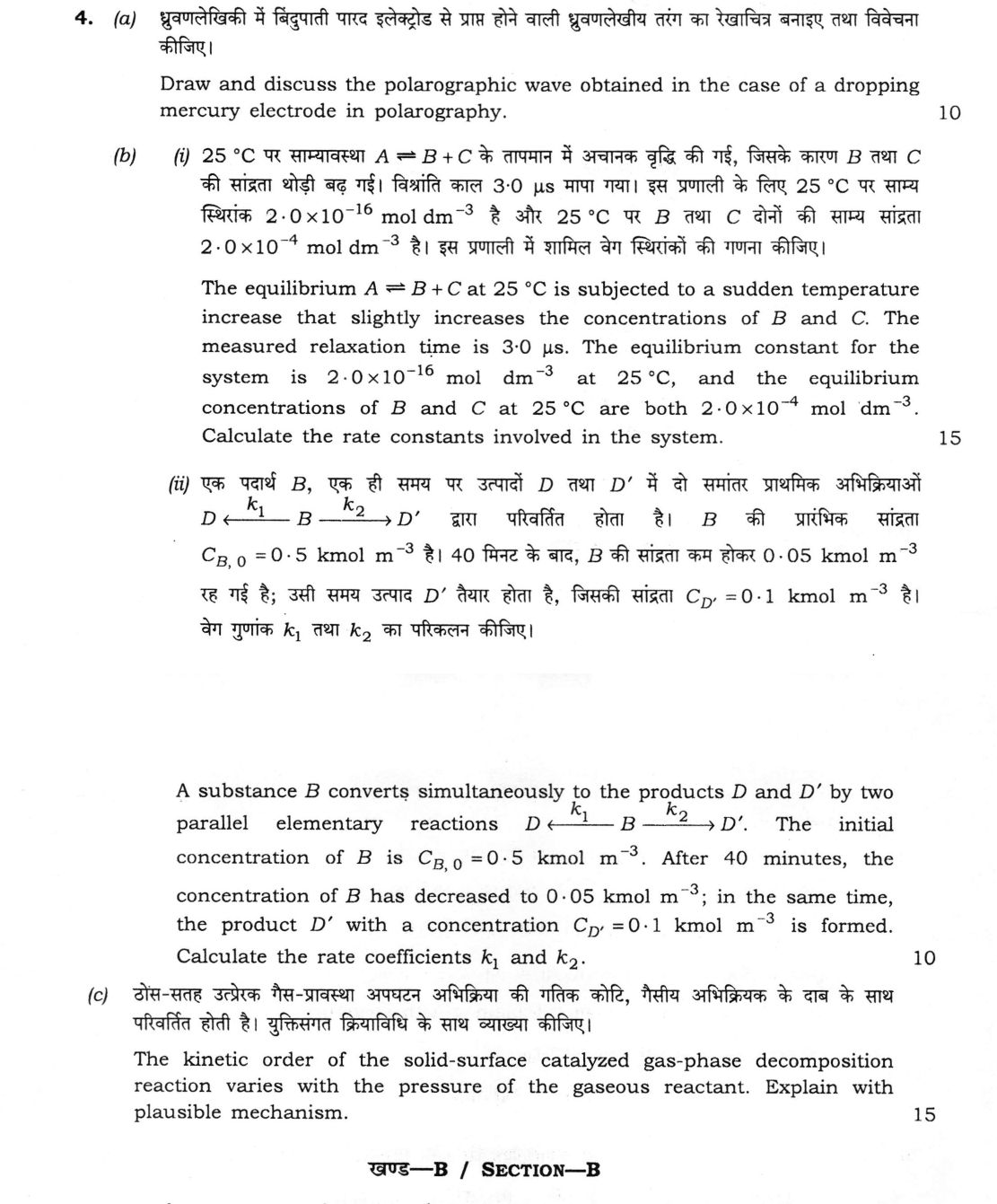
Draw and discuss the polarographic wave obtained in the case of a dropping mercury electrode in polarography. 10 marks
The equilibrium A ⇌ B + C at 25 °C is subjected to a sudden temperature increase that slightly increases the concentrations of B and C. The measured relaxation time is 3·0 μs. The equilibrium constant for the system is 2·0×10^−16 mol dm^−3 at 25 °C, and the equilibrium concentrations of B and C at 25 °C are both 2·0×10^−4 mol dm^−3. Calculate the rate constants involved in the system. 15 marks
A substance B converts simultaneously to the products D and D′ by two parallel elementary reactions D ←k₁— B —k₂→ D′. The initial concentration of B is C_B,0 = 0·5 kmol m⁻³. After 40 minutes, the concentration of B has decreased to 0·05 kmol m⁻³; in the same time, the product D′ with a concentration C_D′ = 0·1 kmol m⁻³ is formed. Calculate the rate coefficients k₁ and k₂. 10 marks
The kinetic order of the solid-surface catalyzed gas-phase decomposition reaction varies with the pressure of the gaseous reactant. Explain with plausible mechanism. 15 marks
हिंदी में प्रश्न पढ़ें
ध्रुवणलेखिकी में बिंदुपाती पारद इलेक्ट्रोड से प्राप्त होने वाली ध्रुवणलेखीय तरंग का रेखाचित्र बनाइए तथा विवेचना कीजिए। (10 अंक)
25 °C पर साम्यावस्था A ⇌ B + C के तापमान में अचानक वृद्धि की गई, जिसके कारण B तथा C की सांद्रता थोड़ी बढ़ गई। विश्रांति काल 3·0 μs मापा गया। इस प्रणाली के लिए 25 °C पर साम्य स्थिरांक 2·0×10^−16 mol dm^−3 है और 25 °C पर B तथा C दोनों की साम्य सांद्रता 2·0×10^−4 mol dm^−3 है। इस प्रणाली में शामिल वेग स्थिरांकों की गणना कीजिए। (15 अंक)
कोई पदार्थ B दो समानांतर प्रारंभिक अभिक्रियाओं द्वारा एक साथ उत्पादों D और D′ में परिवर्तित होता है : D ←k₁— B —k₂→ D′। B की प्रारंभिक सांद्रता C_B,0 = 0·5 kmol m⁻³ है। 40 मिनट के बाद B की सांद्रता घटकर 0·05 kmol m⁻³ हो जाती है; उसी समय में C_D′ = 0·1 kmol m⁻³ सांद्रता वाला उत्पाद D′ बनता है। वेग स्थिरांक k₁ तथा k₂ परिकलित कीजिए। (10 अंक)
ठोस-सतह उत्प्रेरक गैस-प्रावस्था अपघटन अभिक्रिया की गतिक कोटि, गैसीय अभिक्रियक के दाब के साथ परिवर्तित होती है। युक्तिसंगत क्रियाविधि के साथ व्याख्या कीजिए। (15 अंक)
Model answer
Drafted with AI by UPSC Answer Check against this question's marking rubric, to the expected length. UPSC does not publish answers for Mains — this is one way to score well, not an official key. How we build rubrics and answers.
(a) Polarographic wave at a dropping mercury electrode (10 marks)
In polarography the potential applied to a dropping mercury electrode (DME, the microelectrode, connected as cathode) is varied slowly against a large non-polarisable reference (saturated calomel electrode), in an unstirred solution of the analyte containing an excess of inert supporting electrolyte, and the current is recorded. The current-potential curve is the polarogram.

Discussion of the wave:
- Residual current: at potentials before reduction begins, only a small current flows. It arises from the charging of the electrical double layer of the growing drops (the main part) and from trace impurities.
- Rising portion: when the potential reaches the reduction potential of the analyte, Mn+ + ne⁻ → M(Hg), the current rises steeply as the surface concentration of the analyte falls, and the rate is controlled by the electrode reaction and by diffusion.
- Plateau: at more negative potentials the surface concentration falls to zero, so the current is limited by the diffusion of analyte to the electrode. The limiting current less the residual current is the diffusion current i_d, and it is proportional to concentration: i_d = 607 n D^½ m^(2/3) t^(1/6) C (Ilkovic equation, average current in μA, D in cm² s⁻¹, m the mass flow of mercury in mg s⁻¹, t the drop time in s and C in mmol dm⁻³). This is the basis of quantitative analysis, by calibration or standard addition.
- Half-wave potential E½: the potential at which i = i_d/2. It is characteristic of the species and nearly independent of concentration, so it is used for qualitative analysis. For a reversible wave, E = E½ + (0.0592/n) log[(i_d − i)/i] at 25 °C, so a plot of E against log[(i_d − i)/i] is a straight line with slope 0.0592/n, giving n.
- The oscillations in the current follow the growth and fall of each drop, which renews the electrode surface every few seconds.
- Advantages of mercury: a wide cathodic range because of the high hydrogen overpotential, a reproducible fresh surface, and amalgam formation for metals. The excess supporting electrolyte removes the migration current, dissolved oxygen (which gives two waves of its own) is removed with nitrogen, and a maximum-suppressor such as gelatin removes current maxima.
(b)(i) Relaxation time for A ⇌ B + C (15 marks)
The forward step A → B + C has rate constant k_f and the reverse step B + C → A has rate constant k_r, so K = k_f/k_r.
After the temperature jump the system relaxes to its new equilibrium. Let x be the deviation of [A] from its new equilibrium value; then [B] and [C] deviate by −x. Then
dx/dt = −k_f([A]_eq + x) + k_r([B]_eq − x)([C]_eq − x).
At equilibrium, k_f[A]_eq = k_r[B]_eq[C]_eq, and dropping the term in x² (small deviation):
dx/dt = −[k_f + k_r([B]_eq + [C]_eq)] x,
so x decays exponentially with 1/τ = k_f + k_r([B]_eq + [C]_eq).
Here [B]_eq = [C]_eq = 2.0 × 10⁻⁴ mol dm⁻³, so [B]_eq + [C]_eq = 4.0 × 10⁻⁴ mol dm⁻³. Using k_f = K k_r:
1/τ = k_r (K + [B]_eq + [C]_eq) = k_r (2.0 × 10⁻¹⁶ + 4.0 × 10⁻⁴) ≈ 4.0 × 10⁻⁴ k_r,
because K is negligible beside the sum of concentrations. With τ = 3.0 μs, 1/τ = 3.33 × 10⁵ s⁻¹.
k_r = 3.33 × 10⁵/(4.0 × 10⁻⁴) = 8.3 × 10⁸ dm³ mol⁻¹ s⁻¹.
k_f = K k_r = 2.0 × 10⁻¹⁶ × 8.3 × 10⁸ = 1.7 × 10⁻⁷ s⁻¹.
(b)(ii) Parallel first-order reactions (10 marks)
B → D (k₁) and B → D′ (k₂) are parallel first-order reactions, so −d[B]/dt = (k₁ + k₂)[B], and [B] = [B]₀ e^(−(k₁+k₂)t).
With [B]₀ = 0.5 and [B] = 0.05 kmol m⁻³ at t = 40 min:
k₁ + k₂ = (1/t) ln([B]₀/[B]) = ln(10)/40 = 2.303/40 = 0.0576 min⁻¹ = 9.59 × 10⁻⁴ s⁻¹.
The products form in the ratio of the rate constants: [D′]/[D] = k₂/k₁. B reacted = 0.5 − 0.05 = 0.45, of which [D′] = 0.1, so [D] = 0.45 − 0.10 = 0.35 kmol m⁻³. Then k₂/k₁ = 0.10/0.35 = 2/7.
k₁ = 0.0576 × (0.35/0.45) = 0.0448 min⁻¹ = 7.5 × 10⁻⁴ s⁻¹.
k₂ = 0.0576 × (0.10/0.45) = 0.0128 min⁻¹ = 2.1 × 10⁻⁴ s⁻¹.
Check: k₁ + k₂ = 0.0448 + 0.0128 = 0.0576 min⁻¹.
(c) Variable order of a surface-catalysed gas-phase decomposition (15 marks)
Consider the decomposition of a gas A on a solid catalyst. A plausible (Langmuir-Hinshelwood) mechanism has three steps: (1) rapid reversible adsorption of A on a free site, A(g) + ⇌ A, with adsorption coefficient b; (2) unimolecular decomposition of the adsorbed molecule, A* → products, slow and rate-determining, with constant k; (3) desorption of the products.
The rate is proportional to the fraction of surface covered. By the Langmuir isotherm, θ = bP/(1 + bP), so
rate = kθ = k bP/(1 + bP).
- At low pressure or weak adsorption (bP ≪ 1), the rate = k b P: first order in the gas pressure, because the surface is sparsely covered and more gas means more adsorbed molecules.
- At high pressure or strong adsorption (bP ≫ 1), θ → 1 and the rate = k: zero order, since the surface is saturated and more gas cannot increase the rate. Examples are the decomposition of ammonia on tungsten and of hydrogen iodide on gold.
- At intermediate pressures the rate is fractional order (between 0 and 1), which is why the observed order changes with pressure.
If a product is also strongly adsorbed and blocks sites (for example H₂ in the decomposition of ammonia on platinum), the rate = k b_A P_A/(1 + b_A P_A + b_B P_B), and the order in the product is negative (retardation). The order is therefore not a fixed property of the reaction but depends on the surface coverage.
How this answer will be evaluated
Evaluation rubric
Each sub-part is marked on its own, against the marks and word limit printed on the paper.
- (a) (a) Draw and discuss the polarographic wave at a dropping mercury electrode (10 marks). 10 marks
Must cover
- Labelled wave: residual current, rise, plateau (limiting current), E½ at i_d/2
- Diffusion current i_d ∝ C (Ilkovic equation) for quantitative analysis
- E½ characteristic of the species for qualitative analysis; Nernstian log plot gives n
- Role of supporting electrolyte, removal of oxygen, drop oscillations, wide cathodic range of Hg
Loses marks
- Showing a peak-shaped curve.
- Confusing E½ with the decomposition potential.
Earns more
- Source of residual current (charging).
- Diffusion-controlled plateau explained.
Extra mark
- Maximum suppressor (gelatin)
- (b)(i) (b)(i) Rate constants from the relaxation time τ = 3.0 μs for A ⇌ B + C (15 marks). 15 marks
Must cover
- Linearised rate law after the T-jump
- 1/τ = k_f + k_r([B]eq + [C]eq)
- k_r ≈ 8.3 × 10⁸ dm³ mol⁻¹ s⁻¹
- k_f = K k_r ≈ 1.7 × 10⁻⁷ s⁻¹
Loses marks
- Using 1/τ = k_f + k_r[A].
- Using 4[B]eq k_r with wrong stoichiometry.
Earns more
- Use of K = k_f/k_r.
- Neglect of K beside the concentration sum justified.
Extra mark
- Units checked
- (b)(ii) (b)(ii) Rate coefficients for parallel first-order reactions of B (10 marks). 10 marks
Must cover
- k₁ + k₂ = ln(10)/40 = 0.0576 min⁻¹
- D = 0.35 kmol m⁻³, [D′]/[D] = k₂/k₁ = 2/7
- k₁ ≈ 0.0448 min⁻¹ and k₂ ≈ 0.0128 min⁻¹ (7.5 × 10⁻⁴ and 2.1 × 10⁻⁴ s⁻¹)
Loses marks
- Using log₁₀ instead of ln.
- Taking D equal to D′.
Earns more
- Sum check k₁ + k₂.
Extra mark
- Conversion to s⁻¹
- (c) (c) Explain, with a plausible mechanism, why the order of a surface-catalysed gas decomposition varies with pressure (15 marks). 15 marks
Must cover
- Langmuir-Hinshelwood mechanism: adsorption, slow surface reaction, desorption
- Rate = kθ = kbP/(1 + bP)
- Low pressure first order; high pressure zero order; intermediate fractional order
- Example or inhibition by strongly adsorbed product (negative order)
Loses marks
- Assuming the order is fixed at one.
- Confusing molecularity with order.
Earns more
- Explanation in terms of surface coverage.
Extra mark
- Named examples (NH₃ on W, HI on Au)
What "Discuss" is asking you to do
Lay the issue out from more than one side — how it arose, what is claimed for it, what is held against it, and where it now stands. UPSC attaches discuss to broad topics with several live dimensions, so coverage of the dimensions earns more than the strength of your opinion.
Structure that answers it
Set the issue up → the case as it is made → the case against → the dimension both sides leave out → where the balance now lies
Where marks are lost
Listing facts with no thread between them, or arguing one side throughout and calling it a discussion.
Practice this exact question
Write your answer and it is marked point by point against the model answer above — what you covered, what you missed, what you got wrong.
Evaluate my answer →More from Chemistry 2026 Paper I
- Q1 (a) One real gas equation is van der Waals equation \left(P + \frac{n^2 a}{V^2}\right)(V…
- Q2 (a) The Maxwell distribution of molecular speed of a gaseous system is dN_c = 4πN ( M / (…
- Q3 (a) (i) Derive the expressions of chemical potential of a component in a mixture system i…
- Q4 (a) Draw and discuss the polarographic wave obtained in the case of a dropping mercury el…
- Q5 (a) What is the de Broglie wavelength for a baseball (140 g) moving at 40 m s⁻¹? Comment…
- Q6 (a) (i) Predict the Lewis structures and geometry of the following as per VSEPR theory :…
- Q7 (a) (i) Show that ψ(x) = e^(αx) is an eigenfunction for the operator  = d^n/dx^n. What i…