Paper I — Q2
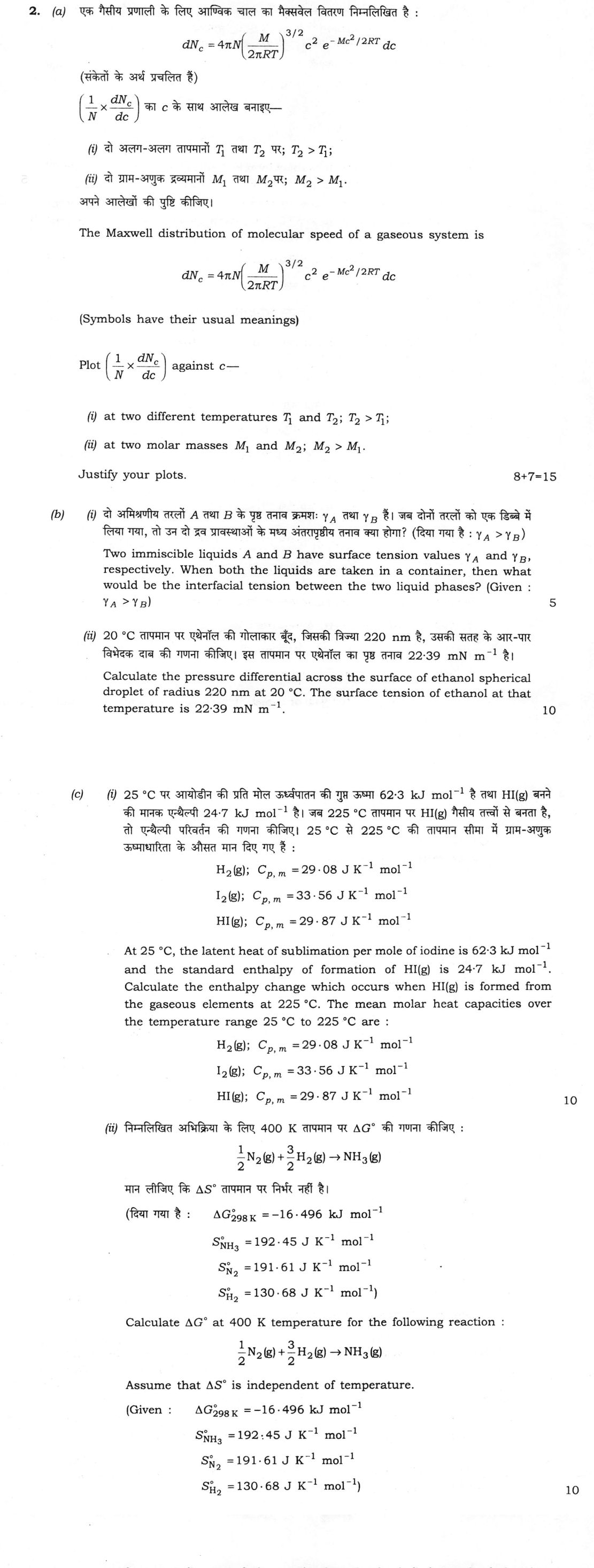
(a) The Maxwell distribution of molecular speed of a gaseous system is dN_c = 4πN ( M / (2πRT) )³/2 c² e^-Mc²/2RT dc (Symbols…
The Maxwell distribution of molecular speed of a gaseous system is
dN_c = 4πN ( M / (2πRT) )³/2 c² e^-Mc²/2RT dc
(Symbols have their usual meanings)
Plot ( 1/N × dN_c/dc ) against c—
at two different temperatures T₁ and T₂; T₂ > T₁;
at two molar masses M₁ and M₂; M₂ > M₁.
Justify your plots. 15 marks
Two immiscible liquids A and B have surface tension values γ_A and γ_B, respectively. When both the liquids are taken in a container, then what would be the interfacial tension between the two liquid phases? (Given : γ_A > γ_B) 5 marks
Calculate the pressure differential across the surface of ethanol spherical droplet of radius 220 nm at 20 °C. The surface tension of ethanol at that temperature is 22·39 mN m⁻¹. 10 marks
At 25 °C, the latent heat of sublimation per mole of iodine is 62·3 kJ mol⁻¹ and the standard enthalpy of formation of HI(g) is 24·7 kJ mol⁻¹. Calculate the enthalpy change which occurs when HI(g) is formed from the gaseous elements at 225 °C. The mean molar heat capacities over the temperature range 25 °C to 225 °C are :
H₂(g); Cp, m = 29·08 J K⁻¹ mol⁻¹
I₂(g); Cp, m = 33·56 J K⁻¹ mol⁻¹
HI(g); Cp, m = 29·87 J K⁻¹ mol⁻¹ 10 marks
Calculate ΔG° at 400 K temperature for the following reaction :
1/2 N₂(g) + 3/2 H₂(g) → NH₃(g)
Assume that ΔS° is independent of temperature.
(Given : ΔG°₂₉₈ K = –16·496 kJ mol⁻¹
S°NH₃ = 192·45 J K⁻¹ mol⁻¹
S°N₂ = 191·61 J K⁻¹ mol⁻¹
S°H₂ = 130·68 J K⁻¹ mol⁻¹) 10 marks
हिंदी में प्रश्न पढ़ें
एक गैसीय प्रणाली के लिए आण्विक चाल का मैक्सवेल वितरण निम्नलिखित है :
dN_c = 4πN ( M / (2πRT) )³/2 c² e^-Mc²/2RT dc
(संकेतों के अर्थ प्रचलित हैं)
( 1/N × dN_c/dc ) का c के साथ आलेख बनाइए—
दो अलग-अलग तापमानों T₁ तथा T₂ पर; T₂ > T₁;
दो ग्राम-अणुक द्रव्यमानों M₁ तथा M₂ पर; M₂ > M₁.
अपने आलेखों की पुष्टि कीजिए। (15 अंक)
दो अमिश्रणीय तरलों A तथा B के पृष्ठ तनाव क्रमशः γ_A तथा γ_B हैं। जब दोनों तरलों को एक डिब्बे में लिया गया, तो उन दो द्रव प्रावस्थाओं के मध्य अंतरापृष्ठीय तनाव क्या होगा? (दिया गया है : γ_A > γ_B) (5 अंक)
20 °C तापमान पर एथेनॉल की गोलाकार बूँद, जिसकी त्रिज्या 220 nm है, उसकी सतह के आर-पार विभेदक दाब की गणना कीजिए। इस तापमान पर एथेनॉल का पृष्ठ तनाव 22·39 mN m⁻¹ है। (10 अंक)
25 °C पर आयोडीन की प्रति मोल ऊर्ध्वपातन की गुप्त ऊष्मा 62·3 kJ mol⁻¹ है तथा HI(g) बनने की मानक एन्थैल्पी 24·7 kJ mol⁻¹ है। जब 225 °C तापमान पर HI(g) गैसीय तत्वों से बनता है, तो एन्थैल्पी परिवर्तन की गणना कीजिए। 25 °C से 225 °C की तापमान सीमा में ग्राम-अणुक ऊष्माधारिता के औसत मान दिए गए हैं :
H₂(g); Cp, m = 29·08 J K⁻¹ mol⁻¹
I₂(g); Cp, m = 33·56 J K⁻¹ mol⁻¹
HI(g); Cp, m = 29·87 J K⁻¹ mol⁻¹ (10 अंक)
निम्नलिखित अभिक्रिया के लिए 400 K तापमान पर ΔG° की गणना कीजिए :
1/2 N₂(g) + 3/2 H₂(g) → NH₃(g)
मान लीजिए कि ΔS° तापमान पर निर्भर नहीं है।
(दिया गया है : ΔG°₂₉₈ K = –16·496 kJ mol⁻¹
S°NH₃ = 192·45 J K⁻¹ mol⁻¹
S°N₂ = 191·61 J K⁻¹ mol⁻¹
S°H₂ = 130·68 J K⁻¹ mol⁻¹) (10 अंक)
Model answer
Drafted with AI by UPSC Answer Check against this question's marking rubric, to the expected length. UPSC does not publish answers for Mains — this is one way to score well, not an official key. How we build rubrics and answers.
(a) Maxwell speed distribution (15 marks)
The distribution is (1/N)(dN/dc) = 4π(M/2πRT)^(3/2) c² e^(−Mc²/2RT). At small c the factor c² dominates and the curve rises from zero (it is zero at c = 0); at large c the exponential dominates and the curve falls to zero. It therefore has a single maximum at the most probable speed c_mp = (2RT/M)^½, obtained from d/dc = 0. The area under every curve is 1, since the fractions of molecules add up to unity.
(i) Effect of temperature (8 marks). At fixed M, c_mp rises as T^½, so on going from T₁ to T₂ (T₂ > T₁) the maximum moves to higher speed. The peak height is proportional to 1/c_mp ∝ T^(−½), so the curve becomes lower and broader, with a larger fraction of molecules at high speeds and a smaller fraction near c_mp. Mean speed ∝ T^½ and the spread of speeds increases, while the area stays 1.
(ii) Effect of molar mass (7 marks). At fixed T, c_mp ∝ M^(−½), so for M₂ > M₁ the heavier gas has its maximum at lower speed. The peak height ∝ M^½, so the curve is taller and narrower: heavier molecules move more slowly and have a smaller spread of speeds, whereas light molecules have a flatter curve extending to high speeds. Again the area is 1.

(b)(i) Interfacial tension between immiscible liquids (5 marks)
The interfacial tension γ_AB between two mutually saturated immiscible liquids is given approximately by Antonoff's rule: γ_AB = γ_A − γ_B (for γ_A > γ_B), where γ_A and γ_B are the surface tensions of the pure liquids. It is therefore smaller than γ_A, and it is the difference of the two. The reason is that each liquid is partly saturated with the other, and at the interface the attractions across the boundary offset part of the surface tension of each liquid. The rule is approximate; a fuller treatment, γ_AB = γ_A + γ_B − 2√(γ_A γ_B), also gives a value smaller than γ_A + γ_B.
(b)(ii) Pressure difference across an ethanol droplet (10 marks)
For a spherical droplet with a single liquid-vapour surface, the Young-Laplace equation gives ΔP = 2γ/r.
γ = 22.39 mN m⁻¹ = 22.39 × 10⁻³ N m⁻¹ and r = 220 nm = 2.20 × 10⁻⁷ m.
ΔP = 2 × 22.39 × 10⁻³/(2.20 × 10⁻⁷) = 4.478 × 10⁻²/2.20 × 10⁻⁷ = 2.04 × 10⁵ Pa.
The pressure inside the droplet is about 2.04 × 10⁵ Pa (roughly 2 bar or 2 atm) higher than outside; it is the excess pressure on the concave side of the curved surface, and it is large because the radius is very small.
(c)(i) Enthalpy of formation of HI(g) at 225 °C (10 marks)
The reaction is ½H₂(g) + ½I₂(g) → HI(g). The given ΔfH° of HI(g) at 25 °C, 24.7 kJ mol⁻¹, refers to solid iodine, so we first convert I₂(s) to I₂(g) using the sublimation enthalpy 62.3 kJ mol⁻¹:
ΔH(298 K) = ΔfH°(HI) − ½ΔsubH(I₂) = 24.7 − ½ × 62.3 = 24.7 − 31.15 = −6.45 kJ mol⁻¹.
By Kirchhoff's law, ΔH(T₂) = ΔH(T₁) + ΔC_p (T₂ − T₁), with ΔC_p = C_p(HI) − ½C_p(H₂) − ½C_p(I₂) = 29.87 − ½(29.08) − ½(33.56) = 29.87 − 14.54 − 16.78 = −1.45 J K⁻¹ mol⁻¹.
ΔH(498 K) = −6450 + (−1.45)(498 − 298) = −6450 − 290 = −6740 J mol⁻¹ ≈ −6.74 kJ mol⁻¹.
(c)(ii) ΔG° for ½N₂ + 3/2 H₂ → NH₃ at 400 K (10 marks)
ΔS° = S°(NH₃) − ½S°(N₂) − 3/2 S°(H₂) = 192.45 − 95.805 − 196.02 = −99.375 J K⁻¹ mol⁻¹.
At 298 K, ΔH° = ΔG° + TΔS° = −16 496 + 298 × (−99.375) = −16 496 − 29 614 = −46 110 J mol⁻¹ ≈ −46.11 kJ mol⁻¹.
Taking ΔH° and ΔS° as independent of temperature, at 400 K:
ΔG°(400 K) = ΔH° − TΔS° = −46 110 − 400 × (−99.375) = −46 110 + 39 750 = −6 360 J mol⁻¹ ≈ −6.36 kJ mol⁻¹.
The reaction is still spontaneous at 400 K but less favourable than at 298 K, as expected for an exothermic reaction with negative ΔS°.
How this answer will be evaluated
Evaluation rubric
Each sub-part is marked on its own, against the marks and word limit printed on the paper.
- (a) (a) Sketch (1/N)(dN/dc) against c for (i) two temperatures T₂ > T₁ (8 marks) and (ii) two molar masses M₂ > M₁ (7 marks), and justify (15 marks). 15 marks
Must cover
- Shape: zero at c = 0, single maximum at c_mp = (2RT/M)^½, decays at large c; area = 1
- (i) Higher T: peak shifts right, lower and broader (height ∝ T^-½)
- (ii) Heavier gas: peak shifts left, taller and narrower (height ∝ M^½)
- Labelled axes and both curves on the same axes for each comparison
Loses marks
- Peak moving right with increasing M.
- Curves not normalised, or higher T with a taller peak.
Earns more
- Derivation of c_mp from d/dc = 0.
- Physical explanation (c² factor versus exponential).
Extra mark
- Mean and rms speeds compared
- (b)(i) (b)(i) Interfacial tension between immiscible liquids A and B with γ_A > γ_B (5 marks). 5 marks
Must cover
- γ_AB = γ_A − γ_B (Antonoff's rule)
- Smaller than γ_A; reason from mutual saturation and cross-boundary attraction
Loses marks
- Giving γ_A + γ_B.
- Stating that interfacial tension is zero.
Earns more
- Statement that the rule is approximate.
Extra mark
- Girifalco-Good relation
- (b)(ii) (b)(ii) Pressure differential across an ethanol droplet of r = 220 nm, γ = 22.39 mN m⁻¹ (10 marks). 10 marks
Must cover
- Young-Laplace ΔP = 2γ/r for a single surface
- Unit conversion: 22.39 × 10⁻³ N m⁻¹, 2.20 × 10⁻⁷ m
- ΔP ≈ 2.04 × 10⁵ Pa (about 2 bar)
Loses marks
- Using 4γ/r (soap bubble).
- Leaving r in nm.
Earns more
- Interpretation: pressure higher inside.
Extra mark
- Reason it is large for small r
- (c)(i) (c)(i) Enthalpy change forming HI(g) from gaseous elements at 225 °C (10 marks). 10 marks
Must cover
- ΔH(298 K) = 24.7 − 31.15 = −6.45 kJ mol⁻¹ (using the sublimation enthalpy of I₂)
- ΔC_p = −1.45 J K⁻¹ mol⁻¹
- Kirchhoff: ΔH(498 K) = −6.45 + (−1.45)(200)/1000 ≈ −6.74 kJ mol⁻¹
Loses marks
- Adding the full 62.3 kJ mol⁻¹ instead of half.
- Using 225 K instead of a 200 K interval.
Earns more
- Sign and stoichiometric halves used correctly.
Extra mark
- Note on the temperature range where I₂ stays gaseous
- (c)(ii) (c)(ii) ΔG° at 400 K for ½N₂ + 3/2 H₂ → NH₃ assuming ΔS° constant (10 marks). 10 marks
Must cover
- ΔS° = 192.45 − 95.805 − 196.02 ≈ −99.4 J K⁻¹ mol⁻¹
- ΔH° = ΔG° + TΔS° ≈ −46.11 kJ mol⁻¹
- ΔG°(400 K) = ΔH° − TΔS° ≈ −6.36 kJ mol⁻¹
Loses marks
- Wrong stoichiometry for S° of H₂ (using 1 instead of 3/2).
- Mixed J and kJ.
Earns more
- Cross-check with ΔG₄₀₀ = ΔG₂₉₈ − ΔS°(ΔT).
Extra mark
- Comment on spontaneity at 400 K
What "Justify" is asking you to do
Defend a position with reasons that carry evidence, and show why the contrary view does not hold. Where the stem runs as a question and asks you to justify your answer, the position is yours to choose and the marks lie wholly in the defence.
Structure that answers it
Position stated plainly → reason 1 with evidence → reason 2 with evidence → strongest objection, met → position restated as qualified
Where marks are lost
Reasons stated and none of them evidenced. The other standard loss is fence-sitting — an answer that finds merit on both sides and commits to neither has justified nothing.
Practice this exact question
Write your answer and it is marked point by point against the model answer above — what you covered, what you missed, what you got wrong.
Evaluate my answer →More from Chemistry 2026 Paper I
- Q1 (a) One real gas equation is van der Waals equation \left(P + \frac{n^2 a}{V^2}\right)(V…
- Q2 (a) The Maxwell distribution of molecular speed of a gaseous system is dN_c = 4πN ( M / (…
- Q3 (a) (i) Derive the expressions of chemical potential of a component in a mixture system i…
- Q4 (a) Draw and discuss the polarographic wave obtained in the case of a dropping mercury el…
- Q5 (a) What is the de Broglie wavelength for a baseball (140 g) moving at 40 m s⁻¹? Comment…