Paper I — Q5
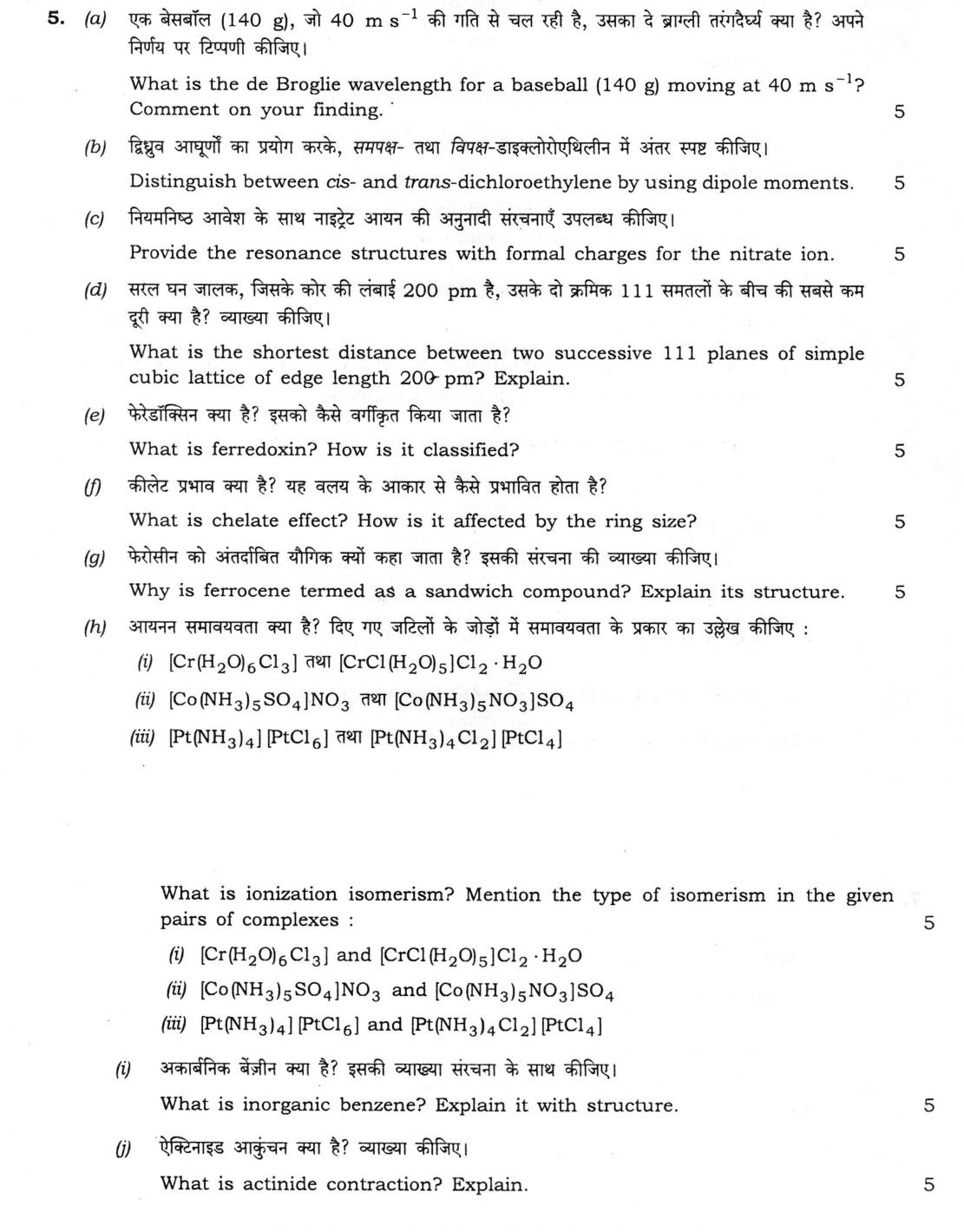
(a) What is the de Broglie wavelength for a baseball (140 g) moving at 40 m s⁻¹? Comment on your finding. (5 marks) (b)…
What is the de Broglie wavelength for a baseball (140 g) moving at 40 m s⁻¹? Comment on your finding. 5 marks
Distinguish between cis- and trans-dichloroethylene by using dipole moments. 5 marks
Provide the resonance structures with formal charges for the nitrate ion. 5 marks
What is the shortest distance between two successive 111 planes of simple cubic lattice of edge length 200 pm? Explain. 5 marks
What is ferredoxin? How is it classified? 5 marks
What is chelate effect? How is it affected by the ring size? 5 marks
Why is ferrocene termed as a sandwich compound? Explain its structure. 5 marks
What is ionization isomerism? Mention the type of isomerism in the given pairs of complexes : [Cr(H₂O)₆Cl₃] and [CrCl(H₂O)₅]Cl₂ · H₂O
[Co(NH₃)₅SO₄]NO₃ and [Co(NH₃)₅NO₃]SO₄
[Pt(NH₃)₄][PtCl₆] and [Pt(NH₃)₄Cl₂][PtCl₄] 5 marks
What is inorganic benzene? Explain it with structure. 5 marks
(j) What is actinide contraction? Explain. 5 marks
हिंदी में प्रश्न पढ़ें
एक बेसबॉल (140 g), जो 40 m s⁻¹ की गति से चल रही है, उसका डी ब्रॉग्ली तरंगदैर्घ्य क्या है? अपने निर्णय पर टिप्पणी कीजिए। (5 अंक)
द्विध्रुव आघूर्णों का प्रयोग करके, समपक्ष- तथा विपक्ष-डाइक्लोरोएथिलीन में अंतर स्पष्ट कीजिए। (5 अंक)
नियमनिष्ठ आवेश के साथ नाइट्रेट आयन की अनुनादी संरचनाएँ उपलब्ध कीजिए। (5 अंक)
सरल घन जालक, जिसके कोर की लंबाई 200 pm है, उसके दो क्रमिक 111 समतलों के बीच की सबसे कम दूरी क्या है? व्याख्या कीजिए। (5 अंक)
फेरोडॉक्सिन क्या है? इसको कैसे वर्गीकृत किया जाता है? (5 अंक)
कीलेट प्रभाव क्या है? यह वलय के आकार से कैसे प्रभावित होता है? (5 अंक)
फेरोसीन को अंतर्विभित यौगिक क्यों कहा जाता है? इसकी संरचना की व्याख्या कीजिए। (5 अंक)
आयनन समावयवता क्या है? दिए गए जटिलों के जोड़ों में समावयवता के प्रकार का उल्लेख कीजिए : [Cr(H₂O)₆Cl₃] तथा [CrCl(H₂O)₅]Cl₂ · H₂O
[Co(NH₃)₅SO₄]NO₃ तथा [Co(NH₃)₅NO₃]SO₄
[Pt(NH₃)₄][PtCl₆] तथा [Pt(NH₃)₄Cl₂][PtCl₄] (5 अंक)
अकार्बनिक बेंज़ीन क्या है? इसकी व्याख्या संरचना के साथ कीजिए। (5 अंक)
(j) ऐक्टिनाइड आकुंचन क्या है? व्याख्या कीजिए। (5 अंक)
Model answer
Drafted with AI by UPSC Answer Check against this question's marking rubric, to the expected length. UPSC does not publish answers for Mains — this is one way to score well, not an official key. How we build rubrics and answers.
(a) de Broglie wavelength of a baseball (5 marks)
λ = h/(mv) = 6.626 × 10⁻³⁴ J s/(0.140 kg × 40 m s⁻¹) = 6.626 × 10⁻³⁴/5.6 = 1.2 × 10⁻³⁴ m.
This wavelength is about 10¹⁹ times smaller than an atomic nucleus (about 10⁻¹⁵ m), so it is far too small to be detected or to cause any diffraction or interference. Wave properties are significant only when the momentum is so small that λ is comparable with the size of the system, as for electrons in atoms; for macroscopic bodies the motion is described accurately by classical mechanics.
(b) Distinguishing cis- and trans-1,2-dichloroethylene by dipole moment (5 marks)
Each C–Cl bond is polar, so each has a bond dipole. In the cis isomer the two C–Cl dipoles lie on the same side of the double bond and their vector sum is non-zero, giving a net dipole moment of about 1.9 D. In the trans isomer they point in opposite directions and cancel exactly, so the molecule is non-polar (μ = 0). Measuring the dipole moment (for example from dielectric constant in solution) therefore identifies the isomer: a non-zero value means cis, and zero means trans. Dipole-dipole attraction also gives the cis isomer the higher boiling point (about 60 °C, against about 48 °C for trans).
(c) Resonance structures of the nitrate ion (5 marks)
The nitrate ion is trigonal planar. Three equivalent Lewis structures can be drawn, each with one N=O double bond and two N–O⁻ single bonds, differing only in which oxygen is double-bonded. In each, the formal charge is +1 on nitrogen, 0 on the double-bonded oxygen and −1 on each of the other two oxygens, so the net charge is −1.

The actual ion is a resonance hybrid of the three: all N–O bonds are equal in length (about 124 pm), with a bond order of 4/3, and the negative charge is delocalised equally over the three oxygens.
(d) Interplanar spacing d₁₁₁ in a simple cubic lattice (5 marks)
For a cubic lattice, d_hkl = a/√(h² + k² + l²).
d₁₁₁ = 200 pm/√(1 + 1 + 1) = 200/1.732 = 115.5 pm.
The (111) planes cut the axes at a, a, a, so they lie at a body-diagonal orientation, and the spacing between two successive planes is the perpendicular distance, one-third of the body diagonal length (√3 a): a/√3. This is the shortest distance between successive (111) planes.
(e) Ferredoxin (5 marks)
Ferredoxins are small iron-sulfur proteins (about 6 to 12 kDa) that act as electron carriers in photosynthesis, nitrogen fixation and metabolism. The iron is bound to inorganic (acid-labile) sulfide and to the cysteine sulfur atoms of the protein, and the Fe centres shuttle between Fe(II) and Fe(III) without change in the structure.
They are classified by the type of iron-sulfur cluster: [2Fe-2S] (two Fe bridged by two S²⁻, as in plant-type ferredoxin), [3Fe-4S], and [4Fe-4S] (cubane-like Fe₄S₄ cluster), with some bacterial ferredoxins carrying two [4Fe-4S] clusters. Rubredoxin, with a single Fe bound by four cysteines, is a related simpler protein.
(f) The chelate effect and the ring size (5 marks)
The chelate effect is the greater stability of a complex containing a polydentate (chelating) ligand than of a similar complex with the corresponding monodentate ligands. For example, [Ni(en)₃]²⁺ is far more stable (log β₃ about 18) than [Ni(NH₃)₆]²⁺ (log β₆ about 9). The reason is mainly entropic: replacing six monodentate ligands by three bidentate ones increases the number of free molecules in solution (four in all), giving a positive ΔS and a more negative ΔG, whereas ΔH is about the same.
Ring size matters. Five-membered rings (for saturated ligands such as en) and six-membered rings (for ligands with delocalised bonds, such as acetylacetonate) are the most stable, since they have the least strain. Three- and four-membered rings are strained, and rings of seven or more have lower stability because of greater loss of freedom and less favourable geometry.
(g) Ferrocene as a sandwich compound (5 marks)
Ferrocene, Fe(η⁵-C₅H₅)₂, has an Fe²⁺ ion held between two parallel cyclopentadienyl rings, like the filling of a sandwich, with all five carbons of each ring bonded equally to iron (Fe-C about 204 pm) and the C-C bonds all equal (about 140 pm). Each ring is C₅H₅⁻ and donates six π electrons, and Fe²⁺ has six d electrons, so the iron has the 18-electron configuration, which explains its great stability. The rings are eclipsed in the gas phase (D₅h) and rotate almost freely (a barrier of only a few kJ mol⁻¹). It is an orange, diamagnetic, air-stable solid that shows aromatic character, for example in Friedel-Crafts acylation.

(h) Ionization isomerism (5 marks)
Ionization isomers have the same formula but differ in which groups are coordinated to the metal and which are counter-ions, so they give different ions in solution. For example, [Co(NH₃)₅SO₄]NO₃ gives NO₃⁻ ions and no precipitate with BaCl₂, whereas [Co(NH₃)₅NO₃]SO₄ gives free SO₄²⁻ and a white BaSO₄ precipitate.
- (i) [Cr(H₂O)₆]Cl₃ and [CrCl(H₂O)₅]Cl₂·H₂O: hydrate (solvate) isomerism, since water is inside the coordination sphere in one and outside as lattice water in the other.
- (ii) [Co(NH₃)₅SO₄]NO₃ and [Co(NH₃)₅NO₃]SO₄: ionization isomerism.
- (iii) [Pt(NH₃)₄][PtCl₆] and [Pt(NH₃)₄Cl₂][PtCl₄]: coordination isomerism, in which ligands are exchanged between the cationic and anionic complexes (here with the metal also in different oxidation states, Pt(II) and Pt(IV)).
(i) Inorganic benzene (5 marks)
Inorganic benzene is borazine (borazole), B₃N₃H₆, which is isoelectronic with benzene (C₆H₆). It is a planar six-membered ring of alternating B and N atoms, each with one H, with sp² hybridised atoms. The B-N bond length (about 144 pm) is between single and double, and the π electrons are partly delocalised, but because N is more electronegative than B the π cloud is polarised towards nitrogen, so borazine is much less aromatic and more reactive than benzene. Unlike benzene it adds HCl, H₂O and other reagents (Cl on B and H on N). It is made by heating diborane with ammonia, or from BCl₃ and NH₄Cl followed by reduction with NaBH₄.

(j) Actinide contraction (5 marks)
The actinide contraction is the steady decrease in atomic and ionic radii on going across the actinides from Ac to Lr (for M³⁺, from about 112 pm for Ac³⁺ to about 90 pm at the end of the series). It is caused by the poor shielding of the nuclear charge by 5f electrons, because f orbitals are diffuse and have complicated shapes: as the nuclear charge rises by one unit and one electron is added to the 5f subshell, the outer electrons feel a larger effective nuclear charge and are drawn in. It is greater than the lanthanide contraction, because 5f orbitals are more diffuse than 4f and shield even less. One consequence is that the later 6d elements have sizes close to their 5d counterparts.
How this answer will be evaluated
Evaluation rubric
Each sub-part is marked on its own, against the marks and word limit printed on the paper.
- (a) (a) de Broglie wavelength of a 140 g baseball at 40 m s⁻¹, with comment (5 marks). 5 marks
Must cover
- λ = h/mv with SI units
- λ ≈ 1.2 × 10⁻³⁴ m
- Comment: immeasurably small, so no observable wave behaviour for macroscopic bodies
Loses marks
- Using grams in the formula.
- Result off by 10³.
Earns more
- Comparison with nuclear or atomic size.
Extra mark
- Condition λ comparable to system size
- (b) (b) Distinguish cis- and trans-1,2-dichloroethylene by dipole moments (5 marks). 5 marks
Must cover
- cis: bond dipoles add, μ ≈ 1.9 D
- trans: dipoles cancel, μ = 0
- Identification by measurement of μ
Loses marks
- Reversing the assignments.
Earns more
- Reasoning with vector addition.
Extra mark
- Boiling-point correlation
- (c) (c) Resonance structures of the nitrate ion with formal charges (5 marks). 5 marks
Must cover
- Three equivalent structures, each with one N=O and two N–O⁻
- Formal charges N +1, =O 0, –O⁻ −1; net −1
- Resonance hybrid: equal N–O bonds, delocalised charge, trigonal planar
Loses marks
- Showing charge on nitrogen as 0.
- Only one structure.
Earns more
- Structures drawn, not just described.
Extra mark
- Bond order 4/3
- (d) (d) Shortest distance between successive 111 planes in a simple cubic lattice with a = 200 pm (5 marks). 5 marks
Must cover
- d = a/√(h² + k² + l²)
- d₁₁₁ = 200/√3
- ≈ 115.5 pm
Loses marks
- Using a/3.
- Using a√3.
Earns more
- Geometric explanation (one third of body diagonal).
Extra mark
- Comment that d decreases with higher indices
- (e) (e) What is ferredoxin and how is it classified (5 marks). 5 marks
Must cover
- Small Fe-S electron-transfer protein with cysteine-bound clusters
- Fe(II)/Fe(III) redox cycling
- Classes: [2Fe-2S], [3Fe-4S], [4Fe-4S]
Loses marks
- Describing it as a haem protein.
- Missing classification.
Earns more
- Biological roles (photosynthesis, N₂ fixation).
Extra mark
- Rubredoxin as related protein
- (f) (f) Chelate effect and effect of ring size (5 marks). 5 marks
Must cover
- Definition: enhanced stability with chelating ligands
- Entropy reason: more free molecules released, ΔS > 0
- Five- and six-membered rings most stable; small and large rings less stable
- Example such as [Ni(en)₃]²⁺ versus [Ni(NH₃)₆]²⁺
Loses marks
- Attributing the effect to enthalpy alone.
- Preferring three-membered rings.
Earns more
- Reason for ring-size preference (strain).
Extra mark
- Log β values
- (g) (g) Why ferrocene is called a sandwich compound; its structure (5 marks). 5 marks
Must cover
- Fe²⁺ between two parallel η⁵-C₅H₅ rings
- Each ring donates 6 π electrons; 18-electron configuration
- Equal Fe–C and C–C bond lengths; eclipsed (gas phase), diamagnetic
- Aromatic character or stability
Loses marks
- Describing σ-bonding to a single carbon.
- Giving Fe as Fe(III).
Earns more
- Electron count shown.
Extra mark
- Discovery or Nobel Prize note
- (h) (h) Define ionization isomerism and identify the isomerism in the three pairs (5 marks). 5 marks
Must cover
- Definition: same formula, different ions in solution (coordinated versus counter-ion exchange)
- (i) hydrate (solvate) isomerism
- (ii) ionization isomerism, distinguished by BaCl₂ test
- (iii) coordination isomerism
Loses marks
- Calling (i) ionization isomerism.
- Calling (iii) linkage isomerism.
Earns more
- Test using BaCl₂ or AgNO₃.
Extra mark
- Oxidation states in (iii)
- (i) (i) What is inorganic benzene; explain with structure (5 marks). 5 marks
Must cover
- Borazine B₃N₃H₆, isoelectronic with benzene
- Planar six-membered ring of alternating B and N
- Polar B–N, less aromatic; adds HCl
- Preparation
Loses marks
- Naming it as B₃N₃H₃.
- Saying it is identical to benzene in reactivity.
Earns more
- Bond length and hybridisation.
Extra mark
- Reason for greater reactivity
- (j) (j) What is actinide contraction; explain (5 marks). 5 marks
Must cover
- Steady decrease of radii from Ac to Lr
- Cause: poor shielding by 5f electrons
- Greater than lanthanide contraction
- Consequence such as similarity of 6d and 5d
Loses marks
- Attributing to shielding by 4f.
- Saying radii increase.
Earns more
- Effective nuclear charge explanation.
Extra mark
- Numerical radii
What "Comment" is asking you to do
Take a position on the statement and support it. Comment usually attaches to a quoted line in the short slots, so the reasoning must be compressed — an opening view, a few load-bearing reasons, and the limit of the claim.
Structure that answers it
Unpack what the statement asserts → your stance → two or three supporting reasons → the qualification that limits it
Where marks are lost
Neutral summary; a comment without a stance has not answered. Equally costly is accepting the quoted line wholesale and never testing where it fails.
Practice this exact question
Write your answer and it is marked point by point against the model answer above — what you covered, what you missed, what you got wrong.
Evaluate my answer →More from Chemistry 2026 Paper I
- Q2 (a) The Maxwell distribution of molecular speed of a gaseous system is dN_c = 4πN ( M / (…
- Q3 (a) (i) Derive the expressions of chemical potential of a component in a mixture system i…
- Q4 (a) Draw and discuss the polarographic wave obtained in the case of a dropping mercury el…
- Q5 (a) What is the de Broglie wavelength for a baseball (140 g) moving at 40 m s⁻¹? Comment…
- Q6 (a) (i) Predict the Lewis structures and geometry of the following as per VSEPR theory :…
- Q7 (a) (i) Show that ψ(x) = e^(αx) is an eigenfunction for the operator  = d^n/dx^n. What i…
- Q8 (a) Differentiate between T and R conformation of hemoglobin. (10 marks) (b) (i) Describe…