Paper I — Q8
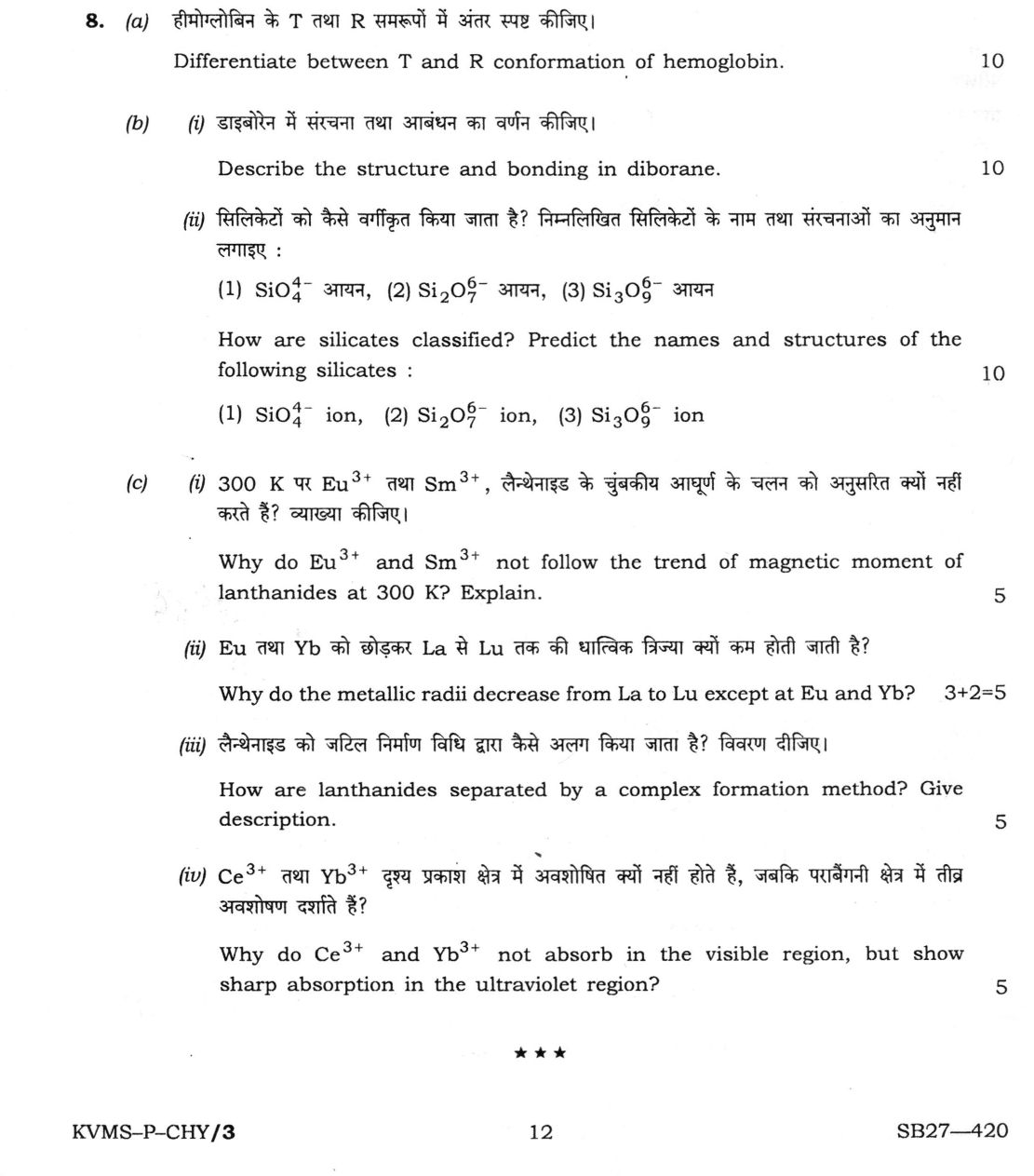
(a) Differentiate between T and R conformation of hemoglobin. (10 marks) (b) (i) Describe the structure and bonding in diborane…
Differentiate between T and R conformation of hemoglobin. 10 marks
Describe the structure and bonding in diborane. 10 marks
How are silicates classified? Predict the names and structures of the following silicates : (1) SiO₄⁴⁻ ion, (2) Si₂O₇⁶⁻ ion, (3) Si₃O₉⁶⁻ ion 10 marks
Why do Eu³⁺ and Sm³⁺ not follow the trend of magnetic moment of lanthanides at 300 K? Explain. 5 marks
Why do the metallic radii decrease from La to Lu except at Eu and Yb? 5 marks
How are lanthanides separated by a complex formation method? Give description. 5 marks
Why do Ce³⁺ and Yb³⁺ not absorb in the visible region, but show sharp absorption in the ultraviolet region? 5 marks
हिंदी में प्रश्न पढ़ें
हीमोग्लोबिन के T तथा R समरूपों में अंतर स्पष्ट कीजिए। (10 अंक)
डाइबोरेन में संरचना तथा आबंधन का वर्णन कीजिए। (10 अंक)
सिलिकेटों को कैसे वर्गीकृत किया जाता है? निम्नलिखित सिलिकेटों के नाम तथा संरचनाओं का अनुमान लगाइए : (1) SiO₄⁴⁻ आयन, (2) Si₂O₇⁶⁻ आयन, (3) Si₃O₉⁶⁻ आयन (10 अंक)
300 K पर Eu³⁺ तथा Sm³⁺, लैन्थेनाइड के चुंबकीय आघूर्ण के चलन को अनुसरित क्यों नहीं करते हैं? व्याख्या कीजिए। (5 अंक)
Eu तथा Yb को छोड़कर La से Lu तक की धात्विक त्रिज्या क्यों कम होती जाती है? (5 अंक)
लैन्थेनाइड को जटिल निर्माण विधि द्वारा कैसे अलग किया जाता है? विवरण दीजिए। (5 अंक)
Ce³⁺ तथा Yb³⁺ दृश्य प्रकाश क्षेत्र में अवशोषित क्यों नहीं होते हैं, जबकि पराबैंगनी क्षेत्र में तीव्र अवशोषण दर्शाते हैं? (5 अंक)
Model answer
Drafted with AI by UPSC Answer Check against this question's marking rubric, to the expected length. UPSC does not publish answers for Mains — this is one way to score well, not an official key. How we build rubrics and answers.
(a) T and R states of haemoglobin (10 marks)
Haemoglobin is a tetramer (α₂β₂) that exists in two quaternary states in equilibrium: the T (tense, taut) state, the form of deoxyhaemoglobin, and the R (relaxed) state, the form of oxyhaemoglobin.
- Oxygen affinity: the T state has low affinity for O₂, whereas the R state has affinity about 100 to 300 times higher.
- Salt bridges: in the T state the subunits are held by extra salt bridges and hydrogen bonds between the α₁β₂ and α₂β₁ interfaces and the C-terminal residues (for example His146β to Asp94β, and Arg141α to the neighbouring subunit); in the R state these are broken, and the structure is looser.
- Iron and haem: in the T state the high-spin Fe(II) is five-coordinate and lies about 0.6 Å out of the porphyrin plane (domed), pulled towards the proximal histidine. On binding O₂, Fe becomes low-spin, smaller and moves into the plane, pulling the proximal histidine and the F helix, which triggers the change to R.
- Quaternary structure: the transition from T to R rotates one αβ dimer relative to the other by about 15° and narrows the central cavity.
- 2,3-Bisphosphoglycerate (2,3-BPG): it binds in the central cavity of the T state, cross-linking the two β chains, and stabilises it; it does not fit in the R state, so BPG lowers oxygen affinity.
- Effectors: H⁺ and CO₂ (Bohr effect) stabilise the T state and promote O₂ release in tissues; high O₂ favours R.
- Cooperativity: binding of O₂ to one subunit shifts the equilibrium towards R and raises the affinity of the remaining sites, so the O₂-binding curve is sigmoidal (Hill coefficient about 2.8), unlike the hyperbolic curve of myoglobin. This is described by the concerted (Monod-Wyman-Changeux) model.
(b)(i) Structure and bonding in diborane (10 marks)
Diborane, B₂H₆, has D₂h symmetry with a bridged structure, not an ethane-like structure. Each boron carries two terminal hydrogens, and two hydrogens bridge the two borons. The four terminal B-H bonds (119 pm) and both borons lie in one plane, and the two bridging H atoms (B-H 133 pm) lie above and below it, in a plane perpendicular to the first. The terminal H-B-H angle is about 122°, the B-H-B angle 83° and B···B 177 pm.

Bonding. B₂H₆ has only 12 valence electrons (3 + 3 from B and 6 from H), too few for eight normal two-centre bonds, so it is electron-deficient. Each B is approximately sp³ hybridised. Eight electrons form the four terminal two-centre two-electron (2c-2e) B-H bonds. The remaining four electrons form two three-centre two-electron (3c-2e) bonds, each B-H-B "banana" bond in which two boron sp³ hybrid orbitals and the hydrogen 1s orbital combine to give a bonding, a non-bonding and an antibonding molecular orbital, and the two electrons occupy the bonding one. Each bridge thus has two electrons spread over three atoms, which is why the bridge bonds are longer and weaker than the terminal bonds. The molecule is diamagnetic and reactive, for example it is a strong Lewis acid, and hydrolyses to boric acid and hydrogen.
(b)(ii) Classification of silicates and the three silicates (10 marks)
Silicates are classified by how the SiO₄ tetrahedra are linked, that is by the number of oxygen corners shared between tetrahedra:
- 0 corners shared: orthosilicates (nesosilicates), isolated SiO₄⁴⁻ units (olivine, zircon).
- 1 corner shared: pyrosilicates (sorosilicates), Si₂O₇⁶⁻.
- 2 corners shared: cyclic silicates (SiO₃)ₙ²ⁿ⁻ (beryl, benitoite) and single-chain silicates (SiO₃)ₙ²ⁿ⁻ (pyroxenes).
- 2 and 3 corners shared alternately: double-chain silicates (Si₄O₁₁)ₙ⁶ⁿ⁻ (amphiboles).
- 3 corners shared: sheet silicates (Si₂O₅)ₙ²ⁿ⁻ (micas, clays, talc).
- 4 corners shared: three-dimensional framework (SiO₂ and, with Al replacing some Si, feldspars and zeolites).
The three ions are:
- (1) SiO₄⁴⁻: the orthosilicate ion, a single isolated tetrahedron with no shared oxygen (as in Mg₂SiO₄, olivine).
- (2) Si₂O₇⁶⁻: the pyrosilicate (disilicate) ion, two tetrahedra sharing one common corner oxygen (a Si-O-Si bridge), with six terminal O⁻ (as in Sc₂Si₂O₇, thortveitite).
- (3) Si₃O₉⁶⁻: the cyclic trisilicate ion, three tetrahedra each sharing two corners, forming a six-membered ring (Si₃O₃) with two terminal O⁻ on each Si (as in BaTiSi₃O₉, benitoite).
(c)(i) Magnetic moments of Eu³⁺ and Sm³⁺ (5 marks)
For most Ln³⁺ ions the observed moment agrees with μ = g_J√(J(J + 1)) (Van Vleck formula) because only the ground spin-orbit level is populated. In Sm³⁺ (4f⁵, ground state ⁶H₅/₂) and Eu³⁺ (4f⁶, ground state ⁷F₀) the spin-orbit coupling is small, so the excited J levels (⁶H₇/₂ and ⁷F₁, ⁷F₂ …) lie only a few hundred to about 1000 cm⁻¹ above the ground state, comparable to kT (about 208 cm⁻¹ at 300 K). They are therefore thermally populated at 300 K and contribute to the moment. For Eu³⁺ the formula gives μ = 0 (J = 0), but the observed value is about 3.4 to 3.6 BM; for Sm³⁺ it gives 0.84 BM, whereas the observed value is about 1.5 to 1.6 BM. There is also a temperature-independent (Van Vleck) contribution from mixing of the ground and excited states.
(c)(ii) Decrease in metallic radii from La to Lu (5 marks)
The radii fall steadily from La to Lu (about 187 pm to 174 pm), the lanthanide contraction (3 marks). Along the series the nuclear charge rises by one unit at each step and an electron is added to the inner 4f subshell. The 4f electrons shield the outer 5s, 5p and 6s electrons poorly because of the diffuse, directional shape of f orbitals, so the effective nuclear charge increases and the outer shells contract.
Eu (about 204 pm) and Yb (about 193 pm) are exceptions with much larger metallic radii (2 marks). They have the stable half-filled (4f⁷) and completely filled (4f¹⁴) configurations, and in the metal they contribute only two electrons, not three, to the conduction band (they behave as divalent metals, like the alkaline earths). With fewer bonding electrons the metallic bonding is weaker and the atoms are larger.
(c)(iii) Separation of lanthanides by complex formation (5 marks)
The lanthanides are separated by cation-exchange chromatography with a complexing eluent. A solution of Ln³⁺ is loaded on the top of a column of a cation-exchange resin (a sulfonated polystyrene such as Dowex-50) and the ions are adsorbed. The column is eluted with a buffered solution of a complexing agent such as citrate, EDTA or α-hydroxyisobutyrate at controlled pH.
The stability of the complexes increases with atomic number, since the ionic radius falls and the charge density rises. Heavier lanthanides therefore form stronger complexes, stay in solution more and are held less by the resin, so they are eluted first; lutetium comes off first and lanthanum last. The successive fractions are collected and the separated ions precipitated as oxalates and ignited to oxides. Repeated equilibration along the long column gives high purity (over 99.9%). The method was developed by Spedding and co-workers in the 1940s, and today solvent extraction with tributyl phosphate is used industrially.
(c)(iv) Absence of visible absorption in Ce³⁺ and Yb³⁺ (5 marks)
Ce³⁺ (4f¹) and Yb³⁺ (4f¹³) each have a single 4f electron or hole, so there is only one f-f transition, ²F₅/₂ ↔ ²F₇/₂, which is the spin-orbit splitting of the ²F term. Its energy is small, lying in the infrared (about 2200 cm⁻¹ for Ce³⁺ and about 10 000 cm⁻¹, or 1000 nm, for Yb³⁺), so it does not absorb visible light and the ions are colourless. With no other f-f transitions possible, there is nothing in the visible region.
In the ultraviolet they show intense absorption. For Ce³⁺ this is the 4f¹ → 5d¹ transition, which is Laporte-allowed (parity-changing), and so intense; for Yb³⁺ it is a ligand-to-metal charge-transfer transition, since Yb³⁺ is readily reduced to the stable 4f¹⁴ Yb²⁺. Both occur at high energy in the UV.
How this answer will be evaluated
Evaluation rubric
Each sub-part is marked on its own, against the marks and word limit printed on the paper.
- (a) (a) Differentiate the T and R conformations of haemoglobin (10 marks). 10 marks
Must cover
- T: deoxy, low O₂ affinity, salt bridges, Fe out of plane; R: oxy, high affinity, salt bridges broken, Fe in plane
- Quaternary rotation of about 15° and change in central cavity
- 2,3-BPG binds T; H⁺ and CO₂ (Bohr effect) favour T
- Cooperativity, sigmoidal curve, MWC concerted model
Loses marks
- Reversing T and R.
- Saying BPG binds the R state.
Earns more
- Fe(II) high-spin versus low-spin and movement of the F helix.
Extra mark
- Hill coefficient about 2.8
- (b)(i) (b)(i) Describe the structure and bonding in diborane (10 marks). 10 marks
Must cover
- Bridged D₂h structure: 4 terminal and 2 bridging H
- 12 valence electrons: 4 terminal 2c–2e bonds and 2 bridging 3c–2e bonds
- Bond lengths or angles (B–Ht 119 pm, B–Hb 133 pm, B–H–B 83°)
- Electron deficiency, sp³ boron, banana bonds
Loses marks
- Ethane-like structure.
- Bridging H bonded by 2c–2e bonds.
Earns more
- Neat diagram of the bridge.
Extra mark
- Molecular orbital description of the 3c–2e bond
- (b)(ii) (b)(ii) Classify silicates and predict the names and structures of SiO₄⁴⁻, Si₂O₇⁶⁻, Si₃O₉⁶⁻ (10 marks). 10 marks
Must cover
- Classification by number of shared corners: 0, 1, 2, 3, 4
- SiO₄⁴⁻: orthosilicate, isolated tetrahedron
- Si₂O₇⁶⁻: pyrosilicate, two tetrahedra sharing one corner
- Si₃O₉⁶⁻: cyclic trisilicate, six-membered ring, two corners shared per tetrahedron
Loses marks
- Calling Si₃O₉⁶⁻ a chain silicate.
- Wrong number of shared corners.
Earns more
- Examples of minerals for each type.
Extra mark
- Chain, double chain, sheet and framework classes
- (c)(i) (c)(i) Why Eu³⁺ and Sm³⁺ do not follow the magnetic-moment trend at 300 K (5 marks). 5 marks
Must cover
- Low-lying excited J levels (small spin-orbit splitting)
- Thermally populated at 300 K since separation is comparable with kT
- Observed versus Van Vleck values (Eu³⁺ 0 versus about 3.4 BM; Sm³⁺ 0.84 versus about 1.5 BM)
Loses marks
- Attributing it to orbital quenching.
- Attributing it to crystal-field splitting of f orbitals.
Earns more
- Contribution of temperature-independent paramagnetism.
Extra mark
- Numerical value of kT in cm⁻¹
- (c)(ii) (c)(ii) Why radii decrease from La to Lu except at Eu and Yb (3 + 2 marks). 5 marks
Must cover
- Lanthanide contraction: increasing nuclear charge with poor 4f shielding
- Effective nuclear charge rises and outer shells shrink
- Eu and Yb have larger radii: divalent character, only two electrons in metallic bonding
- Stable half-filled 4f⁷ and filled 4f¹⁴
Loses marks
- Attributing contraction to shielding by 6s electrons.
- Saying Eu and Yb are trivalent in the metal.
Earns more
- Approximate radii values.
Extra mark
- Comparison with alkaline earths
- (c)(iii) (c)(iii) Separation of lanthanides by a complex-formation method (5 marks). 5 marks
Must cover
- Cation-exchange resin with Ln³⁺ adsorbed
- Elution with a complexing agent such as citrate or EDTA at controlled pH
- Stability of complexes rises with atomic number; heavier ions elute first
- Fractions collected and processed
Loses marks
- Stating that La elutes first.
- No mention of complexing agent.
Earns more
- Reason for stability trend (charge density).
Extra mark
- Solvent extraction as an industrial alternative
- (c)(iv) (c)(iv) Why Ce³⁺ and Yb³⁺ do not absorb in the visible but absorb in the UV (5 marks). 5 marks
Must cover
- Only one f-f transition ²F₅/₂ ↔ ²F₇/₂, at low (IR) energy
- No visible absorption, so colourless
- UV absorption: 4f → 5d (Ce³⁺), Laporte-allowed and intense
- UV absorption: charge transfer (Yb³⁺)
Loses marks
- Attributing colourlessness to empty f orbitals.
- Saying f-f transitions are Laporte-allowed.
Earns more
- Approximate energies of the transitions.
Extra mark
- Yb²⁺ stability
What "Differentiate" is asking you to do
Fix the criteria on which the two differ and apply each criterion to both, so the pair can no longer be mixed up. Differentiate stems usually carry a further task attached — describe the mechanism, set out the principles, discuss the applications — and that task carries its own marks.
Structure that answers it
Criterion 1 applied to both → criterion 2 → criterion 3 → summary line or table → the attached second demand answered in full
Where marks are lost
Two standalone definitions placed side by side, leaving the reader to extract the difference. The second common loss is running out of space before the attached task, which is often worth as much as the differentiation.
Practice this exact question
Write your answer and it is marked point by point against the model answer above — what you covered, what you missed, what you got wrong.
Evaluate my answer →More from Chemistry 2026 Paper I
- Q5 (a) What is the de Broglie wavelength for a baseball (140 g) moving at 40 m s⁻¹? Comment…
- Q6 (a) (i) Predict the Lewis structures and geometry of the following as per VSEPR theory :…
- Q7 (a) (i) Show that ψ(x) = e^(αx) is an eigenfunction for the operator  = d^n/dx^n. What i…
- Q8 (a) Differentiate between T and R conformation of hemoglobin. (10 marks) (b) (i) Describe…