Paper II — Q1
(a) “Technological environment is considered dynamic.” Comment. (10 marks) (b) Explain the concept of organisational goals. (10…
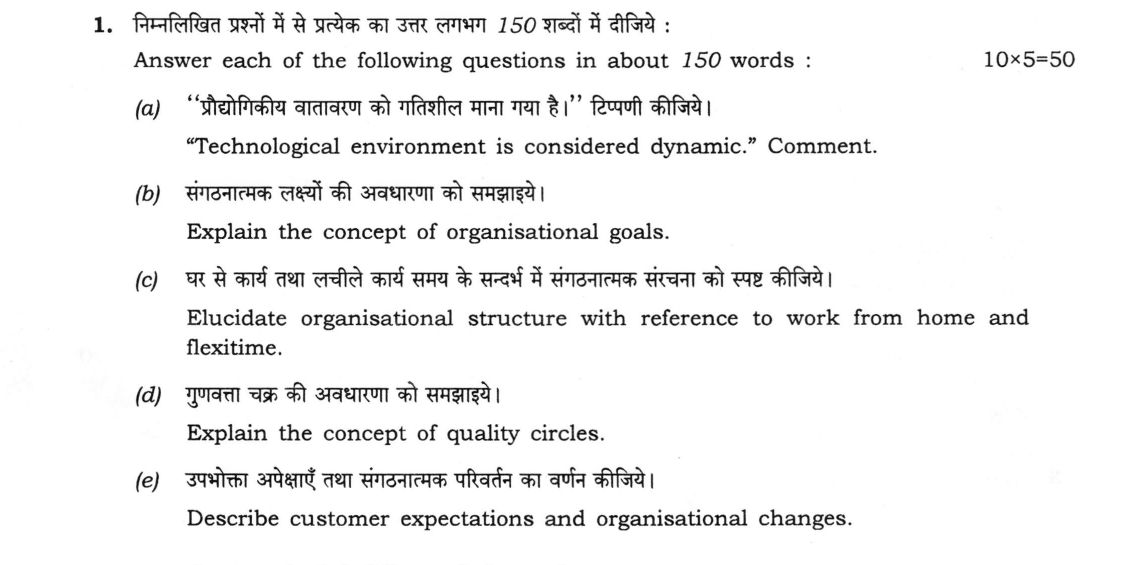
Answer each of the following questions in about 150 words :
“Technological environment is considered dynamic.” Comment. 10 marks
Explain the concept of organisational goals. 10 marks
Elucidate organisational structure with reference to work from home and flexitime. 10 marks
Explain the concept of quality circles. 10 marks
Describe customer expectations and organisational changes. 10 marks
हिंदी में प्रश्न पढ़ें
निम्नलिखित प्रश्नों में से प्रत्येक का उत्तर लगभग 150 शब्दों में दीजिये :
‘‘प्रौद्योगिकीय वातावरण को गतिशील माना गया है।’’ टिप्पणी कीजिये। (10 अंक)
संगठनात्मक लक्ष्यों की अवधारणा को समझाइये। (10 अंक)
घर से कार्य तथा लचीले कार्य समय के सन्दर्भ में संगठनात्मक संरचना को स्पष्ट कीजिये। (10 अंक)
गुणवत्ता चक्र की अवधारणा को समझाइये। (10 अंक)
उपभोक्ता अपेक्षाएँ तथा संगठनात्मक परिवर्तन का वर्णन कीजिये। (10 अंक)
Model answer
Drafted with AI by UPSC Answer Check against this question's marking rubric, to the 150-word length. UPSC does not publish answers for Mains — this is one way to score well, not an official key. How we build rubrics and answers.
(a) "Technological environment is considered dynamic" (10 marks)
The technological environment covers the inventions, methods and machines that alter how firms produce, market and organise, and it is called dynamic because it changes faster and less predictably than other environmental forces. Product life cycles have shortened, since smartphones, cloud computing, artificial intelligence, automation, digital payments (UPI) and e-commerce have altered whole industries within a few years. Technologies diffuse quickly, disrupt incumbents (film cameras, taxis, retail) and make skills, plants and business models obsolete. R&D spending, patents and the pace of innovation intensify competition. The comment is therefore valid: a firm must scan the environment continuously, invest in R&D, upgrade skills and remain flexible, as failure to adapt threatens survival, while alert firms gain cost, quality and market advantage. Yet the effect varies by industry, since some sectors change slowly, and technology has to be adopted with judgement about cost, fit and readiness.
(b) Organisational goals (10 marks)
Organisational goals are the desired future states or ends that an organisation seeks to attain, and they give it direction, purpose and a basis for decisions. They provide a standard for measuring performance, coordinate the efforts of members, and justify the existence of the organisation to society. Types include: official goals stated in charters and mission statements, and operative goals reflecting actual practice; and, by time, long-term, medium-term and short-term goals; and by area, economic (profit, growth, market share), social (employment, community, environment) and personal goals of members. A good goal is specific, measurable, attainable, relevant and time-bound (SMART), and goals are arranged in a hierarchy from mission to departmental and individual targets, as in management by objectives. Conflicts between goals, for example profit and social responsibility, have to be reconciled by priorities. Example: a company may set a target of 15% growth in sales in three years, with a quality goal of below 1% defects.
(c) Organisational structure with work from home and flexitime (10 marks)
Organisational structure is the framework of authority, responsibility, roles and communication relationships through which work is divided, grouped and coordinated to achieve objectives; it is depicted in an organisation chart and may be functional, divisional, matrix or network. Work from home and flexitime change how the structure works. Work from home, or remote work, using digital tools, weakens the fixed workplace link, so coordination depends on virtual teams, clear outputs, communication technology and trust; hierarchy becomes flatter and control shifts from supervision to results. Flexitime lets employees choose their start and end times within core hours; it needs core-hours rules, scheduling and shared coordination. These arrangements improve morale, retention, work-life balance and reduce costs of space, but raise problems of communication, supervision, data security, team cohesion and fairness. Structures therefore need to become more flexible, decentralised and technology-enabled, with clear role definitions and performance measurement.
(d) Quality circles (10 marks)
A quality circle is a small voluntary group of 6 to 12 employees from the same work area who meet regularly, usually an hour a week, to identify, analyse and solve work-related problems, particularly of quality and productivity. The idea came from Japan, drawing on Deming's and Juran's work, and was popularised by Kaoru Ishikawa in the early 1960s; it has been adopted in India by firms such as BHEL. A circle has a leader, often a supervisor, a facilitator and members trained in techniques such as brainstorming, Pareto analysis and cause-and-effect (fishbone) diagrams. Circles pick a problem, analyse causes, propose solutions and present them to management for approval and implementation. Benefits are higher quality, lower cost, participation, morale, teamwork and skill development. Limitations are lack of management support, insufficient training, and loss of interest if suggestions are ignored. Example: a circle of machine operators that reduces rejections by a change in tool set-up.
(e) Customer expectations and organisational changes (10 marks)
Customer expectations are what buyers believe a product or service should deliver, in quality, price, delivery, service and experience. They have risen with competition, information from the internet and social media, and better service by leading firms: customers now expect wider choice, customised products, speed, 24 × 7 availability, convenience through digital channels, transparency, responsiveness and ethical, sustainable conduct. Organisations respond with changes such as:
- A customer-focused strategy and culture, with marketing and service at the centre.
- Restructuring around customers, with flatter, cross-functional teams and empowered front-line staff.
- Investment in technology, such as customer relationship management, analytics and omnichannel platforms.
- Quality management and continuous improvement, with shorter delivery times and flexible production.
- Training, incentives and feedback systems, including complaint handling and customer surveys. Meeting these expectations builds satisfaction, loyalty and profit, but calls for continuing change.
How this answer will be evaluated
What earns full marks: Meets all 'must' criteria, includes 2-3 'credit' points, and is within the 150-word limit.
Evaluation rubric
Each sub-part is marked on its own, against the marks and word limit printed on the paper.
- (a) (a) Technological environment is considered dynamic: comment (10, about 150 words). 10 marks · 150 words
comment— context → arguments both sides → judgment → close
Must cover
- Meaning of technological environment
- Reasons for dynamism: rapid change, shorter life cycles, disruption, obsolescence
- Examples: digital payments, AI, e-commerce
- Judgment: firms must scan, adapt and invest in R&D, with industry variation
Loses marks
- Only describing technology with no comment.
- Ignoring the business implication.
- Well over the word limit.
Earns more
- Balanced comment noting limits or slow-changing sectors.
- Within about 150 words.
Extra mark
- Innovation and competitive advantage link
- (b) (b) Explain the concept of organisational goals (10, about 150 words). 10 marks · 150 words
explain— definition/context → points in order → small example → short close
Must cover
- Definition of organisational goals as desired future ends
- Functions: direction, standard for performance, coordination, legitimacy
- Types: official and operative, short and long term, economic and social
- SMART criteria or goal hierarchy with an example
Loses marks
- Confusing goals with plans or policies.
- No example.
- Well over the word limit.
Earns more
- Goal conflict and its resolution.
- Link to MBO.
Extra mark
- Mission versus goal distinction
- (c) (c) Explain organisational structure with reference to work from home and flexitime (10, about 150 words). 10 marks · 150 words
explain— definition/context → points in order → small example → short close
Must cover
- Meaning of organisational structure and its types
- Effect of work from home: virtual teams, flatter hierarchy, results-based control
- Effect of flexitime: core hours, coordination
- Benefits and problems: morale, cost, communication, security, cohesion
Loses marks
- Only defining structure with no reference to WFH or flexitime.
- Treating flexitime as fewer working hours.
- Well over the word limit.
Earns more
- Need for a flexible, technology-enabled structure.
- Reference to both arrangements.
Extra mark
- Hybrid work model
- (d) (d) Explain the concept of quality circles (10, about 150 words). 10 marks · 150 words
explain— definition/context → points in order → small example → short close
Must cover
- Definition: small voluntary group of 6-12 employees meeting regularly to solve work problems
- Origin in Japan (Ishikawa) and use in India
- Working and tools: brainstorming, Pareto, fishbone, presentation to management
- Benefits, limitations and an example
Loses marks
- Confusing quality circles with quality control departments.
- No benefits or limits.
- Well over the word limit.
Earns more
- Roles of leader and facilitator.
- Link to TQM.
Extra mark
- Kaizen
- (e) (e) Describe customer expectations and the resulting organisational changes (10, about 150 words). 10 marks · 150 words
describe— define → structure or process in order → labelled diagram → significance
Must cover
- Customer expectations: quality, price, choice, speed, service, transparency, digital convenience
- Reasons for rising expectations: competition, information, social media
- Organisational changes: customer-focused strategy, restructuring, technology, quality, training and feedback
- Outcome: satisfaction, loyalty, and continuing change
Loses marks
- Covering only expectations or only changes.
- Generic marketing description.
- Well over the word limit.
Earns more
- Example of a firm changing to meet expectations.
- Both parts covered.
Extra mark
- Customer relationship management
What "Comment" is asking you to do
Take a position on the statement and support it. Comment usually attaches to a quoted line in the short slots, so the reasoning must be compressed — an opening view, a few load-bearing reasons, and the limit of the claim.
Structure that answers it
Unpack what the statement asserts → your stance → two or three supporting reasons → the qualification that limits it
Where marks are lost
Neutral summary; a comment without a stance has not answered. Equally costly is accepting the quoted line wholesale and never testing where it fails.
Practice this exact question
Write your answer and it is marked point by point against the model answer above — what you covered, what you missed, what you got wrong.
Evaluate my answer →More from Commerce & Accountancy 2026 Paper II
- Q1 Answer each of the following questions in about 150 words : (a) “Technological environmen…
- Q2 (a) Explain the various types of organisational culture. (10 marks) (b) Define organisati…
- Q3 (a) What is formalisation? Discuss its role in achieving organisational efficiency and me…
- Q4 (a) “Transactional analysis provides a useful but limited framework for understanding org…