Paper II — Q2
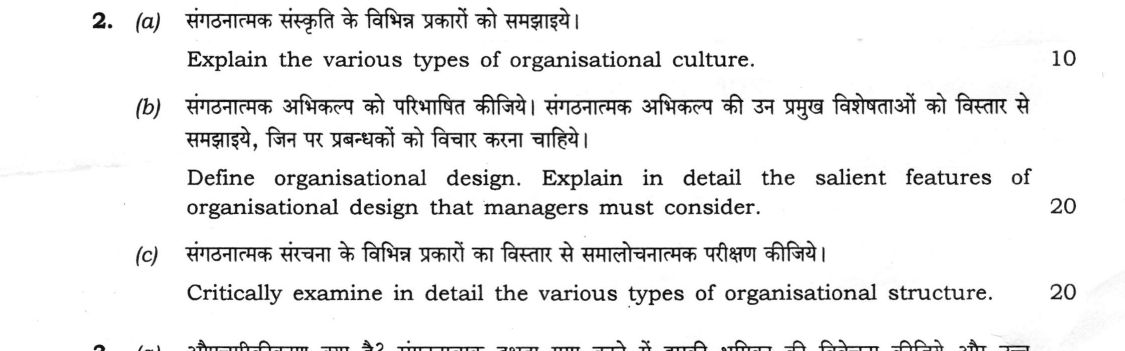
(a) Explain the various types of organisational culture. (10 marks) (b) Define organisational design. Explain in detail the…
Explain the various types of organisational culture. 10 marks
Define organisational design. Explain in detail the salient features of organisational design that managers must consider. 20 marks
Critically examine in detail the various types of organisational structure. 20 marks
हिंदी में प्रश्न पढ़ें
संगठनात्मक संस्कृति के विभिन्न प्रकारों को समझाइये। (10 अंक)
संगठनात्मक अभिकल्प को परिभाषित कीजिये। संगठनात्मक अभिकल्प की उन प्रमुख विशेषताओं को विस्तार से समझाइये, जिन पर प्रबन्धकों को विचार करना चाहिये। (20 अंक)
संगठनात्मक संरचना के विभिन्न प्रकारों का विस्तार से समालोचनात्मक परीक्षण कीजिये। (20 अंक)
Model answer
Drafted with AI by UPSC Answer Check against this question's marking rubric, to the expected length. UPSC does not publish answers for Mains — this is one way to score well, not an official key. How we build rubrics and answers.
(a) Types of organisational culture (10 marks)
Organisational culture is the shared set of values, beliefs, norms and practices that shapes how people in an organisation behave. Cameron and Quinn's Competing Values Framework, built on internal versus external focus and flexibility versus control, gives four types:
- Clan culture: a family-like, people-oriented workplace based on loyalty, teamwork, participation and mentoring; leaders act as facilitators (for example Infosys in its early years).
- Adhocracy culture: a creative, entrepreneurial culture rewarding innovation, risk-taking and adaptability, common in start-ups and technology firms.
- Market culture: a results-oriented culture focused on competition, targets, achievement and market share, with a tough, driven leadership.
- Hierarchy culture: a formal, structured culture based on rules, procedures, control and stability, common in government offices and large bureaucracies.
Other classifications are Handy's power, role, task and person cultures, and Deal and Kennedy's work-hard/play-hard, tough-guy, process and bet-your-company cultures. Culture may also be strong or weak, and dominant or subculture. No type is best: the fit with strategy, environment and people decides effectiveness.
(b) Organisational design (20 marks)
Meaning (6). Organisational design is the process by which managers decide how work is divided, grouped and coordinated, and how authority and communication flow, so that the structure fits the strategy and environment. It is a managerial process (deciding), whereas organisational structure is its outcome, the resulting framework of positions and relationships, as shown in the organisation chart. Design is therefore purposeful and ongoing, as changes in strategy, technology or environment call for redesign.
Salient features managers must consider (14):
- Work specialisation (division of labour): the degree to which tasks are broken into separate jobs, which raises efficiency but may lead to monotony.
- Departmentalisation: grouping jobs by function, product, geography, customer or process.
- Chain of command and authority: unbroken lines of authority, unity of command, and delegation and responsibility.
- Span of control: the number of subordinates a manager can effectively supervise, which decides whether the structure is tall or flat.
- Centralisation and decentralisation: where decision-making authority lies.
- Formalisation: the extent of rules, procedures and written documentation.
- Coordination and integration mechanisms: committees, liaison roles, task forces and information systems. Design choices depend on contingencies: strategy (Chandler: structure follows strategy), size and life cycle, technology, and environmental uncertainty. Burns and Stalker showed that stable environments suit a mechanistic design (rigid, formal, centralised) and turbulent ones an organic design (flexible, decentralised). Managers must balance differentiation with integration, and control with flexibility.
(c) Types of organisational structure (20 marks)
Structures range from traditional to contemporary forms.
- Functional structure: groups people by specialised function (production, marketing, finance). Strengths: specialisation, economies of scale and clear career paths. Limitations: silos, slow cross-functional coordination, and narrow view of overall goals. Best for small or single-product firms in stable environments.
- Divisional structure (product, geographic or market): semi-autonomous units with their own functions. Strengths: focus on products or markets, accountability for profit, and quicker response. Limitations: duplication of resources, rivalry between divisions and loss of scale economies.
- Matrix structure: functional and project or product lines overlay, so that employees report to two bosses. Strengths: flexible use of experts, better coordination, and suited to complex projects. Limitations: dual authority, role conflict, power struggles and high communication cost.
- Team-based structure: cross-functional teams are the central unit, giving empowerment, speed and innovation, but needing strong skills and facing accountability and conflict problems.
- Network or virtual structure: a small core firm outsources major functions to specialised partners linked by technology. Strengths: flexibility, low overhead and access to expertise; limitations: loss of control, dependence on partners and risk to quality and confidentiality.
- Boundaryless and hybrid forms: blend structures to remove internal and external barriers; effective but complex to manage.
- Line and line-and-staff structures: the simple base of authority, with staff specialists advising line managers, which can cause line-staff conflict. Critical examination: no structure is universally superior. The functional form suits stability and efficiency, divisional forms diversification, matrix and team forms complexity and innovation, and network forms agility. The right choice fits strategy, size, technology, environment and people, and structures must be reviewed as these change; frequent restructuring, however, itself disrupts the organisation.
How this answer will be evaluated
Evaluation rubric
Each sub-part is marked on its own, against the marks and word limit printed on the paper.
- (a) (a) Explain the various types of organisational culture (10). 10 marks
Must cover
- Definition of organisational culture
- Four types: clan, adhocracy, market, hierarchy, each described
- Other classifications such as Handy or Deal and Kennedy
- Fit with strategy and environment; no single best type
Loses marks
- Listing names only.
- Confusing culture with climate.
- One classification only, with no elaboration.
Earns more
- Example for each type.
- Strong versus weak culture.
Extra mark
- Link to organisational performance
- (b) (b) Define organisational design and explain the salient features managers must consider (20). 20 marks
Must cover
- Definition of organisational design, distinguished from structure
- Work specialisation and departmentalisation
- Chain of command, span of control, centralisation and formalisation
- Contingency factors: strategy, size, technology, environment; mechanistic versus organic
Loses marks
- Treating design and structure as identical.
- Listing features without explaining them.
- Omitting the contingencies.
Earns more
- Coordination mechanisms.
- Balance of differentiation and integration.
Extra mark
- Chandler and Burns-Stalker references
- (c) (c) Critically examine in detail the various types of organisational structure (20). 20 marks
Must cover
- Functional and divisional structures with strengths and limitations
- Matrix and team-based structures with strengths and limitations
- Network or virtual and boundaryless forms
- Critical conclusion: no universal best; fit with strategy, size, technology and environment
Loses marks
- Describing structures with no critical evaluation.
- Only two or three types covered.
- No comparison or conclusion.
Earns more
- Line and line-staff structures.
- Suitability for a type of firm.
Extra mark
- Reference to restructuring costs
What "Explain" is asking you to do
Make the working of something clear — what sets it off, what follows from what, and what it produces. Explain is the Commission's mechanism word: it dominates the technical papers and the “explain why” stems, where the marks sit in the causal chain and not in the label.
Structure that answers it
State what it is → the initiating condition → the chain of cause, step by step → an instance where it plays out → what the chain produces
Where marks are lost
Describing what something looks like instead of why it works that way. Naming the stages without linking them reads as description too.
Practice this exact question
Write your answer and it is marked point by point against the model answer above — what you covered, what you missed, what you got wrong.
Evaluate my answer →More from Commerce & Accountancy 2026 Paper II
- Q1 Answer each of the following questions in about 150 words : (a) “Technological environmen…
- Q2 (a) Explain the various types of organisational culture. (10 marks) (b) Define organisati…
- Q3 (a) What is formalisation? Discuss its role in achieving organisational efficiency and me…
- Q4 (a) “Transactional analysis provides a useful but limited framework for understanding org…
- Q5 Write on the following in about 150 words each : (a) Paradoxes in Human Resource Manageme…