Paper II — Q4
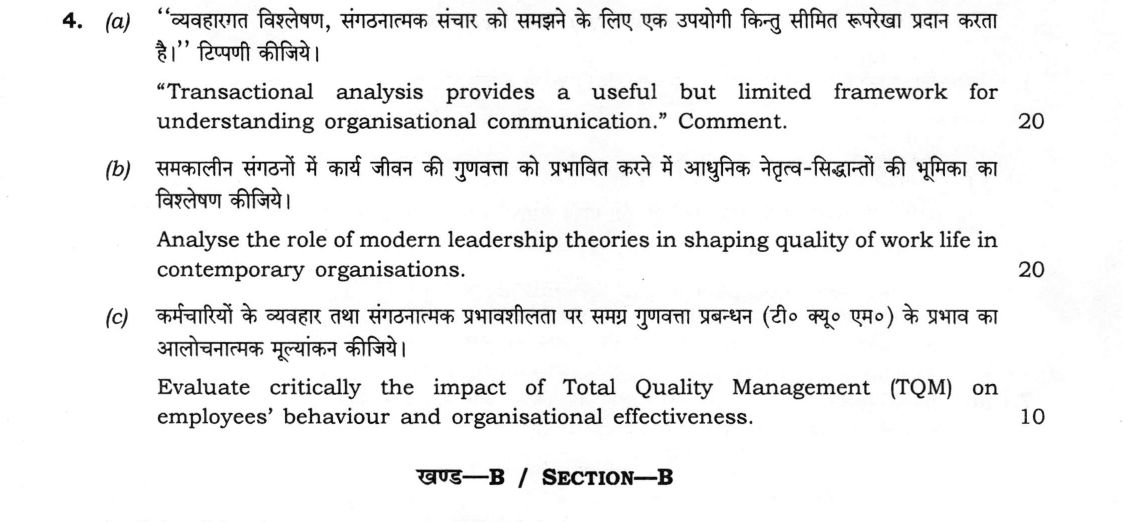
(a) “Transactional analysis provides a useful but limited framework for understanding organisational communication.” Comment. (20…
“Transactional analysis provides a useful but limited framework for understanding organisational communication.” Comment. 20 marks
Analyse the role of modern leadership theories in shaping quality of work life in contemporary organisations. 20 marks
Evaluate critically the impact of Total Quality Management (TQM) on employees’ behaviour and organisational effectiveness. 10 marks
हिंदी में प्रश्न पढ़ें
“व्यवहारात विश्लेषण, संगठनात्मक संचार को समझने के लिए एक उपयोगी किन्तु सीमित रूपरेखा प्रदान करता है।” टिप्पणी कीजिये। (20 अंक)
समकालीन संगठनों में कार्य जीवन की गुणवत्ता को प्रभावित करने में आधुनिक नेतृत्व-सिद्धांतों की भूमिका का विश्लेषण कीजिये। (20 अंक)
कर्मचारियों के व्यवहार तथा संगठनात्मक प्रभावशीलता पर समग्र गुणवत्ता प्रबंधन (टी० क्यू० एम०) के प्रभाव का आलोचनात्मक मूल्यांकन कीजिये। (10 अंक)
Model answer
Drafted with AI by UPSC Answer Check against this question's marking rubric, to the expected length. UPSC does not publish answers for Mains — this is one way to score well, not an official key. How we build rubrics and answers.
(a) Transactional analysis and organisational communication (20 marks)
Transactional analysis (TA), developed by Eric Berne and popularised in management by Thomas Harris (I'm OK, You're OK), analyses the transactions, that is the exchange of stimulus and response, between people.
Framework:
- Ego states: every person shifts among the Parent (learned rules, values and judgments, critical or nurturing), the Adult (rational, fact-based, present-oriented) and the Child (feelings, spontaneity, natural or adapted).
- Transactions: complementary (the response comes from the ego state addressed, and communication continues), crossed (an unexpected ego state answers, and communication breaks down) and ulterior (a hidden message under a social one).
- Also strokes (recognition), psychological games, life scripts and life positions (I'm OK, you're OK being the healthy one).
Usefulness in organisational communication:
- It explains why communication breaks down, for example a supervisor speaking Parent to Child provokes a crossed reply, and shows how to restore it by moving to Adult-Adult.
- It improves self-awareness and interpersonal skills, helps in customer handling, counselling, feedback, negotiation and conflict resolution, and is used in training.
- It helps managers recognise ulterior messages, games and the role of positive strokes in motivation.
Limitations:
- It is a framework for interpersonal, one-to-one communication and mostly ignores organisational channels, networks, direction (upward, downward, lateral), formal structure, media and information overload.
- Its concepts are subjective and hard to verify empirically, and ego states are not directly observable; research support is weaker than for other models.
- It has cultural limits, since norms of parent-child or superior-subordinate transactions vary by culture, and it can be oversimplified.
- It gives insight, but not a complete guide to organisation-wide communication systems or technology. Comment: TA is a useful, but limited, lens, best used along with models of channels, barriers, networks and the communication process.
(b) Modern leadership theories and quality of work life (20 marks)
Quality of work life (QWL) is the extent to which employees can satisfy important personal needs through work: fair pay, safe and healthy conditions, growth and security, participation, social integration, respect and work-life balance (Walton's eight dimensions). Leadership shapes QWL because leaders set the climate, and the following modern theories explain how:
- Transformational leadership (Burns, Bass): leaders inspire through vision (idealised influence, inspirational motivation, intellectual stimulation, individualised consideration), raising employees' commitment, purpose, growth and satisfaction, and so their QWL.
- Transactional leadership: clarity of goals and contingent rewards and exceptions management gives fairness and security, but on its own limits meaning and growth.
- Servant leadership (Greenleaf): the leader puts the needs, development and wellbeing of followers first, supporting trust, empowerment and dignity.
- Authentic and ethical leadership: transparency, integrity and fairness build trust, psychological safety and justice at work.
- Leader-member exchange (LMX): high-quality relations between leader and each member bring more autonomy, support and opportunity, while unequal relations may create in-group and out-group problems.
- Charismatic, distributed or shared, and emotionally intelligent leadership: empathy, participation and team empowerment improve morale and reduce stress. Contribution to QWL: better communication and participation, job enrichment and development, recognition, work-life balance, health and safety, and reduced turnover and absenteeism, which in turn improve productivity. In contemporary organisations, with remote work, diverse workforces, knowledge work and digital stress, leaders need empathy, flexibility and inclusion. Caution: leadership alone does not secure QWL: pay, policy, workload and culture also matter, and style must fit the situation and culture.
(c) Impact of TQM on employees and organisational effectiveness (10 marks)
Total Quality Management is an organisation-wide commitment to continuous improvement and customer satisfaction, through leadership, employee involvement, process focus, fact-based decisions and supplier partnership.
Impact on employee behaviour (positive): empowerment and participation, teamwork through quality circles and cross-functional teams, ownership of quality, training and skill development, better communication and morale. Negative or limiting: stress from pressure for zero defects and measurement, resistance where change is imposed, cynicism when management commitment is weak, and workload from extra meetings and documentation.
Impact on organisational effectiveness: higher product and service quality, lower rework and cost, better customer satisfaction and loyalty, improved processes and competitive position, and a culture of continuous improvement (Kaizen), as at Toyota and Indian firms such as Tata and Titan. But results are uneven: many programmes fail through lack of top-management commitment, cultural mismatch, short-term thinking, high initial cost of training and certification, and excessive bureaucracy.
Critical evaluation: TQM is effective when it is a genuine cultural change with long-term commitment, participation and measurable outcomes; when treated as a fashion or a set of tools, it gives limited gains.
How this answer will be evaluated
Evaluation rubric
Each sub-part is marked on its own, against the marks and word limit printed on the paper.
- (a) (a) Comment: transactional analysis provides a useful but limited framework for understanding organisational communication (20). 20 marks
Must cover
- TA framework: Parent, Adult, Child ego states; complementary, crossed and ulterior transactions
- Usefulness: explains breakdown, improves interpersonal skills, customer handling, conflict resolution
- Limitations: interpersonal only, ignores channels, networks and structure; subjective and hard to test; cultural limits
- Balanced conclusion that it should be combined with other models
Loses marks
- Only describing TA without commenting on limits.
- Treating TA as a full theory of organisational communication.
- Confusing ego states with personality traits.
Earns more
- Example of a crossed transaction in a workplace.
- Strokes, games and life positions mentioned.
Extra mark
- Harris's four life positions
- (b) (b) Analyse the role of modern leadership theories in shaping quality of work life in contemporary organisations (20). 20 marks
Must cover
- QWL defined with dimensions (fair pay, safety, growth, participation, work-life balance)
- Transformational and transactional leadership and how each affects QWL
- Servant, authentic or ethical leadership, and LMX or emotional intelligence
- Contemporary context (remote work, diversity, digital stress) and limits of leadership alone
Loses marks
- Describing leadership theories without linking to QWL.
- Only classical trait or behavioural theories.
- No contemporary context.
Earns more
- Link to outcomes such as retention and productivity.
- Examples of organisations.
Extra mark
- Walton's eight dimensions
- (c) (c) Critically evaluate the impact of TQM on employees' behaviour and organisational effectiveness (10). 10 marks
Must cover
- TQM defined with its principles
- Positive impact on employees: empowerment, teamwork, training, morale
- Negative or limiting impact: stress, resistance, cynicism, workload
- Impact on effectiveness: quality, cost, customer satisfaction, Kaizen; critical verdict on conditions for success
Loses marks
- Uncritical praise of TQM.
- Covering only employees or only effectiveness.
- Confusing TQM with quality inspection.
Earns more
- Reasons for failure.
- Indian or global example.
Extra mark
- Link to ISO 9000 or Six Sigma
What "Comment" is asking you to do
Take a position on the statement and support it. Comment usually attaches to a quoted line in the short slots, so the reasoning must be compressed — an opening view, a few load-bearing reasons, and the limit of the claim.
Structure that answers it
Unpack what the statement asserts → your stance → two or three supporting reasons → the qualification that limits it
Where marks are lost
Neutral summary; a comment without a stance has not answered. Equally costly is accepting the quoted line wholesale and never testing where it fails.
Practice this exact question
Write your answer and it is marked point by point against the model answer above — what you covered, what you missed, what you got wrong.
Evaluate my answer →More from Commerce & Accountancy 2026 Paper II
- Q1 Answer each of the following questions in about 150 words : (a) “Technological environmen…
- Q2 (a) Explain the various types of organisational culture. (10 marks) (b) Define organisati…
- Q3 (a) What is formalisation? Discuss its role in achieving organisational efficiency and me…
- Q4 (a) “Transactional analysis provides a useful but limited framework for understanding org…
- Q5 Write on the following in about 150 words each : (a) Paradoxes in Human Resource Manageme…
- Q6 (a) “Job rotation, job enlargement and job enrichment are merely attempts by managers to…
- Q7 (a) “Many of the industrial conflicts have their roots in communication gap between manag…