Paper II — Q7
(a) “Many of the industrial conflicts have their roots in communication gap between management and workers.” Discuss the…
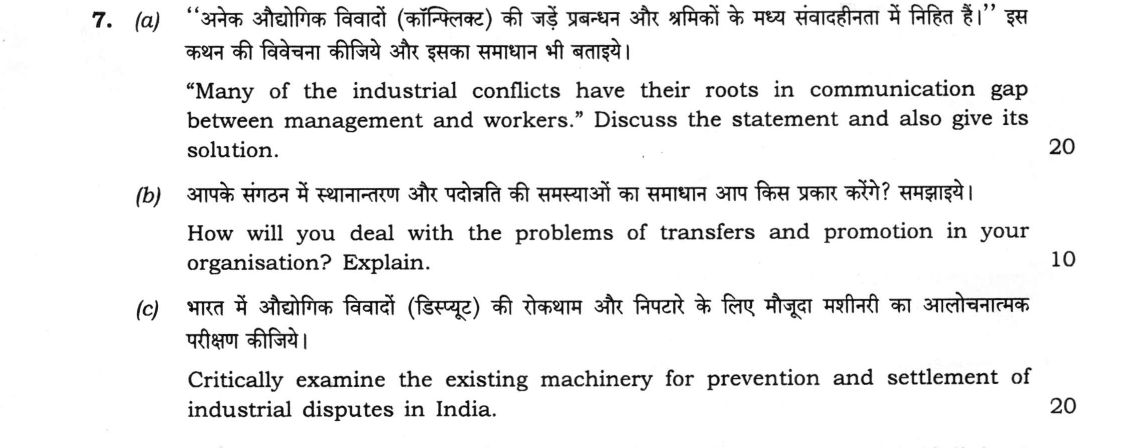
“Many of the industrial conflicts have their roots in communication gap between management and workers.” Discuss the statement and also give its solution. 20 marks
How will you deal with the problems of transfers and promotion in your organisation? Explain. 10 marks
Critically examine the existing machinery for prevention and settlement of industrial disputes in India. 20 marks
हिंदी में प्रश्न पढ़ें
“अनेक औद्योगिक विवादों (कॉन्फ्लिक्ट) की जड़ें प्रबन्धन और श्रमिकों के मध्य संवादहीनता में निहित हैं।” इस कथन की विवेचना कीजिये और इसका समाधान भी बताइये। (20 अंक)
आपके संगठन में स्थानान्तरण और पदोन्नति की समस्याओं का समाधान आप किस प्रकार करेंगे? समझाइये। (10 अंक)
भारत में औद्योगिक विवादों (डिस्प्यूट) की रोकथाम और निपटारे के लिए मौजूदा मशीनरी का आलोचनात्मक परीक्षण कीजिये। (20 अंक)
Model answer
Drafted with AI by UPSC Answer Check against this question's marking rubric, to the expected length. UPSC does not publish answers for Mains — this is one way to score well, not an official key. How we build rubrics and answers.
(a) Communication gap and industrial conflict (20 marks)
Discussion. The statement is largely valid: although industrial disputes have economic causes such as wages, bonus and working conditions, and also political and managerial ones, many of them grow out of, or are made worse by, poor communication between management and workers.
- Management decisions (retrenchment, new technology, shift or rule changes) are conveyed late or in one direction only, so workers learn of them through rumour.
- Distrust and a hierarchy of status and language: the workers' voice does not reach the top, and the message is distorted on its way down.
- No effective grievance channel: small issues go unresolved and are magnified into disputes.
- Misperception: workers see profits as exploitation, and managers see demands as unreasonable, since each side lacks the facts of the other, such as the firm's financial position.
- Rumours and misinformation, and weak trade union-management dialogue, increase suspicion and resistance to change. However, communication is not the only root: conflicts of interest over pay and job security, power and ideology, and legal and political influences also exist, and better communication cannot remove them fully, though it can reduce and manage them.
Solution:
- Two-way communication: regular meetings, town halls, suggestion schemes, house journals, notice boards, digital and mobile channels, and open-door policy.
- Institutional forums: works committees, joint management councils, workers' participation in management, and bipartite consultation.
- A clear, timely grievance redressal procedure with time limits.
- Transparency: sharing information on performance, plans and changes in advance, with reasons.
- Training supervisors in listening and interpersonal skills, and using local language and simple messages.
- Collective bargaining in good faith, and regular dialogue with unions, not only at times of crisis.
- Feedback and follow-up to confirm that the message has been understood. With trust built through such dialogue, most differences can be settled before they turn into disputes.
(b) Transfers and promotion (10 marks)
As an HR manager I would deal with both through a clear, written, transparent policy, applied fairly and communicated to all.
Transfers. Problems: arbitrary or punitive transfers, favouritism, disruption to family life and children's education, loss of morale and resistance, and use of transfer to send away unwanted staff. I would: state in policy the reasons (organisational need, job rotation, request, replacement, remedial); use objective criteria and equity; give reasonable notice, joining time and an allowance for relocation and housing; consult the employee and consider genuine hardship; prefer voluntary or rotational transfers; keep records; and provide a route of appeal to a grievance committee.
Promotion. Problems: favouritism, disputes between seniority and merit, unclear criteria, stagnation where posts are few, and jealousy of those passed over. I would: publish a promotion policy with criteria (seniority-cum-merit, appraisal, potential, skills, tests or interviews); ensure fair, documented appraisal and a selection committee; announce vacancies openly; plan careers and succession, and use training and development to prepare candidates; create lateral moves, job enrichment, a dual career ladder and non-monetary recognition for those who cannot be promoted; explain decisions to unsuccessful candidates and offer an appeal. Fairness, transparency, consultation and consistency would reduce grievances and keep trust in the organisation.
(c) Machinery for prevention and settlement of industrial disputes in India (20 marks)
Framework. Industrial disputes are dealt with under the Industrial Relations Code, 2020, one of the four labour codes in force from 21 November 2025, which consolidated the Industrial Disputes Act, 1947, the Trade Unions Act, 1926 and the Industrial Employment (Standing Orders) Act, 1946.
Prevention machinery:
- Works Committee: a body of employer and worker representatives to promote good relations, in establishments with 100 or more workers; and a Grievance Redressal Committee for individual grievances in establishments with 20 or more workers.
- Standing orders, which specify conditions of employment and discipline.
- Collective bargaining, with recognition of a sole negotiating union (with support of 51% of workers) or a negotiating council.
- Workers' participation in management, tripartite bodies (Indian Labour Conference, Standing Labour Committees), the Code of Discipline (1958) and voluntary codes.
- Notice requirements before strikes and lockouts (14 days' notice in all establishments under the Code) and a cooling period.
Settlement machinery:
- Conciliation officers: mediate in disputes and try to bring settlement, with a report.
- Voluntary arbitration by agreement between parties.
- Industrial Tribunals, including the National Industrial Tribunal, with judicial and administrative members, to adjudicate on referred disputes and give binding awards (the Code replaced separate Labour Courts with Industrial Tribunals).
- Retrenchment, lay-off and closure provisions with a reskilling fund for retrenched workers, and a higher threshold for prior government permission (300 workers).
Critical examination:
- Strengths: a multi-tier, tripartite, and legally backed structure, with an emphasis on conciliation, negotiation and quick settlement, and consolidation of scattered laws into one Code.
- Weaknesses: delays and pendency in adjudication, weak implementation of settlements and awards, underuse of voluntary arbitration and works committees, multiplicity and political affiliation of unions, the lack of any statutory basis for the Code of Discipline, and inadequate coverage of the unorganised, contract and gig workforce.
- Views on the new Code differ: employers welcome flexibility, such as the raised threshold and fixed-term employment, while unions fear weaker protection and constraints on the right to strike. Its effect depends on the state rules and how they are enforced. Reforms suggested: faster tribunals, stronger conciliation, digital case management, greater use of arbitration, and social security for all workers.
How this answer will be evaluated
Evaluation rubric
Each sub-part is marked on its own, against the marks and word limit printed on the paper.
- (a) (a) Discuss the statement that many industrial conflicts have their roots in the communication gap between management and workers, and give the solution (20). 20 marks
Must cover
- Statement discussed: how poor or one-way communication, distrust and rumours create or worsen disputes
- Balancing recognition that pay, power and job security are also root causes
- Solutions: two-way communication, works committee and participation, grievance procedure, transparency
- Collective bargaining and training of supervisors, feedback
Loses marks
- Accepting the statement with no discussion of other causes.
- Solutions with no link to communication.
- Only listing causes.
Earns more
- Examples of workplace situations.
- Link to conflict prevention.
Extra mark
- Role of digital channels
- (b) (b) How will you deal with the problems of transfers and promotion in your organisation? (10) 10 marks
Must cover
- Transfer problems and policy: reasons, criteria, notice, allowance, consultation, appeal
- Promotion problems and policy: criteria (seniority-cum-merit), fair appraisal, open vacancies, appeals
- Support: career planning, lateral moves, recognition for those not promoted
- Answer in the first person as an HR manager, stressing fairness and transparency
Loses marks
- Purely theoretical description of types with no policy action.
- Ignoring one of transfers or promotion.
- Favouring seniority or merit alone with no reasoning.
Earns more
- Examples of retention or morale impact.
- Communication of the policy.
Extra mark
- Dual career ladder
- (c) (c) Critically examine the existing machinery for prevention and settlement of industrial disputes in India (20). 20 marks
Must cover
- Legal framework: Industrial Relations Code 2020 in force from 21.11.2025, replacing the Industrial Disputes Act 1947
- Prevention machinery: works committee, grievance redressal committee, standing orders, collective bargaining, participation, notice for strikes
- Settlement machinery: conciliation, voluntary arbitration, Industrial Tribunals
- Critical assessment: strengths, delays, weak enforcement, coverage gaps, differing views on the Code
Loses marks
- Describing the repealed Act as current law.
- No critical evaluation.
- Listing bodies with no functions.
Earns more
- Code of Discipline and tripartite bodies.
- Reform suggestions.
Extra mark
- Comparison with the old Industrial Disputes Act
What "Discuss" is asking you to do
Lay the issue out from more than one side — how it arose, what is claimed for it, what is held against it, and where it now stands. UPSC attaches discuss to broad topics with several live dimensions, so coverage of the dimensions earns more than the strength of your opinion.
Structure that answers it
Set the issue up → the case as it is made → the case against → the dimension both sides leave out → where the balance now lies
Where marks are lost
Listing facts with no thread between them, or arguing one side throughout and calling it a discussion.
Practice this exact question
Write your answer and it is marked point by point against the model answer above — what you covered, what you missed, what you got wrong.
Evaluate my answer →More from Commerce & Accountancy 2026 Paper II
- Q4 (a) “Transactional analysis provides a useful but limited framework for understanding org…
- Q5 Write on the following in about 150 words each : (a) Paradoxes in Human Resource Manageme…
- Q6 (a) “Job rotation, job enlargement and job enrichment are merely attempts by managers to…
- Q7 (a) “Many of the industrial conflicts have their roots in communication gap between manag…
- Q8 (a) “Over the last few decades, the relationships between workers and management have con…