Paper II — Q6
(a) “Job rotation, job enlargement and job enrichment are merely attempts by managers to avoid individuals at work.” Comment. (20…
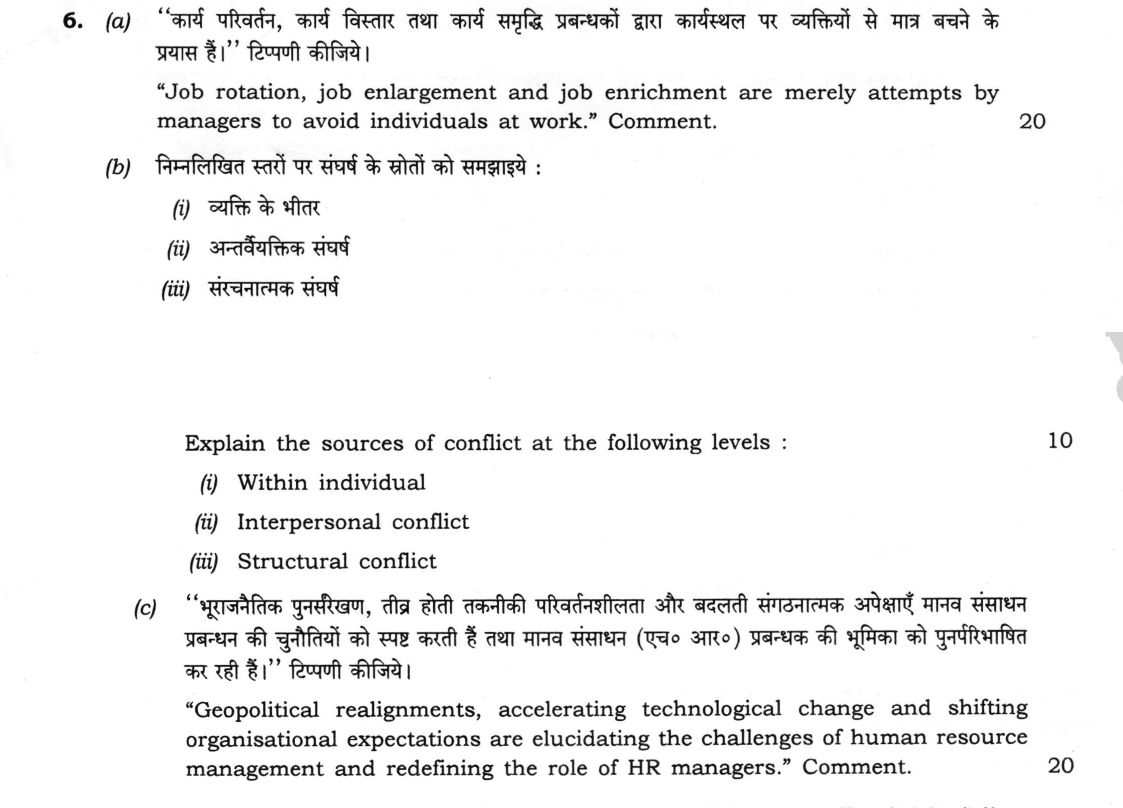
“Job rotation, job enlargement and job enrichment are merely attempts by managers to avoid individuals at work.” Comment. 20 marks
Explain the sources of conflict at the following levels : Within individual
Interpersonal conflict
Structural conflict 10 marks
“Geopolitical realignments, accelerating technological change and shifting organisational expectations are elucidating the challenges of human resource management and redefining the role of HR managers.” Comment. 20 marks
हिंदी में प्रश्न पढ़ें
“कार्य परिवर्तन, कार्य विस्तार तथा कार्य समृद्धि प्रबन्धकों द्वारा कार्यस्थल पर व्यक्तियों से मात्र बचने के प्रयास हैं।” टिप्पणी कीजिये। (20 अंक)
निम्नलिखित स्तरों पर संघर्ष के स्रोतों को समझाइये : व्यक्ति के भीतर
अन्तर्वैयक्तिक संघर्ष
संरचनात्मक संघर्ष (10 अंक)
“भूराजनीतिक पुनर्संरेखण, तीव्र होती तकनीकी परिवर्तनशीलता और बदलती संगठनात्मक अपेक्षाएँ मानव संसाधन प्रबन्धन की चुनौतियों को स्पष्ट करती हैं तथा मानव संसाधन (एच० आर०) प्रबन्धक की भूमिका को पुनर्परिभाषित कर रही हैं।” टिप्पणी कीजिये। (20 अंक)
Model answer
Drafted with AI by UPSC Answer Check against this question's marking rubric, to the expected length. UPSC does not publish answers for Mains — this is one way to score well, not an official key. How we build rubrics and answers.
(a) Job rotation, enlargement and enrichment (20 marks)
The proposition that these techniques are merely attempts by managers to avoid individuals at work is largely unfounded, though partly true where they are used carelessly or cynically.
The three techniques:
- Job rotation moves employees between jobs of similar skill level for a period, to relieve monotony and build multi-skilling, cross-training and succession depth.
- Job enlargement is horizontal loading: adding more tasks at the same level, to widen the job and reduce repetitiveness.
- Job enrichment is vertical loading: adding planning, control, autonomy and responsibility, so that the person owns a meaningful piece of work. It rests on Herzberg's two-factor theory, in which motivators such as achievement, recognition and responsibility, not hygiene factors, produce satisfaction, and on Hackman and Oldham's job characteristics model (skill variety, task identity, significance, autonomy, feedback).
Why the proposition fails: they were designed to deal with the problem of boredom, fatigue, absenteeism and turnover created by extreme specialisation, and they aim at engagement and development, not at avoiding people. They increase involvement, satisfaction, flexibility and skill, and evidence generally links them with higher motivation and quality.
Where it has some truth: management may use enlargement as "more of the same work", loading extra work without pay or authority, which adds burden and resentment; rotation may be superficial, or used to avoid dealing with poor performers or conflicts, or to cut headcount; and enrichment may transfer responsibility without support. Not every employee wants a bigger job, and results depend on individual growth need, pay, training and culture.
Conclusion: the techniques are genuine job-design tools for motivation and development, and they become mere avoidance devices only when misapplied. Effective use needs proper analysis of jobs, training, fair rewards and employee consent.
(b) Sources of conflict at different levels (10 marks)
(i) Within the individual (intrapersonal). Conflict arises within one person from:
- Goal conflict: approach-approach (two attractive options), avoidance-avoidance (two unattractive options) and approach-avoidance (one option both attractive and unattractive).
- Role conflict and ambiguity: incompatible expectations from different roles, or unclear role expectations; and role overload.
- Frustration from blocked needs, and clashes between personal values and organisational demands, as in ethical dilemmas.
(ii) Interpersonal conflict. Conflict between two or more individuals arises from personality and style differences; differences in perception, values, attitudes and goals; poor or misleading communication; competition for scarce resources, promotions and recognition; status and power struggles; dependence between people; and stereotypes and personal disputes.
(iii) Structural conflict. Conflict built into the organisation's design arises from: differentiation of departments with different goals and time horizons; interdependence and overlapping authority (as in line-staff and matrix structures); competition for shared limited resources and budgets; unclear or overlapping responsibilities and jurisdiction; unfair reward or performance systems; and hierarchy, rules and communication gaps. It appears as inter-group, inter-department and management-labour conflict. Recognising the source helps to choose the resolution method (collaboration, compromise, restructuring, or clarity of roles).
(c) Geopolitical realignments, technological change and the role of HR managers (20 marks)
The statement is largely valid: three forces are reshaping HRM, and the HR manager's role is moving from administrator to strategic partner and change leader.
Geopolitical realignments: shifting alliances, trade and tariff disputes, sanctions, supply-chain "friend-shoring", conflicts and changes in migration and visa rules affect the location of operations, talent supply and mobility, expatriate policy, and workforce risk. HR must plan global mobility, compliance across jurisdictions, business continuity and duty of care, and manage the local-global talent balance.
Accelerating technological change: automation, artificial intelligence, analytics, platform and remote work create demand for new skills and cut demand for others. HR must lead reskilling and upskilling, workforce planning, digital HR (analytics, recruitment and learning platforms), ethical use of data and AI, and management of gig and hybrid workforces, and address data privacy and employee surveillance concerns.
Shifting organisational expectations: employees, particularly younger cohorts, expect flexibility, purpose, well-being, diversity, inclusion, continuous learning and career growth, while organisations expect agility, cost efficiency, ethics and ESG compliance and measurable business impact.
Challenges these clarify: talent shortages and skill gaps, retention and engagement, culture in a distributed workforce, compliance with changing labour law (including India's labour codes, in force from 21 November 2025), change management and ethical use of technology.
The redefined role: HR managers become strategic business partners (Ulrich's roles: strategic partner, change agent, employee champion, administrative expert), culture custodians, data-driven decision-makers and agility builders.
Comment: the statement holds, but the change is a matter of degree, since core HR concerns of fairness, motivation and compliance remain. HR's credibility depends on linking its actions with business strategy.
How this answer will be evaluated
Evaluation rubric
Each sub-part is marked on its own, against the marks and word limit printed on the paper.
- (a) (a) Comment: job rotation, enlargement and enrichment are merely attempts by managers to avoid individuals at work (20). 20 marks
Must cover
- Definitions: rotation, enlargement (horizontal), enrichment (vertical)
- Purpose: reduce monotony, motivate, develop skills; Herzberg and Hackman-Oldham
- Where the proposition has some truth: misuse as extra work, superficial rotation, avoidance
- Reasoned conclusion that they are genuine job-design tools, dependent on correct use
Loses marks
- Accepting or rejecting the statement without argument.
- Confusing enlargement with enrichment.
- Only definitions with no comment.
Earns more
- Individual differences and growth need.
- Requirements for success: training, pay, consent.
Extra mark
- Socio-technical or autonomous work groups
- (b) (b) Explain the sources of conflict: (i) within the individual, (ii) interpersonal, (iii) structural (10). 10 marks
Must cover
- Intrapersonal: goal conflict types, role conflict and ambiguity, frustration, values clash
- Interpersonal: personality, perception, communication, resources, status and power
- Structural: differentiation, interdependence, shared resources, overlapping authority, reward systems
- Each source clearly assigned to the right level
Loses marks
- Confusing types of conflict with sources.
- Missing one level.
- Listing without explanation.
Earns more
- Examples for each level.
- Link to resolution approach.
Extra mark
- Thomas-Kilmann modes
- (c) (c) Comment: geopolitical realignments, technological change and shifting organisational expectations clarify HRM challenges and redefine the HR manager's role (20). 20 marks
Must cover
- Geopolitical realignments and their HR effects: mobility, supply of talent, compliance, continuity
- Technological change: automation, AI, analytics, reskilling, gig and hybrid work, data ethics
- Shifting expectations of employees and organisations; challenges such as skills gaps, retention, culture, labour-law change
- Redefined HR role: strategic partner, change agent, culture custodian, data-driven; reasoned comment
Loses marks
- Listing trends with no HR link.
- No comment or verdict.
- Treating HR only as an administrative function.
Earns more
- Ulrich's HR roles.
- Reference to India's labour codes in force from 21.11.2025.
Extra mark
- Examples from Indian firms
What "Comment" is asking you to do
Take a position on the statement and support it. Comment usually attaches to a quoted line in the short slots, so the reasoning must be compressed — an opening view, a few load-bearing reasons, and the limit of the claim.
Structure that answers it
Unpack what the statement asserts → your stance → two or three supporting reasons → the qualification that limits it
Where marks are lost
Neutral summary; a comment without a stance has not answered. Equally costly is accepting the quoted line wholesale and never testing where it fails.
Practice this exact question
Write your answer and it is marked point by point against the model answer above — what you covered, what you missed, what you got wrong.
Evaluate my answer →More from Commerce & Accountancy 2026 Paper II
- Q3 (a) What is formalisation? Discuss its role in achieving organisational efficiency and me…
- Q4 (a) “Transactional analysis provides a useful but limited framework for understanding org…
- Q5 Write on the following in about 150 words each : (a) Paradoxes in Human Resource Manageme…
- Q6 (a) “Job rotation, job enlargement and job enrichment are merely attempts by managers to…
- Q7 (a) “Many of the industrial conflicts have their roots in communication gap between manag…
- Q8 (a) “Over the last few decades, the relationships between workers and management have con…