Paper II — Q5
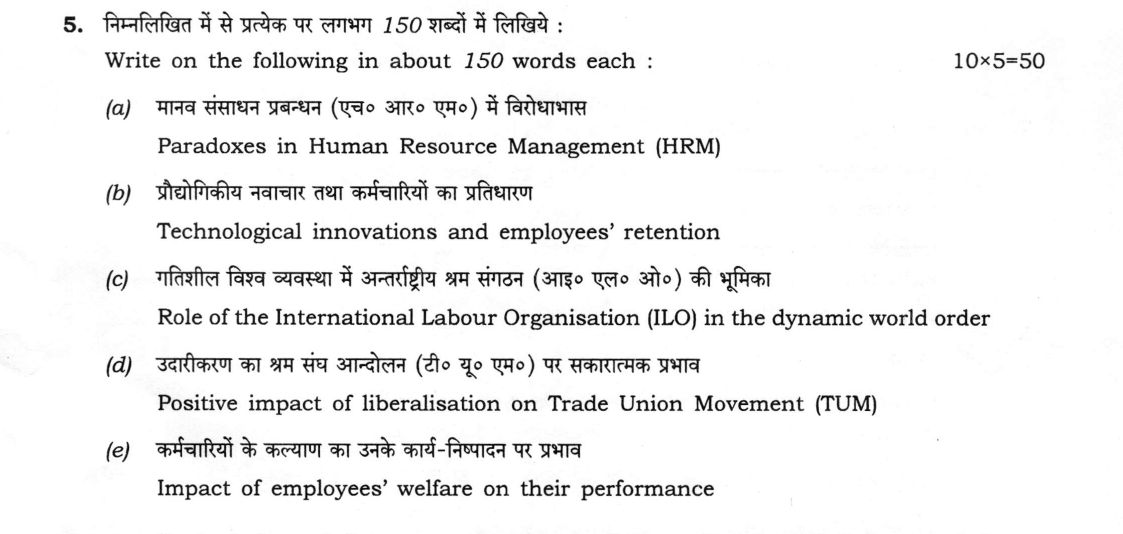
(a) Paradoxes in Human Resource Management (HRM) (10 marks) (b) Technological innovations and employees’ retention (10…
Write on the following in about 150 words each :
Paradoxes in Human Resource Management (HRM) 10 marks
Technological innovations and employees’ retention 10 marks
Role of the International Labour Organisation (ILO) in the dynamic world order 10 marks
Positive impact of liberalisation on Trade Union Movement (TUM) 10 marks
Impact of employees’ welfare on their performance 10 marks
हिंदी में प्रश्न पढ़ें
निम्नलिखित में से प्रत्येक पर लगभग 150 शब्दों में लिखिये :
मानव संसाधन प्रबंधन (एच० आर० एम०) में विरोधाभास (10 अंक)
प्रौद्योगिकीय नवाचार तथा कर्मचारियों का प्रतिधारण (10 अंक)
गतिशील विश्व व्यवस्था में अंतर्राष्ट्रीय श्रम संगठन (आई० एल० ओ०) की भूमिका (10 अंक)
उदारीकरण का श्रम संघ आन्दोलन (टी० यू० एम०) पर सकारात्मक प्रभाव (10 अंक)
कर्मचारियों के कल्याण का उनके कार्य-निष्पादन पर प्रभाव (10 अंक)
Model answer
Drafted with AI by UPSC Answer Check against this question's marking rubric, to the 150-word length. UPSC does not publish answers for Mains — this is one way to score well, not an official key. How we build rubrics and answers.
(a) Paradoxes in Human Resource Management (10 marks)
A paradox in HRM is a pair of contradictory yet interrelated demands that must be met together, and cannot be fully resolved by choosing one. Examples: commitment versus flexibility (building loyalty while keeping workforce flexibility through contract and gig work); control versus autonomy (standard procedures and monitoring, while empowering employees); standardisation versus customisation of HR practices across units and countries; individual performance versus teamwork, when rewards go to individuals but work needs collaboration; cost reduction versus investment in people; short-term results versus long-term capability; and the "hard" (resource, cost) versus "soft" (human, commitment) view of HRM. The HR function likewise must be a strategic partner and an employee champion (Ulrich). Instead of picking one side, effective managers accept the tension, and use "both-and" thinking, balance, sequencing and context-specific choices, such as flexible working with clear goals. Paradox thinking helps HR to handle complexity and avoid extremes.
(b) Technological innovations and employees' retention (10 marks)
Technology affects retention in both directions. Positively: digital and remote work tools give flexibility and work-life balance; e-learning and upskilling platforms build careers; HR analytics predict attrition and identify flight risks; engagement apps, digital recognition and quick grievance channels improve satisfaction; automation of routine tasks frees people for meaningful work. Negatively: fear of job loss through automation and AI, and skill obsolescence, raise insecurity; digital surveillance and always-on culture cause stress and burnout; job portals and social networks make it easy for competitors to poach talent; and the digital divide and resistance to change cause frustration. Firms should retain employees through reskilling, transparent communication about technology change, involvement in adoption, fair monitoring, and career paths linked to new skills. Where technology is introduced with employees rather than at their cost, it strengthens retention; otherwise it drives attrition.
(c) Role of the ILO in the dynamic world order (10 marks)
The International Labour Organization, founded in 1919 and now a specialised agency of the United Nations, is unique in its tripartite structure of governments, employers and workers. Its role is to set international labour standards through conventions and recommendations, to monitor their application, to give technical cooperation and research, and to promote social dialogue. Its key instruments are the Declaration on Fundamental Principles and Rights at Work (1998, with a safe and healthy working environment added in 2022) and the Decent Work Agenda. Its relevance has grown in a changing order shaped by globalisation, digital and platform work, migration, climate transition and informal employment: it guides standards on platform work, pushes social protection floors, fights child and forced labour, and supports fair transition. Limits: conventions are binding only on ratifying states, and enforcement depends on reporting and moral pressure (India, for instance, has not ratified the conventions on freedom of association and collective bargaining), and there is no sanctioning power. It remains labour's principal standard-setting voice.
(d) Positive impact of liberalisation on the trade union movement (10 marks)
Liberalisation since 1991 has also had positive effects on the trade union movement, though the overall effect is debated. Growth of the organised private sector and of services, and new industries, created new areas for unionisation, including white-collar, IT and professional employees. Unions have shifted from purely wage militancy to productivity, skill development, retraining and job security, and to cooperative, partnership-style relations with management. Competition, and the need to respond to restructuring, stimulated union modernisation, professional leadership, mergers and federations. Greater global integration has connected Indian unions with international networks, such as the global union federations and the ILO, and raised awareness of labour standards and social clauses. Unions have also broadened their agenda to include unorganised, contract and gig workers, social security and gender issues. The labour codes in force from 21 November 2025 recognise negotiating unions and councils, giving a framework for collective bargaining.
(e) Impact of employees' welfare on performance (10 marks)
Employee welfare covers statutory measures (safe conditions, canteens, crèches, rest rooms, provident fund, insurance and gratuity under the labour laws and the Code on Social Security) and voluntary ones (housing, transport, medical care, education, recreation and counselling). The chain from welfare to performance runs as follows: welfare improves health, safety and security; these raise satisfaction, morale and commitment; higher morale reduces absenteeism, accidents and turnover; and stable, healthy, motivated workers give higher productivity and quality, better industrial relations and a positive employer image, drawing talent. Herzberg's hygiene factors and social exchange theory explain this, since employees reciprocate care with effort and loyalty, as at Tata Steel and Infosys. Benefits are weaker where welfare is seen as token, is unrelated to needs, or replaces fair pay. Performance improves most when welfare is well planned, valued and linked to a positive culture; its cost is then repaid through returns in productivity.
How this answer will be evaluated
Evaluation rubric
Each sub-part is marked on its own, against the marks and word limit printed on the paper.
- (a) (a) Paradoxes in Human Resource Management (10, about 150 words). 10 marks · 150 words
Must cover
- Meaning of paradox: contradictory yet interrelated demands
- At least three named paradoxes (commitment versus flexibility, control versus autonomy, standardisation versus customisation, cost versus investment)
- Hard versus soft HRM or strategic partner versus employee champion
- How managers handle them: both-and thinking, balance, context
Loses marks
- Defining paradox as a mere problem or contradiction with a single answer.
- No examples.
- Well over the word limit.
Earns more
- Example from practice.
- Within about 150 words.
Extra mark
- Ulrich's HR roles
- (b) (b) Technological innovations and employees' retention (10, about 150 words). 10 marks · 150 words
Must cover
- Positive effects: flexibility, upskilling, HR analytics, engagement tools
- Negative effects: job insecurity, skill obsolescence, surveillance and stress, easier poaching
- Retention measures: reskilling, communication, involvement, career paths
- Balanced conclusion
Loses marks
- One-sided answer.
- Ignoring retention as the focus.
- Well over the word limit.
Earns more
- Example such as AI or remote work.
- Within about 150 words.
Extra mark
- Digital divide
- (c) (c) Role of the ILO in the dynamic world order (10, about 150 words). 10 marks · 150 words
Must cover
- ILO: founded 1919, UN agency, tripartite structure
- Functions: standards through conventions and recommendations, supervision, technical cooperation, social dialogue
- Instruments: Fundamental Principles and Rights at Work Declaration, Decent Work Agenda
- Current relevance (platform work, migration, informality, climate transition) and limits of enforcement
Loses marks
- Describing the ILO's history only.
- Stating that ILO conventions bind all members.
- Well over the word limit.
Earns more
- India-specific point on ratification.
- Within about 150 words.
Extra mark
- Centenary Declaration 2019
- (d) (d) Positive impact of liberalisation on the trade union movement (10, about 150 words). 10 marks · 150 words
Must cover
- Growth of organised private and services sector with new unionisation areas (white-collar, IT)
- Shift to productivity, skills, job security and cooperative relations
- Modernisation, mergers, global links and wider agenda (unorganised, contract, gig workers)
- Balanced acknowledgement that the overall effect is debated; labour codes framework
Loses marks
- Answering only negative impacts, which the question does not ask.
- Unsupported claims of union strength.
- Well over the word limit.
Earns more
- Reference to negotiating unions under the labour codes in force from 21.11.2025.
- Within about 150 words.
Extra mark
- Tripartite consultation
- (e) (e) Impact of employees' welfare on their performance (10, about 150 words). 10 marks · 150 words
Must cover
- Welfare defined with statutory and voluntary measures
- Causal chain: health and security, satisfaction, morale, lower absenteeism and turnover, productivity
- Theoretical link: Herzberg hygiene or social exchange
- Conditions: well planned, valued, not a substitute for pay
Loses marks
- Listing welfare schemes without linking to performance.
- Assuming welfare always raises output.
- Well over the word limit.
Earns more
- Examples of firms.
- Within about 150 words.
Extra mark
- Employer branding
What "Discuss" is asking you to do
Lay the issue out from more than one side — how it arose, what is claimed for it, what is held against it, and where it now stands. UPSC attaches discuss to broad topics with several live dimensions, so coverage of the dimensions earns more than the strength of your opinion.
Structure that answers it
Set the issue up → the case as it is made → the case against → the dimension both sides leave out → where the balance now lies
Where marks are lost
Listing facts with no thread between them, or arguing one side throughout and calling it a discussion.
Practice this exact question
Write your answer and it is marked point by point against the model answer above — what you covered, what you missed, what you got wrong.
Evaluate my answer →More from Commerce & Accountancy 2026 Paper II
- Q2 (a) Explain the various types of organisational culture. (10 marks) (b) Define organisati…
- Q3 (a) What is formalisation? Discuss its role in achieving organisational efficiency and me…
- Q4 (a) “Transactional analysis provides a useful but limited framework for understanding org…
- Q5 Write on the following in about 150 words each : (a) Paradoxes in Human Resource Manageme…
- Q6 (a) “Job rotation, job enlargement and job enrichment are merely attempts by managers to…
- Q7 (a) “Many of the industrial conflicts have their roots in communication gap between manag…
- Q8 (a) “Over the last few decades, the relationships between workers and management have con…