Paper II — Q8
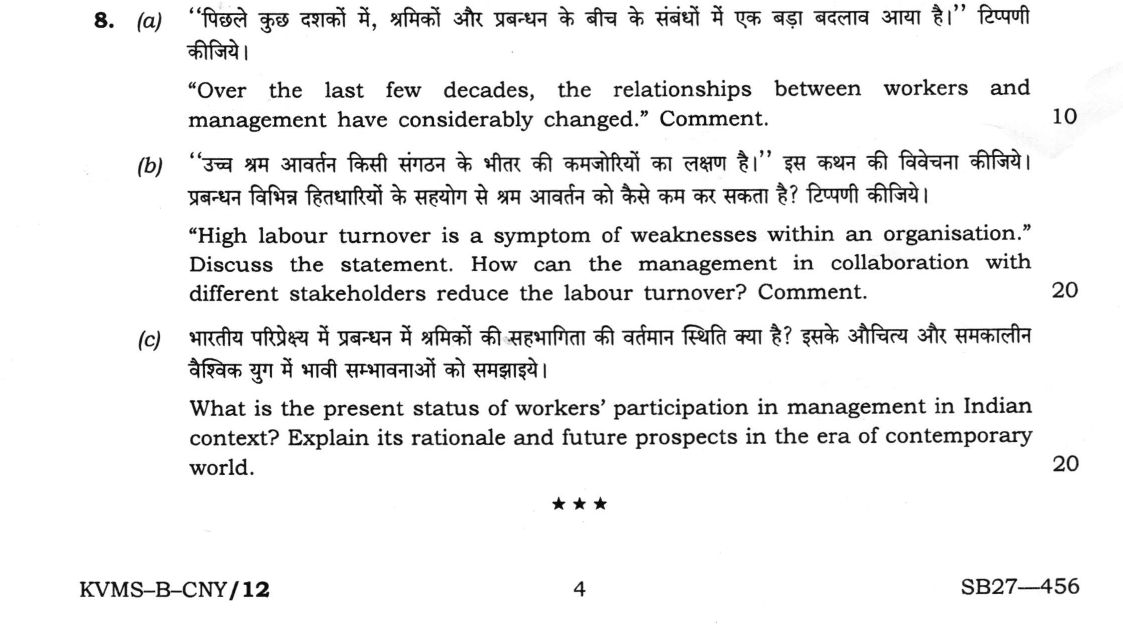
(a) “Over the last few decades, the relationships between workers and management have considerably changed.” Comment. (10…
“Over the last few decades, the relationships between workers and management have considerably changed.” Comment. 10 marks
“High labour turnover is a symptom of weaknesses within an organisation.” Discuss the statement. How can the management in collaboration with different stakeholders reduce the labour turnover? Comment. 20 marks
What is the present status of workers’ participation in management in Indian context? Explain its rationale and future prospects in the era of contemporary world. 20 marks
हिंदी में प्रश्न पढ़ें
“पिछले कुछ दशकों में, श्रमिकों और प्रबन्धन के बीच के संबंधों में एक बड़ा बदलाव आया है।” टिप्पणी कीजिये। (10 अंक)
“उच्च श्रम आवर्तन किसी संगठन के भीतर की कमजोरियों का लक्षण है।” इस कथन की विवेचना कीजिये। प्रबन्धन विभिन्न हितधारियों के सहयोग से श्रम आवर्तन को कैसे कम कर सकता है? टिप्पणी कीजिये। (20 अंक)
भारतीय परिप्रेक्ष्य में प्रबन्धन में श्रमिकों की सहभागिता की वर्तमान स्थिति क्या है? इसके औचित्य और समकालीन वैश्विक युग में भावी सक्षमताओं को समझाइए। (20 अंक)
Model answer
Drafted with AI by UPSC Answer Check against this question's marking rubric, to the expected length. UPSC does not publish answers for Mains — this is one way to score well, not an official key. How we build rubrics and answers.
(a) Change in worker-management relations (10 marks)
The statement is broadly true. Relations have moved from an adversarial, master-servant model, in which management treated labour as a cost and unions responded with confrontation, towards one that emphasises partnership, employee engagement and individual relations.
Reasons for the change:
- Legislation and welfare measures, and the growth of trade unions and collective bargaining, gave workers legal voice and protection.
- Higher education levels, skills and awareness of rights among workers, and a younger workforce with different expectations.
- The rise of HRM, which sees people as an asset and stresses engagement, communication and development rather than only control.
- Technology, automation, and a shift to services and knowledge work, weakening the factory-based union base.
- Globalisation, competition and liberalisation: pressure for productivity, flexible employment (contract, fixed-term and gig work) and a decline in union density; and more direct, individual employer-employee relations.
- Workers' participation, grievance systems and social dialogue at the enterprise level. Yet conflict has not disappeared: it has changed form, with disputes over job security, contract labour, wages of informal workers and reforms. The relationship is now more varied, cooperative in many firms but strained in others, and depends on trust and fairness.
(b) Labour turnover (20 marks)
Discussion. Labour turnover is the rate at which employees leave an organisation and are replaced, usually measured as separations divided by average workforce. High turnover is largely a symptom of internal weaknesses:
- Inadequate pay, benefits and job security, compared with the market.
- Poor recruitment and selection, giving mismatch between people and job.
- Weak supervision, poor leadership and lack of respect or fairness.
- Unsafe or poor working conditions, long hours and stress.
- Lack of career growth, training and recognition.
- Poor communication, unresolved grievances, and a weak culture.
- Injustice in transfers, promotion and appraisal. However, it is not always a weakness of the organisation: external causes such as better labour-market opportunities, personal reasons, retirement, migration, seasonal work or industry norms also produce turnover; and some turnover is functional, removing poor performers and bringing in new ideas. So the statement is largely, but not wholly, true: the cause should be diagnosed through exit interviews, surveys and analysis by department, age and tenure.
Reducing turnover with stakeholders:
- Employees and unions: participation, grievance redressal, joint committees and open communication, to build trust and identify problems.
- Government: use of skill development schemes, social security and labour laws, so that security and benefits are assured.
- Educational and training institutions: tie-ups for campus hiring, apprenticeships and training that match the job.
- Community and families: housing, transport, schooling and health facilities and family engagement, where the worker is from a distant area.
- Industry associations: benchmarking pay and practices, and sharing good practice on ethical hiring norms.
- Customers and suppliers: stable business and demand, leading to stable employment.
- Management's own measures: competitive pay, sound selection, induction, training, career paths, safe conditions, fair appraisal, work-life balance and recognition. Comment: turnover can be reduced, but not eliminated; the aim is to reduce avoidable, dysfunctional turnover, and the collaborative approach adds legitimacy, resources and information to management's efforts.
(c) Workers' participation in management in India (20 marks)
Present status. Participation in India has developed through a mix of legislation and voluntary schemes, with uneven results:
- Works Committees, under the Industrial Disputes Act and now the Industrial Relations Code, 2020 (in force from 21 November 2025), in establishments with 100 or more workers, and a Grievance Redressal Committee in those with 20 or more.
- Joint Management Councils (1958 scheme), shop and joint councils (1975 scheme), and participation at board level in public sector undertakings and banks through worker directors (employee directors).
- Safety committees under the safety and health law, canteen committees, and bipartite bodies such as quality circles and productivity councils.
- Employee stock ownership, and profit-sharing or bonus schemes, as forms of financial participation, in some firms.
- No general law compels participation; the 1990 Bill for participation in management was never enacted. The overall position is limited and patchy: it is strong in some public sector and large private firms, while in most small and unorganised establishments it is absent; problems are lack of interest of employers, rivalry of unions, poor training of worker representatives, and treating the forums as ritual.
Rationale:
- Industrial democracy: workers have a right to be heard in decisions that affect them.
- It gives industrial peace by reducing conflict and building trust.
- It improves productivity, quality and innovation, since workers know the shop floor.
- It raises motivation, commitment and job satisfaction, and lowers absenteeism and turnover.
- It eases acceptance of change, including technology, and builds a sense of ownership and human dignity, in line with constitutional principles (Article 43A, Directive Principles).
Future prospects. The prospects are good, given contemporary trends: employee engagement and voice are central to HRM; digital platforms enable participation and feedback at scale; ESOPs and profit-linked pay can spread ownership; ESG and stakeholder capitalism stress worker voice, as in German co-determination and works councils in Europe; and a more educated workforce expects a say. New forms, including gig workers' representation, are needed. Success depends on legal support, trust, training of representatives, real decision powers, and cooperation of unions and management.
How this answer will be evaluated
Evaluation rubric
Each sub-part is marked on its own, against the marks and word limit printed on the paper.
- (a) (a) Comment: over the last few decades relationships between workers and management have considerably changed (10). 10 marks
Must cover
- Shift from adversarial master-servant to partnership and engagement
- Reasons: legislation and unions, education, HRM, technology, globalisation and flexible employment
- Continuing or changed form of conflict; relations now varied
- Comment or verdict on the statement
Loses marks
- Merely listing changes with no comment.
- Ignoring continuing conflict.
- One-sided view.
Earns more
- Indian illustrations.
- Reference to individual employment relations.
Extra mark
- Decline of union density
- (b) (b) Discuss: high labour turnover is a symptom of weaknesses within an organisation; how can management with stakeholders reduce it (20). 20 marks
Must cover
- Meaning of turnover and the internal causes: pay, selection, supervision, conditions, growth, culture
- Qualification that external causes and functional turnover exist
- Role of stakeholders: employees and unions, government, educational institutions, community, industry bodies
- Management measures and a reasoned comment
Loses marks
- Treating all turnover as bad.
- Stakeholder role missing.
- Causes without any remedy.
Earns more
- Diagnostic tools such as exit interviews.
- Distinction between avoidable and unavoidable turnover.
Extra mark
- Formula for turnover rate
- (c) (c) Present status of workers' participation in management in India; rationale; future prospects in the contemporary world (20). 20 marks
Must cover
- Present status: works committees, grievance committees under IR Code, JMCs, board-level participation, ESOPs; no general compulsory law
- Assessment: limited and patchy, with reasons
- Rationale: industrial democracy, peace, productivity, motivation, Article 43A
- Future prospects: engagement and digital voice, ESOPs, ESG, global examples, gig workers
Loses marks
- Describing only the theory of participation.
- Ignoring the present Indian position.
- No future prospects.
Earns more
- Constitutional link.
- Comparison with Germany or Europe.
Extra mark
- 1990 Bill on participation
What "Comment" is asking you to do
Take a position on the statement and support it. Comment usually attaches to a quoted line in the short slots, so the reasoning must be compressed — an opening view, a few load-bearing reasons, and the limit of the claim.
Structure that answers it
Unpack what the statement asserts → your stance → two or three supporting reasons → the qualification that limits it
Where marks are lost
Neutral summary; a comment without a stance has not answered. Equally costly is accepting the quoted line wholesale and never testing where it fails.
Practice this exact question
Write your answer and it is marked point by point against the model answer above — what you covered, what you missed, what you got wrong.
Evaluate my answer →More from Commerce & Accountancy 2026 Paper II
- Q5 Write on the following in about 150 words each : (a) Paradoxes in Human Resource Manageme…
- Q6 (a) “Job rotation, job enlargement and job enrichment are merely attempts by managers to…
- Q7 (a) “Many of the industrial conflicts have their roots in communication gap between manag…
- Q8 (a) “Over the last few decades, the relationships between workers and management have con…