Paper II — Q3
(a) What is formalisation? Discuss its role in achieving organisational efficiency and mention the potential challenges of high…
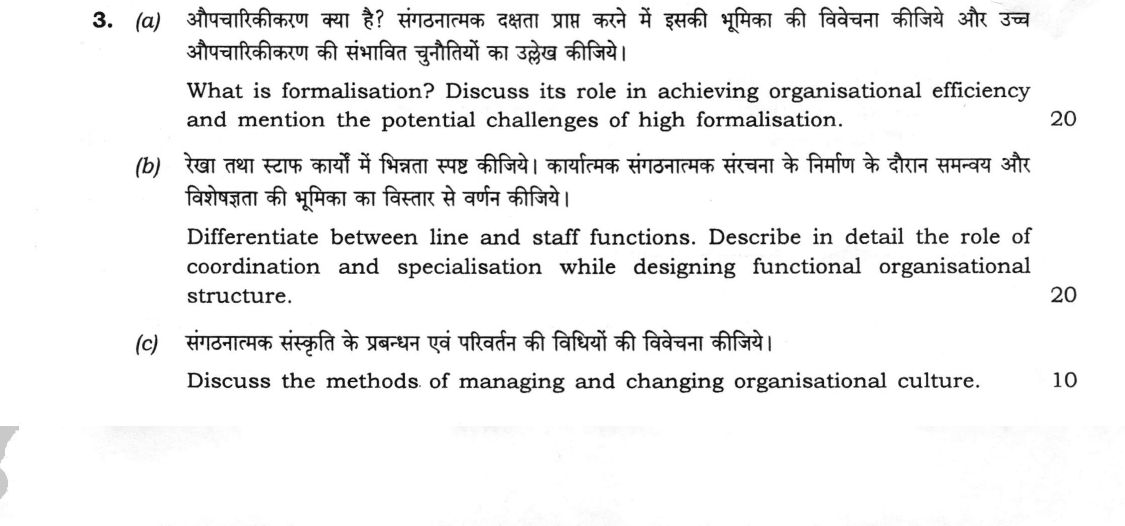
What is formalisation? Discuss its role in achieving organisational efficiency and mention the potential challenges of high formalisation. 20 marks
Differentiate between line and staff functions. Describe in detail the role of coordination and specialisation while designing functional organisational structure. 20 marks
Discuss the methods of managing and changing organisational culture. 10 marks
हिंदी में प्रश्न पढ़ें
औपचारिकीकरण क्या है? संगठनात्मक दक्षता प्राप्त करने में इसकी भूमिका की विवेचना कीजिये और उच्च औपचारिकीकरण की संभावित चुनौतियों का उल्लेख कीजिये। (20 अंक)
रेखा तथा स्टाफ कार्यों में भिन्नता स्पष्ट कीजिये। कार्यात्मक संगठनात्मक संरचना के निर्माण के दौरान समन्वय और विशेषज्ञता की भूमिका का विस्तार से वर्णन कीजिये। (20 अंक)
संगठनात्मक संस्कृति के प्रबन्धन एवं परिवर्तन की विधियों की विवेचना कीजिये। (10 अंक)
Model answer
Drafted with AI by UPSC Answer Check against this question's marking rubric, to the expected length. UPSC does not publish answers for Mains — this is one way to score well, not an official key. How we build rubrics and answers.
(a) Formalisation (20 marks)
Meaning. Formalisation is the degree to which jobs, rules, procedures, and communications in an organisation are standardised and documented in writing, through job descriptions, manuals, standard operating procedures, forms and policies. A highly formalised job leaves little discretion about what is done, when and how; a low-formalised job leaves wide freedom to the employee.
Role in organisational efficiency:
- Predictability and consistency: standard procedures give uniform output and quality, especially in routine and high-volume work such as banking, manufacturing and government offices.
- Coordination and control: written rules reduce the need for direct supervision and make roles and responsibilities clear.
- Fairness and accountability: uniform rules limit favouritism and arbitrary decisions, and give a basis for performance appraisal and audit.
- Lower cost of training and error: employees know what to do, new staff are easily trained, and compliance with law and safety norms is easier.
- Continuity: organisational knowledge is preserved when people leave.
Challenges of high formalisation:
- Rigidity and slow response: rules prevent flexible or quick reaction to new situations and customer needs, and cause "red tape".
- Reduced creativity, initiative and job satisfaction, with employees following rules for their own sake and displacing goals (means become ends).
- Delay and cost of administration, and heavy paperwork.
- Resistance to change, and poor fit for dynamic environments, innovation-driven work or professional jobs needing judgement.
- Low morale, alienation and absenteeism, through loss of autonomy.
- Sub-optimal decisions from applying rules in cases they were not designed for. The degree of formalisation should suit the task, technology and environment: stable, routine work needs more, while creative, uncertain work needs less. Managers should therefore keep rules for critical activities and give discretion elsewhere.
(b) Line and staff functions; coordination and specialisation in functional structure (20 marks)
Line and staff functions (8):
- Line functions directly contribute to the primary objectives of the organisation, such as production, sales and operations. Line managers hold authority to command and take decisions, along the chain of command, and are accountable for results.
- Staff functions support and advise the line, through specialised knowledge, for example human resources, finance advice, legal, research and accounting. Staff have advisory or service authority, and no direct command over line, apart from functional authority in their own field.
- Line managers decide, and staff advise; line has command authority and staff has expertise; line is directly linked to output, and staff indirectly. Conflicts arise when staff advice is ignored or staff overstep, and are resolved by clear roles.
Coordination and specialisation in a functional structure (12). A functional structure groups people into departments such as production, marketing, finance and HR by their specialised skills.
- Specialisation: grouping similar tasks lets employees build deep expertise, gives economies of scale, avoids duplication of resources, encourages standardised methods and clear career paths, and makes training simple.
- Its drawback: functional silos, with departments pursuing their own goals, narrow perspectives and poor communication across functions, and slow decision-making that is pushed up to top managers.
- Coordination is therefore needed to integrate the specialised units towards overall objectives, through: hierarchy and chain of command; rules, plans and standard procedures; budgets and schedules; liaison persons, committees, task forces and cross-functional teams; integrating roles such as product managers; and management information systems and regular meetings. Designers should balance specialisation with coordination: the more differentiated the departments, the more integration effort is needed.
(c) Managing and changing organisational culture (10 marks)
Managing culture. Leaders shape and sustain culture by: role-modelling the desired behaviour; stating a clear vision, mission and values; selection and socialisation, with orientation and mentoring; reward, promotion and recognition systems; training and communication through stories, symbols, rituals and ceremonies; and consistent policies and structure.
Changing culture. This is slow and difficult, since cultures are deeply rooted. Methods are:
- Diagnose the existing culture and define the desired one, with a clear reason for change (a crisis or new strategy helps).
- Strong leadership commitment, with visible changes in top managers' behaviour, and, where necessary, change of key people.
- Communicate the vision and involve employees, using participation to reduce resistance.
- Realign systems: hiring, appraisal, rewards, structure and processes with the new values.
- Train employees, introduce new rituals and symbols, use change agents, and reinforce early wins.
- Monitor, review and sustain, through feedback and consistent reinforcement. Mergers, new leadership, technology and crises are common triggers, and results take years.
How this answer will be evaluated
Evaluation rubric
Each sub-part is marked on its own, against the marks and word limit printed on the paper.
- (a) (a) What is formalisation; its role in organisational efficiency; challenges of high formalisation (20). 20 marks
Must cover
- Definition: degree of standardisation and written rules, procedures and job descriptions
- Role in efficiency: predictability, coordination and control, fairness, lower training cost, continuity
- Challenges: rigidity, red tape, reduced creativity and morale, goal displacement, poor fit for dynamic work
- Balance suited to task, technology and environment
Loses marks
- Confusing formalisation with formal organisation.
- Only benefits or only problems.
- No contextual balance.
Earns more
- Examples from banks, government or factories.
- Contrast with low formalisation.
Extra mark
- Bureaucracy link (Weber)
- (b) (b) Differentiate line and staff functions; describe the role of coordination and specialisation in designing a functional structure (20). 20 marks
Must cover
- Line functions: direct contribution to objectives, command authority; staff: advisory, expertise and support
- Differences on authority, function, output link and examples; line-staff conflict
- Specialisation in functional structure: expertise, economies of scale, standard methods
- Coordination mechanisms: hierarchy, rules, committees, cross-functional teams, integrators, MIS
Loses marks
- Saying staff have command authority over line.
- Missing coordination or specialisation.
- No drawbacks or link between the two.
Earns more
- Drawbacks of functional silos.
- Balance of specialisation and coordination.
Extra mark
- Functional authority of staff
- (c) (c) Discuss the methods of managing and changing organisational culture (10). 10 marks
Must cover
- Managing culture: leadership role-modelling, vision and values, selection and socialisation, rewards, symbols and rituals
- Changing culture: diagnosis, leadership commitment, communication and participation
- Realigning systems, training, change agents and reinforcement
- Monitoring and sustaining; slow, difficult process
Loses marks
- Confusing culture change with structural change only.
- No process or sequence.
- Ignoring leadership.
Earns more
- Triggers such as mergers or crisis.
- Handling resistance.
Extra mark
- Model such as Kotter or Schein's mechanisms
What "Discuss" is asking you to do
Lay the issue out from more than one side — how it arose, what is claimed for it, what is held against it, and where it now stands. UPSC attaches discuss to broad topics with several live dimensions, so coverage of the dimensions earns more than the strength of your opinion.
Structure that answers it
Set the issue up → the case as it is made → the case against → the dimension both sides leave out → where the balance now lies
Where marks are lost
Listing facts with no thread between them, or arguing one side throughout and calling it a discussion.
Practice this exact question
Write your answer and it is marked point by point against the model answer above — what you covered, what you missed, what you got wrong.
Evaluate my answer →More from Commerce & Accountancy 2026 Paper II
- Q1 Answer each of the following questions in about 150 words : (a) “Technological environmen…
- Q2 (a) Explain the various types of organisational culture. (10 marks) (b) Define organisati…
- Q3 (a) What is formalisation? Discuss its role in achieving organisational efficiency and me…
- Q4 (a) “Transactional analysis provides a useful but limited framework for understanding org…
- Q5 Write on the following in about 150 words each : (a) Paradoxes in Human Resource Manageme…
- Q6 (a) “Job rotation, job enlargement and job enrichment are merely attempts by managers to…