Paper I — Q3
(a) Show that differences in underlying expectation lead to differences in Keynesian and classical aggregate supply curve. (15…
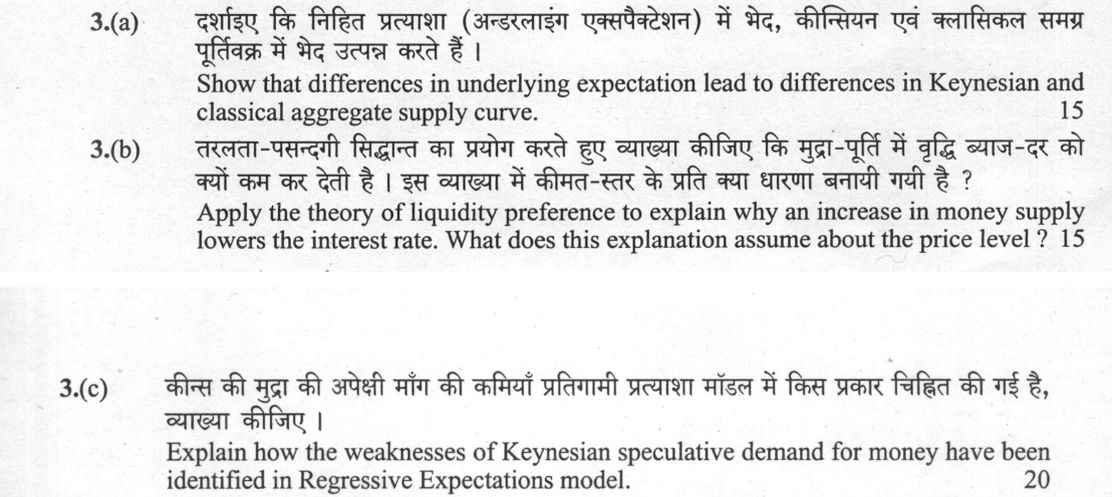
Show that differences in underlying expectation lead to differences in Keynesian and classical aggregate supply curve. 15 marks
Apply the theory of liquidity preference to explain why an increase in money supply lowers the interest rate. What does this explanation assume about the price level ? 15 marks
Explain how the weaknesses of Keynesian speculative demand for money have been identified in Regressive Expectations model. 20 marks
हिंदी में प्रश्न पढ़ें
दर्शाइए कि निहित प्रत्याशा (अन्डरलाइंग एक्सपेक्टेशन) में भेद, कीन्सियन एवं क्लासिकल समग्र पूर्तिवक्र में भेद उत्पन्न करते हैं । (15 अंक)
तरलता-पसन्दगी सिद्धान्त का प्रयोग करते हुए व्याख्या कीजिए कि मुद्रा-पूर्ति में वृद्धि ब्याज-दर को क्यों कम कर देती है । इस व्याख्या में कीमत-स्तर के प्रति क्या धारणा बनायी गयी है ? (15 अंक)
कीन्स की मुद्रा की अपेक्षी मांग की कमियाँ प्रतिगामी प्रत्याशा मॉडल में किस प्रकार चिह्नित की गई है, व्याख्या कीजिए । (20 अंक)
Model answer
Written by UPSC Answer Check against this question's marking rubric, to the expected length. UPSC does not publish answers for Mains — this is one way to score well, not an official key.
(a) Expectations and the AS curve The Keynesian–classical difference in aggregate supply is a difference in price-level expectations and wage adjustment. In the classical view, wages and prices are flexible and agents correctly anticipate the price level, so P^e = P. If nominal wages are set on P^e, a rise in P raises nominal wages one-for-one; the real wage W/P is unchanged, labour market clears at natural output, and AS is vertical. In the Keynesian view, expectations are adaptive and P^e adjusts slowly. If P rises above P^e, the real wage falls, firms hire more and output rises; if P falls below P^e, real wage rises and output falls. Hence AS is upward sloping. In the very short run, with fixed nominal wages or rigid contracts, AS can be horizontal up to capacity, because firms can sell more at the given price without immediate cost changes. The causal chain is expectation error → real-wage change → employment/output change.
(b) Liquidity preference and the interest rate Liquidity preference says money is held for transactions, precautionary and speculative motives. At given income and price level, money demand is L(Y,r), rising with Y and falling with r. If the central bank raises money supply, Ms, then at the initial interest rate money demand is below supply, leaving excess liquid balances. To restore portfolio balance, people buy bonds. Higher bond demand raises bond prices and lowers yields. The interest rate falls until the opportunity cost of holding money is low enough that money demand equals the larger supply. In India, an RBI open-market purchase of government securities can lower bond yields through this channel if prices do not rise immediately. The explanation assumes a fixed or constant price level in the short run, so nominal money supply raises real balances. If prices rose proportionately, real balances would be unchanged and the rate need not fall. It also allows a liquidity trap: at a very low rate, money demand is highly elastic, so more money may not lower the rate.
(c) Regressive expectations and speculative money demand Keynes’ speculative demand for money treats money as a store of value held to avoid expected capital losses on bonds. If bond prices are expected to fall, people hold money; if they are expected to rise, people hold bonds. The weakness is an all-or-nothing, discrete choice: it ignores uncertainty, risk aversion and portfolio diversification, and gives no smooth interest-rate relationship. The regressive-expectations model, an adaptive form of expectations, assumes that the expected future interest rate or expected return regresses toward a normal long-run level, r̄. If current r is above r̄, the expected future rate is lower, so bond prices are expected to rise and bonds offer an expected capital gain. For a perpetuity expected to revert fully to r̄, the expected rate of capital gain is (r − r̄)/r̄; if r is below r̄, the expected gain is negative, an expected capital loss. This makes expected bond return depend systematically on the distance of r from normal. Consequently, speculative money demand becomes continuous: as r rises above r̄, the expected gain from bonds rises, but risk-averse investors shift gradually from money into bonds rather than switching abruptly. The interest elasticity of money demand is therefore not fixed; it varies with how far r is from r̄ and with perceived bond-price risk. Tobin’s portfolio model reinforces this by showing that investors hold both money and bonds according to risk and return, not a single expected price movement. Thus the regressive-expectations critique shows that Keynesian speculative demand is too sharp and deterministic; a more realistic money demand is smooth, risk-sensitive and dependent on expected reversion of returns to normal.
What "Explain" is asking you to do
Make the working of something clear — what sets it off, what follows from what, and what it produces. Explain is the Commission's mechanism word: it dominates the technical papers and the “explain why” stems, where the marks sit in the causal chain and not in the label.
Structure that answers it
State what it is → the initiating condition → the chain of cause, step by step → an instance where it plays out → what the chain produces
Where marks are lost
Describing what something looks like instead of why it works that way. Naming the stages without linking them reads as description too.
How this answer will be evaluated
Approach
Framework: Keynesian vs Classical AS; Liquidity Preference; Regressive Expectations. (a) derive: given > assumptions > stepwise derivation > result > check | (b) explain: definition/context > points in order > small example > short close | (c) explain: definition/context > points in order > small example > short close Full marks: All parts: correct model, diagram, derivation, stated assumptions, named economist, policy implication.
Key points expected
- Classical: flexible prices, full employment, vertical AS
- Keynesian: sticky prices, horizontal/flat AS at low output
- Link expectations (adaptive vs rational) to curve shape
- Diagram with P on Y-axis, Y on X-axis
- Liquidity preference: M^d = L(Y, r), downward sloping in r
- Money supply vertical in (r, M) space
- M↑ shifts supply right, intersection at lower r
- Assumption: price level P is fixed (short run)
Evaluation rubric
Each sub-part is marked on its own, against the marks and word limit printed on the paper.
- (a) Derive AS curves from differing price-level expectations. 15 marks
derive— given → assumptions → stepwise derivation → result → check
Must cover
- Classical: flexible prices, full employment, vertical AS
- Keynesian: sticky prices, horizontal/flat AS at low output
- Link expectations (adaptive vs rational) to curve shape
- Diagram with P on Y-axis, Y on X-axis
Loses marks
- Verbal description without diagram
- Confusing AD with AS curve
- Failing to state price flexibility assumption
Earns more
- Mention of Phillips curve linkage
- Reference to IS-LM intersection determining Y
- Distinction between short-run and long-run AS
Extra mark
- Cite Friedman or Lucas on expectations
- Mention of New Classical critique
- (b) Use liquidity preference to show M↑ → r↓, state price assumption. 15 marks
explain— definition/context → points in order → small example → short close
Must cover
- Liquidity preference: M^d = L(Y, r), downward sloping in r
- Money supply vertical in (r, M) space
- M↑ shifts supply right, intersection at lower r
- Assumption: price level P is fixed (short run)
Loses marks
- Omitting the fixed-price assumption
- Confusing money demand with money supply
- No diagram or unlabelled axes
Earns more
- Mention of transaction, precautionary, speculative motives
- Reference to Keynes' original formulation
- Note that if P rises, real M falls, offsetting effect
Extra mark
- Cite Keynes' Treatise on Money
- Mention of liquidity trap as limiting case
- (c) Identify Keynesian speculative demand weaknesses via Regressive Expectations. 20 marks
explain— definition/context → points in order → small example → short close
Must cover
- Keynesian speculative demand: M^s = f(r - r^e), based on expected r
- Weakness: r^e is static or adaptive, ignores feedback
- Regressive expectations: r^e adjusts toward long-run mean
- Result: speculative demand becomes stabilising, not destabilising
Loses marks
- Confusing regressive with adaptive expectations
- Failing to state the specific weakness of Keynesian model
- No reference to the mechanism of expectation adjustment
Earns more
- Mention of Tobin's portfolio approach as alternative
- Reference to Minsky or Hyman on expectations
- Contrast with rational expectations model
Extra mark
- Cite Tobin (1969) or Minsky (1975) by name
- Mention of mean-reversion in interest rates
Practice this exact question
Write your answer and it is marked point by point against the model answer above — what you covered, what you missed, what you got wrong.
Evaluate my answer →More from Economics 2021 Paper I
- Q1 Answer the following questions in about 150 words each: (a) Compare and contrast Marshall…
- Q2 (a) Explain the differences between Cournot model of duopoly with similar product and dif…
- Q3 (a) Show that differences in underlying expectation lead to differences in Keynesian and…
- Q4 (a) Derive short-run aggregate supply curve following Lucas, when expectations are not re…
- Q5 Answer the following questions in about 150 words each: (a) Explain Rosenstein-Rodan's vi…
- Q6 (a) Evaluate Kuznets' inverted U shaped curve hypothesis of income distribution. Does it…