Paper I — Q4
(a) Derive short-run aggregate supply curve following Lucas, when expectations are not realised, assuming that labour market…
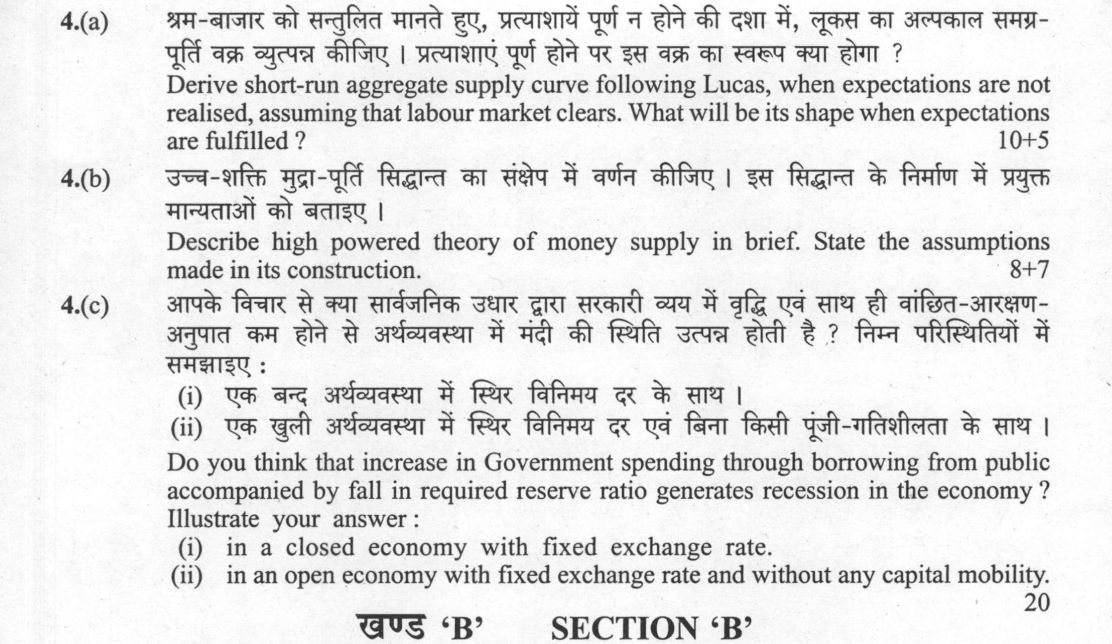
Derive short-run aggregate supply curve following Lucas, when expectations are not realised, assuming that labour market clears. What will be its shape when expectations are fulfilled ? (10+5 marks)
Describe high powered theory of money supply in brief. State the assumptions made in its construction. (8+7 marks)
Do you think that increase in Government spending through borrowing from public accompanied by fall in required reserve ratio generates recession in the economy ? Illustrate your answer: in a closed economy with fixed exchange rate.
in an open economy with fixed exchange rate and without any capital mobility. 20 marks
हिंदी में प्रश्न पढ़ें
श्रम-बाजार को संतुलित मानते हुए, प्रत्याशाएं पूर्ण न होने की दशा में, लुकास का अल्पकाल समग्र-पूर्ति वक्र व्युत्पन्न कीजिए । प्रत्याशाएं पूर्ण होने पर इस वक्र का स्वरूप क्या होगा ? (10+5 अंक)
उच्च-शक्ति मुद्रा-पूर्ति सिद्धांत का संक्षेप में वर्णन कीजिए । इस सिद्धांत के निर्माण में प्रयुक्त मान्यताओं को बताइए । (8+7 अंक)
आपके विचार से क्या सार्वजनिक उधार द्वारा सरकारी व्यय में वृद्धि एवं साथ ही वांछित-आरक्षण-अनुपात कम होने से अर्थव्यवस्था में मंदी की स्थिति उत्पन्न होती है ? निम्न परिस्थितियों में समझाइए : एक बंद अर्थव्यवस्था में स्थिर विनिमय दर के साथ ।
एक खुली अर्थव्यवस्था में स्थिर विनिमय दर एवं बिना किसी पूंजी-गतिशीलता के साथ । (20 अंक)
Model answer
Written by UPSC Answer Check against this question's marking rubric, to the expected length. UPSC does not publish answers for Mains — this is one way to score well, not an official key.
(a) Lucas misperception model with clearing labour market. Let Y = F(L), F′ > 0, F″ < 0. Firms set W/P = F′(L). Workers supply labour on expected real wage: W/Pᵉ = ψ(L), ψ′ > 0. Labour-market clearing gives: P F′(L) = Pᵉ ψ(L). Log-linearise around full-information equilibrium P = Pᵉ, L = L*, Y = Y*. Let λ = −L*F″(L*)/F′(L*) > 0 and δ = L*ψ′(L*)/ψ(L*) > 0. Then: ln F′(L) ≈ ln F′(L*) − λ(ln L − ln L*), ln ψ(L) ≈ ln ψ(L*) + δ(ln L − ln L*). Since F′(L*) = ψ(L*), subtracting gives: ln P − ln Pᵉ = ln ψ(L) − ln F′(L) = (λ + δ)(ln L − ln L*). Hence: ln L = ln L* + [1/(λ + δ)](ln P − ln Pᵉ). Using ln Y = ln Y* + ε_L(ln L − ln L*), where ε_L = L*F′(L*)/Y* > 0, the Lucas short-run aggregate supply curve is: ln Y = ln Y* + α(ln P − ln Pᵉ), α = ε_L/(λ + δ) > 0, or equivalently: Y = Y*(P/Pᵉ)^α. It is upward sloping: when P > Pᵉ, workers mistake the price rise for a higher real wage and supply more labour, while firms demand more labour. When expectations are fulfilled, P = Pᵉ, so ln Y = ln Y*. Thus SAS is vertical at natural output Y*.
(b) High-powered money theory: Let H = C + R, M = C + D, c = C/D. If total reserve ratio is r = R/D, then: M/H = (C + D)/(C + R) = (1 + c)/(c + r), so M = mH, where m = (1 + c)/(c + r) is the money multiplier. If required reserve ratio is r_r and excess reserve ratio is e, then r = r_r + e and m = (1 + c)/(c + r_r + e). The central bank controls H; the public determines c; banks determine r_r and e. Hence M = mH, and the central bank can influence M by changing H, provided m is stable.
Assumptions: (i) central bank exogenously controls H; (ii) currency-deposit ratio c is stable and determined by public habits; (iii) required reserve ratio r_r is stable or policy-determined; (iv) excess reserve ratio e is stable or negligible; (v) money multiplier m is stable and predictable; (vi) interest rates do not significantly alter c, r_r and e; (vii) no foreign-exchange or other leakages disturb H.
(c) Bond-financed G↑ shifts IS right. Fall in required reserve ratio rr↓ raises m, so M = mH rises and LM shifts right.
(i) In a closed economy, there is no foreign sector, so the fixed exchange-rate clause is inoperative. Use IS-LM. G↑ shifts IS right; rr↓ shifts LM right. At initial interest, both raise Y. Equilibrium output and employment rise. Interest may rise or fall depending on relative shifts. Crowding-out from G is offset or reversed by the monetary expansion. Thus no recession is generated.
(ii) Use Mundell-Fleming. Open economy, fixed exchange rate E, no capital mobility. The BP condition is NX(Y,E) + K(r) = 0 with K = 0, so NX(Y,E) = 0, i.e. Y = Y_T, giving a vertical BP curve. G↑ shifts IS right; rr↓ shifts LM right. Both tend to raise Y above Y_T. Then imports exceed exports, causing a BoP deficit. To defend the fixed exchange rate, the central bank sells foreign exchange and buys domestic currency, so H falls. LM shifts left. With no capital mobility, interest cannot attract capital, so adjustment occurs through reserve loss. Final equilibrium restores Y = Y_T. The increase in G raises interest and crowds out investment or consumption, while the fall in rr merely raises the multiplier and forces a larger reserve loss. Output is unchanged relative to the initial trade-balance level, not reduced below it. Hence the policy mix does not generate recession in the standard equilibrium; it mainly causes foreign-reserve depletion and higher interest.
What "Derive" is asking you to do
Reach the stated expression from a starting relation, justifying every step. The destination is printed in the question, so only the route earns marks, and the assumptions you work under are part of that route.
Structure that answers it
Assumptions and notation defined → starting relation or governing equation → each step with its justification → the required expression → limiting case or boundary check
Where marks are lost
Writing the standard result first and fitting three lines to it, which an examiner reads at a glance. Marks also go on assumptions left unstated — lossless medium, small amplitude, errors independent with zero mean — and on symbols used before they are defined, even when the question says usual notations.
How this answer will be evaluated
Approach
Framework: Lucas Supply Curve / High Powered Money / IS-LM-BP. (a) derive: given > assumptions > stepwise derivation > result > check | (b) describe: define > structure or process in order > labelled diagram > significance | (c) analyse: intro > causes > effects > stakeholders/linkages > way forward Full marks: Rigorous derivation with correct diagrams, clear assumptions, and policy implications for all parts.
Key points expected
- State Lucas supply function with price expectations
- Show labour market clearing condition
- Derive slope of SRAS curve
- State SRAS becomes vertical when expectations fulfilled
- Define high powered money (H) and money multiplier
- Show relationship M = H × k
- List assumptions of the theory
- Explain central bank control over H
Evaluation rubric
Each sub-part is marked on its own, against the marks and word limit printed on the paper.
- (a) Derive Lucas SRAS with unfulfilled expectations and describe shape when fulfilled. 15 marks
derive— given → assumptions → stepwise derivation → result → check
Must cover
- State Lucas supply function with price expectations
- Show labour market clearing condition
- Derive slope of SRAS curve
- State SRAS becomes vertical when expectations fulfilled
Loses marks
- Confusing Lucas with Keynesian SRAS
- Failing to show labour market clearing
- Asserting verticality without derivation
Earns more
- Mention rational expectations assumption
- Draw P-Y diagram showing SRAS shift
- Distinguish between unanticipated and anticipated inflation
Extra mark
- Reference to Lucas 1972 paper
- Mention of New Classical critique
- (b) Describe high powered money theory and state its construction assumptions. 15 marks
describe— define → structure or process in order → labelled diagram → significance
Must cover
- Define high powered money (H) and money multiplier
- Show relationship M = H × k
- List assumptions of the theory
- Explain central bank control over H
Loses marks
- Confusing high powered money with M3
- Failing to state multiplier assumptions
- Verbal description without formula
Earns more
- Mention currency-deposit ratio assumption
- Reference to fractional reserve banking
- Draw money creation process diagram
Extra mark
- Reference to Friedman's monetary theory
- Mention of RBI's monetary policy framework
- (c) Analyse whether fiscal expansion with reserve ratio cut causes recession in closed and open economies. 20 marks
analyse— intro → causes → effects → stakeholders/linkages → way forward
Must cover
- Set up IS-LM-BP framework for both cases
- Show effect of G↑ and rr↓ on IS and LM
- Analyze closed economy with fixed exchange rate
- Analyze open economy with fixed rate and no capital mobility
Loses marks
- Failing to distinguish closed vs open economy
- Ignoring fixed exchange rate constraint
- No diagram or verbal only analysis
Earns more
- Draw IS-LM-BP diagrams for both cases
- Explain crowding out effect
- Mention monetary policy accommodation
- Reference to Mundell-Fleming model
Extra mark
- Reference to specific Indian fiscal policy
- Mention of recent RBI reserve ratio changes
Practice this exact question
Write your answer and it is marked point by point against the model answer above — what you covered, what you missed, what you got wrong.
Evaluate my answer →More from Economics 2021 Paper I
- Q1 Answer the following questions in about 150 words each: (a) Compare and contrast Marshall…
- Q2 (a) Explain the differences between Cournot model of duopoly with similar product and dif…
- Q3 (a) Show that differences in underlying expectation lead to differences in Keynesian and…
- Q4 (a) Derive short-run aggregate supply curve following Lucas, when expectations are not re…
- Q5 Answer the following questions in about 150 words each: (a) Explain Rosenstein-Rodan's vi…
- Q6 (a) Evaluate Kuznets' inverted U shaped curve hypothesis of income distribution. Does it…
- Q7 (a) Discuss the theory of acquired advantage in international trade using suitable exampl…