Paper I — Q8
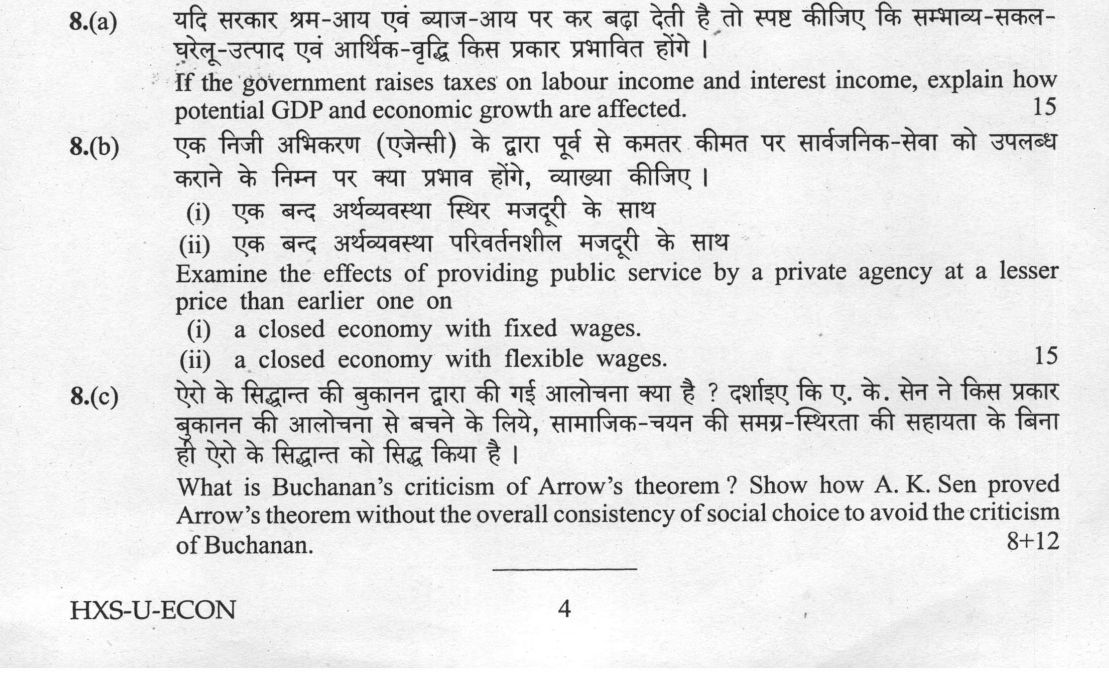
(a) If the government raises taxes on labour income and interest income, explain how potential GDP and economic growth are…
If the government raises taxes on labour income and interest income, explain how potential GDP and economic growth are affected. 15 marks
Examine the effects of providing public service by a private agency at a lesser price than earlier one on a closed economy with fixed wages.
a closed economy with flexible wages. 15 marks
What is Buchanan's criticism of Arrow's theorem ? Show how A. K. Sen proved Arrow's theorem without the overall consistency of social choice to avoid the criticism of Buchanan. (8+12 marks)
हिंदी में प्रश्न पढ़ें
यदि सरकार श्रम-आय एवं ब्याज-आय पर कर बढ़ा देती है, तो स्पष्ट कीजिए कि संभाव्य-सकल-घरेलू-उत्पाद एवं आर्थिक-वृद्धि किस प्रकार प्रभावित होंगे । (15 अंक)
एक निजी अभिकरण (एजेंसी) के द्वारा पूर्व से कमतर कीमत पर सार्वजनिक-सेवा को उपलब्ध कराने के निम्न पर क्या प्रभाव होंगे, व्याख्या कीजिए । एक बंद अर्थव्यवस्था स्थिर मजदूरी के साथ
एक बंद अर्थव्यवस्था परिवर्तनशील मजदूरी के साथ (15 अंक)
ऐरो के सिद्धांत की बुकानन द्वारा की गई आलोचना क्या है ? दर्शाइए कि अ. के. सेन ने किस प्रकार बुकानन की आलोचना से बचने के लिये, सामाजिक-चयन की समग्र-निश्चिता की सहायता के बिना ही ऐरो के सिद्धांत को सिद्ध किया है । (8+12 अंक)
Model answer
Written by UPSC Answer Check against this question's marking rubric, to the expected length. UPSC does not publish answers for Mains — this is one way to score well, not an official key.
Taxes on labour and interest income A tax on labour income lowers the after-tax wage. The substitution effect makes leisure cheaper and tends to reduce labour supply; the income effect, by lowering after-tax income, may induce more work if leisure is normal. The net effect on potential GDP is therefore ambiguous, but if the tax discourages effort, skill formation or participation, it lowers the effective labour input and hence the level of potential output. A tax on interest income lowers the after-tax return to saving, reducing savings and capital accumulation; in a Solow-type model this lowers the steady-state capital stock and output, while in endogenous-growth models it can also lower the long-run growth rate. The Laffer curve is relevant to revenue: if the tax rate is already high, a rise may shrink the tax base and reduce revenue. Deadweight loss, however, generally rises roughly with the square of the tax rate even before the revenue peak. Thus the main effect is a level effect on potential GDP, with a growth-rate effect only where incentives for saving, investment or productivity are persistently distorted.
Private provision at a lower price (i) In a closed economy with fixed nominal wages, a cheaper public service raises the real wage and real income. The lower price level can increase real balances and demand for other goods, an expansionary channel; in India, lower electricity tariffs raise real income, but wage rigidity can blunt employment adjustment. At the same time, if the private agency supplies the service more efficiently, it may need fewer workers; because wages cannot fall, displaced workers may become unemployed, and the higher real wage may reduce firms' labour demand. Distributionally, consumers gain, public-sector workers lose, and private owners earn profits. The net output effect is therefore not automatically contractionary: it depends on whether demand and real-balance gains outweigh employment and real-wage rigidity losses.
(ii) With flexible wages, nominal wages adjust downward in response to lower prices and reduced labour demand. This restores labour-market clearing and prevents persistent unemployment. The fall in prices raises real balances, supporting demand, while lower-cost provision raises efficiency. Output is therefore more likely to improve, though workers share the gain through lower nominal wages; the main effect is reallocation toward a more efficient provider with a lower price level.
Buchanan, Arrow and Sen Arrow’s theorem says that, with unrestricted domain, Pareto, IIA, non-dictatorship and a complete transitive social ordering, no non-dictatorial social welfare function exists. Buchanan’s criticism was that the theorem depends on “overall consistency”: it requires a rational, transitive social ordering, which is unrealistic. He preferred procedural rules, especially Wicksellian unanimity, and argued that if collective choice need not be fully transitive, the impossibility might be avoided.
Sen tested this by weakening consistency while retaining IIA and Pareto. Under the Pareto extension, if everyone prefers x to y, society must prefer x to y; if everyone prefers y to x, society must prefer y to x; non-unanimous cases are not settled and need not be indifference. Sen showed that with only quasi-transitive social preference, Arrow’s result still yields a dictator. With mere acyclicity, the result is an oligarchy or veto structure: a non-empty set of individuals whose preferences constrain the social ranking. Thus Sen did not prove a non-dictatorial rule satisfying Arrow’s conditions; he showed the impossibility survives without full collective rationality, so Buchanan’s criticism does not dissolve the theorem. Sen’s liberal paradox reinforces this: minimal liberty plus Pareto can generate cycles, showing partial orderings or acyclicity may fail rather than provide a clean escape. Overall, public policy trades efficiency against distribution, and social-choice theory shows procedural consistency cannot escape impossibility without strong assumptions.
What "Examine" is asking you to do
Test the proposition the question puts to you and return a finding on how far it holds. Examine stems carry a claim, or ask whether something has happened, and expect evidence weighed both ways before the extent is stated — often with remedial measures attached.
Structure that answers it
Restate the claim as the question frames it → evidence that supports it → evidence that undercuts it → the conditions under which it holds → verdict on how far it stands
Where marks are lost
Stopping at description. An examination has to reach a finding, and “examine with justification” means the extent must be stated, not implied.
How this answer will be evaluated
Approach
Framework: Solow Growth Model & Public Finance Theory. (a) explain: definition/context > points in order > small example > short close | (b) examine: intro > 3-4 dimensions > example > balanced close | (c) explain: definition/context > points in order > small example > short close Full marks: Comprehensive analysis with clear models and specific examples
Key points expected
- Potential GDP and economic growth
- Labor supply effect of income tax
- Capital accumulation effect of interest tax
- Closed economy with fixed wages
- Closed economy with flexible wages
- Arrow's theorem
- Buchanan's criticism
- A.K. Sen's proof
Evaluation rubric
Each sub-part is marked on its own, against the marks and word limit printed on the paper.
- (a) Analyze the impact of tax hikes on labor and interest income on potential GDP and growth. 15 marks
explain— definition/context → points in order → small example → short close
Must cover
- Define potential GDP and economic growth
- Explain labor supply effect of income tax
- Explain capital accumulation effect of interest tax
- Link tax changes to production function
Loses marks
- Verbal answer without model
- Ignoring interest income tax effect
- Confusing actual GDP with potential GDP
Earns more
- Mention Solow growth model
- Discuss substitution effect vs income effect
- Reference Laffer curve
- Mention human capital investment
Extra mark
- Cite specific tax rate data
- Reference specific economist (e.g., Solow)
- (b) Examine effects of private agency providing public service at lower price on closed economies with fixed and flexible wages. 15 marks
examine— intro → 3-4 dimensions → example → balanced close
Must cover
- Define closed economy with fixed wages
- Define closed economy with flexible wages
- Analyze effect on labor demand
- Analyze effect on output and employment
Loses marks
- Ignoring wage rigidity/flexibility distinction
- Confusing closed with open economy
- Verbal answer without model
Earns more
- Mention crowding out effect
- Discuss wage rigidity vs flexibility
- Reference public choice theory
- Mention efficiency gains
Extra mark
- Cite specific privatization example
- Reference specific economist (e.g., Buchanan)
- (c) Explain Buchanan's criticism of Arrow's theorem and how A.K. Sen proved it without overall consistency.
explain— definition/context → points in order → small example → short close
Must cover
- State Arrow's theorem
- Explain Buchanan's criticism
- Describe A.K. Sen's proof
- Mention overall consistency of social choice
Loses marks
- Ignoring Buchanan's criticism
- Confusing Arrow's theorem with other theorems
- Verbal answer without model
Earns more
- Reference social choice theory
- Mention Pareto efficiency
- Discuss transitivity
- Reference specific theorem (e.g., Sen's theorem)
Extra mark
- Cite specific paper or book
- Reference specific economist (e.g., Arrow, Sen)
Practice this exact question
Write your answer and it is marked point by point against the model answer above — what you covered, what you missed, what you got wrong.
Evaluate my answer →More from Economics 2021 Paper I
- Q5 Answer the following questions in about 150 words each: (a) Explain Rosenstein-Rodan's vi…
- Q6 (a) Evaluate Kuznets' inverted U shaped curve hypothesis of income distribution. Does it…
- Q7 (a) Discuss the theory of acquired advantage in international trade using suitable exampl…
- Q8 (a) If the government raises taxes on labour income and interest income, explain how pote…