Paper I — Q6
(a) Evaluate Kuznets' inverted U shaped curve hypothesis of income distribution. Does it hold good for less developed countries…
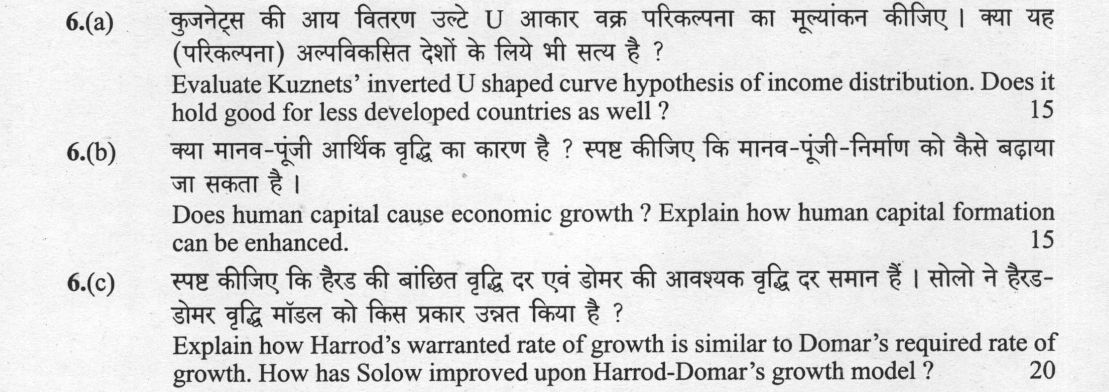
Evaluate Kuznets' inverted U shaped curve hypothesis of income distribution. Does it hold good for less developed countries as well ? 15 marks
Does human capital cause economic growth ? Explain how human capital formation can be enhanced. 15 marks
Explain how Harrod's warranted rate of growth is similar to Domar's required rate of growth. How has Solow improved upon Harrod-Domar's growth model ? 20 marks
हिंदी में प्रश्न पढ़ें
कुज़नेट्स की आय वितरण उलटे U आकार वक्र परिकल्पना का मूल्यांकन कीजिए । क्या यह (परिकल्पना) अल्पविकसित देशों के लिये भी सत्य है ? (15 अंक)
क्या मानव-पूँजी आर्थिक वृद्धि का कारण है ? स्पष्ट कीजिए कि मानव-पूँजी-निर्माण को कैसे बढ़ाया जा सकता है । (15 अंक)
स्पष्ट कीजिए कि हैरोड की बांछित वृद्धि दर एवं डोमर की आवश्यक वृद्धि दर समान हैं । सोलो ने हैरोड-डोमर वृद्धि मॉडल को किस प्रकार उन्नत किया है ? (20 अंक)
Model answer
Written by UPSC Answer Check against this question's marking rubric, to the expected length. UPSC does not publish answers for Mains — this is one way to score well, not an official key.
The three themes are linked: growth alters inequality, human capital raises productivity, and growth models explain expansion.
(a) Kuznets' inverted-U hypothesis Kuznets argued that as an economy shifts from agriculture to industry, inequality first rises and later falls. The standard is a predictable path across development stages. Early growth draws labour from low-income subsistence farming to higher-wage manufacturing and services, widens urban-rural and skill gaps, and concentrates capital. Later, mass education, social security, labour bargaining and services raise bottom incomes, reducing inequality. It is plausible for some developed economies, but empirical support is weak. Anand and Kanbur showed that the inverted-U is not robust to changes in inequality measure or regression specification. Longitudinal studies by Fields and Deininger-Squire show many countries do not follow it; inequality can fall early or remain high. Piketty suggests a U-shaped revival in advanced economies, where capital income, top incomes and skill-biased technology raise inequality again. For LDCs, the curve is not a law. China’s inequality rose after market reforms as coastal industry grew faster, but later social programmes reduced it. India’s experience is mixed: liberalisation raised growth but also skill-biased technology, urban concentration and crony capitalism widened gaps; later growth and social schemes have not guaranteed a fall. Thus the inverted-U may describe a possible pattern, not a universal stage.
(b) Human capital and growth Human capital causes growth in endogenous theory. Lucas showed education and training raise productivity and generate spillovers; Romer showed knowledge and innovation, accumulated through human capital, can produce increasing returns. Quantity and quality matter: enrolment alone is insufficient if learning outcomes, health and cognitive skills are weak. Health reduces absenteeism and cognitive deficits, while education improves technology absorption. It can be enhanced by public expenditure on education and health, school quality, teacher training and learning outcomes. Vocational training and the Skill India Mission can align labour skills with industry needs. Reducing malnutrition through ICDS and POSHAN Abhiyaan protects early childhood development. Addressing gender gaps in girls’ education, female labour force participation and maternal health raises effective human capital. In India, these are essential because growth without broad-based skill formation may increase inequality.
(c) Harrod-Domar and Solow Harrod’s warranted rate is where planned saving exactly creates capacity that is fully absorbed. With savings rate s and capital-output ratio Cr, Gw = s/Cr. Domar’s required rate comes from investment’s capacity effect. If investment I adds capital, the new capacity is σI, where σ = 1/Cr. To absorb this capacity, output must grow by σI. Writing this as a growth rate, gY = σI, so g = σ(I/Y). Since I/Y = s, g = σs. Thus the two rates are the same: growth depends only on savings and the capital-output ratio. It is knife-edge: deviation from the warranted rate creates excess capacity or demand, with no automatic adjustment. Policy focuses on raising savings and lowering the capital-output ratio, but technology and labour productivity are ignored. Solow introduced a neoclassical production function with capital-labour substitutability and diminishing returns to capital. In Solow, if the capital-labour ratio is below the steady state, saving accumulates capital faster than labour, raising the ratio; if above, the ratio falls, restoring equilibrium. The steady state is stable, and poorer economies can converge. Solow treats technological progress as a TFP residual, explaining growth not due to capital or labour. However, Solow’s technology is exogenous. Romer and Lucas internalise innovation and human capital, showing R&D, education and spillovers can sustain growth.
Thus Kuznets’ curve is a heuristic, not a reliable guide for LDCs; human capital causally drives growth; and Solow’s stable framework, extended by endogenous theory, better guides policy than Harrod-Domar.
What "Evaluate" is asking you to do
Judge how well something has performed against the standard it set for itself — its stated aim, mandate or promise — and commit to a verdict. Name the yardstick before you judge; an unanchored judgement reads as opinion.
Structure that answers it
Name the yardstick — stated aim, mandate or benchmark → performance against it → shortfall against it → why the gap exists → verdict
Where marks are lost
Presenting both sides and then declining to decide, or delivering a verdict against a standard you never stated, which makes it look arbitrary.
How this answer will be evaluated
Approach
Framework: Economic Growth and Development. (a) evaluate: criteria > evidence > balanced judgment | (b) explain: definition/context > points in order > small example > short close | (c) explain: definition/context > points in order > small example > short close Full marks: Comprehensive, well-structured, with clear derivations and critical evaluation.
Key points expected
- Define the inverted U-shaped curve hypothesis
- Explain the mechanism of rising then falling inequality
- Critically evaluate the hypothesis with evidence
- Discuss applicability to less developed countries
- Define human capital and its role in growth
- Explain the mechanism of human capital formation
- List methods to enhance human capital
- Link human capital to economic growth
Evaluation rubric
Each sub-part is marked on its own, against the marks and word limit printed on the paper.
- (a) Assess the validity of Kuznets' hypothesis and its applicability to LDCs. 15 marks
evaluate— criteria → evidence → balanced judgment
Must cover
- Define the inverted U-shaped curve hypothesis
- Explain the mechanism of rising then falling inequality
- Critically evaluate the hypothesis with evidence
- Discuss applicability to less developed countries
Loses marks
- Describing the curve without evaluating it
- Ignoring the LDC applicability question
- Confusing income distribution with income growth
Earns more
- Reference to Kuznets' original 1955 paper
- Mention of structural transformation
- Reference to modern data (e.g., Gini coefficients)
- Discussion of policy implications
Extra mark
- Reference to recent World Bank data
- Mention of specific LDC examples
- (b) Explain the causal link between human capital and growth, and methods to enhance it. 15 marks
explain— definition/context → points in order → small example → short close
Must cover
- Define human capital and its role in growth
- Explain the mechanism of human capital formation
- List methods to enhance human capital
- Link human capital to economic growth
Loses marks
- Treating human capital as a mere input
- Failing to explain the causal mechanism
- Listing methods without explaining how they enhance capital
Earns more
- Reference to Schultz or Becker
- Mention of education and health
- Discussion of returns to human capital
- Reference to Indian context
Extra mark
- Reference to recent ASER or NFHS data
- Mention of specific government schemes
- (c) Compare Harrod and Domar models, and explain Solow's improvements. 20 marks
explain— definition/context → points in order → small example → short close
Must cover
- Define Harrod's warranted rate of growth
- Define Domar's required rate of growth
- Explain the similarity between the two rates
- Explain Solow's improvements over Harrod-Domar
Loses marks
- Confusing warranted and required rates
- Failing to explain Solow's specific improvements
- Treating the models as identical without nuance
Earns more
- Derivation of the warranted rate
- Mention of the knife-edge stability problem
- Explanation of the Solow model's steady state
- Reference to the savings rate and depreciation
Extra mark
- Graphical representation of the Solow model
- Mention of the golden rule of capital accumulation
Practice this exact question
Write your answer and it is marked point by point against the model answer above — what you covered, what you missed, what you got wrong.
Evaluate my answer →More from Economics 2021 Paper I
- Q3 (a) Show that differences in underlying expectation lead to differences in Keynesian and…
- Q4 (a) Derive short-run aggregate supply curve following Lucas, when expectations are not re…
- Q5 Answer the following questions in about 150 words each: (a) Explain Rosenstein-Rodan's vi…
- Q6 (a) Evaluate Kuznets' inverted U shaped curve hypothesis of income distribution. Does it…
- Q7 (a) Discuss the theory of acquired advantage in international trade using suitable exampl…
- Q8 (a) If the government raises taxes on labour income and interest income, explain how pote…