Paper I — Q5
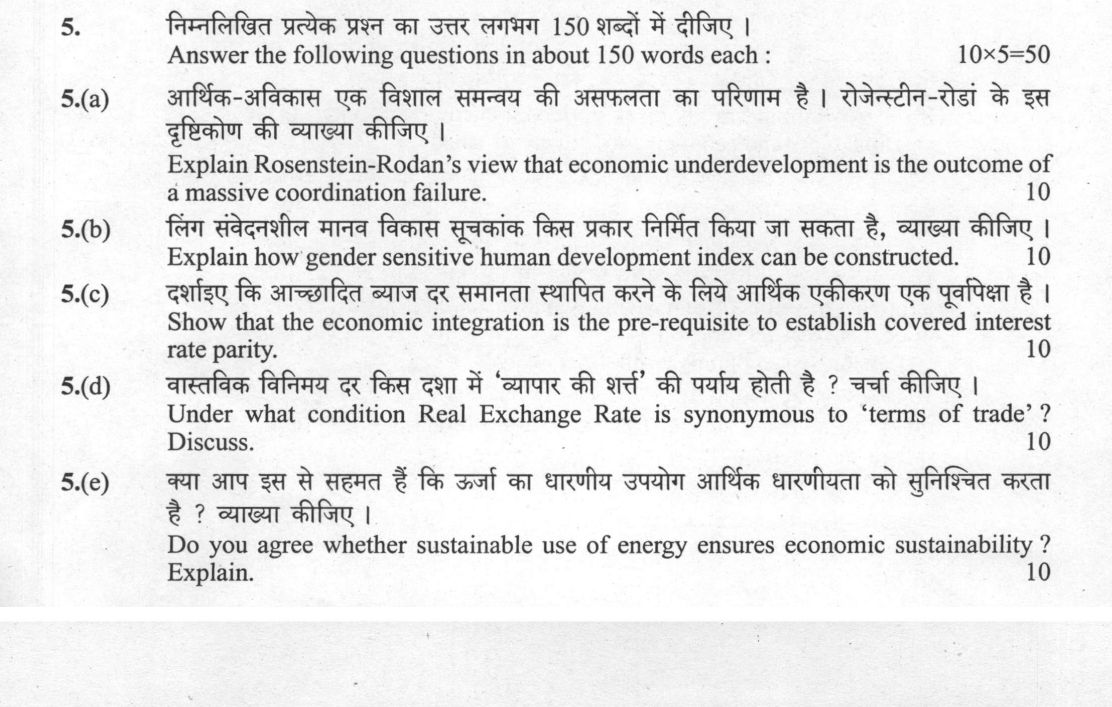
Answer the following questions in about 150 words each: (a) Explain Rosenstein-Rodan's view that economic underdevelopment is the…
Answer the following questions in about 150 words each: Explain Rosenstein-Rodan's view that economic underdevelopment is the outcome of a massive coordination failure. 10 marks
Explain how gender sensitive human development index can be constructed. 10 marks
Show that the economic integration is the pre-requisite to establish covered interest rate parity. 10 marks
Under what condition Real Exchange Rate is synonymous to 'terms of trade' ? Discuss. 10 marks
Do you agree whether sustainable use of energy ensures economic sustainability ? Explain. 10 marks
हिंदी में प्रश्न पढ़ें
निम्नलिखित प्रत्येक प्रश्न का उत्तर लगभग 150 शब्दों में दीजिए । आर्थिक-अविकास एक विशाल समन्वय की असफलता का परिणाम है । रोजेनस्टीन-रोडां के इस दृष्टिकोण की व्याख्या कीजिए । (10 अंक)
लिंग संवेदनशील मानव विकास सूचकांक किस प्रकार निर्मित किया जा सकता है, व्याख्या कीजिए । (10 अंक)
दर्शाइए कि आच्छादित ब्याज दर समानता स्थापित करने के लिये आर्थिक एकीकरण एक पूर्वापेक्षा है । (10 अंक)
वास्तविक विनिमय दर किस दशा में 'व्यापार की शर्त' की पर्याय होती है ? चर्चा कीजिए । (10 अंक)
क्या आप इस से सहमत हैं कि ऊर्जा का धारणीय उपयोग आर्थिक धारणीयता को सुनिश्चित करता है ? व्याख्या कीजिए । (10 अंक)
Model answer
Written by UPSC Answer Check against this question's marking rubric, to the 150-word length. UPSC does not publish answers for Mains — this is one way to score well, not an official key.
(a) Rosenstein-Rodan’s Coordination Failure and the Big Push
Paul Rosenstein-Rodan posited that economic underdevelopment is not merely a lack of capital, but a low-level equilibrium trap caused by massive coordination failure. This failure stems from three structural indivisibilities: in the production function (lumpy Social Overhead Capital), in demand, and in the supply of savings.
Demand indivisibility illustrates the core mechanism: a single entrepreneur investing in a shoe factory cannot generate enough wages to buy all the shoes produced. If isolated, the factory fails due to insufficient market size. However, if a coordinated cluster of diverse industries is established simultaneously, workers from one sector buy the products of others, generating self-sustaining mutual demand through pecuniary external economies.
Because private entrepreneurs cannot capture these external spillovers, private profit falls short of social productivity, causing private investment to underperform. Overcoming this trap requires a state-coordinated "Big Push"—a critical minimum threshold of investment, historically estimated around 30 percent of national income—to build infrastructure and synchronize manufacturing.
(b) Construction of a Gender-Sensitive Human Development Index
The standard Human Development Index (HDI) masks intra-household and structural disparities by relying on national aggregates. A gender-sensitive framework rectifies this by constructing the Gender Development Index (GDI) and the Gender Empowerment Measure (GEM).
The GDI construction begins with gender-disaggregated data across the three standard HDI dimensions:
- Health, measured by female and male life expectancy at birth, adjusted for the biological female advantage.
- Education, measured by gender-disaggregated mean years of schooling for adults and expected years of schooling for children.
- Command over resources, estimated using female and male shares of economically active population and wage ratios to calculate gender-specific GNI per capita.
Separate female (HDI_F) and male (HDI_M) indices are calculated and aggregated using an inequality-aversion parameter (ε) to penalize gender gaps:
GDI = [P_f (HDI_F)¹-ε + Pₘ (HDI_M)¹-ε]¹/(1-ε)
To capture agency rather than just capability, the GEM measures political participation (parliamentary seats), administrative shares, and female shares of earned income.
(c) Economic Integration as a Prerequisite for Covered Interest Rate Parity
Covered Interest Rate Parity (CIRP) is a non-arbitrage condition stating that the forward premium or discount on a foreign currency equals the nominal interest rate differential between two economies:
(F - S)/S = (i_d - i_f)/(1 + i_f) ≈ i_d - i_f
where S is the spot exchange rate, F is the forward rate, i_d is the domestic interest rate, and i_f is the foreign interest rate.
The realization of CIRP relies entirely on spatial arbitrage. If domestic yields exceed foreign covered yields (1 + i_d > F/S(1 + i_f)), capital inflows immediately bid up the spot price of domestic currency and drive down forward contracts until parity is restored.
This arbitrage mechanism functions only under complete economic and financial integration. The requisite conditions are: perfect capital mobility with zero capital controls, absence of cross-border transaction costs and withholding taxes, deep and liquid forward foreign exchange markets, and negligible sovereign default risk differential. Without financial openness and institutional integration, arbitrage capital is obstructed, causing CIRP to fail.
(d) Real Exchange Rate and Terms of Trade Equivalence
The Real Exchange Rate (RER) and the Terms of Trade (TOT) are conceptually distinct. RER measures the relative price of foreign goods in terms of domestic goods:
RER = E · (P_f)/(P_d)
where E is the nominal exchange rate (domestic currency per foreign currency unit), P_f is the foreign price level, and P_d is the domestic price level. Conversely, the Net Barter Terms of Trade represents the purchasing power of exports:
TOT = (Pₓ)/(Pₘ)
where Pₓ and Pₘ are export and import price indices, respectively.
RER becomes synonymous with (or the exact inverse of) TOT under specific restrictive conditions:
- The domestic economy produces only exportables (P_d = Pₓ) and consumes only importables (P_f = Pₘ).
- The consumption baskets between the two countries are identical and contain only tradable goods, eliminating non-tradables (such that the Law of One Price holds across all composite goods).
Under these assumptions, an increase in Pₓ/Pₘ (TOT improvement) corresponds directly to an appreciation of the real exchange rate (RER decreases), making them functional equivalents.
(e) Sustainable Energy and Economic Sustainability
Sustainable use of energy is a necessary, but not sufficient, condition to ensure long-term economic sustainability. The energy-growth nexus demonstrates that energy is a vital factor of production; decarbonizing energy systems through renewables decouples output growth from environmental degradation and mitigates macroeconomic vulnerabilities linked to fossil fuel import shocks. For instance, India's declining energy intensity under schemes like Perform, Achieve and Trade (PAT) has improved industrial efficiency.
However, energy sustainability alone cannot guarantee economic sustainability due to two main economic frictions:
- The Jevons Paradox: Technological gains in energy efficiency reduce the effective cost of energy services, which can trigger a rebound in aggregate energy consumption, neutralizing ecological gains.
- Structural Bottlenecks: A rapid green transition entails substantial capital expenditure, grid stability costs, stranded fossil-fuel assets, and reliance on critical mineral supply chains.
True economic sustainability requires inter-generational wealth preservation across all forms of capital—natural, human, physical, and fiscal. Sustainable energy stabilizes the ecological boundary, but broad economic sustainability also demands fiscal solvency, human capital development, and structural employment generation.
What "Explain" is asking you to do
Make the working of something clear — what sets it off, what follows from what, and what it produces. Explain is the Commission's mechanism word: it dominates the technical papers and the “explain why” stems, where the marks sit in the causal chain and not in the label.
Structure that answers it
State what it is → the initiating condition → the chain of cause, step by step → an instance where it plays out → what the chain produces
Where marks are lost
Describing what something looks like instead of why it works that way. Naming the stages without linking them reads as description too.
How this answer will be evaluated
Approach
Framework: Rosenstein-Rodan Big Push. (a) explain: definition/context > points in order > small example > short close | (b) explain: definition/context > points in order > small example > short close | (c) derive: given > assumptions > stepwise derivation > result > check | (d) discuss: intro > 3-4 dimensions > example > balanced close | (e) comment: context > arguments both sides > judgment > close Full marks: Clear definitions, accurate models, and well-supported arguments.
Key points expected
- Define coordination failure in underdeveloped economies
- Explain the Big Push theory
- Mention interdependence of industries
- Discuss the role of simultaneous investment
- Define the Human Development Index (HDI)
- Explain the components of HDI
- Describe how gender sensitivity is incorporated
- Mention the Gender Inequality Index (GII)
Evaluation rubric
Each sub-part is marked on its own, against the marks and word limit printed on the paper.
- (a) Define underdevelopment as a coordination failure and explain the Big Push theory. 10 marks · 150 words
explain— definition/context → points in order → small example → short close
Must cover
- Define coordination failure in underdeveloped economies
- Explain the Big Push theory
- Mention interdependence of industries
- Discuss the role of simultaneous investment
Loses marks
- Failing to define coordination failure
- Not explaining the interdependence of industries
- Ignoring the role of simultaneous investment
Earns more
- Mention Rosenstein-Rodan by name
- Provide a simple diagram of the Big Push
- Discuss the role of government in coordination
- Mention the concept of indivisibilities
Extra mark
- Reference to a specific developing country example
- Mention the concept of 'critical minimum effort'
- (b) Explain the construction of a gender-sensitive Human Development Index. 10 marks · 150 words
explain— definition/context → points in order → small example → short close
Must cover
- Define the Human Development Index (HDI)
- Explain the components of HDI
- Describe how gender sensitivity is incorporated
- Mention the Gender Inequality Index (GII)
Loses marks
- Failing to define HDI
- Not explaining the components of HDI
- Ignoring the role of gender sensitivity
Earns more
- Provide a formula for HDI
- Explain the calculation of GII
- Mention the role of UNDP
- Discuss the limitations of HDI
Extra mark
- Reference to a specific country's HDI and GII
- Mention the concept of 'gender parity'
- (c) Show that economic integration is a prerequisite for covered interest rate parity. 10 marks · 150 words
derive— given → assumptions → stepwise derivation → result → check
Must cover
- Define covered interest rate parity (CIP)
- Explain the role of economic integration
- Mention the role of capital mobility
- Discuss the role of exchange rate stability
Loses marks
- Failing to define CIP
- Not explaining the role of economic integration
- Ignoring the role of capital mobility
Earns more
- Provide a formula for CIP
- Explain the role of arbitrage
- Mention the role of financial markets
- Discuss the role of government policy
Extra mark
- Reference to a specific country's experience with CIP
- Mention the concept of 'interest rate differentials'
- (d) Discuss the condition under which Real Exchange Rate is synonymous to 'terms of trade'. 10 marks · 150 words
discuss— intro → 3-4 dimensions → example → balanced close
Must cover
- Define Real Exchange Rate (RER)
- Define Terms of Trade (ToT)
- Explain the condition for RER = ToT
- Mention the role of price levels
Loses marks
- Failing to define RER
- Not defining ToT
- Ignoring the condition for RER = ToT
Earns more
- Provide a formula for RER
- Provide a formula for ToT
- Explain the role of inflation
- Discuss the role of exchange rate policy
Extra mark
- Reference to a specific country's experience with RER and ToT
- Mention the concept of 'real appreciation'
- (e) Comment on whether sustainable use of energy ensures economic sustainability. 10 marks · 150 words
comment— context → arguments both sides → judgment → close
Must cover
- Define sustainable use of energy
- Define economic sustainability
- Explain the link between the two
- Mention the role of renewable energy
Loses marks
- Failing to define sustainable use of energy
- Not defining economic sustainability
- Ignoring the link between the two
Earns more
- Provide examples of sustainable energy use
- Explain the role of government policy
- Mention the role of technology
- Discuss the role of consumer behavior
Extra mark
- Reference to a specific country's experience with sustainable energy
- Mention the concept of 'green economy'
Practice this exact question
Write your answer and it is marked point by point against the model answer above — what you covered, what you missed, what you got wrong.
Evaluate my answer →More from Economics 2021 Paper I
- Q2 (a) Explain the differences between Cournot model of duopoly with similar product and dif…
- Q3 (a) Show that differences in underlying expectation lead to differences in Keynesian and…
- Q4 (a) Derive short-run aggregate supply curve following Lucas, when expectations are not re…
- Q5 Answer the following questions in about 150 words each: (a) Explain Rosenstein-Rodan's vi…
- Q6 (a) Evaluate Kuznets' inverted U shaped curve hypothesis of income distribution. Does it…
- Q7 (a) Discuss the theory of acquired advantage in international trade using suitable exampl…
- Q8 (a) If the government raises taxes on labour income and interest income, explain how pote…