Paper I — Q7
(a) Discuss the theory of acquired advantage in international trade using suitable examples. (15 marks) (b) Do you think that…
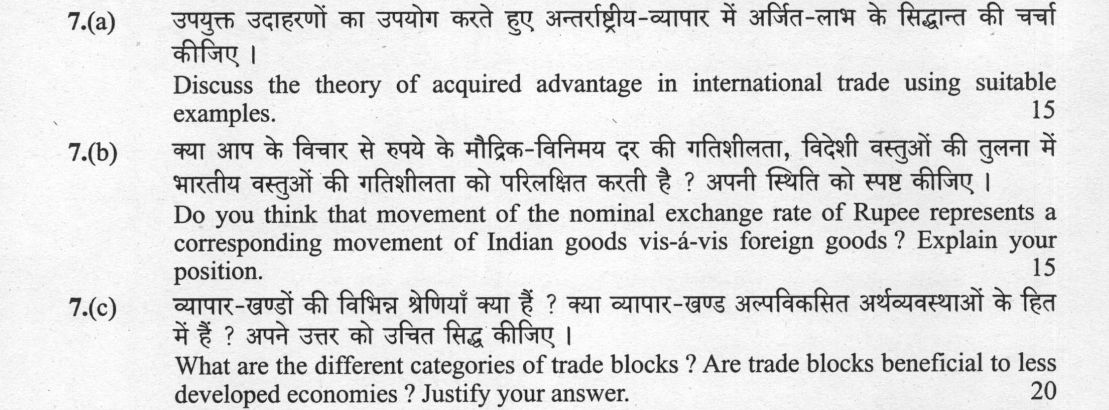
Discuss the theory of acquired advantage in international trade using suitable examples. 15 marks
Do you think that movement of the nominal exchange rate of Rupee represents a corresponding movement of Indian goods vis-á-vis foreign goods ? Explain your position. 15 marks
What are the different categories of trade blocks ? Are trade blocks beneficial to less developed economies ? Justify your answer. 20 marks
हिंदी में प्रश्न पढ़ें
उपयुक्त उदाहरणों का उपयोग करते हुए अंतर्राष्ट्रीय-व्यापार में अर्जित-लाभ के सिद्धांत की चर्चा कीजिए । (15 अंक)
क्या आप के विचार से रुपये के मौद्रिक-विनिमय दर की गतिशीलता, विदेशी वस्तुओं की तुलना में भारतीय वस्तुओं की गतिशीलता को परिलक्षित करती है ? अपनी स्थिति को स्पष्ट कीजिए । (15 अंक)
व्यापार-खंडों की विभिन्न श्रेणियाँ क्या हैं ? क्या व्यापार-खंड अल्पविकसित अर्थव्यवस्थाओं के हित में हैं ? अपने उत्तर को उचित सिद्ध कीजिए । (20 अंक)
Model answer
Written by UPSC Answer Check against this question's marking rubric, to the expected length. UPSC does not publish answers for Mains — this is one way to score well, not an official key.
Theory of Acquired Advantage in International Trade
Unlike classical theories of natural advantage grounded in immobile factor endowments such as climate or mineral reserves, the theory of acquired advantage posits that comparative advantage is dynamically created through technological innovation, human capital accumulation, and economies of scale. Developed through dynamic trade and endogenous growth literature, acquired advantage operates via product technology, where a country creates differentiated, high-value goods, and process technology, which systematically lowers unit production costs.
For instance, Japan, despite lacking domestic iron ore and petroleum, created a dominant global advantage in automobiles through pioneering lean production systems and robotics. Similarly, India's dominance in IT services stems not from static factor endowments, but from deliberate investments in tertiary technical education, English-language proficiency, and agglomeration economies in hubs like Bengaluru and Hyderabad. Acquired advantage demonstrates that international competitiveness is malleable and shaped by institutional learning-by-doing.
Nominal Exchange Rate Movements and Real Competitiveness
A movement in the nominal exchange rate (NER) of the Rupee does not necessarily translate into a corresponding movement in the relative competitiveness of Indian goods vis-à-vis foreign goods. Trade competitiveness is determined by the Real Effective Exchange Rate (REER), which adjusts the trade-weighted NER for relative price differentials between India and its major trading partners.
If domestic inflation in India outpaces inflation in trading partner economies, a nominal depreciation of the Rupee can be completely neutralised, leaving the REER constant or even appreciating. Consequently, Indian goods become relatively more expensive despite nominal depreciation. Furthermore, even when the REER depreciates, the volume response of trade depends on the Marshall-Lerner condition: the sum of price elasticities of demand for exports and imports must exceed unity. In the short run, this condition often fails, triggering the J-curve effect where the trade deficit temporarily widens due to pre-existing import contracts and price-inelastic critical imports like crude petroleum and electronic components. Finally, incomplete exchange rate pass-through—driven by pricing-to-market behaviour and the high import intensity of Indian manufacturing exports—weakens the transmission from nominal currency movements to real price competitiveness.
Trade Blocs: Categories and Implications for Developing Economies
Trade blocs represent institutional arrangements that eliminate trade barriers among member states, classified into ascending levels of regional integration:
- Preferential Trade Agreements (PTAs): Partial tariff reductions on an agreed positive list of goods (e.g., SAARC PTA).
- Free Trade Agreements (FTAs): Complete elimination of internal tariffs among members, while each retains its independent external tariffs (e.g., ASEAN-India FTA).
- Customs Unions: Internal free trade combined with a Common External Tariff on third-party imports (e.g., SACU).
- Common Markets: Customs union features augmented by the free mobility of labour and capital.
- Economic and Monetary Unions: Complete market integration with harmonised fiscal and monetary policies and a common currency (e.g., Eurozone).
For less developed economies (LDCs), trade blocs present mixed outcomes. The static benefits arise from Jacob Viner’s concept of trade creation, where consumption shifts from high-cost domestic producers to lower-cost member nations. Dynamic gains include scale economies, technological spillovers, foreign direct investment, and deeper integration into global value chains (GVCs).
However, LDCs also face severe structural risks. Trade diversion occurs when low-cost imports from the rest of the world are displaced by higher-cost imports from bloc partners due to tariff preferences. LDCs frequently suffer from asymmetric power dynamics, tariff revenue losses, and premature de-industrialisation when exposed to more competitive partners. India’s experience illustrates this duality: while FTAs with ASEAN, Japan, and South Korea expanded market access, they resulted in widening bilateral trade deficits due to non-tariff barriers, inverted duty structures, and domestic supply-side bottlenecks, prompting India to withdraw from the Regional Comprehensive Economic Partnership (RCEP). Similarly, regional arrangements like SAFTA have yielded minimal gains due to low intra-regional economic complementarity and persistent non-tariff barriers.
Way Forward
Trade policy for developing economies must combine exchange rate management targeting real stability with domestic structural reforms. To benefit sustainably from regional trade blocs, developing nations must address logistics and factor-market inefficiencies, phase out inverted duties, and negotiate deep-integration agreements focused on services, standards harmonisation, and GVC integration rather than simple tariff elimination.
What "Discuss" is asking you to do
Lay the issue out from more than one side — how it arose, what is claimed for it, what is held against it, and where it now stands. UPSC attaches discuss to broad topics with several live dimensions, so coverage of the dimensions earns more than the strength of your opinion.
Structure that answers it
Set the issue up → the case as it is made → the case against → the dimension both sides leave out → where the balance now lies
Where marks are lost
Listing facts with no thread between them, or arguing one side throughout and calling it a discussion.
How this answer will be evaluated
Approach
Framework: UPSC Economics Paper 1. (a) discuss: intro > 3-4 dimensions > example > balanced close | (b) explain: definition/context > points in order > small example > short close | (c) justify: claim > 3-4 reasons > evidence > conclusion Full marks: Clear definitions, correct models, specific examples, and a well-justified position.
Key points expected
- Define acquired advantage (learning by doing)
- Link to increasing returns to scale
- Provide a suitable industry example
- Contrast with comparative advantage
- Define nominal vs real exchange rate
- State the relationship (PPP or relative price)
- Explain the role of domestic vs foreign inflation
- Provide a clear position (yes/no/conditional)
Evaluation rubric
Each sub-part is marked on its own, against the marks and word limit printed on the paper.
- (a) Explain the theory of acquired advantage with examples. 15 marks
discuss— intro → 3-4 dimensions → example → balanced close
Must cover
- Define acquired advantage (learning by doing)
- Link to increasing returns to scale
- Provide a suitable industry example
- Contrast with comparative advantage
Loses marks
- Confusing with absolute advantage
- No examples provided
- Verbal description without theoretical basis
Earns more
- Mention Paul Krugman or Paul Samuelson
- Reference to 'learning curve' or 'experience curve'
- Mention 'first-mover advantage'
Extra mark
- Reference to specific Indian industry (e.g., IT or Pharma)
- (b) Explain if nominal exchange rate movement reflects relative price changes. 15 marks
explain— definition/context → points in order → small example → short close
Must cover
- Define nominal vs real exchange rate
- State the relationship (PPP or relative price)
- Explain the role of domestic vs foreign inflation
- Provide a clear position (yes/no/conditional)
Loses marks
- Confusing nominal and real exchange rate
- Ignoring inflation differentials
- No clear position taken
Earns more
- Use the formula: RER = (Nominal Rate * P_domestic) / P_foreign
- Mention Balassa-Samuelson effect
- Reference to specific RBI data or recent trend
Extra mark
- Mention specific RBI policy or recent data point
- (c) Categorize trade blocks and justify their benefit to LDCs. 20 marks
justify— claim → 3-4 reasons → evidence → conclusion
Must cover
- List different categories of trade blocks
- Define each category briefly
- State a clear position on benefit to LDCs
- Provide 3-4 reasons for the position
Loses marks
- No clear position on benefit to LDCs
- Confusing trade blocks with trade agreements
- No justification provided
Earns more
- Mention specific trade blocks (e.g., EU, ASEAN, SAARC)
- Discuss trade creation vs trade diversion
- Reference to specific LDC experience (e.g., India or Bangladesh)
Extra mark
- Mention specific trade agreement or recent development
Practice this exact question
Write your answer and it is marked point by point against the model answer above — what you covered, what you missed, what you got wrong.
Evaluate my answer →More from Economics 2021 Paper I
- Q4 (a) Derive short-run aggregate supply curve following Lucas, when expectations are not re…
- Q5 Answer the following questions in about 150 words each: (a) Explain Rosenstein-Rodan's vi…
- Q6 (a) Evaluate Kuznets' inverted U shaped curve hypothesis of income distribution. Does it…
- Q7 (a) Discuss the theory of acquired advantage in international trade using suitable exampl…
- Q8 (a) If the government raises taxes on labour income and interest income, explain how pote…