Paper II — Q1
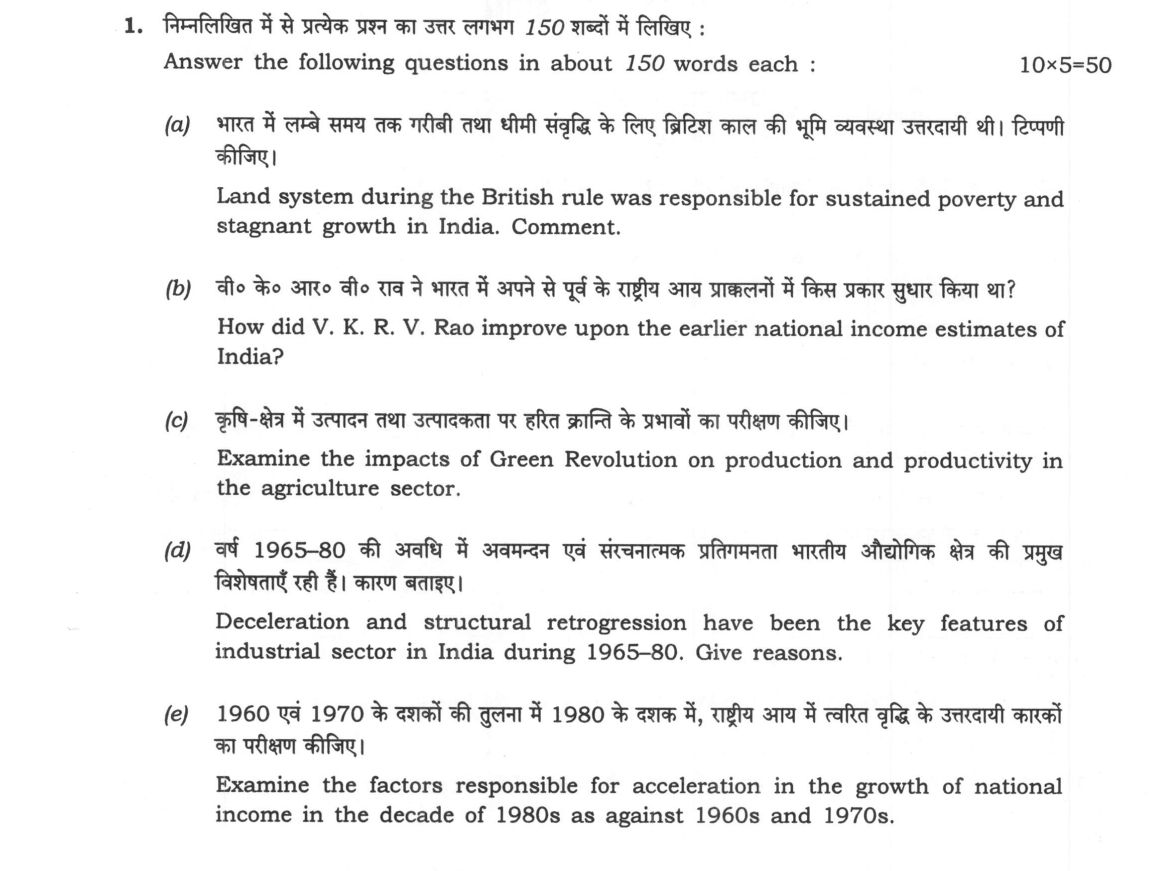
Answer the following questions in about 150 words each: (a) Land system during the British rule was responsible for sustained…
Answer the following questions in about 150 words each:
Land system during the British rule was responsible for sustained poverty and stagnant growth in India. Comment. 10 marks
How did V. K. R. V. Rao improve upon the earlier national income estimates of India? 10 marks
Examine the impacts of Green Revolution on production and productivity in the agriculture sector. 10 marks
Deceleration and structural retrogression have been the key features of industrial sector in India during 1965-80. Give reasons. 10 marks
Examine the factors responsible for acceleration in the growth of national income in the decade of 1980s as against 1960s and 1970s. 10 marks
हिंदी में प्रश्न पढ़ें
निम्नलिखित में से प्रत्येक प्रश्न का उत्तर लगभग 150 शब्दों में लिखिए :
भारत में लम्बे समय तक गरीबी तथा धीमी संवृद्धि के लिए ब्रिटिश काल की भूमि व्यवस्था उत्तरदायी थी। टिप्पणी कीजिए। (10 अंक)
वी० के० आर० वी० राव ने भारत में अपने से पूर्व के राष्ट्रीय आय प्राकलनों में किस प्रकार सुधार किया था? (10 अंक)
कृषि-क्षेत्र में उत्पादन तथा उत्पादकता पर हरित क्रांति के प्रभावों का परीक्षण कीजिए। (10 अंक)
वर्ष 1965-80 की अवधि में अवमंदन एवं संरचनात्मक प्रतिगमनता भारतीय औद्योगिक क्षेत्र की प्रमुख विशेषताएं रही हैं। कारण बताइए। (10 अंक)
1960 एवं 1970 के दशकों की तुलना में 1980 के दशक में, राष्ट्रीय आय में त्वरित वृद्धि के उत्तरदायी कारकों का परीक्षण कीजिए। (10 अंक)
Model answer
Written by UPSC Answer Check against this question's marking rubric, to the 150-word length. UPSC does not publish answers for Mains — this is one way to score well, not an official key.
(a) Land System During British Rule and Agrarian Stagnation
The institutional land revenue systems instituted by the British—the Permanent Settlement (Zamindari), Ryotwari, and Mahalwari systems—fundamentally restructured Indian agrarian relations to maximize colonial revenue extraction. By converting land into alienable property and imposing rigid, exorbitant cash demands, the British created a parasitic hierarchy of absentee landlords, moneylenders, and intermediaries. This institutional framework incentivized rack-renting, forced commercialization, and peasant dispossession (depeasantisation), leaving cultivators with neither the incentive nor the investible surplus to undertake capital improvements. The destruction of traditional rural handicrafts further intensified demographic pressure on land. Although colonial investments in railways and canal colonies stimulated market integration and commercial cropping in select enclaves, these were designed primarily to extract primary commodities for Britain rather than foster domestic productivity. Consequently, agricultural output remained virtually stagnant at below 0.5 percent per annum in the late-colonial era, structurally locking the rural economy into chronic poverty and underdevelopment.
(b) V. K. R. V. Rao's Contribution to National Income Estimates
Dr. V. K. R. V. Rao pioneered the first scientifically rigorous and methodologically sound estimation of India’s national income for the year 1931–32 (published in 1940), marking a decisive departure from the early, heuristic attempts of Dadabhai Naoroji, William Digby, and Findlay Shirras. Earlier pioneers had largely relied on ad-hoc approximations restricted to non-service agricultural output or arbitrary mark-ups for the tertiary sector. Rao revolutionized Indian national accounting by integrating the product method (inventory approach) for estimating net output in primary sectors (agriculture, livestock, forestry, fishing) with the income method for secondary, tertiary, and unorganized sectors. He addressed critical data gaps by conducting stratified rural-urban surveys, factoring in non-monetized transactions, deducting seed, wastage, and depreciation, and applying explicit base-year price deflators. Rao's conceptual definitions and sectoral disaggregations corrected systemic underestimations of previous scholars and established the methodological blueprint subsequently institutionalized by the Central Statistical Organisation (CSO).
(c) Impacts of Green Revolution on Production and Productivity
The Green Revolution, introduced in the mid-1960s through the intensive application of High Yielding Variety (HYV) seeds, chemical fertilizers, pesticides, and canal-tubewell irrigation, transformed Indian agriculture. It induced dramatic shifts in agricultural production and land productivity, particularly in wheat and rice, elevating national foodgrain output from around 72 million tonnes in 1965–66 to self-sufficiency levels that insulated India from ship-to-mouth PL-480 dependency.
However, these gains were structurally uneven. Crop-wise, it remained predominantly a "wheat-rice revolution," neglecting pulses, coarse cereals, and oilseeds. Spatially, productivity jumped substantially in the north-western plains (Punjab, Haryana, and Western Uttar Pradesh), while the rain-fed and eastern regions remained largely bypassed, creating severe regional imbalances. Economically, the capital-intensive nature of the package initially favored large farmers, exacerbating rural income disparities. Ecologically, prolonged monoculture, over-application of subsidized nitrogenous fertilizers, and unrestrained groundwater extraction led to falling water tables, soil salinity, and environmental degradation, posing long-term sustainability challenges.
(d) Industrial Deceleration and Structural Retrogression (1965–80)
The Indian industrial sector experienced marked deceleration from 1965 to 1980, with annual growth dropping from over 7 percent during the first three Five-Year Plans to around 4 percent, accompanied by "structural retrogression"—a relative slowdown of basic and capital goods sectors relative to non-essential consumer goods.
This stagnation stemmed from several systemic factors: First, regulatory barriers tightened via the Industrial Licensing regime, the Monopolies and Restrictive Trade Practices (MRTP) Act of 1969, and the Foreign Exchange Regulation Act (FERA) of 1973, which curtailed private capacity expansion and stifled competition. Second, consecutive droughts (1965–67), wars (1965, 1971), and oil shocks (1973, 1979) triggered severe foreign exchange crises, forcing sharp cutbacks in public capital expenditure, which dampened the crowding-in effect for private investment. Third, public sector enterprises suffered from operational inefficiencies, low capacity utilization, and rising capital-output ratios. Finally, an inward-looking import substitution policy neglected export competitiveness, while rising rural-urban income disparities constrained domestic demand for mass-consumption manufactured goods.
(e) Factors for Acceleration of National Income Growth in the 1980s
During the 1980s, India’s national income accelerated to an average growth rate exceeding 5.5 percent per annum, breaking away from the historical 3.5 percent "Hindu rate of growth" of the 1960s and 1970s.
This acceleration was propelled by a combination of policy shifts and structural factors: First, early industrial deregulation under Indira Gandhi and Rajiv Gandhi, including broad-banding of industrial licenses, relaxation of MRTP asset thresholds, and liberalized imports of capital goods and technology, enhanced manufacturing efficiency and private investment. Second, the geographic diffusion of the Green Revolution into eastern and southern states raised agricultural productivity, improving the rural terms of trade and expanding domestic demand. Third, the oil-boom-led migration to the Gulf economies generated substantial workers' remittances, bolstering domestic private consumption and household savings. Finally, expansionary fiscal policy characterized by increased public investment in infrastructure (energy, transport, and communications) coupled with domestic borrowing provided a significant aggregate demand stimulus, which, along with buoyant growth in the services sector, sustained this high-growth trajectory.
What "Comment" is asking you to do
Take a position on the statement and support it. Comment usually attaches to a quoted line in the short slots, so the reasoning must be compressed — an opening view, a few load-bearing reasons, and the limit of the claim.
Structure that answers it
Unpack what the statement asserts → your stance → two or three supporting reasons → the qualification that limits it
Where marks are lost
Neutral summary; a comment without a stance has not answered. Equally costly is accepting the quoted line wholesale and never testing where it fails.
How this answer will be evaluated
Approach
Framework: Indian Economic History & Planning Commission Analysis. (a) comment: context > arguments both sides > judgment > close | (b) explain: definition/context > points in order > small example > short close | (c) examine: definition/context > points in order > small example > short close | (d) explain: definition/context > points in order > small example > short close | (e) examine: definition/context > points in order > small example > short close Full marks: Precise economic terminology, specific data points, clear causal links, balanced judgment where required.
Key points expected
- British land systems (Permanent, Ryotwari, Mahalwari) and their impact on poverty
- V.K.R.V. Rao's methodological shift to expenditure method and NSS data
- Green Revolution's impact on production vs. productivity and regional concentration
- 1965-80 industrial stagnation due to License Raj, droughts, and war
- 1980s acceleration due to deregulation, private sector growth, and agricultural surplus
Evaluation rubric
Each sub-part is marked on its own, against the marks and word limit printed on the paper.
- (a) Evaluate the extent to which British land revenue systems caused poverty and stagnation. 10 marks · 150 words
comment— context → arguments both sides → judgment → close
Must cover
- Define Permanent, Ryotwari, Mahalwari systems
- Link revenue extraction to rural poverty
- Mention de-industrialization or drain of wealth
- Provide a balanced judgment on causality
Loses marks
- Listing systems without linking to poverty
- Ignoring the 'stagnant growth' aspect
- Purely descriptive history without economic analysis
Earns more
- Reference to Dadabhai Naoroji's drain theory
- Mention of specific regions for each system
- Discussion of commercialization of agriculture
- Reference to R.C. Dutt's critique
Extra mark
- Citation of specific revenue-to-income ratios
- Reference to specific British administrative reports
- (b) Detail the methodological improvements V.K.R.V. Rao made to national income estimation. 10 marks · 150 words
explain— definition/context → points in order → small example → short close
Must cover
- Mention shift from income to expenditure method
- Use of National Sample Survey (NSS) data
- Inclusion of unorganized sector estimates
- Standardization of price indices
Loses marks
- Confusing Rao with later Planning Commission estimates
- Failing to mention the unorganized sector
- Vague statements about 'better data' without specifics
Earns more
- Reference to the 1953-54 base year
- Mention of the 'Rao Report' or 1954 estimates
- Comparison with earlier Dutt or Kulkarni estimates
- Discussion of the 'value added' concept
Extra mark
- Specific mention of the 'Rao Committee' (if applicable)
- Reference to specific statistical tables used
- (c) Analyze the effect of Green Revolution on agricultural output and efficiency. 10 marks · 150 words
examine— definition/context → points in order → small example → short close
Must cover
- Define Green Revolution (HYV seeds, irrigation, fertilizer)
- Distinguish between production (total) and productivity (per unit)
- Mention regional concentration (Punjab, Haryana, UP)
- Note the shift from foodgrains to commercial crops
Loses marks
- Ignoring the 'productivity' aspect (only talking about total output)
- Failing to mention regional disparities
- Ignoring environmental or social costs if 'examine' implies balance
Earns more
- Reference to M.S. Swaminathan
- Mention of 'food for all' achievement
- Discussion of input-output ratio changes
- Reference to specific crop yields (wheat/rice)
Extra mark
- Data on specific yield increases (e.g., % growth)
- Mention of specific HYV varieties (e.g., Sonora wheat)
- (d) Explain why industrial growth slowed and structure worsened between 1965-80. 10 marks · 150 words
explain— definition/context → points in order → small example → short close
Must cover
- Mention the 'Hindu Rate of Growth' context
- Identify 'License Raj' or regulatory burden
- Cite the 1965-67 and 1972-73 droughts
- Mention the 1971 war and 1973 nationalization of banks
Loses marks
- Ignoring the 'structural retrogression' aspect
- Failing to mention external shocks (drought/war)
- Blaming only internal policy without external factors
Earns more
- Reference to the 'License Raj' specifically
- Mention of the 1968 devaluation of rupee
- Discussion of the 'License Raj' stifling private investment
- Reference to the 1973 nationalization of banks
Extra mark
- Specific data on industrial growth rates for 1965-80
- Mention of the 'License Raj' specifically
- (e) Identify factors driving faster national income growth in the 1980s compared to earlier decades. 10 marks · 150 words
examine— definition/context → points in order → small example → short close
Must cover
- Mention the 'Liberalization' or 'Deregulation' of 1980s
- Cite the 'License Raj' relaxation (1985)
- Mention the 'License Raj' relaxation (1985)
- Reference to the 'License Raj' relaxation (1985)
Loses marks
- Ignoring the 'structural retrogression' aspect
- Failing to mention external shocks (drought/war)
- Blaming only internal policy without external factors
Earns more
- Reference to the 'License Raj' relaxation (1985)
- Mention of the 'License Raj' relaxation (1985)
- Discussion of the 'License Raj' relaxation (1985)
- Reference to the 'License Raj' relaxation (1985)
Extra mark
- Specific data on industrial growth rates for 1980s
- Mention of the 'License Raj' relaxation (1985)
Practice this exact question
Write your answer and it is marked point by point against the model answer above — what you covered, what you missed, what you got wrong.
Evaluate my answer →More from Economics 2023 Paper II
- Q1 Answer the following questions in about 150 words each: (a) Land system during the Britis…
- Q2 (a) Explain the main features of money and credit policies in India during the pre-Indepe…
- Q3 (a) Discuss the role of D. R. Gadgil in economic planning and development in India. (20 m…
- Q4 (a) Explain the main causes of inequality in income distribution in India and examine how…