Paper II — Q7
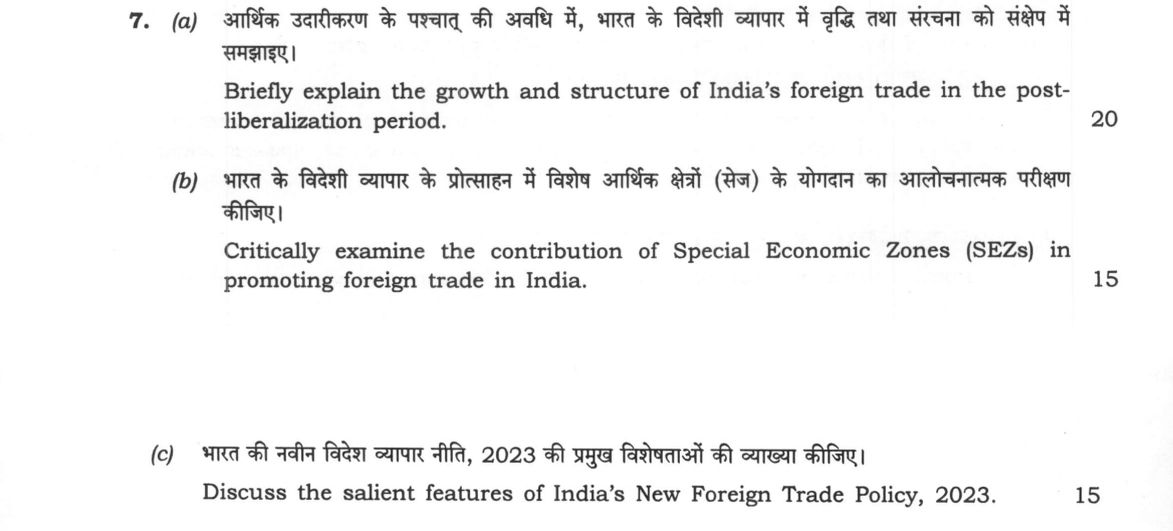
(a) Briefly explain the growth and structure of India's foreign trade in the post-liberalization period. (20 marks) (b)…
Briefly explain the growth and structure of India's foreign trade in the post-liberalization period. 20 marks
Critically examine the contribution of Special Economic Zones (SEZs) in promoting foreign trade in India. 15 marks
Discuss the salient features of India's New Foreign Trade Policy, 2023. 15 marks
हिंदी में प्रश्न पढ़ें
आर्थिक उदारीकरण के पश्चात् की अवधि में, भारत के विदेशी व्यापार में वृद्धि तथा संरचना को संक्षेप में समझाइए। (20 अंक)
भारत के विदेशी व्यापार के प्रोत्साहन में विशेष आर्थिक क्षेत्रों (सेज) के योगदान का आलोचनात्मक परीक्षण कीजिए। (15 अंक)
भारत की नवीन विदेश व्यापार नीति, 2023 की प्रमुख विशेषताओं की व्याख्या कीजिए। (15 अंक)
Model answer
Written by UPSC Answer Check against this question's marking rubric, to the expected length. UPSC does not publish answers for Mains — this is one way to score well, not an official key.
Since 1991, India’s foreign trade has moved from a protected, import-substitution system to an export-oriented, globally integrated one. The causal chain is clear: tariff cuts, de-licensing, trade agreements and institutional support lowered transaction costs, exposed domestic firms to competition, and encouraged firms to scale for global markets. Export promotion councils, EXIM Bank credit and trade agreements reinforced this by reducing market-access and financing constraints. This raised the trade-GDP ratio from about 20% in the early 1990s to around 40% by the 2020s, while making India more vulnerable to global cycles.
Growth and structure Merchandise exports rose from roughly $36 billion in 1990-91 to over $380 billion in 2022-23, and services exports from about $17 billion to over $330 billion. The growth was not uniform. Liberalisation first boosted primary and basic manufactures, but over time the composition shifted: primary products’ share declined, while engineering goods, chemicals and chemical products, petroleum products, textiles and apparel, gems and jewellery, pharmaceuticals and automobiles gained weight. Services became the distinctive structural change. IT and ITeS, travel and transport, and financial services turned India into a major services exporter, reducing the relative dominance of merchandise and improving the quality of export growth. Regionally, trade diversified across ASEAN, the EU, the US and Africa, reflecting supply-chain reorientation and demand for Indian goods and services. The result is a larger, more complex trade structure, but also a persistent merchandise deficit because imports of crude oil, capital goods and electronics remain high.
SEZs The SEZ Act, 2005 created duty-free enclaves with single-window clearance, infrastructure support and fiscal incentives. The mechanism is simple: by reducing customs friction and improving logistics, SEZs lower the cost of exporting and attract FDI. In 2022-23, SEZ exports were about ₹12.62 lakh crore, with merchandise exports around 68% and services around 32%; this was close to one-fifth of India’s total exports and about a quarter of merchandise exports. SEZs have generated direct employment for over a million workers and attracted FDI in electronics, pharmaceuticals, automobiles and IT-enabled services. Yet their contribution is uneven. Many SEZs remain underutilised, and export performance varies by sector. Land acquisition controversies, revenue forgone, weak backward linkages and limited technology spillovers have constrained their impact. Most operational SEZs remain concentrated in Gujarat, Maharashtra, Tamil Nadu and Karnataka, limiting regional diffusion. Compared with China’s SEZs, Indian SEZs have not produced the same scale of global manufacturing integration, partly because of higher logistics costs, labour rigidity and compliance burdens.
FTP 2023 The Foreign Trade Policy 2023 replaces the earlier policy and seeks to make exports more competitive, diversified and future-oriented. It liberalises SCOMET exports by easing licence requirements, while retaining controls on sensitive dual-use items; facilitates e-commerce exports by simplifying procedures for e-commerce operators; and promotes Districts as Export Hubs to localise export potential. It streamlines export obligation norms, reducing compliance costs for duty-free inputs. Structurally, it replaces ad hoc incentive schemes with RoDTEP, focuses on emerging sectors such as green hydrogen, drones and medical devices, and integrates with PLI schemes to build domestic manufacturing capacity for export. The policy’s logic is that easier compliance, sector-specific promotion and manufacturing support will raise export volumes and improve India’s position in global value chains.
In sum, post-liberalisation trade growth has been real but uneven; SEZs have helped but remain limited; and FTP 2023 must deliver implementation, logistics and manufacturing depth if trade-led growth is to be sustained. The verdict is that liberalisation expanded India’s global footprint, but SEZs have not yet become the manufacturing engine expected; FTP 2023 can succeed only if implementation, logistics and manufacturing depth are strengthened.
What "Explain" is asking you to do
Make the working of something clear — what sets it off, what follows from what, and what it produces. Explain is the Commission's mechanism word: it dominates the technical papers and the “explain why” stems, where the marks sit in the causal chain and not in the label.
Structure that answers it
State what it is → the initiating condition → the chain of cause, step by step → an instance where it plays out → what the chain produces
Where marks are lost
Describing what something looks like instead of why it works that way. Naming the stages without linking them reads as description too.
How this answer will be evaluated
Approach
Framework: UPSC Economics Paper II (Indian Economy). (a) explain: definition/context > points in order > small example > short close | (b) examine: intro > how/why with reasoning > evidence > conclusion | (c) discuss: intro > 3-4 dimensions > example > balanced close Full marks: Comprehensive, data-driven, balanced, and directly addresses all command words.
Key points expected
- Define post-liberalization period (1991 onwards)
- Quantify growth in trade volume/value
- Analyze shift in commodity structure (primary to services)
- Identify key trade partners (China, US, EU)
- Define SEZs and their objectives
- List positive contributions (FDI, exports)
- Identify criticisms (land acquisition, labor issues)
- Provide a balanced conclusion on their efficacy
Evaluation rubric
Each sub-part is marked on its own, against the marks and word limit printed on the paper.
- (a) Chronological account of trade growth and structural shifts post-1991. 20 marks
explain— definition/context → points in order → small example → short close
Must cover
- Define post-liberalization period (1991 onwards)
- Quantify growth in trade volume/value
- Analyze shift in commodity structure (primary to services)
- Identify key trade partners (China, US, EU)
Loses marks
- Pre-1991 data without context
- Ignoring services sector growth
- No mention of trade partners
Earns more
- Mention specific trade deficit/surplus trends
- Reference RBI or Ministry of Commerce data
- Discuss impact of WTO accession
- Note rise in services exports (IT/BPO)
Extra mark
- Cite specific year-on-year growth figures
- Reference specific trade agreements (CEPA, etc.)
- (b) Assessment of SEZs' role in trade promotion with balanced judgment. 15 marks
examine— intro → how/why with reasoning → evidence → conclusion
Must cover
- Define SEZs and their objectives
- List positive contributions (FDI, exports)
- Identify criticisms (land acquisition, labor issues)
- Provide a balanced conclusion on their efficacy
Loses marks
- Only listing benefits without critique
- Ignoring the 'critical' aspect of the command
- Vague generalities without specific examples
Earns more
- Mention specific successful SEZs (Dholera, Mundra)
- Reference SEZ Act 2005
- Discuss 'land bank' issues
- Compare SEZ exports to national average
Extra mark
- Cite specific FDI inflow figures to SEZs
- Reference specific policy amendments
- (c) Detailed overview of the key features of the 2023 Trade Policy. 15 marks
discuss— intro → 3-4 dimensions → example → balanced close
Must cover
- State the policy's main objective (trade growth)
- List key measures (export promotion, import policy)
- Mention specific sectors (semiconductors, EVs)
- Discuss the 'Viksit Bharat' vision linkage
Loses marks
- Confusing 2023 policy with 2015 policy
- Ignoring the 'salient features' requirement
- No mention of specific sectors or targets
Earns more
- Reference specific export targets (e.g., $1.5 trillion)
- Mention 'Make in India' linkage
- Discuss digital trade initiatives
- Note changes in import licensing
Extra mark
- Cite specific budget allocations for trade
- Reference specific new export promotion councils
Practice this exact question
Write your answer and it is marked point by point against the model answer above — what you covered, what you missed, what you got wrong.
Evaluate my answer →More from Economics 2023 Paper II
- Q4 (a) Explain the main causes of inequality in income distribution in India and examine how…
- Q5 Answer the following questions in about 150 words each: (a) Distinguish between explicit…
- Q6 (a) Discuss the characteristic features of Agreement on Agriculture (AOA) under Uruguay R…
- Q7 (a) Briefly explain the growth and structure of India's foreign trade in the post-liberal…
- Q8 (a) State the main provisions of the 73rd and 74th Constitutional Amendment Act, 1992. Do…