Paper II — Q5
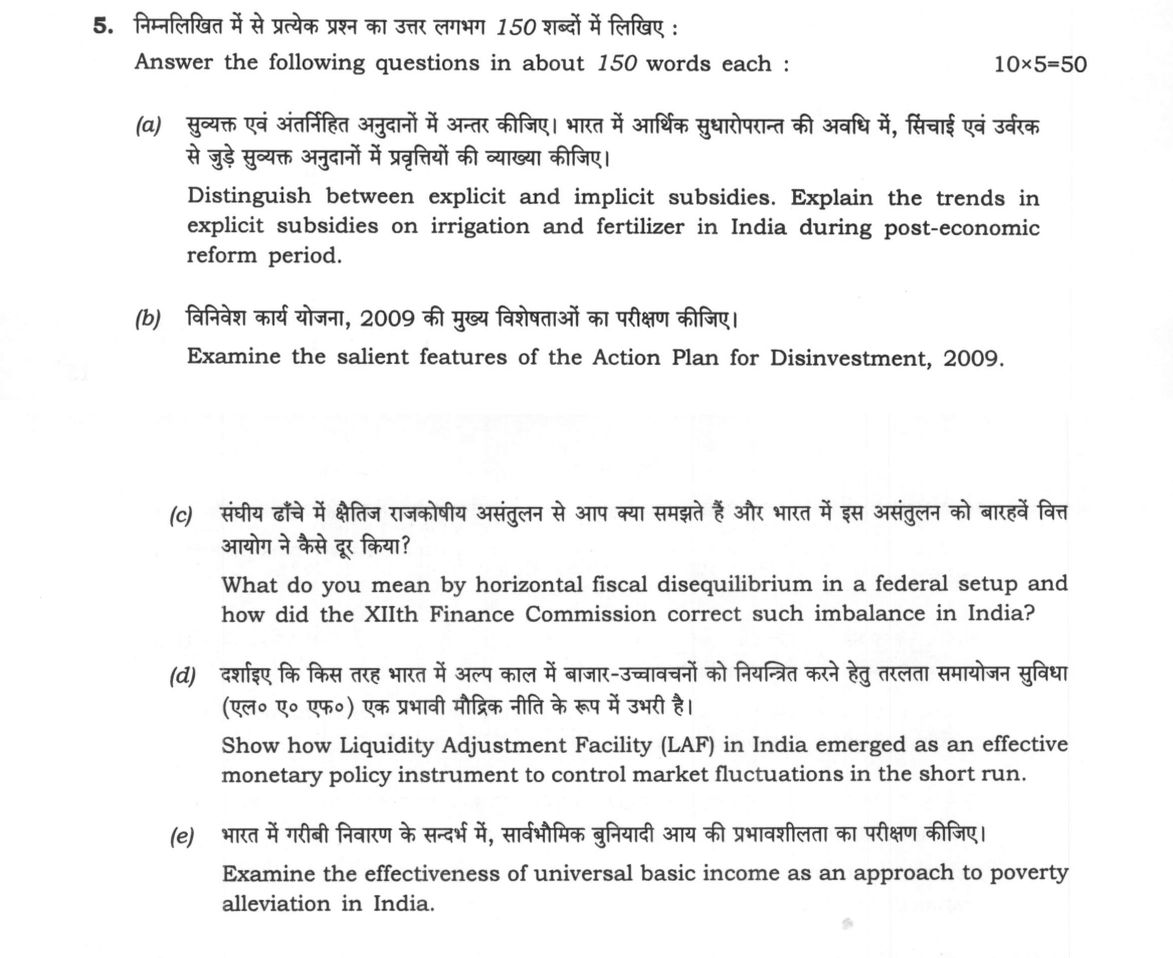
Answer the following questions in about 150 words each: (a) Distinguish between explicit and implicit subsidies. Explain the…
Answer the following questions in about 150 words each:
Distinguish between explicit and implicit subsidies. Explain the trends in explicit subsidies on irrigation and fertilizer in India during post-economic reform period. 10 marks
Examine the salient features of the Action Plan for Disinvestment, 2009. 10 marks
What do you mean by horizontal fiscal disequilibrium in a federal setup and how did the XIIth Finance Commission correct such imbalance in India? 10 marks
Show how Liquidity Adjustment Facility (LAF) in India emerged as an effective monetary policy instrument to control market fluctuations in the short run. 10 marks
Examine the effectiveness of universal basic income as an approach to poverty alleviation in India. 10 marks
हिंदी में प्रश्न पढ़ें
निम्नलिखित में से प्रत्येक प्रश्न का उत्तर लगभग 150 शब्दों में लिखिए :
सुप्तक एवं अंतर्निहित अनुदानों में अंतर कीजिए। भारत में आर्थिक सुधारोत्तर की अवधि में, सिंचाई एवं उर्वरक से जुड़े सुप्तक अनुदानों में प्रवृत्तियों की व्याख्या कीजिए। (10 अंक)
विनिवेश कार्य योजना, 2009 की मुख्य विशेषताओं का परीक्षण कीजिए। (10 अंक)
संघीय ढांचे में क्षैतिज राजकोषीय असंतुलन से आप क्या समझते हैं और भारत में इस असंतुलन को बारहवें वित्त आयोग ने कैसे दूर किया? (10 अंक)
दर्शाइए कि किस तरह भारत में अल्प काल में बाजार-उच्चावचनों को नियंत्रित करने हेतु तरलता समायोजन सुविधा (एल० ए० एफ०) एक प्रभावी मौद्रिक नीति के रूप में उभरी है। (10 अंक)
भारत में गरीबी निवारण के संदर्भ में, सार्वभौमिक बुनियादी आय की प्रभावशीलता का परीक्षण कीजिए। (10 अंक)
Model answer
Written by UPSC Answer Check against this question's marking rubric, to the 150-word length. UPSC does not publish answers for Mains — this is one way to score well, not an official key.
(a) Explicit and Implicit Subsidies: Trends in Irrigation and Fertilizer
Explicit subsidies are direct, transparent budgetary outlays provided by the government to bridge the gap between the market price and the subsidized price paid by consumers or producers (e.g., budgetary transfers for fertilizer). Implicit subsidies represent the unrecovered economic cost of public goods and services due to underpricing below opportunity costs (e.g., unmetered electricity for agriculture, canal water charges below operation and maintenance costs).
In the post-1991 reform era, explicit fertilizer subsidies rose significantly in absolute terms due to increased consumption and volatile international feedstock prices, even as they fluctuated between 0.6% and 1.5% of GDP. To curb fiscal leakages, the government introduced the Nutrient Based Subsidy (NBS) policy in 2010 for phosphatic and potassic fertilizers, though urea remains under direct price control. Explicit irrigation support shifted from inefficient input transfers toward capital-oriented programmatic outlays under the Accelerated Irrigation Benefit Programme (AIBP) and later the Pradhan Mantri Krishi Sinchayee Yojana (PMKSY). While capital provisioning expanded, the persistence of untargeted input subsidies continues to distort cropping patterns and strain public finances.
(b) Salient Features of the Action Plan for Disinvestment, 2009
The Action Plan for Disinvestment (2009) marked a decisive move toward non-strategic minority stake sales, reviving the disinvestment agenda following the 2008 global financial crisis. Its salient features include:
First, it mandated that all profitable Central Public Sector Enterprises (CPSEs) with positive net worth list on domestic stock exchanges via Initial Public Offerings (IPOs) or Follow-on Public Offerings (FPOs) to enhance transparency and corporate governance. Second, the policy instituted a strict ceiling, retaining a minimum of 51% government shareholding and management control in all disinvestment candidates. Third, it set an ambitious benchmark to mobilize roughly ₹25,000 crore annually. Fourth, it diversified disinvestment techniques, facilitating the subsequent introduction of the CPSE Exchange Traded Fund (CPSE ETF) to encourage retail participation. Fifth, it restructured the National Investment Fund (NIF), directing disinvestment proceeds away from general budget financing toward capital expenditure in social sector schemes (such as education and health) and the revival of viable public sector units. The policy successfully monetized public assets without yielding management control.
(c) Horizontal Fiscal Disequilibrium and the XIIth Finance Commission
Horizontal fiscal disequilibrium refers to the structural mismatch between the revenue-raising capacities and the expenditure commitments across different sub-national units (states) within a federation, resulting in unequal capacities to provide comparable standards of public services.
The Twelfth Finance Commission (2005–10), headed by Dr. C. Rangarajan, tackled this disparity through a comprehensive equalization framework:
First, it increased the states' vertical share in the divisible pool of Union taxes to 30.5% (aggregate devolution reaching nearly 32% when including direct tax transfers), expanding the overall resource envelope. Second, it revised the horizontal devolution formula by placing higher weight on fiscal distance (50%) and population (25%), directing larger resources to poorer states. Third, it provided targeted non-plan revenue grants and sector-specific equalization grants under Article 275 for elementary education and health. Fourth, it allocated ₹25,000 crore as targeted grants-in-aid to strengthen Panchayati Raj Institutions (PRIs) and Urban Local Bodies (ULBs). Finally, it incentivized fiscal prudence by linking debt relief to the enactment of state-level Fiscal Responsibility and Budget Management Acts (FRBMAs), effectively reducing cross-state fiscal disparities.
(d) Liquidity Adjustment Facility (LAF) and Short-Run Market Fluctuations
Recommended by the Narasimham Committee-II (1998) and operationalized by the Reserve Bank of India in 2000, the Liquidity Adjustment Facility (LAF) emerged as the principal day-to-day monetary management instrument to control short-run liquidity volatility.
The LAF operates through daily Repo auctions (injecting liquidity against collateral of eligible government securities) and Reverse Repo auctions (absorbing excess liquidity). By establishing an interest rate corridor, it keeps the Weighted Average Call Rate (WACR)—the primary operating target—closely aligned with the policy repo rate. During the 2004 surges in capital inflows and the 2008 global financial shock, the LAF successfully absorbed surplus funds and injected emergency liquidity respectively, dampening extreme volatility in money and forex markets. Complementing quantitative tools like the Cash Reserve Ratio (CRR) and the Market Stabilization Scheme (MSS), the LAF transitioned Indian monetary policy from blunt direct controls to an agile, price-based market signaling mechanism.
(e) Universal Basic Income (UBI) as an Approach to Poverty Alleviation
Universal Basic Income offers a rights-based, unconditional cash transfer to all citizens, presented as a radical alternative to India's complex welfare delivery system.
Examining its efficacy reveals significant strengths and constraints:
On the positive side, UBI eliminates pervasive inclusion and exclusion errors inherent in targeted welfare schemes. Leveraging the JAM (Jan Dhan-Aadhaar-Mobile) trinity, it drastically cuts administrative leakages. Evidence from pilots conducted by SEWA in Madhya Pradesh and state-level cash support models (e.g., Telangana's Rythu Bandhu) demonstrates improved nutritional intake, debt reduction, and localized economic activity.
However, UBI faces formidable implementation hurdles. The Economic Survey (2016–17) estimated a modest basic income (₹7,620 per capita annually) to cost nearly 4.9% of GDP. Funding this would necessitate pruning over 950 distortionary, explicit centrally sponsored subsidies, which faces entrenched political resistance. Additionally, unconditional cash cannot substitute for critical public investments in physical infrastructure, state schooling, and healthcare. Therefore, while a pure universal basic income remains fiscally prohibitive, a quasi-universal basic income targeted at women, senior citizens, and resource-poor agricultural households offers a pragmatically sound welfare path.
What "Examine" is asking you to do
Test the proposition the question puts to you and return a finding on how far it holds. Examine stems carry a claim, or ask whether something has happened, and expect evidence weighed both ways before the extent is stated — often with remedial measures attached.
Structure that answers it
Restate the claim as the question frames it → evidence that supports it → evidence that undercuts it → the conditions under which it holds → verdict on how far it stands
Where marks are lost
Stopping at description. An examination has to reach a finding, and “examine with justification” means the extent must be stated, not implied.
How this answer will be evaluated
Approach
Framework: UPSC Economics Paper II. (a) compare: paired headings or table > key differences > significance > conclusion | (b) examine: intro > how/why with reasoning > evidence > conclusion | (c) examine: intro > how/why with reasoning > evidence > conclusion | (d) explain: definition/context > points in order > small example > short close | (e) examine: intro > how/why with reasoning > evidence > conclusion Full marks: Precise definitions, correct mechanisms, India-specific evidence, clear structure
Key points expected
- Define explicit as direct budgetary outgo
- Define implicit as unrecovered cost of public goods
- Identify irrigation/fertilizer as major explicit subsidies
- Describe trend of rising explicit subsidies post-reform
- Identify 2009 Action Plan as key document
- Mention listing of profitable CPSEs
- Government retaining at least 51% stake
- Strategic disinvestment for loss-making units
Evaluation rubric
Each sub-part is marked on its own, against the marks and word limit printed on the paper.
- (a) Define explicit vs implicit subsidies and explain trends in irrigation/fertilizer subsidies post-reform. · 150 words
compare— paired headings or table → key differences → significance → conclusion
Must cover
- Define explicit as direct budgetary outgo
- Define implicit as unrecovered cost of public goods
- Identify irrigation/fertilizer as major explicit subsidies
- Describe trend of rising explicit subsidies post-reform
Loses marks
- Confusing explicit with implicit subsidies
- No mention of post-reform period
- Vague without specific examples
Earns more
- Mention fertilizer subsidy as largest explicit subsidy
- Note implicit subsidies in power/irrigation
- Reference post-reform period (1991 onwards)
- Mention fiscal burden of subsidies
Extra mark
- Cite specific fertilizer subsidy figures
- Reference NITI Aayog recommendations
- (b) Examine salient features of Action Plan for Disinvestment, 2009. · 150 words
examine— intro → how/why with reasoning → evidence → conclusion
Must cover
- Identify 2009 Action Plan as key document
- Mention listing of profitable CPSEs
- Government retaining at least 51% stake
- Strategic disinvestment for loss-making units
Loses marks
- Confusing with 2015 or 2017 plans
- No mention of 51% retention
- Vague without specific features
Earns more
- Mention exit from non-core businesses
- Reference efficiency improvement goals
- Note revenue generation objective
- Mention governance reforms in CPSEs
Extra mark
- Cite specific CPSEs listed under plan
- Reference disinvestment proceeds figures
- (c) Define horizontal fiscal disequilibrium and explain XIIth Finance Commission's corrective measures. · 150 words
examine— intro → how/why with reasoning → evidence → conclusion
Must cover
- Define horizontal fiscal disequilibrium in federal setup
- Identify XIIth Finance Commission (2005-10)
- Mention equalisation approach to distribution
- Explain corrective measures for imbalance
Loses marks
- Confusing with vertical fiscal imbalance
- Wrong Finance Commission number
- No mention of equalisation approach
Earns more
- Mention Dr C. Rangarajan as chairman
- Reference states' share of shareable taxes
- Note criteria for horizontal distribution
- Mention grants for specific purposes
Extra mark
- Cite specific devolution percentage
- Reference specific grants recommended
- (d) Explain how LAF emerged as effective monetary policy instrument for short-run liquidity control. · 150 words
explain— definition/context → points in order → small example → short close
Must cover
- Define Liquidity Adjustment Facility (LAF)
- Mention repo and reverse repo operations
- Explain standing corridor mechanism
- Describe short-run liquidity control function
Loses marks
- Confusing LAF with SDF or MSF
- No mention of repo/reverse repo
- Vague without mechanism explanation
Earns more
- Mention RBI as implementing authority
- Reference market fluctuation control
- Note daily operations for liquidity
- Mention interest rate corridor
Extra mark
- Cite specific repo rate levels
- Reference VRRP as related instrument
- (e) Examine effectiveness of universal basic income as poverty alleviation approach in India. · 150 words
examine— intro → how/why with reasoning → evidence → conclusion
Must cover
- Define universal basic income (UBI)
- Examine effectiveness for poverty alleviation
- Provide evidence for/against UBI in India
- Conclude on overall effectiveness
Loses marks
- No definition of UBI
- No evidence-based examination
- Vague without India-specific context
Earns more
- Mention pilot studies in India
- Reference poverty line criteria
- Note administrative feasibility
- Mention fiscal implications
Extra mark
- Cite specific pilot study results
- Reference NITI Aayog or RBI views
Practice this exact question
Write your answer and it is marked point by point against the model answer above — what you covered, what you missed, what you got wrong.
Evaluate my answer →More from Economics 2023 Paper II
- Q2 (a) Explain the main features of money and credit policies in India during the pre-Indepe…
- Q3 (a) Discuss the role of D. R. Gadgil in economic planning and development in India. (20 m…
- Q4 (a) Explain the main causes of inequality in income distribution in India and examine how…
- Q5 Answer the following questions in about 150 words each: (a) Distinguish between explicit…
- Q6 (a) Discuss the characteristic features of Agreement on Agriculture (AOA) under Uruguay R…
- Q7 (a) Briefly explain the growth and structure of India's foreign trade in the post-liberal…
- Q8 (a) State the main provisions of the 73rd and 74th Constitutional Amendment Act, 1992. Do…