Paper II — Q6
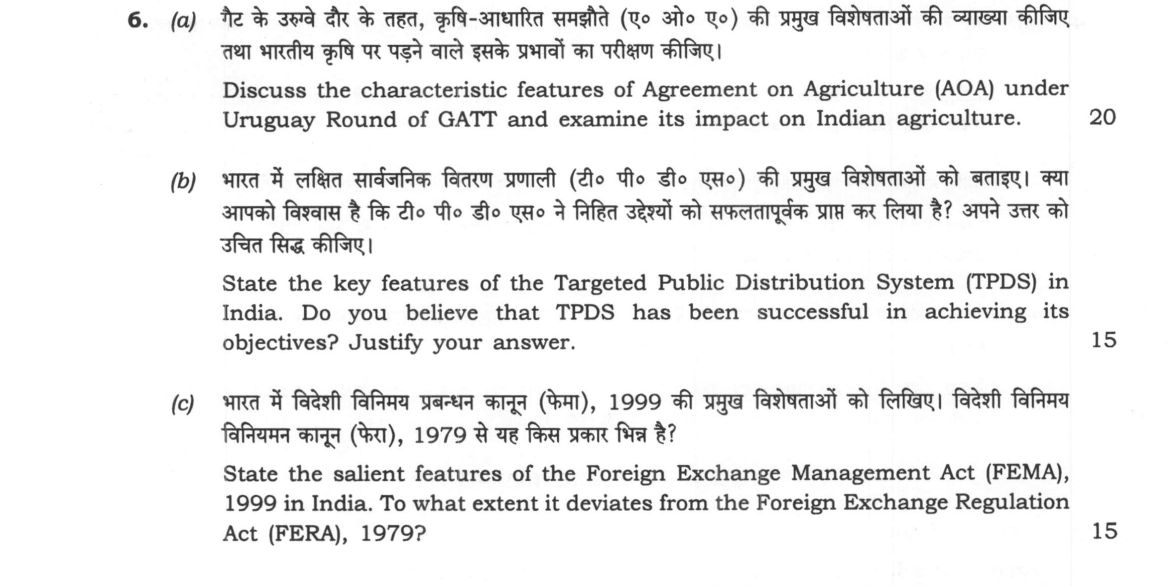
(a) Discuss the characteristic features of Agreement on Agriculture (AOA) under Uruguay Round of GATT and examine its impact on…
Discuss the characteristic features of Agreement on Agriculture (AOA) under Uruguay Round of GATT and examine its impact on Indian agriculture. 20 marks
State the key features of the Targeted Public Distribution System (TPDS) in India. Do you believe that TPDS has been successful in achieving its objectives? Justify your answer. 15 marks
State the salient features of the Foreign Exchange Management Act (FEMA), 1999 in India. To what extent it deviates from the Foreign Exchange Regulation Act (FERA), 1979? 15 marks
हिंदी में प्रश्न पढ़ें
गैट के उरुग्वे दौर के तहत, कृषि-आधारित समझौते (ए० ओ० ए०) की प्रमुख विशेषताओं की व्याख्या कीजिए तथा भारतीय कृषि पर पड़ने वाले इसके प्रभावों का परीक्षण कीजिए। (20 अंक)
भारत में लक्षित सार्वजनिक वितरण प्रणाली (टी० पी० डी० एस०) की प्रमुख विशेषताओं को बताइए। क्या आपको विश्वास है कि टी० पी० डी० एस० ने निहित उद्देश्यों को सफलतापूर्वक प्राप्त कर लिया है? अपने उत्तर को उचित सिद्ध कीजिए। (15 अंक)
भारत में विदेशी विनिमय प्रबंधन कानून (फेमा), 1999 की प्रमुख विशेषताओं को लिखिए। विदेशी विनिमय विनियमन कानून (फेरा), 1979 से यह किस प्रकार भिन्न है? (15 अंक)
Model answer
Written by UPSC Answer Check against this question's marking rubric, to the expected length. UPSC does not publish answers for Mains — this is one way to score well, not an official key.
Agreement on Agriculture The Uruguay Round’s Agreement on Agriculture (AoA) brought farming into WTO discipline through three pillars. Domestic support was classified into Amber, Blue and Green Boxes: Amber Box measures are trade-distorting and subject to reduction commitments, while support below the de minimis threshold is exempt from reduction; Blue Box covers production-limiting programmes; Green Box covers non-trade-distorting public services. Market access required tariffication of non-tariff barriers and binding of tariffs, with tariff-rate quotas for sensitive products. Export subsidies were to be reduced. For India, the framework constrained price-support instruments such as MSP: where MSP is above the reference price, it is counted in AMS, and only support within the de minimis threshold is exempt, so large-scale price support becomes trade-sensitive. It limited policy space to shield farmers from volatile world prices and exposed foodgrain and edible-oil markets to import surges when domestic prices rose above import parity, especially where applied tariffs are low. These pressures complicate food security, as higher procurement and buffer stocks can conflict with trade commitments and fiscal limits. The AoA is also asymmetric: developed countries use Green Box research, infrastructure and decoupled payments extensively, while India remains constrained by Amber Box reduction commitments and de minimis thresholds, limiting its ability to use direct price support.
TPDS TPDS is a targeted food-security system built on BPL/APL identification, ration cards, dual pricing (fair price and open market), and decentralised procurement and distribution through FPOs/mandis and fair price shops. The central government procures foodgrains, while states distribute them to eligible households; BPL households receive subsidised rates, while APL households can buy at market prices. Its objectives are poverty alleviation, price stabilisation and nutritional security. It also aims to stabilise prices by releasing buffer stocks in the open market when prices rise, but its foodgrain-centric supply limits nutritional security. It has expanded coverage and reduced open-market price volatility, but success is partial. NFSA 2013 institutionalised entitlements for eligible households, but implementation depends on state capacity. Shanta Kumar Committee (2015) reported significant leakages, exclusion errors and poor targeting, especially for marginalised groups. Aadhaar-seeded e-PoS and One Nation One Ration Card (launched in 2019) have improved portability and reduced some diversion, yet leakages, inclusion/exclusion errors and nutritional gaps remain significant. TPDS is therefore useful but not fully successful unless targeting, supply and monitoring are strengthened.
FEMA FEMA 1999 replaced FERA after the 1991 balance-of-payments crisis, shifting from conservation of foreign exchange to its management and facilitation. Its salient features are current-account convertibility, liberalisation of capital-account transactions subject to RBI rules, delegated legislation to the RBI, and a civil-offence framework. FEMA applies to current and capital account transactions and gives the RBI wide rule-making powers to regulate, monitor and penalise contraventions. Unlike FERA, FEMA presumes innocence, treats contraventions as civil rather than criminal, and removes draconian imprisonment and confiscatory penalties. This reflects the lesson that excessive controls stifled investment and trade, while India’s growing forex reserves and global integration required a flexible regulatory architecture. FEMA thus deviates from FERA in philosophy, enforcement and penalties, enabling India to manage external risks while attracting capital.
In synthesis, AoA, TPDS and FEMA show India’s evolving economic governance: trade commitments constrain agricultural support, food distribution must balance equity with efficiency, and forex regulation has moved from control to facilitation. A way forward is to use WTO flexibility, strengthen TPDS targeting and nutrition, and maintain a rules-based forex framework that safeguards reserves without deterring investment. This requires better data, state coordination, and a regulatory stance that is neither protectionist nor reckless, while preserving policy space for farmers and food security and macroeconomic stability.
What "Discuss" is asking you to do
Lay the issue out from more than one side — how it arose, what is claimed for it, what is held against it, and where it now stands. UPSC attaches discuss to broad topics with several live dimensions, so coverage of the dimensions earns more than the strength of your opinion.
Structure that answers it
Set the issue up → the case as it is made → the case against → the dimension both sides leave out → where the balance now lies
Where marks are lost
Listing facts with no thread between them, or arguing one side throughout and calling it a discussion.
How this answer will be evaluated
Approach
Framework: UPSC Economics Paper II. (a) discuss: intro > 3-4 dimensions > example > balanced close | (b) enumerate: list the items in order > one line each > no commentary | (c) enumerate: list the items in order > one line each > no commentary Full marks: Precise definitions, specific Indian data, clear statutory references, balanced evaluation.
Key points expected
- Define Market Access, Domestic Support, Export Subsidies
- Explain Amber, Blue, Green Box categories
- Link AOA to Indian MSP and subsidy policy
- Assess impact on Indian agri exports and food security
- Define AAY, AY, and Antyodaya categories
- Mention specific entitlements (e.g., 5kg vs 30kg)
- Provide evidence of success (e.g., coverage stats)
- Provide evidence of failure (e.g., leakage, exclusion)
Evaluation rubric
Each sub-part is marked on its own, against the marks and word limit printed on the paper.
- (a) Define AOA pillars and evaluate their specific impact on Indian agri policy. 20 marks
discuss— intro → 3-4 dimensions → example → balanced close
Must cover
- Define Market Access, Domestic Support, Export Subsidies
- Explain Amber, Blue, Green Box categories
- Link AOA to Indian MSP and subsidy policy
- Assess impact on Indian agri exports and food security
Loses marks
- Confusing GATT with WTO
- Ignoring the 'Domestic Support' pillar
- Vague generalities without specific Indian policy links
Earns more
- Mention 'Peace Clause' or 'Special Safeguard Mechanism'
- Reference WTO Doha Round deadlock
- Cite specific Indian agri export data
- Mention 'Minimum Access Volume' (MAV)
Extra mark
- Reference 'Singapore Issues' or 'NAMA'
- Mention specific WTO dispute case (e.g., US-Cotton)
- (b) List TPDS features and justify its success with evidence. 15 marks
enumerate— list the items in order → one line each → no commentary
Must cover
- Define AAY, AY, and Antyodaya categories
- Mention specific entitlements (e.g., 5kg vs 30kg)
- Provide evidence of success (e.g., coverage stats)
- Provide evidence of failure (e.g., leakage, exclusion)
Loses marks
- Confusing TPDS with general PDS
- Listing features without evaluating success
- Ignoring the 'Targeted' aspect of the system
Earns more
- Mention 'One Nation One Ration Card'
- Reference 'DBT' (Direct Benefit Transfer) in PDS
- Cite 'NFHS' or 'NSS' data on coverage
- Mention 'e-NAM' or 'e-KYC' integration
Extra mark
- Reference 'NITI Aayog' recommendations on PDS
- Mention 'Universal PDS' debate
- (c) List FEMA features and compare its deviation from FERA. 15 marks
enumerate— list the items in order → one line each → no commentary
Must cover
- Define FEMA's objective (facilitation vs regulation)
- Mention 'Resident' and 'Non-Resident' definitions
- Contrast FEMA's 'management' with FERA's 'regulation'
- Mention FEMA's 'offshore' and 'onshore' transaction coverage
Loses marks
- Confusing FEMA with 'FEMA' (Foreign Exchange Management Act)
- Ignoring the 'deviation' aspect of the question
- Vague generalities without specific statutory references
Earns more
- Mention 'RBI' and 'SEBI' roles under FEMA
- Reference 'Liberalised Remittance Scheme' (LRS)
- Cite specific FEMA sections (e.g., Sec 46)
- Mention 'FEMA' vs 'FERA' penalty structures
Extra mark
- Reference 'FEMA' amendments (e.g., 2019)
- Mention 'FEMA' impact on 'FDI' policy
Practice this exact question
Write your answer and it is marked point by point against the model answer above — what you covered, what you missed, what you got wrong.
Evaluate my answer →More from Economics 2023 Paper II
- Q3 (a) Discuss the role of D. R. Gadgil in economic planning and development in India. (20 m…
- Q4 (a) Explain the main causes of inequality in income distribution in India and examine how…
- Q5 Answer the following questions in about 150 words each: (a) Distinguish between explicit…
- Q6 (a) Discuss the characteristic features of Agreement on Agriculture (AOA) under Uruguay R…
- Q7 (a) Briefly explain the growth and structure of India's foreign trade in the post-liberal…
- Q8 (a) State the main provisions of the 73rd and 74th Constitutional Amendment Act, 1992. Do…