Paper II — Q2
(a) Explain the main features of money and credit policies in India during the pre-Independence era. (20 marks) (b) What are the…
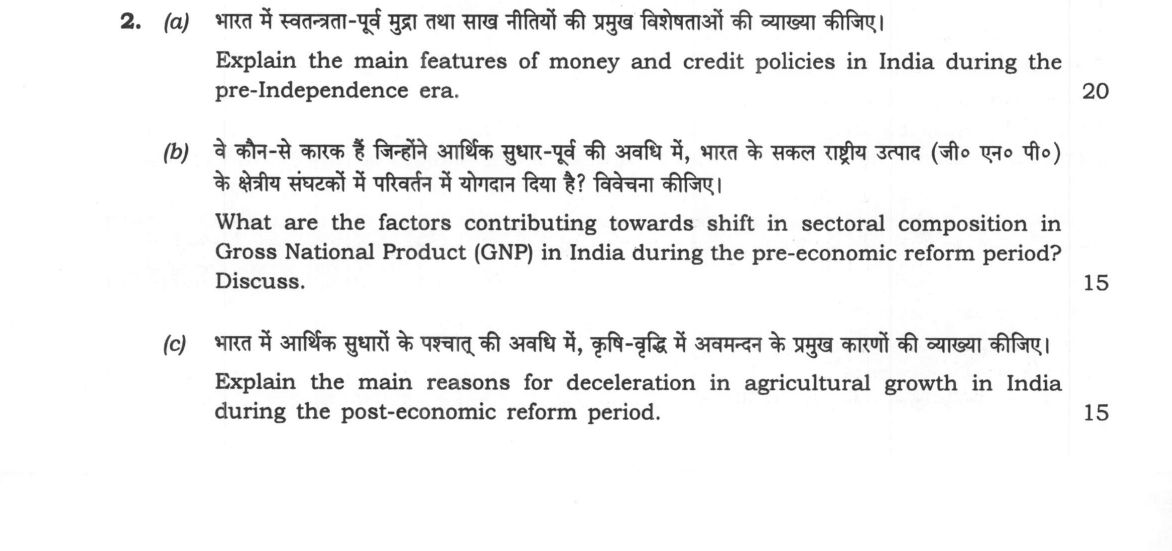
Explain the main features of money and credit policies in India during the pre-Independence era. 20 marks
What are the factors contributing towards shift in sectoral composition in Gross National Product (GNP) in India during the pre-economic reform period? Discuss. 15 marks
Explain the main reasons for deceleration in agricultural growth in India during the post-economic reform period. 15 marks
हिंदी में प्रश्न पढ़ें
भारत में स्वतंत्रता-पूर्व मुद्रा तथा साख नीतियों की प्रमुख विशेषताओं की व्याख्या कीजिए। (20 अंक)
वे कौन-से कारक हैं जिन्होंने आर्थिक सुधार-पूर्व की अवधि में, भारत के सकल राष्ट्रीय उत्पाद (जी० एन० पी०) के क्षेत्रीय संघटकों में परिवर्तन में योगदान दिया है? विवेचना कीजिए। (15 अंक)
भारत में आर्थिक सुधारों के पश्चात् की अवधि में, कृषि-वृद्धि में अवमंदन के प्रमुख कारणों की व्याख्या कीजिए। (15 अंक)
Model answer
Written by UPSC Answer Check against this question's marking rubric, to the expected length. UPSC does not publish answers for Mains — this is one way to score well, not an official key.
India’s pre-Independence monetary system was shaped less by domestic development than by imperial trade, exchange-rate stability and European capital. The Presidency Banks—Bank of Bengal, Bank of Bombay and Bank of Madras—were commercial and clearing banks, but credit concentrated on trade, government bills and European merchants. Their 1921 merger into the Imperial Bank of India strengthened centralised banking but did not remove the split between European and Indian money markets. European banks and the Imperial Bank worked in sterling-linked trade finance, while Indian traders, artisans and peasants depended on indigenous bankers, moneylenders and small native banks. Institutional credit to Indian traders was limited; rural credit exclusion was severe. Cooperative credit societies and land mortgage banks existed, but limited reach, capital and lending discipline left much rural borrowing informal and expensive.
After the rupee was tied to sterling, India experienced relative exchange-rate stabilization between 1893 and 1913, which helped trade but made the economy vulnerable to sterling cycles. The currency board system fixed the rupee’s value by holding sterling reserves and made the money supply passive to external balances rather than domestic credit needs. The Hilton Young Commission’s recommendations, especially the gold-sterling standard and a gold reserve, further anchored the rupee to external stability. The result was limited monetization: credit expansion was restrained, and the monetary system did not channel savings into productive rural or industrial investment.
Pre-reform sectoral shift Between the early 1950s and 1990-91, GNP composition shifted because planned industrialization deliberately raised manufacturing and services. Agriculture’s share fell from about 55% in the early 1950s to well below 45%—roughly 30-35%—by 1990-91, while industry and services rose. The Second and Third Five Year Plans emphasized capital goods, heavy industry and import substitution, creating public-sector dominance in steel, power, fertilizers and machinery. This capital formation pattern shifted output away from agriculture even where farm production grew. The Green Revolution raised foodgrain output, but its uneven regional impact—strong in Punjab, Haryana, western UP and parts of Tamil Nadu, weaker in rain-fed eastern regions—prevented broad-based agrarian transformation. Demographic transition and urbanization also mattered: rising labour force, migration to towns, and expanding public administration, education and transport services raised the services share. Thus the pre-reform shift reflected state-led industrial bias, uneven agricultural technology and changing labour absorption.
Post-reform agricultural deceleration After 1991, agricultural growth decelerated because the reform package reduced the state’s direct role in agriculture while exposing farmers to global markets. Public investment in irrigation, rural infrastructure and agricultural research fell relative to industrial and urban priorities. Input subsidy reforms and rationalization of administered prices weakened the earlier support structure, while trade liberalization exposed Indian farmers to global price volatility. WTO Agreement on Agriculture constraints limited the scope for border protection and some domestic support, making it harder to shield smallholders from cheap imports and volatile world prices. Declining terms of trade for agriculture followed: farm output prices rose less than industrial and service prices, reducing farmers’ real income. Infrastructure neglect—poor roads, storage, cold chains and market access—increased post-harvest losses and marketing costs. Technology fatigue in Green Revolution regions, with limited new breakthroughs, slowed yield growth, while environmental degradation, especially groundwater depletion in Punjab-Haryana, raised costs and damaged sustainability. Together, these factors slowed growth to around 2.5-3.0% in the 1990s and about 2.4% in the 2000s, below the earlier Green Revolution pace.
Thus, pre-Independence monetary constraints, planned industrialization and post-reform liberalization together produced uneven structural transformation: industrial and services shares rose, while agriculture remained dependent on public investment, technology and market protection.
What "Explain" is asking you to do
Make the working of something clear — what sets it off, what follows from what, and what it produces. Explain is the Commission's mechanism word: it dominates the technical papers and the “explain why” stems, where the marks sit in the causal chain and not in the label.
Structure that answers it
State what it is → the initiating condition → the chain of cause, step by step → an instance where it plays out → what the chain produces
Where marks are lost
Describing what something looks like instead of why it works that way. Naming the stages without linking them reads as description too.
How this answer will be evaluated
Approach
Framework: UPSC Economics Paper II. (a) explain: definition/context > points in order > small example > short close | (b) discuss: intro > 3-4 dimensions > example > balanced close | (c) explain: definition/context > points in order > small example > short close Full marks: Comprehensive, well-structured, with specific examples and data.
Key points expected
- Define 'money policy' and 'credit policy' in historical context
- Identify the Bank of England's role in Indian monetary management
- Explain the 'Gold Standard' or 'Sterling Standard' linkage
- Describe the 'Bank Rate' and 'Open Market Operations' mechanisms
- Define 'sectoral composition' of GNP
- Identify the shift from Agriculture to Industry/Services
- Explain the 'Five Year Plans' role in industrialization
- Discuss the 'License Raj' and its impact on sectors
Evaluation rubric
Each sub-part is marked on its own, against the marks and word limit printed on the paper.
- (a) Define and list features of pre-Independence money and credit policies. 20 marks
explain— definition/context → points in order → small example → short close
Must cover
- Define 'money policy' and 'credit policy' in historical context
- Identify the Bank of England's role in Indian monetary management
- Explain the 'Gold Standard' or 'Sterling Standard' linkage
- Describe the 'Bank Rate' and 'Open Market Operations' mechanisms
Loses marks
- Confusing pre- and post-Independence policies
- Failing to distinguish between money and credit policy
- Ignoring the colonial context of the policies
Earns more
- Mention the 'RBI Act 1934' and its failure to pass
- Reference the 'Hindu Code' or 'Hindu Law' impact on credit
- Discuss the 'Colonial' nature of credit (export-oriented)
- Mention the 'Currency and Finance Act 1928'
Extra mark
- Cite the 'Himalaya Bank' or 'Punjab National Bank' as examples
- Reference the 'RBI' or 'Reserve Bank of India' establishment
- (b) Analyze factors causing sectoral shift in GNP pre-reform. 15 marks
discuss— intro → 3-4 dimensions → example → balanced close
Must cover
- Define 'sectoral composition' of GNP
- Identify the shift from Agriculture to Industry/Services
- Explain the 'Five Year Plans' role in industrialization
- Discuss the 'License Raj' and its impact on sectors
Loses marks
- Failing to link factors to specific sectors
- Ignoring the 'pre-reform' time period (pre-1991)
- Confusing GNP with GDP
Earns more
- Mention the 'Green Revolution' impact on agriculture
- Reference the 'Import Substitution' policy
- Discuss the 'Public Sector' expansion
- Mention the 'Inflation' and 'Price Control' policies
Extra mark
- Cite specific 'Five Year Plan' data (e.g., 1st vs 5th)
- Reference the 'NITI Aayog' or 'Planning Commission' reports
- (c) List reasons for agricultural growth deceleration post-reform. 15 marks
explain— definition/context → points in order → small example → short close
Must cover
- Define 'agricultural growth' and 'deceleration'
- Identify the 'post-reform' period (post-1991)
- Explain the 'Liberalization' impact on agriculture
- Discuss the 'Fertilizer' and 'Pesticide' cost increase
Loses marks
- Failing to link reasons to the 'post-reform' period
- Ignoring the 'Liberalization' impact
- Confusing 'growth' with 'production'
Earns more
- Mention the 'MSP' (Minimum Support Price) policy
- Reference the 'Water' and 'Irrigation' issues
- Discuss the 'Land' and 'Tenancy' laws
- Mention the 'Climate Change' and 'Drought' impact
Extra mark
- Cite specific 'Agricultural Census' data
- Reference the 'NITI Aayog' or 'Agriculture Ministry' reports
Practice this exact question
Write your answer and it is marked point by point against the model answer above — what you covered, what you missed, what you got wrong.
Evaluate my answer →More from Economics 2023 Paper II
- Q1 Answer the following questions in about 150 words each: (a) Land system during the Britis…
- Q2 (a) Explain the main features of money and credit policies in India during the pre-Indepe…
- Q3 (a) Discuss the role of D. R. Gadgil in economic planning and development in India. (20 m…
- Q4 (a) Explain the main causes of inequality in income distribution in India and examine how…
- Q5 Answer the following questions in about 150 words each: (a) Distinguish between explicit…